"Stay Global, Act Local:" Pietro Candela on the future of digital payments.
AliPay+ is creating
seamless connections between Asian consumers and European businesses. Pietro
Candela, General Manager of Europe at AliPay+,
sat down with Finance Magnates and delved on the company's rapid advancements, ambitious
future plans, and the overarching vision that drives their initiatives.
During AliPay+’s SME
Heroes event in Gelsenkirchen, Germany, Candela
reflected on the swift development of a new concept that AliPay+ executed with
remarkable speed. This
initiative, which targeted both existing and new user bases through promotions
linked to soccer events, garnered immediate and significant attention,
resulting in a notable increase in transactions. "We produced this concept
very fast to be ready
for the UEFA Euro 2024. We did a miracle because in a few months, we
did what usually takes a year," Candela remarked, highlighting the
company's ability to innovate under tight timelines.
The spotlight was also on SM owners
based in Cologne and Dusseldorf who were able to share their experience of how
inbound global tourism during the UEFA EURO 2024 has benefitted business owners
in Germany.
AliPay+ is witnessing a substantial rise in transactions in
Germany, driven by the return of Chinese travelers and the surge of
international football fans for UEFA EURO 2024.
The company's vast user base, encompassing 1.5
billion users globally, underscores its expansive reach. During the opening
week of the tournament alone, transactions in Germany increased by over
two-thirds (67%), and the number of customers paying with AliPay+ partner
wallets rose by 59% WoW.
This
spike was reportedly driven by fans congregating across the
continent to watch the matches, leading to a 13% increase in overall European
AliPay+ transactions (WoW). "The numbers we are seeing in Germany are
beautiful, pushed by the return of Chinese travelers and people we invited from
our wallet user base," Candela explained. This resurgence is not just
about regaining lost ground but forging ahead to new heights of connectivity
and service integration.
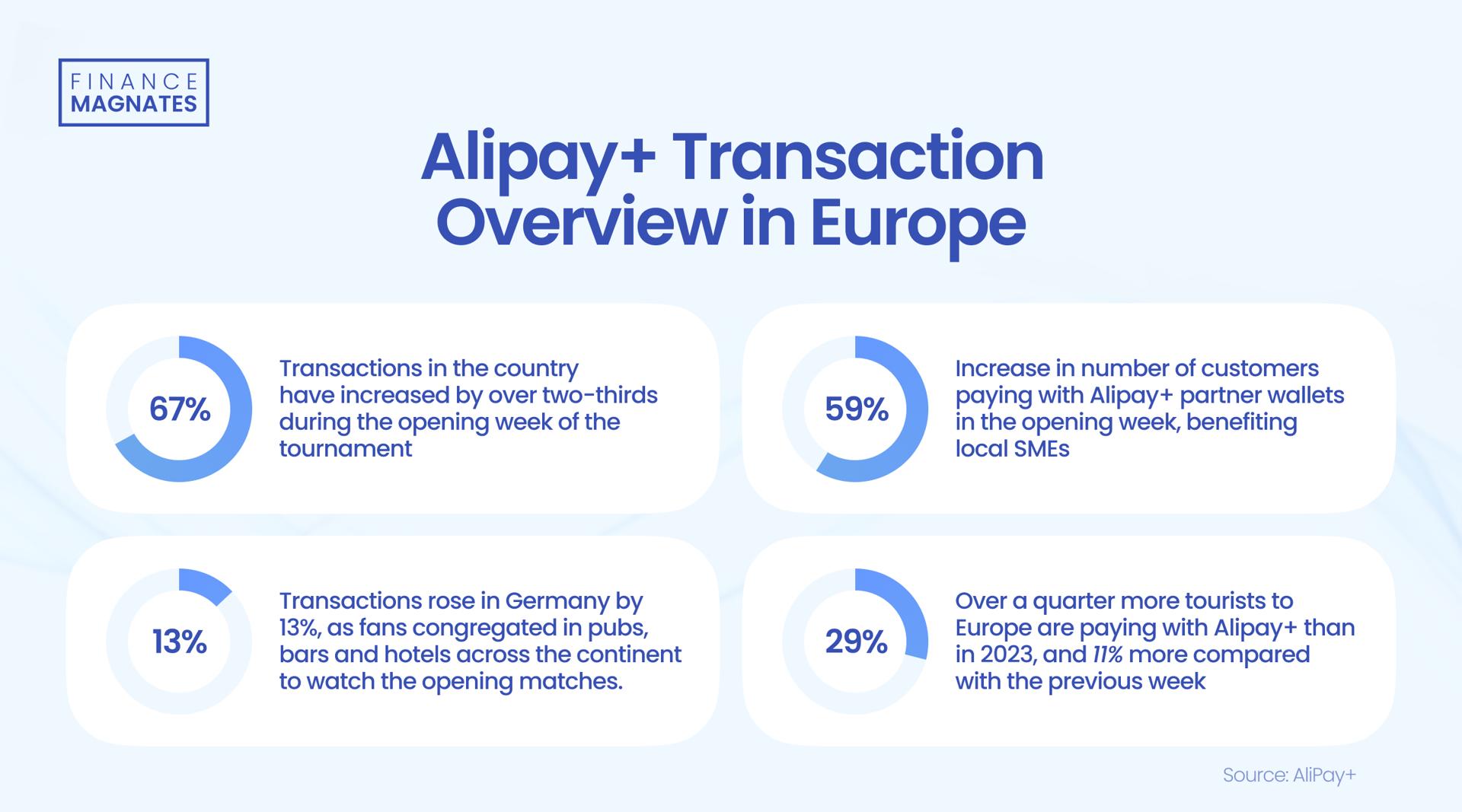
AliPay+ Transaction Overview in Europe
AliPay+ aims to bridge Asian consumers with European
businesses, facilitating global tourism and commerce through their app.
This initiative enhances the travel experience
by offering services like booking taxis, paying for transportation, and
accessing promotions. The company is advancing its super app concept in Europe,
starting with transportation and ticketing services. "We are creating a
convenient environment for our partners to grow," Candela noted, signaling the beginning of a new phase in
digital convenience and connectivity.
This approach has
been well-received by local businesses but it seems that AliPay+ won't stop there. Candela expressed excitement about upcoming launches, emphasizing
the potential for AliPay+ to set new benchmarks in digital services. "The
babies are finally crying and the mother is not pregnant anymore," he said
with a touch of humor, encapsulating the anticipation and readiness for the
next big step.
AliPay+ leverages a dual strategy that
respects regional specificities.
Candela emphasized AliPay+'s strategy of
creating a connected world for mobile app users, offering seamless payment and
additional services such as promotions and privileges. This approach is
particularly focused on markets with high tourist numbers, notably in Europe
and the Middle East.
"We want to stay global but also local. Compliance is definitely local, so
we have local compliance teams," he elucidated, pointing out the delicate
balance between global ambitions and local realities.
The vision of AliPay+ includes leveraging its
global brand while tailoring solutions to fit local markets. Compliance and
privacy are managed locally, with technology solutions that can be globally
deployed but adapted to meet local needs. This strategy is particularly
significant in Europe, where market dynamics differ substantially from Asia.
"We need to understand how our product can fit locally and adjust it based
on local economy requirements," Candela asserted, highlighting the nuanced
approach necessary for diverse markets.
This is crucial in a market like Europe, which
differs vastly from Asia in terms of population density, economic development,
and consumer behavior. "We are enthusiastic about this because after
COVID, we concentrated on online due to the lack of travel, and now we are
expanding once again," Candela added, reflecting on the resilience and
adaptability of the company.
AliPay+'s role in the broader financial ecosystem is not
confined to payments alone.
According to Candela, as AliPay+
continues to grow and evolve, it remains committed to creating value for both merchants
and consumers. "We try to position in the middle, providing a
solution that handles the transaction and the wider shopping experience," he noted, illustrating the company's holistic approach. This commitment is
reflected in their strategic partnerships and innovative solutions that cater
to a global audience while respecting local nuances. "Our goal is to
connect the business from the West to the consumer of the East and vice
versa," Candela emphasized, underscoring the company's mission to bridge
global commerce through digital innovation.
AliPay+ is redefining global commerce by
creating an interconnected world where seamless transactions and enriched
experiences are the norm. Candela’s insights reveal a company dedicated to
growth, adaptation, and providing unparalleled value to both merchants and consumers
in an increasingly interconnected world, reflecting a broader trend in the
digital economy: the convergence of global connectivity with local specificity.
And as the world continues to embrace
digitalization, AliPay+ seems primed for
driving a new era of global commerce that bridges East and West.
AliPay+ is creating
seamless connections between Asian consumers and European businesses. Pietro
Candela, General Manager of Europe at AliPay+,
sat down with Finance Magnates and delved on the company's rapid advancements, ambitious
future plans, and the overarching vision that drives their initiatives.
During AliPay+’s SME
Heroes event in Gelsenkirchen, Germany, Candela
reflected on the swift development of a new concept that AliPay+ executed with
remarkable speed. This
initiative, which targeted both existing and new user bases through promotions
linked to soccer events, garnered immediate and significant attention,
resulting in a notable increase in transactions. "We produced this concept
very fast to be ready
for the UEFA Euro 2024. We did a miracle because in a few months, we
did what usually takes a year," Candela remarked, highlighting the
company's ability to innovate under tight timelines.
The spotlight was also on SM owners
based in Cologne and Dusseldorf who were able to share their experience of how
inbound global tourism during the UEFA EURO 2024 has benefitted business owners
in Germany.
AliPay+ is witnessing a substantial rise in transactions in
Germany, driven by the return of Chinese travelers and the surge of
international football fans for UEFA EURO 2024.
The company's vast user base, encompassing 1.5
billion users globally, underscores its expansive reach. During the opening
week of the tournament alone, transactions in Germany increased by over
two-thirds (67%), and the number of customers paying with AliPay+ partner
wallets rose by 59% WoW.
This
spike was reportedly driven by fans congregating across the
continent to watch the matches, leading to a 13% increase in overall European
AliPay+ transactions (WoW). "The numbers we are seeing in Germany are
beautiful, pushed by the return of Chinese travelers and people we invited from
our wallet user base," Candela explained. This resurgence is not just
about regaining lost ground but forging ahead to new heights of connectivity
and service integration.
AliPay+ Transaction Overview in Europe
AliPay+ aims to bridge Asian consumers with European
businesses, facilitating global tourism and commerce through their app.
This initiative enhances the travel experience
by offering services like booking taxis, paying for transportation, and
accessing promotions. The company is advancing its super app concept in Europe,
starting with transportation and ticketing services. "We are creating a
convenient environment for our partners to grow," Candela noted, signaling the beginning of a new phase in
digital convenience and connectivity.
This approach has
been well-received by local businesses but it seems that AliPay+ won't stop there. Candela expressed excitement about upcoming launches, emphasizing
the potential for AliPay+ to set new benchmarks in digital services. "The
babies are finally crying and the mother is not pregnant anymore," he said
with a touch of humor, encapsulating the anticipation and readiness for the
next big step.
AliPay+ leverages a dual strategy that
respects regional specificities.
Candela emphasized AliPay+'s strategy of
creating a connected world for mobile app users, offering seamless payment and
additional services such as promotions and privileges. This approach is
particularly focused on markets with high tourist numbers, notably in Europe
and the Middle East.
"We want to stay global but also local. Compliance is definitely local, so
we have local compliance teams," he elucidated, pointing out the delicate
balance between global ambitions and local realities.
The vision of AliPay+ includes leveraging its
global brand while tailoring solutions to fit local markets. Compliance and
privacy are managed locally, with technology solutions that can be globally
deployed but adapted to meet local needs. This strategy is particularly
significant in Europe, where market dynamics differ substantially from Asia.
"We need to understand how our product can fit locally and adjust it based
on local economy requirements," Candela asserted, highlighting the nuanced
approach necessary for diverse markets.
This is crucial in a market like Europe, which
differs vastly from Asia in terms of population density, economic development,
and consumer behavior. "We are enthusiastic about this because after
COVID, we concentrated on online due to the lack of travel, and now we are
expanding once again," Candela added, reflecting on the resilience and
adaptability of the company.
AliPay+'s role in the broader financial ecosystem is not
confined to payments alone.
According to Candela, as AliPay+
continues to grow and evolve, it remains committed to creating value for both merchants
and consumers. "We try to position in the middle, providing a
solution that handles the transaction and the wider shopping experience," he noted, illustrating the company's holistic approach. This commitment is
reflected in their strategic partnerships and innovative solutions that cater
to a global audience while respecting local nuances. "Our goal is to
connect the business from the West to the consumer of the East and vice
versa," Candela emphasized, underscoring the company's mission to bridge
global commerce through digital innovation.
AliPay+ is redefining global commerce by
creating an interconnected world where seamless transactions and enriched
experiences are the norm. Candela’s insights reveal a company dedicated to
growth, adaptation, and providing unparalleled value to both merchants and consumers
in an increasingly interconnected world, reflecting a broader trend in the
digital economy: the convergence of global connectivity with local specificity.
And as the world continues to embrace
digitalization, AliPay+ seems primed for
driving a new era of global commerce that bridges East and West.
In this conversation, we sit down with Drew Niv, CSO at ATFX Connect and one of the most influential figures in modern FX.
We speak about market structure, the institutional view on liquidity, and the sharp rise of prop trading, a sector Drew has been commenting on in recent months. Drew explains why he once dismissed prop trading, why his view changed, and what he now thinks the model means for brokers, clients and risk managers.
We explore subscription-fee dependency, the high reneging rate, and the long-term challenge: how brokers can build a more stable and honest version of the model. Drew also talks about the traffic advantage standalone prop firms have built and why brokers may still win in the long run if they take the right approach.
In this conversation, we sit down with Drew Niv, CSO at ATFX Connect and one of the most influential figures in modern FX.
We speak about market structure, the institutional view on liquidity, and the sharp rise of prop trading, a sector Drew has been commenting on in recent months. Drew explains why he once dismissed prop trading, why his view changed, and what he now thinks the model means for brokers, clients and risk managers.
We explore subscription-fee dependency, the high reneging rate, and the long-term challenge: how brokers can build a more stable and honest version of the model. Drew also talks about the traffic advantage standalone prop firms have built and why brokers may still win in the long run if they take the right approach.
In this conversation, we sit down with Drew Niv, CSO at ATFX Connect and one of the most influential figures in modern FX.
We speak about market structure, the institutional view on liquidity, and the sharp rise of prop trading, a sector Drew has been commenting on in recent months. Drew explains why he once dismissed prop trading, why his view changed, and what he now thinks the model means for brokers, clients and risk managers.
We explore subscription-fee dependency, the high reneging rate, and the long-term challenge: how brokers can build a more stable and honest version of the model. Drew also talks about the traffic advantage standalone prop firms have built and why brokers may still win in the long run if they take the right approach.
In this conversation, we sit down with Drew Niv, CSO at ATFX Connect and one of the most influential figures in modern FX.
We speak about market structure, the institutional view on liquidity, and the sharp rise of prop trading, a sector Drew has been commenting on in recent months. Drew explains why he once dismissed prop trading, why his view changed, and what he now thinks the model means for brokers, clients and risk managers.
We explore subscription-fee dependency, the high reneging rate, and the long-term challenge: how brokers can build a more stable and honest version of the model. Drew also talks about the traffic advantage standalone prop firms have built and why brokers may still win in the long run if they take the right approach.
Executive Interview | Remonda Z. Kirketerp Møller| CEO & Founder Muinmos | FMLS:25
In this interview, Remonda Z. Kirketerp Møller, founder of Muinmos, breaks down the state of AI in regtech and what responsible adoption really looks like for brokers. We talk about rising fragmentation, the pressures around compliance accuracy, and why most firms are still in the early stages of AI maturity.
Ramanda also shares insights on regulator sandboxes, shifting expectations around accountability, and the current reality of MiCA licensing and passporting in Europe.
A concise look at where compliance, onboarding, and AI-driven processes are heading next.
In this interview, Remonda Z. Kirketerp Møller, founder of Muinmos, breaks down the state of AI in regtech and what responsible adoption really looks like for brokers. We talk about rising fragmentation, the pressures around compliance accuracy, and why most firms are still in the early stages of AI maturity.
Ramanda also shares insights on regulator sandboxes, shifting expectations around accountability, and the current reality of MiCA licensing and passporting in Europe.
A concise look at where compliance, onboarding, and AI-driven processes are heading next.
In this interview, Remonda Z. Kirketerp Møller, founder of Muinmos, breaks down the state of AI in regtech and what responsible adoption really looks like for brokers. We talk about rising fragmentation, the pressures around compliance accuracy, and why most firms are still in the early stages of AI maturity.
Ramanda also shares insights on regulator sandboxes, shifting expectations around accountability, and the current reality of MiCA licensing and passporting in Europe.
A concise look at where compliance, onboarding, and AI-driven processes are heading next.
In this interview, Remonda Z. Kirketerp Møller, founder of Muinmos, breaks down the state of AI in regtech and what responsible adoption really looks like for brokers. We talk about rising fragmentation, the pressures around compliance accuracy, and why most firms are still in the early stages of AI maturity.
Ramanda also shares insights on regulator sandboxes, shifting expectations around accountability, and the current reality of MiCA licensing and passporting in Europe.
A concise look at where compliance, onboarding, and AI-driven processes are heading next.
In this interview, Remonda Z. Kirketerp Møller, founder of Muinmos, breaks down the state of AI in regtech and what responsible adoption really looks like for brokers. We talk about rising fragmentation, the pressures around compliance accuracy, and why most firms are still in the early stages of AI maturity.
Ramanda also shares insights on regulator sandboxes, shifting expectations around accountability, and the current reality of MiCA licensing and passporting in Europe.
A concise look at where compliance, onboarding, and AI-driven processes are heading next.
In this interview, Remonda Z. Kirketerp Møller, founder of Muinmos, breaks down the state of AI in regtech and what responsible adoption really looks like for brokers. We talk about rising fragmentation, the pressures around compliance accuracy, and why most firms are still in the early stages of AI maturity.
Ramanda also shares insights on regulator sandboxes, shifting expectations around accountability, and the current reality of MiCA licensing and passporting in Europe.
A concise look at where compliance, onboarding, and AI-driven processes are heading next.
In this conversation, we speak with Aydin Bonabi, CEO and co-founder of Surveill, a firm focused on fraud detection and AI-driven compliance tools for financial institutions.
We start with Aydin’s view of the Summit and the challenges brokers face as fraud tactics grow more complex. He explains how firms can stay ahead through real-time signals, data patterns, and early-stage detection.
We also talk about AI training and why compliance teams often struggle to keep models accurate, fair, and aligned with regulatory expectations. Aydin breaks down what “good” AI training looks like inside a financial environment, including the importance of clean data, domain expertise, and human oversight.
He closes with a clear message: fraud is scaling, and so must the tools that stop it.
In this conversation, we speak with Aydin Bonabi, CEO and co-founder of Surveill, a firm focused on fraud detection and AI-driven compliance tools for financial institutions.
We start with Aydin’s view of the Summit and the challenges brokers face as fraud tactics grow more complex. He explains how firms can stay ahead through real-time signals, data patterns, and early-stage detection.
We also talk about AI training and why compliance teams often struggle to keep models accurate, fair, and aligned with regulatory expectations. Aydin breaks down what “good” AI training looks like inside a financial environment, including the importance of clean data, domain expertise, and human oversight.
He closes with a clear message: fraud is scaling, and so must the tools that stop it.
In this conversation, we speak with Aydin Bonabi, CEO and co-founder of Surveill, a firm focused on fraud detection and AI-driven compliance tools for financial institutions.
We start with Aydin’s view of the Summit and the challenges brokers face as fraud tactics grow more complex. He explains how firms can stay ahead through real-time signals, data patterns, and early-stage detection.
We also talk about AI training and why compliance teams often struggle to keep models accurate, fair, and aligned with regulatory expectations. Aydin breaks down what “good” AI training looks like inside a financial environment, including the importance of clean data, domain expertise, and human oversight.
He closes with a clear message: fraud is scaling, and so must the tools that stop it.
In this conversation, we speak with Aydin Bonabi, CEO and co-founder of Surveill, a firm focused on fraud detection and AI-driven compliance tools for financial institutions.
We start with Aydin’s view of the Summit and the challenges brokers face as fraud tactics grow more complex. He explains how firms can stay ahead through real-time signals, data patterns, and early-stage detection.
We also talk about AI training and why compliance teams often struggle to keep models accurate, fair, and aligned with regulatory expectations. Aydin breaks down what “good” AI training looks like inside a financial environment, including the importance of clean data, domain expertise, and human oversight.
He closes with a clear message: fraud is scaling, and so must the tools that stop it.
In this conversation, we speak with Aydin Bonabi, CEO and co-founder of Surveill, a firm focused on fraud detection and AI-driven compliance tools for financial institutions.
We start with Aydin’s view of the Summit and the challenges brokers face as fraud tactics grow more complex. He explains how firms can stay ahead through real-time signals, data patterns, and early-stage detection.
We also talk about AI training and why compliance teams often struggle to keep models accurate, fair, and aligned with regulatory expectations. Aydin breaks down what “good” AI training looks like inside a financial environment, including the importance of clean data, domain expertise, and human oversight.
He closes with a clear message: fraud is scaling, and so must the tools that stop it.
In this conversation, we speak with Aydin Bonabi, CEO and co-founder of Surveill, a firm focused on fraud detection and AI-driven compliance tools for financial institutions.
We start with Aydin’s view of the Summit and the challenges brokers face as fraud tactics grow more complex. He explains how firms can stay ahead through real-time signals, data patterns, and early-stage detection.
We also talk about AI training and why compliance teams often struggle to keep models accurate, fair, and aligned with regulatory expectations. Aydin breaks down what “good” AI training looks like inside a financial environment, including the importance of clean data, domain expertise, and human oversight.
He closes with a clear message: fraud is scaling, and so must the tools that stop it.
Exness expands its presence in Africa: Inside our interview with Paul Margarites in Cape Town
Finance Magnates met with Paul Margarites, Exness regional commercial director for Sub-Saharan Africa, during a visit to the firm’s office opening in Cape Town. In this talk, led by Andrea Badiola Mateos, Co-CEO at Finance Magnates, Paul shares views on the South African trading space, local user behavior, mobile trends, regulation, team growth, and how Exness plans to grow in more markets across the region. @Exness
Read the article at: https://www.financemagnates.com/thought-leadership/exness-expands-its-presence-in-africa-inside-our-interview-with-paul-margarites/
#exness #financemagnates #exnesstrading #CFDtrading #tradeonline #africanews #capetown
Finance Magnates met with Paul Margarites, Exness regional commercial director for Sub-Saharan Africa, during a visit to the firm’s office opening in Cape Town. In this talk, led by Andrea Badiola Mateos, Co-CEO at Finance Magnates, Paul shares views on the South African trading space, local user behavior, mobile trends, regulation, team growth, and how Exness plans to grow in more markets across the region. @Exness
Read the article at: https://www.financemagnates.com/thought-leadership/exness-expands-its-presence-in-africa-inside-our-interview-with-paul-margarites/
#exness #financemagnates #exnesstrading #CFDtrading #tradeonline #africanews #capetown
Finance Magnates met with Paul Margarites, Exness regional commercial director for Sub-Saharan Africa, during a visit to the firm’s office opening in Cape Town. In this talk, led by Andrea Badiola Mateos, Co-CEO at Finance Magnates, Paul shares views on the South African trading space, local user behavior, mobile trends, regulation, team growth, and how Exness plans to grow in more markets across the region. @Exness
Read the article at: https://www.financemagnates.com/thought-leadership/exness-expands-its-presence-in-africa-inside-our-interview-with-paul-margarites/
#exness #financemagnates #exnesstrading #CFDtrading #tradeonline #africanews #capetown
Finance Magnates met with Paul Margarites, Exness regional commercial director for Sub-Saharan Africa, during a visit to the firm’s office opening in Cape Town. In this talk, led by Andrea Badiola Mateos, Co-CEO at Finance Magnates, Paul shares views on the South African trading space, local user behavior, mobile trends, regulation, team growth, and how Exness plans to grow in more markets across the region. @Exness
Read the article at: https://www.financemagnates.com/thought-leadership/exness-expands-its-presence-in-africa-inside-our-interview-with-paul-margarites/
#exness #financemagnates #exnesstrading #CFDtrading #tradeonline #africanews #capetown
Finance Magnates met with Paul Margarites, Exness regional commercial director for Sub-Saharan Africa, during a visit to the firm’s office opening in Cape Town. In this talk, led by Andrea Badiola Mateos, Co-CEO at Finance Magnates, Paul shares views on the South African trading space, local user behavior, mobile trends, regulation, team growth, and how Exness plans to grow in more markets across the region. @Exness
Read the article at: https://www.financemagnates.com/thought-leadership/exness-expands-its-presence-in-africa-inside-our-interview-with-paul-margarites/
#exness #financemagnates #exnesstrading #CFDtrading #tradeonline #africanews #capetown
Finance Magnates met with Paul Margarites, Exness regional commercial director for Sub-Saharan Africa, during a visit to the firm’s office opening in Cape Town. In this talk, led by Andrea Badiola Mateos, Co-CEO at Finance Magnates, Paul shares views on the South African trading space, local user behavior, mobile trends, regulation, team growth, and how Exness plans to grow in more markets across the region. @Exness
Read the article at: https://www.financemagnates.com/thought-leadership/exness-expands-its-presence-in-africa-inside-our-interview-with-paul-margarites/
#exness #financemagnates #exnesstrading #CFDtrading #tradeonline #africanews #capetown
Executive Interview | Jas Shah | FMLS:25
Interview with Jas Shah
Builder | Adviser | Fintech Writer | Product Strategist
In this episode, Jonathan Fine sat down with Jas Shah, one of the most thoughtful voices in global fintech. Known for his work across advisory, product, stablecoins, and his widely read writing, Jas brings a rare combination of industry insight and plain-spoken clarity.
We talk about his first impression of the Summit, the projects that keep him busy today, and how they connect to the stablecoin panel he joined. Jas shares his view on the link between fintech, wealthtech and retail brokers, especially as firms like Revolut, eToro and Trading212 blur long-standing lines in the market.
We also explore what stablecoin adoption might look like for retail investment platforms, including a few product and UX angles that are not obvious at first glance.
To close, Jas explains how he thinks about writing, and how he approaches “shipping” pieces that spark debate across the industry.
Interview with Jas Shah
Builder | Adviser | Fintech Writer | Product Strategist
In this episode, Jonathan Fine sat down with Jas Shah, one of the most thoughtful voices in global fintech. Known for his work across advisory, product, stablecoins, and his widely read writing, Jas brings a rare combination of industry insight and plain-spoken clarity.
We talk about his first impression of the Summit, the projects that keep him busy today, and how they connect to the stablecoin panel he joined. Jas shares his view on the link between fintech, wealthtech and retail brokers, especially as firms like Revolut, eToro and Trading212 blur long-standing lines in the market.
We also explore what stablecoin adoption might look like for retail investment platforms, including a few product and UX angles that are not obvious at first glance.
To close, Jas explains how he thinks about writing, and how he approaches “shipping” pieces that spark debate across the industry.
Interview with Jas Shah
Builder | Adviser | Fintech Writer | Product Strategist
In this episode, Jonathan Fine sat down with Jas Shah, one of the most thoughtful voices in global fintech. Known for his work across advisory, product, stablecoins, and his widely read writing, Jas brings a rare combination of industry insight and plain-spoken clarity.
We talk about his first impression of the Summit, the projects that keep him busy today, and how they connect to the stablecoin panel he joined. Jas shares his view on the link between fintech, wealthtech and retail brokers, especially as firms like Revolut, eToro and Trading212 blur long-standing lines in the market.
We also explore what stablecoin adoption might look like for retail investment platforms, including a few product and UX angles that are not obvious at first glance.
To close, Jas explains how he thinks about writing, and how he approaches “shipping” pieces that spark debate across the industry.
Interview with Jas Shah
Builder | Adviser | Fintech Writer | Product Strategist
In this episode, Jonathan Fine sat down with Jas Shah, one of the most thoughtful voices in global fintech. Known for his work across advisory, product, stablecoins, and his widely read writing, Jas brings a rare combination of industry insight and plain-spoken clarity.
We talk about his first impression of the Summit, the projects that keep him busy today, and how they connect to the stablecoin panel he joined. Jas shares his view on the link between fintech, wealthtech and retail brokers, especially as firms like Revolut, eToro and Trading212 blur long-standing lines in the market.
We also explore what stablecoin adoption might look like for retail investment platforms, including a few product and UX angles that are not obvious at first glance.
To close, Jas explains how he thinks about writing, and how he approaches “shipping” pieces that spark debate across the industry.
Interview with Jas Shah
Builder | Adviser | Fintech Writer | Product Strategist
In this episode, Jonathan Fine sat down with Jas Shah, one of the most thoughtful voices in global fintech. Known for his work across advisory, product, stablecoins, and his widely read writing, Jas brings a rare combination of industry insight and plain-spoken clarity.
We talk about his first impression of the Summit, the projects that keep him busy today, and how they connect to the stablecoin panel he joined. Jas shares his view on the link between fintech, wealthtech and retail brokers, especially as firms like Revolut, eToro and Trading212 blur long-standing lines in the market.
We also explore what stablecoin adoption might look like for retail investment platforms, including a few product and UX angles that are not obvious at first glance.
To close, Jas explains how he thinks about writing, and how he approaches “shipping” pieces that spark debate across the industry.
Interview with Jas Shah
Builder | Adviser | Fintech Writer | Product Strategist
In this episode, Jonathan Fine sat down with Jas Shah, one of the most thoughtful voices in global fintech. Known for his work across advisory, product, stablecoins, and his widely read writing, Jas brings a rare combination of industry insight and plain-spoken clarity.
We talk about his first impression of the Summit, the projects that keep him busy today, and how they connect to the stablecoin panel he joined. Jas shares his view on the link between fintech, wealthtech and retail brokers, especially as firms like Revolut, eToro and Trading212 blur long-standing lines in the market.
We also explore what stablecoin adoption might look like for retail investment platforms, including a few product and UX angles that are not obvious at first glance.
To close, Jas explains how he thinks about writing, and how he approaches “shipping” pieces that spark debate across the industry.