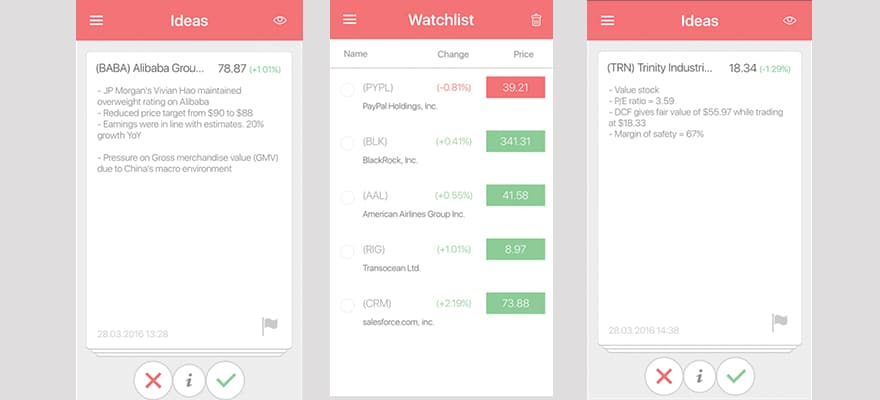
The idea behind FinanceSwipe’s design is not something new but rather inspired by the popular dating app Tinder, in which users swipe right to indicate interest in another person, and swipe left to pass to the next prospective match.
"The product is a minimal viable product and we plan on continuing to add new features."
Tinder-Like Theme
FinanceSwipe uses trading ideas, instead of potential mates, and users of the app are presented with a stream of these ideas, in which each idea must be dealt with – either by swiping left to discard it or swiping right to add it to a watchlist – before the next idea is displayed.
Other companies have applied this approach to various industries, such as retail shopping, and job searches. For example, Switch raised $2 million in seed funding for its app that helps users swipe through different job offerings, and Mallzee raised £2.5 million in funding for its mall themed, shopping inspired app.
Source: FinanceSwipe
Bootstrapped Startup
Finance Magnates spoke with the company’s CEO and founder Aamir Chaudry who is literally running the bootstrapped company single-handedly after taking a loan from his friends, leading to the app's successful addition to the app store at the end of February, and official launch on March 22nd this year, after starting the company last August.
Mr. Chaudry studied accounting and finance and currently holds a position with Deloitte, and after a brief stint as an intern at Barclay’s for barely a week, he also traded stocks and equity index derivatives including options for two years starting in 2011.
When I asked how he did it alone, and what programming skills he had, he explained that his expertise was in Wordpress and not software development per se, and how he was able to create the application by interviewing a large number of freelancers before finding the right people for the job.
Aamir Chaudry Source: LinkedIn
This type of approach to building a company has become increasingly common in the startup world by digital nomads for many years already and so was applicable to FinTech just as well.
Mr. Chaudry said during the interview: "FinanceSwipe is the perfect tool for discovering new ideas. The swiping feature allows you to quickly view many ideas. The product is a minimal viable product and we plan on continuing to add new features. In the short term, this includes a hashtag search feature and ability to read more information on each idea presented. We have every intention to expand into more asset classes (e.g. Commodities) and devices (e.g. Android), over the short-to-medium term."
App Review
During the call, I was able to install the app on my iPad even though it was the iPhone version of the app, and was impressed with the number of functions available already for such a new company and product, and considering that Aamir is running a one-man operation, not taking into consideration any outside contractors the company uses.
He is, however, looking for a partner and to offer an equity stake, preferably someone with coding expertise in languages like objective C, as it would be hard to scale the company by himself by using only freelancers.
FinanceSwipe displays a trading idea regarding a specific stock or trading instrument or asset class, and then compiles a list of bullet points regarding the prospects for the security, such as collating analysts' opinions and recent news such as earnings, and technical related chart analysis.
After reviewing the app I was able to ask Mr. Chaudry more about the flow of content within the various parts of the app, after I had already 'liked' a few ideas by swiping right when I was presented with them.
The ideas are created manually by sourcing information from various third parties and adding it in one place for users to swipe through for the next idea. Eventually, Mr. Chaudry hopes to add the capability for clients to trade directly with a broker, such as initiating an order when a user swipes right.
Monetization Pathways
With regard to how the company plans to monetize its business model, Mr. Chaudry explained that a premium subscription could be added in the future, for a monthly fee. He also said that an advertisement model could be added, as well as a potential affiliate marketing agreement with brokers – where any successful client conversions would result in remuneration for FinanceSwipe.
However, considering how new the company is and its recent app launch, Mr. Chaudry explained that he is not looking at the monetization options any time soon, as he focuses on building up the product.
Future plans
Even though the product may be far away from competing with firms like Stocktwits, or other social-network styled trading apps, FinanceSwipe is planning to add a social element to the app. Now, more than ever, FinTech solutions are enabling entrepreneurs to start up businesses from places such as within a Starbucks and with limited resources. Companies can overcome that startup bootstrap phase and attract seed capital, and use funding when the business is ready for commercialization.
FinanceSwipe currently has a pool of nearly 100 trading ideas that it is actively updating and reviewing, with price data from Yahoo Finance, and is planning on launching an Android app within six months.
For now, after launching the app officially at the end of March, the company had 180 users around the time of the interview earlier last week with Finance Magnates, and was expecting a list of changes to be added to the next updates to the app.
The idea behind FinanceSwipe’s design is not something new but rather inspired by the popular dating app Tinder, in which users swipe right to indicate interest in another person, and swipe left to pass to the next prospective match.
"The product is a minimal viable product and we plan on continuing to add new features."
Tinder-Like Theme
FinanceSwipe uses trading ideas, instead of potential mates, and users of the app are presented with a stream of these ideas, in which each idea must be dealt with – either by swiping left to discard it or swiping right to add it to a watchlist – before the next idea is displayed.
Other companies have applied this approach to various industries, such as retail shopping, and job searches. For example, Switch raised $2 million in seed funding for its app that helps users swipe through different job offerings, and Mallzee raised £2.5 million in funding for its mall themed, shopping inspired app.
Source: FinanceSwipe
Bootstrapped Startup
Finance Magnates spoke with the company’s CEO and founder Aamir Chaudry who is literally running the bootstrapped company single-handedly after taking a loan from his friends, leading to the app's successful addition to the app store at the end of February, and official launch on March 22nd this year, after starting the company last August.
Mr. Chaudry studied accounting and finance and currently holds a position with Deloitte, and after a brief stint as an intern at Barclay’s for barely a week, he also traded stocks and equity index derivatives including options for two years starting in 2011.
When I asked how he did it alone, and what programming skills he had, he explained that his expertise was in Wordpress and not software development per se, and how he was able to create the application by interviewing a large number of freelancers before finding the right people for the job.
Aamir Chaudry Source: LinkedIn
This type of approach to building a company has become increasingly common in the startup world by digital nomads for many years already and so was applicable to FinTech just as well.
Mr. Chaudry said during the interview: "FinanceSwipe is the perfect tool for discovering new ideas. The swiping feature allows you to quickly view many ideas. The product is a minimal viable product and we plan on continuing to add new features. In the short term, this includes a hashtag search feature and ability to read more information on each idea presented. We have every intention to expand into more asset classes (e.g. Commodities) and devices (e.g. Android), over the short-to-medium term."
App Review
During the call, I was able to install the app on my iPad even though it was the iPhone version of the app, and was impressed with the number of functions available already for such a new company and product, and considering that Aamir is running a one-man operation, not taking into consideration any outside contractors the company uses.
He is, however, looking for a partner and to offer an equity stake, preferably someone with coding expertise in languages like objective C, as it would be hard to scale the company by himself by using only freelancers.
FinanceSwipe displays a trading idea regarding a specific stock or trading instrument or asset class, and then compiles a list of bullet points regarding the prospects for the security, such as collating analysts' opinions and recent news such as earnings, and technical related chart analysis.
After reviewing the app I was able to ask Mr. Chaudry more about the flow of content within the various parts of the app, after I had already 'liked' a few ideas by swiping right when I was presented with them.
The ideas are created manually by sourcing information from various third parties and adding it in one place for users to swipe through for the next idea. Eventually, Mr. Chaudry hopes to add the capability for clients to trade directly with a broker, such as initiating an order when a user swipes right.
Monetization Pathways
With regard to how the company plans to monetize its business model, Mr. Chaudry explained that a premium subscription could be added in the future, for a monthly fee. He also said that an advertisement model could be added, as well as a potential affiliate marketing agreement with brokers – where any successful client conversions would result in remuneration for FinanceSwipe.
However, considering how new the company is and its recent app launch, Mr. Chaudry explained that he is not looking at the monetization options any time soon, as he focuses on building up the product.
Future plans
Even though the product may be far away from competing with firms like Stocktwits, or other social-network styled trading apps, FinanceSwipe is planning to add a social element to the app. Now, more than ever, FinTech solutions are enabling entrepreneurs to start up businesses from places such as within a Starbucks and with limited resources. Companies can overcome that startup bootstrap phase and attract seed capital, and use funding when the business is ready for commercialization.
FinanceSwipe currently has a pool of nearly 100 trading ideas that it is actively updating and reviewing, with price data from Yahoo Finance, and is planning on launching an Android app within six months.
For now, after launching the app officially at the end of March, the company had 180 users around the time of the interview earlier last week with Finance Magnates, and was expecting a list of changes to be added to the next updates to the app.
Prediction Markets Force Sportsbooks to Rethink Their World Cup Strategy
Featured Videos
FM Daily Brief – 11 June 2026
FM Daily Brief – 11 June 2026
FM Daily Brief – 11 June 2026
FM Daily Brief – 11 June 2026
Today’s Thursday, the 11th of June 2026, and these are our main stories: Spain moves to classify certain futures products as CFDs for retail investors, IUX reports more than $1.5 trillion in monthly trading volume, and a closer look at why crypto still struggles to reach the mainstream.
Today’s Thursday, the 11th of June 2026, and these are our main stories: Spain moves to classify certain futures products as CFDs for retail investors, IUX reports more than $1.5 trillion in monthly trading volume, and a closer look at why crypto still struggles to reach the mainstream.
Today’s Thursday, the 11th of June 2026, and these are our main stories: Spain moves to classify certain futures products as CFDs for retail investors, IUX reports more than $1.5 trillion in monthly trading volume, and a closer look at why crypto still struggles to reach the mainstream.
Today’s Thursday, the 11th of June 2026, and these are our main stories: Spain moves to classify certain futures products as CFDs for retail investors, IUX reports more than $1.5 trillion in monthly trading volume, and a closer look at why crypto still struggles to reach the mainstream.
In this video, we review @AxiOfficialChannel , a multi-asset broker offering access to forex and CFD markets through MetaTrader 4, MetaTrader 5, the Axi Trading App, and copy trading solutions.
We examine the broker’s regulatory framework, platform offering, market coverage, and customer support structure. We also explore key features such as available trading instruments, swap-free account options, funding considerations, and multilingual support.
Watch the full video for a clear, fact-based overview of Axi’s products, trading tools, and overall broker offering.
#Axi #ForexBroker #CFDTrading #FinanceMagnates #Trading #BrokerReview #OnlineTrading
In this video, we review @AxiOfficialChannel , a multi-asset broker offering access to forex and CFD markets through MetaTrader 4, MetaTrader 5, the Axi Trading App, and copy trading solutions.
We examine the broker’s regulatory framework, platform offering, market coverage, and customer support structure. We also explore key features such as available trading instruments, swap-free account options, funding considerations, and multilingual support.
Watch the full video for a clear, fact-based overview of Axi’s products, trading tools, and overall broker offering.
#Axi #ForexBroker #CFDTrading #FinanceMagnates #Trading #BrokerReview #OnlineTrading
In this video, we review @AxiOfficialChannel , a multi-asset broker offering access to forex and CFD markets through MetaTrader 4, MetaTrader 5, the Axi Trading App, and copy trading solutions.
We examine the broker’s regulatory framework, platform offering, market coverage, and customer support structure. We also explore key features such as available trading instruments, swap-free account options, funding considerations, and multilingual support.
Watch the full video for a clear, fact-based overview of Axi’s products, trading tools, and overall broker offering.
#Axi #ForexBroker #CFDTrading #FinanceMagnates #Trading #BrokerReview #OnlineTrading
In this video, we review @AxiOfficialChannel , a multi-asset broker offering access to forex and CFD markets through MetaTrader 4, MetaTrader 5, the Axi Trading App, and copy trading solutions.
We examine the broker’s regulatory framework, platform offering, market coverage, and customer support structure. We also explore key features such as available trading instruments, swap-free account options, funding considerations, and multilingual support.
Watch the full video for a clear, fact-based overview of Axi’s products, trading tools, and overall broker offering.
#Axi #ForexBroker #CFDTrading #FinanceMagnates #Trading #BrokerReview #OnlineTrading
In this video, we review @AxiOfficialChannel , a multi-asset broker offering access to forex and CFD markets through MetaTrader 4, MetaTrader 5, the Axi Trading App, and copy trading solutions.
We examine the broker’s regulatory framework, platform offering, market coverage, and customer support structure. We also explore key features such as available trading instruments, swap-free account options, funding considerations, and multilingual support.
Watch the full video for a clear, fact-based overview of Axi’s products, trading tools, and overall broker offering.
#Axi #ForexBroker #CFDTrading #FinanceMagnates #Trading #BrokerReview #OnlineTrading
In this video, we review @AxiOfficialChannel , a multi-asset broker offering access to forex and CFD markets through MetaTrader 4, MetaTrader 5, the Axi Trading App, and copy trading solutions.
We examine the broker’s regulatory framework, platform offering, market coverage, and customer support structure. We also explore key features such as available trading instruments, swap-free account options, funding considerations, and multilingual support.
Watch the full video for a clear, fact-based overview of Axi’s products, trading tools, and overall broker offering.
#Axi #ForexBroker #CFDTrading #FinanceMagnates #Trading #BrokerReview #OnlineTrading
Multi-Asset or Die: The New Brokerage Playbook
Multi-Asset or Die: The New Brokerage Playbook
Multi-Asset or Die: The New Brokerage Playbook
Multi-Asset or Die: The New Brokerage Playbook
Multi-Asset or Die: The New Brokerage Playbook
Multi-Asset or Die: The New Brokerage Playbook
This panel will explore how firms are moving beyond CFDs into crypto, perpetuals, equities, and multi‑asset offerings, and the challenges they face across regulation, technology, liquidity, and risk management. It examines what is driving the shift, what it takes to execute it successfully, and how brokers can position themselves for the next phase of growth.
This panel will explore how firms are moving beyond CFDs into crypto, perpetuals, equities, and multi‑asset offerings, and the challenges they face across regulation, technology, liquidity, and risk management. It examines what is driving the shift, what it takes to execute it successfully, and how brokers can position themselves for the next phase of growth.
This panel will explore how firms are moving beyond CFDs into crypto, perpetuals, equities, and multi‑asset offerings, and the challenges they face across regulation, technology, liquidity, and risk management. It examines what is driving the shift, what it takes to execute it successfully, and how brokers can position themselves for the next phase of growth.
This panel will explore how firms are moving beyond CFDs into crypto, perpetuals, equities, and multi‑asset offerings, and the challenges they face across regulation, technology, liquidity, and risk management. It examines what is driving the shift, what it takes to execute it successfully, and how brokers can position themselves for the next phase of growth.
This panel will explore how firms are moving beyond CFDs into crypto, perpetuals, equities, and multi‑asset offerings, and the challenges they face across regulation, technology, liquidity, and risk management. It examines what is driving the shift, what it takes to execute it successfully, and how brokers can position themselves for the next phase of growth.
This panel will explore how firms are moving beyond CFDs into crypto, perpetuals, equities, and multi‑asset offerings, and the challenges they face across regulation, technology, liquidity, and risk management. It examines what is driving the shift, what it takes to execute it successfully, and how brokers can position themselves for the next phase of growth.
Beyond Reach? Retail Investor Acquisition Across APAC
Beyond Reach? Retail Investor Acquisition Across APAC
Beyond Reach? Retail Investor Acquisition Across APAC
Beyond Reach? Retail Investor Acquisition Across APAC
Beyond Reach? Retail Investor Acquisition Across APAC
Beyond Reach? Retail Investor Acquisition Across APAC
APAC accounts for two-thirds of global retail trading traffic, but with differences of language, regulation, and trader profile, the region's growth is ag great as complexity.
This session gathers CMOs, heads of acquisition, and IB relationship managers to examine what actually works, channel by channel, market by market.
Attendees will walk away with:
A clear view of which channels deliver funded, retained traders across Singapore, Japan, and Southeast Asia
Understanding of how to structure IB partnerships for LTV, not first deposit
Insight into what localization actually costs beyond the translation budget
Perspective on how ad restrictions, crypto promotion limits, and bundling rules differ across APAC jurisdictions
A read on whether the super-app model changes acquisition economics for retail investing platforms
APAC accounts for two-thirds of global retail trading traffic, but with differences of language, regulation, and trader profile, the region's growth is ag great as complexity.
This session gathers CMOs, heads of acquisition, and IB relationship managers to examine what actually works, channel by channel, market by market.
Attendees will walk away with:
A clear view of which channels deliver funded, retained traders across Singapore, Japan, and Southeast Asia
Understanding of how to structure IB partnerships for LTV, not first deposit
Insight into what localization actually costs beyond the translation budget
Perspective on how ad restrictions, crypto promotion limits, and bundling rules differ across APAC jurisdictions
A read on whether the super-app model changes acquisition economics for retail investing platforms
APAC accounts for two-thirds of global retail trading traffic, but with differences of language, regulation, and trader profile, the region's growth is ag great as complexity.
This session gathers CMOs, heads of acquisition, and IB relationship managers to examine what actually works, channel by channel, market by market.
Attendees will walk away with:
A clear view of which channels deliver funded, retained traders across Singapore, Japan, and Southeast Asia
Understanding of how to structure IB partnerships for LTV, not first deposit
Insight into what localization actually costs beyond the translation budget
Perspective on how ad restrictions, crypto promotion limits, and bundling rules differ across APAC jurisdictions
A read on whether the super-app model changes acquisition economics for retail investing platforms
APAC accounts for two-thirds of global retail trading traffic, but with differences of language, regulation, and trader profile, the region's growth is ag great as complexity.
This session gathers CMOs, heads of acquisition, and IB relationship managers to examine what actually works, channel by channel, market by market.
Attendees will walk away with:
A clear view of which channels deliver funded, retained traders across Singapore, Japan, and Southeast Asia
Understanding of how to structure IB partnerships for LTV, not first deposit
Insight into what localization actually costs beyond the translation budget
Perspective on how ad restrictions, crypto promotion limits, and bundling rules differ across APAC jurisdictions
A read on whether the super-app model changes acquisition economics for retail investing platforms
APAC accounts for two-thirds of global retail trading traffic, but with differences of language, regulation, and trader profile, the region's growth is ag great as complexity.
This session gathers CMOs, heads of acquisition, and IB relationship managers to examine what actually works, channel by channel, market by market.
Attendees will walk away with:
A clear view of which channels deliver funded, retained traders across Singapore, Japan, and Southeast Asia
Understanding of how to structure IB partnerships for LTV, not first deposit
Insight into what localization actually costs beyond the translation budget
Perspective on how ad restrictions, crypto promotion limits, and bundling rules differ across APAC jurisdictions
A read on whether the super-app model changes acquisition economics for retail investing platforms
APAC accounts for two-thirds of global retail trading traffic, but with differences of language, regulation, and trader profile, the region's growth is ag great as complexity.
This session gathers CMOs, heads of acquisition, and IB relationship managers to examine what actually works, channel by channel, market by market.
Attendees will walk away with:
A clear view of which channels deliver funded, retained traders across Singapore, Japan, and Southeast Asia
Understanding of how to structure IB partnerships for LTV, not first deposit
Insight into what localization actually costs beyond the translation budget
Perspective on how ad restrictions, crypto promotion limits, and bundling rules differ across APAC jurisdictions
A read on whether the super-app model changes acquisition economics for retail investing platforms