
The idea behind FinanceSwipe’s design is not something new but rather inspired by the popular dating app Tinder, in which users swipe right to indicate interest in another person, and swipe left to pass to the next prospective match.
"The product is a minimal viable product and we plan on continuing to add new features."
Tinder-Like Theme
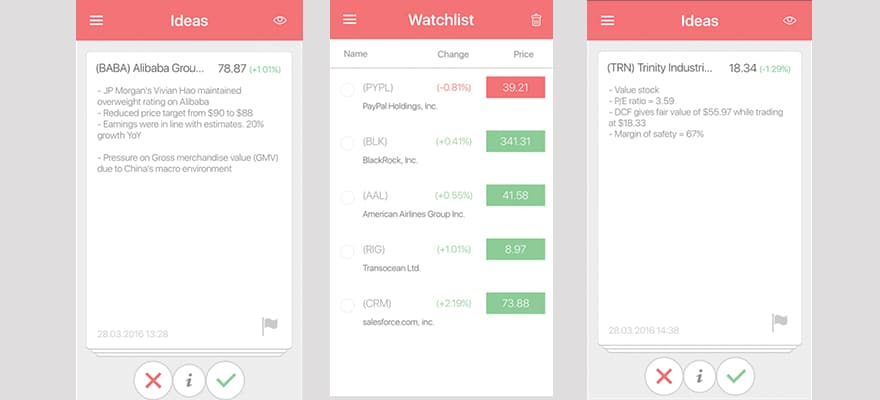
FinanceSwipe uses trading ideas, instead of potential mates, and users of the app are presented with a stream of these ideas, in which each idea must be dealt with – either by swiping left to discard it or swiping right to add it to a watchlist – before the next idea is displayed.
Other companies have applied this approach to various industries, such as retail shopping, and job searches. For example, Switch raised $2 million in seed funding for its app that helps users swipe through different job offerings, and Mallzee raised £2.5 million in funding for its mall themed, shopping inspired app.
Source: FinanceSwipe
Bootstrapped Startup
Finance Magnates spoke with the company’s CEO and founder Aamir Chaudry who is literally running the bootstrapped company single-handedly after taking a loan from his friends, leading to the app's successful addition to the app store at the end of February, and official launch on March 22nd this year, after starting the company last August.
Mr. Chaudry studied accounting and finance and currently holds a position with Deloitte, and after a brief stint as an intern at Barclay’s for barely a week, he also traded stocks and equity index derivatives including options for two years starting in 2011.
When I asked how he did it alone, and what programming skills he had, he explained that his expertise was in Wordpress and not software development per se, and how he was able to create the application by interviewing a large number of freelancers before finding the right people for the job.

Aamir Chaudry Source: LinkedIn
This type of approach to building a company has become increasingly common in the startup world by digital nomads for many years already and so was applicable to FinTech just as well.
Mr. Chaudry said during the interview: "FinanceSwipe is the perfect tool for discovering new ideas. The swiping feature allows you to quickly view many ideas. The product is a minimal viable product and we plan on continuing to add new features. In the short term, this includes a hashtag search feature and ability to read more information on each idea presented. We have every intention to expand into more asset classes (e.g. Commodities) and devices (e.g. Android), over the short-to-medium term."
App Review
During the call, I was able to install the app on my iPad even though it was the iPhone version of the app, and was impressed with the number of functions available already for such a new company and product, and considering that Aamir is running a one-man operation, not taking into consideration any outside contractors the company uses.
He is, however, looking for a partner and to offer an equity stake, preferably someone with coding expertise in languages like objective C, as it would be hard to scale the company by himself by using only freelancers.
FinanceSwipe displays a trading idea regarding a specific stock or trading instrument or asset class, and then compiles a list of bullet points regarding the prospects for the security, such as collating analysts' opinions and recent news such as earnings, and technical related chart analysis.
After reviewing the app I was able to ask Mr. Chaudry more about the flow of content within the various parts of the app, after I had already 'liked' a few ideas by swiping right when I was presented with them.
The ideas are created manually by sourcing information from various third parties and adding it in one place for users to swipe through for the next idea. Eventually, Mr. Chaudry hopes to add the capability for clients to trade directly with a broker, such as initiating an order when a user swipes right.
Monetization Pathways
With regard to how the company plans to monetize its business model, Mr. Chaudry explained that a premium subscription could be added in the future, for a monthly fee. He also said that an advertisement model could be added, as well as a potential affiliate marketing agreement with brokers – where any successful client conversions would result in remuneration for FinanceSwipe.
However, considering how new the company is and its recent app launch, Mr. Chaudry explained that he is not looking at the monetization options any time soon, as he focuses on building up the product.
Future plans
Even though the product may be far away from competing with firms like Stocktwits, or other social-network styled trading apps, FinanceSwipe is planning to add a social element to the app. Now, more than ever, FinTech solutions are enabling entrepreneurs to start up businesses from places such as within a Starbucks and with limited resources. Companies can overcome that startup bootstrap phase and attract seed capital, and use funding when the business is ready for commercialization.
FinanceSwipe currently has a pool of nearly 100 trading ideas that it is actively updating and reviewing, with price data from Yahoo Finance, and is planning on launching an Android app within six months.
For now, after launching the app officially at the end of March, the company had 180 users around the time of the interview earlier last week with Finance Magnates, and was expecting a list of changes to be added to the next updates to the app.
The idea behind FinanceSwipe’s design is not something new but rather inspired by the popular dating app Tinder, in which users swipe right to indicate interest in another person, and swipe left to pass to the next prospective match.
"The product is a minimal viable product and we plan on continuing to add new features."
Tinder-Like Theme
FinanceSwipe uses trading ideas, instead of potential mates, and users of the app are presented with a stream of these ideas, in which each idea must be dealt with – either by swiping left to discard it or swiping right to add it to a watchlist – before the next idea is displayed.
Other companies have applied this approach to various industries, such as retail shopping, and job searches. For example, Switch raised $2 million in seed funding for its app that helps users swipe through different job offerings, and Mallzee raised £2.5 million in funding for its mall themed, shopping inspired app.
Source: FinanceSwipe
Bootstrapped Startup
Finance Magnates spoke with the company’s CEO and founder Aamir Chaudry who is literally running the bootstrapped company single-handedly after taking a loan from his friends, leading to the app's successful addition to the app store at the end of February, and official launch on March 22nd this year, after starting the company last August.
Mr. Chaudry studied accounting and finance and currently holds a position with Deloitte, and after a brief stint as an intern at Barclay’s for barely a week, he also traded stocks and equity index derivatives including options for two years starting in 2011.
When I asked how he did it alone, and what programming skills he had, he explained that his expertise was in Wordpress and not software development per se, and how he was able to create the application by interviewing a large number of freelancers before finding the right people for the job.
Aamir Chaudry Source: LinkedIn
This type of approach to building a company has become increasingly common in the startup world by digital nomads for many years already and so was applicable to FinTech just as well.
Mr. Chaudry said during the interview: "FinanceSwipe is the perfect tool for discovering new ideas. The swiping feature allows you to quickly view many ideas. The product is a minimal viable product and we plan on continuing to add new features. In the short term, this includes a hashtag search feature and ability to read more information on each idea presented. We have every intention to expand into more asset classes (e.g. Commodities) and devices (e.g. Android), over the short-to-medium term."
App Review
During the call, I was able to install the app on my iPad even though it was the iPhone version of the app, and was impressed with the number of functions available already for such a new company and product, and considering that Aamir is running a one-man operation, not taking into consideration any outside contractors the company uses.
He is, however, looking for a partner and to offer an equity stake, preferably someone with coding expertise in languages like objective C, as it would be hard to scale the company by himself by using only freelancers.
FinanceSwipe displays a trading idea regarding a specific stock or trading instrument or asset class, and then compiles a list of bullet points regarding the prospects for the security, such as collating analysts' opinions and recent news such as earnings, and technical related chart analysis.
After reviewing the app I was able to ask Mr. Chaudry more about the flow of content within the various parts of the app, after I had already 'liked' a few ideas by swiping right when I was presented with them.
The ideas are created manually by sourcing information from various third parties and adding it in one place for users to swipe through for the next idea. Eventually, Mr. Chaudry hopes to add the capability for clients to trade directly with a broker, such as initiating an order when a user swipes right.
Monetization Pathways
With regard to how the company plans to monetize its business model, Mr. Chaudry explained that a premium subscription could be added in the future, for a monthly fee. He also said that an advertisement model could be added, as well as a potential affiliate marketing agreement with brokers – where any successful client conversions would result in remuneration for FinanceSwipe.
However, considering how new the company is and its recent app launch, Mr. Chaudry explained that he is not looking at the monetization options any time soon, as he focuses on building up the product.
Future plans
Even though the product may be far away from competing with firms like Stocktwits, or other social-network styled trading apps, FinanceSwipe is planning to add a social element to the app. Now, more than ever, FinTech solutions are enabling entrepreneurs to start up businesses from places such as within a Starbucks and with limited resources. Companies can overcome that startup bootstrap phase and attract seed capital, and use funding when the business is ready for commercialization.
FinanceSwipe currently has a pool of nearly 100 trading ideas that it is actively updating and reviewing, with price data from Yahoo Finance, and is planning on launching an Android app within six months.
For now, after launching the app officially at the end of March, the company had 180 users around the time of the interview earlier last week with Finance Magnates, and was expecting a list of changes to be added to the next updates to the app.
Visa Brings Stablecoins to Main Street Banking With U.S. Rollout
Featured Videos
Executive Interview | Charlotte Bullock | Chief Product Officer, Bank of London | FMLS:25
In this interview, we sat down with Charlotte Bullock, Head of Product at The Bank of London, previously at SAP and now shaping product at one of the sector’s most ambitious new banking players.
Charlotte reflects on the Summit so far and talks about the culture inside fintech banks today. We look at the pressures that come with scaling, and how firms can hold onto the nimble approach that made them stand out early on.
We also cover the state of payments ahead of her appearance on the payments roundtable: the blockages financial firms face, the areas that still need fixing, and what a realistic solution looks like in 2026.
In this interview, we sat down with Charlotte Bullock, Head of Product at The Bank of London, previously at SAP and now shaping product at one of the sector’s most ambitious new banking players.
Charlotte reflects on the Summit so far and talks about the culture inside fintech banks today. We look at the pressures that come with scaling, and how firms can hold onto the nimble approach that made them stand out early on.
We also cover the state of payments ahead of her appearance on the payments roundtable: the blockages financial firms face, the areas that still need fixing, and what a realistic solution looks like in 2026.
In this interview, we sat down with Charlotte Bullock, Head of Product at The Bank of London, previously at SAP and now shaping product at one of the sector’s most ambitious new banking players.
Charlotte reflects on the Summit so far and talks about the culture inside fintech banks today. We look at the pressures that come with scaling, and how firms can hold onto the nimble approach that made them stand out early on.
We also cover the state of payments ahead of her appearance on the payments roundtable: the blockages financial firms face, the areas that still need fixing, and what a realistic solution looks like in 2026.
In this interview, we sat down with Charlotte Bullock, Head of Product at The Bank of London, previously at SAP and now shaping product at one of the sector’s most ambitious new banking players.
Charlotte reflects on the Summit so far and talks about the culture inside fintech banks today. We look at the pressures that come with scaling, and how firms can hold onto the nimble approach that made them stand out early on.
We also cover the state of payments ahead of her appearance on the payments roundtable: the blockages financial firms face, the areas that still need fixing, and what a realistic solution looks like in 2026.
In this conversation, we sit down with Drew Niv, CSO at ATFX Connect and one of the most influential figures in modern FX.
We speak about market structure, the institutional view on liquidity, and the sharp rise of prop trading, a sector Drew has been commenting on in recent months. Drew explains why he once dismissed prop trading, why his view changed, and what he now thinks the model means for brokers, clients and risk managers.
We explore subscription-fee dependency, the high reneging rate, and the long-term challenge: how brokers can build a more stable and honest version of the model. Drew also talks about the traffic advantage standalone prop firms have built and why brokers may still win in the long run if they take the right approach.
In this conversation, we sit down with Drew Niv, CSO at ATFX Connect and one of the most influential figures in modern FX.
We speak about market structure, the institutional view on liquidity, and the sharp rise of prop trading, a sector Drew has been commenting on in recent months. Drew explains why he once dismissed prop trading, why his view changed, and what he now thinks the model means for brokers, clients and risk managers.
We explore subscription-fee dependency, the high reneging rate, and the long-term challenge: how brokers can build a more stable and honest version of the model. Drew also talks about the traffic advantage standalone prop firms have built and why brokers may still win in the long run if they take the right approach.
In this conversation, we sit down with Drew Niv, CSO at ATFX Connect and one of the most influential figures in modern FX.
We speak about market structure, the institutional view on liquidity, and the sharp rise of prop trading, a sector Drew has been commenting on in recent months. Drew explains why he once dismissed prop trading, why his view changed, and what he now thinks the model means for brokers, clients and risk managers.
We explore subscription-fee dependency, the high reneging rate, and the long-term challenge: how brokers can build a more stable and honest version of the model. Drew also talks about the traffic advantage standalone prop firms have built and why brokers may still win in the long run if they take the right approach.
In this conversation, we sit down with Drew Niv, CSO at ATFX Connect and one of the most influential figures in modern FX.
We speak about market structure, the institutional view on liquidity, and the sharp rise of prop trading, a sector Drew has been commenting on in recent months. Drew explains why he once dismissed prop trading, why his view changed, and what he now thinks the model means for brokers, clients and risk managers.
We explore subscription-fee dependency, the high reneging rate, and the long-term challenge: how brokers can build a more stable and honest version of the model. Drew also talks about the traffic advantage standalone prop firms have built and why brokers may still win in the long run if they take the right approach.
In this conversation, we sit down with Drew Niv, CSO at ATFX Connect and one of the most influential figures in modern FX.
We speak about market structure, the institutional view on liquidity, and the sharp rise of prop trading, a sector Drew has been commenting on in recent months. Drew explains why he once dismissed prop trading, why his view changed, and what he now thinks the model means for brokers, clients and risk managers.
We explore subscription-fee dependency, the high reneging rate, and the long-term challenge: how brokers can build a more stable and honest version of the model. Drew also talks about the traffic advantage standalone prop firms have built and why brokers may still win in the long run if they take the right approach.
In this conversation, we sit down with Drew Niv, CSO at ATFX Connect and one of the most influential figures in modern FX.
We speak about market structure, the institutional view on liquidity, and the sharp rise of prop trading, a sector Drew has been commenting on in recent months. Drew explains why he once dismissed prop trading, why his view changed, and what he now thinks the model means for brokers, clients and risk managers.
We explore subscription-fee dependency, the high reneging rate, and the long-term challenge: how brokers can build a more stable and honest version of the model. Drew also talks about the traffic advantage standalone prop firms have built and why brokers may still win in the long run if they take the right approach.
Executive Interview | Remonda Z. Kirketerp Møller| CEO & Founder Muinmos | FMLS:25
In this interview, Remonda Z. Kirketerp Møller, founder of Muinmos, breaks down the state of AI in regtech and what responsible adoption really looks like for brokers. We talk about rising fragmentation, the pressures around compliance accuracy, and why most firms are still in the early stages of AI maturity.
Ramanda also shares insights on regulator sandboxes, shifting expectations around accountability, and the current reality of MiCA licensing and passporting in Europe.
A concise look at where compliance, onboarding, and AI-driven processes are heading next.
In this interview, Remonda Z. Kirketerp Møller, founder of Muinmos, breaks down the state of AI in regtech and what responsible adoption really looks like for brokers. We talk about rising fragmentation, the pressures around compliance accuracy, and why most firms are still in the early stages of AI maturity.
Ramanda also shares insights on regulator sandboxes, shifting expectations around accountability, and the current reality of MiCA licensing and passporting in Europe.
A concise look at where compliance, onboarding, and AI-driven processes are heading next.
In this interview, Remonda Z. Kirketerp Møller, founder of Muinmos, breaks down the state of AI in regtech and what responsible adoption really looks like for brokers. We talk about rising fragmentation, the pressures around compliance accuracy, and why most firms are still in the early stages of AI maturity.
Ramanda also shares insights on regulator sandboxes, shifting expectations around accountability, and the current reality of MiCA licensing and passporting in Europe.
A concise look at where compliance, onboarding, and AI-driven processes are heading next.
In this interview, Remonda Z. Kirketerp Møller, founder of Muinmos, breaks down the state of AI in regtech and what responsible adoption really looks like for brokers. We talk about rising fragmentation, the pressures around compliance accuracy, and why most firms are still in the early stages of AI maturity.
Ramanda also shares insights on regulator sandboxes, shifting expectations around accountability, and the current reality of MiCA licensing and passporting in Europe.
A concise look at where compliance, onboarding, and AI-driven processes are heading next.
In this interview, Remonda Z. Kirketerp Møller, founder of Muinmos, breaks down the state of AI in regtech and what responsible adoption really looks like for brokers. We talk about rising fragmentation, the pressures around compliance accuracy, and why most firms are still in the early stages of AI maturity.
Ramanda also shares insights on regulator sandboxes, shifting expectations around accountability, and the current reality of MiCA licensing and passporting in Europe.
A concise look at where compliance, onboarding, and AI-driven processes are heading next.
In this interview, Remonda Z. Kirketerp Møller, founder of Muinmos, breaks down the state of AI in regtech and what responsible adoption really looks like for brokers. We talk about rising fragmentation, the pressures around compliance accuracy, and why most firms are still in the early stages of AI maturity.
Ramanda also shares insights on regulator sandboxes, shifting expectations around accountability, and the current reality of MiCA licensing and passporting in Europe.
A concise look at where compliance, onboarding, and AI-driven processes are heading next.
In this conversation, we speak with Aydin Bonabi, CEO and co-founder of Surveill, a firm focused on fraud detection and AI-driven compliance tools for financial institutions.
We start with Aydin’s view of the Summit and the challenges brokers face as fraud tactics grow more complex. He explains how firms can stay ahead through real-time signals, data patterns, and early-stage detection.
We also talk about AI training and why compliance teams often struggle to keep models accurate, fair, and aligned with regulatory expectations. Aydin breaks down what “good” AI training looks like inside a financial environment, including the importance of clean data, domain expertise, and human oversight.
He closes with a clear message: fraud is scaling, and so must the tools that stop it.
In this conversation, we speak with Aydin Bonabi, CEO and co-founder of Surveill, a firm focused on fraud detection and AI-driven compliance tools for financial institutions.
We start with Aydin’s view of the Summit and the challenges brokers face as fraud tactics grow more complex. He explains how firms can stay ahead through real-time signals, data patterns, and early-stage detection.
We also talk about AI training and why compliance teams often struggle to keep models accurate, fair, and aligned with regulatory expectations. Aydin breaks down what “good” AI training looks like inside a financial environment, including the importance of clean data, domain expertise, and human oversight.
He closes with a clear message: fraud is scaling, and so must the tools that stop it.
In this conversation, we speak with Aydin Bonabi, CEO and co-founder of Surveill, a firm focused on fraud detection and AI-driven compliance tools for financial institutions.
We start with Aydin’s view of the Summit and the challenges brokers face as fraud tactics grow more complex. He explains how firms can stay ahead through real-time signals, data patterns, and early-stage detection.
We also talk about AI training and why compliance teams often struggle to keep models accurate, fair, and aligned with regulatory expectations. Aydin breaks down what “good” AI training looks like inside a financial environment, including the importance of clean data, domain expertise, and human oversight.
He closes with a clear message: fraud is scaling, and so must the tools that stop it.
In this conversation, we speak with Aydin Bonabi, CEO and co-founder of Surveill, a firm focused on fraud detection and AI-driven compliance tools for financial institutions.
We start with Aydin’s view of the Summit and the challenges brokers face as fraud tactics grow more complex. He explains how firms can stay ahead through real-time signals, data patterns, and early-stage detection.
We also talk about AI training and why compliance teams often struggle to keep models accurate, fair, and aligned with regulatory expectations. Aydin breaks down what “good” AI training looks like inside a financial environment, including the importance of clean data, domain expertise, and human oversight.
He closes with a clear message: fraud is scaling, and so must the tools that stop it.
In this conversation, we speak with Aydin Bonabi, CEO and co-founder of Surveill, a firm focused on fraud detection and AI-driven compliance tools for financial institutions.
We start with Aydin’s view of the Summit and the challenges brokers face as fraud tactics grow more complex. He explains how firms can stay ahead through real-time signals, data patterns, and early-stage detection.
We also talk about AI training and why compliance teams often struggle to keep models accurate, fair, and aligned with regulatory expectations. Aydin breaks down what “good” AI training looks like inside a financial environment, including the importance of clean data, domain expertise, and human oversight.
He closes with a clear message: fraud is scaling, and so must the tools that stop it.
In this conversation, we speak with Aydin Bonabi, CEO and co-founder of Surveill, a firm focused on fraud detection and AI-driven compliance tools for financial institutions.
We start with Aydin’s view of the Summit and the challenges brokers face as fraud tactics grow more complex. He explains how firms can stay ahead through real-time signals, data patterns, and early-stage detection.
We also talk about AI training and why compliance teams often struggle to keep models accurate, fair, and aligned with regulatory expectations. Aydin breaks down what “good” AI training looks like inside a financial environment, including the importance of clean data, domain expertise, and human oversight.
He closes with a clear message: fraud is scaling, and so must the tools that stop it.
Exness expands its presence in Africa: Inside our interview with Paul Margarites in Cape Town
Finance Magnates met with Paul Margarites, Exness regional commercial director for Sub-Saharan Africa, during a visit to the firm’s office opening in Cape Town. In this talk, led by Andrea Badiola Mateos, Co-CEO at Finance Magnates, Paul shares views on the South African trading space, local user behavior, mobile trends, regulation, team growth, and how Exness plans to grow in more markets across the region. @Exness
Read the article at: https://www.financemagnates.com/thought-leadership/exness-expands-its-presence-in-africa-inside-our-interview-with-paul-margarites/
#exness #financemagnates #exnesstrading #CFDtrading #tradeonline #africanews #capetown
Finance Magnates met with Paul Margarites, Exness regional commercial director for Sub-Saharan Africa, during a visit to the firm’s office opening in Cape Town. In this talk, led by Andrea Badiola Mateos, Co-CEO at Finance Magnates, Paul shares views on the South African trading space, local user behavior, mobile trends, regulation, team growth, and how Exness plans to grow in more markets across the region. @Exness
Read the article at: https://www.financemagnates.com/thought-leadership/exness-expands-its-presence-in-africa-inside-our-interview-with-paul-margarites/
#exness #financemagnates #exnesstrading #CFDtrading #tradeonline #africanews #capetown
Finance Magnates met with Paul Margarites, Exness regional commercial director for Sub-Saharan Africa, during a visit to the firm’s office opening in Cape Town. In this talk, led by Andrea Badiola Mateos, Co-CEO at Finance Magnates, Paul shares views on the South African trading space, local user behavior, mobile trends, regulation, team growth, and how Exness plans to grow in more markets across the region. @Exness
Read the article at: https://www.financemagnates.com/thought-leadership/exness-expands-its-presence-in-africa-inside-our-interview-with-paul-margarites/
#exness #financemagnates #exnesstrading #CFDtrading #tradeonline #africanews #capetown
Finance Magnates met with Paul Margarites, Exness regional commercial director for Sub-Saharan Africa, during a visit to the firm’s office opening in Cape Town. In this talk, led by Andrea Badiola Mateos, Co-CEO at Finance Magnates, Paul shares views on the South African trading space, local user behavior, mobile trends, regulation, team growth, and how Exness plans to grow in more markets across the region. @Exness
Read the article at: https://www.financemagnates.com/thought-leadership/exness-expands-its-presence-in-africa-inside-our-interview-with-paul-margarites/
#exness #financemagnates #exnesstrading #CFDtrading #tradeonline #africanews #capetown
Finance Magnates met with Paul Margarites, Exness regional commercial director for Sub-Saharan Africa, during a visit to the firm’s office opening in Cape Town. In this talk, led by Andrea Badiola Mateos, Co-CEO at Finance Magnates, Paul shares views on the South African trading space, local user behavior, mobile trends, regulation, team growth, and how Exness plans to grow in more markets across the region. @Exness
Read the article at: https://www.financemagnates.com/thought-leadership/exness-expands-its-presence-in-africa-inside-our-interview-with-paul-margarites/
#exness #financemagnates #exnesstrading #CFDtrading #tradeonline #africanews #capetown
Finance Magnates met with Paul Margarites, Exness regional commercial director for Sub-Saharan Africa, during a visit to the firm’s office opening in Cape Town. In this talk, led by Andrea Badiola Mateos, Co-CEO at Finance Magnates, Paul shares views on the South African trading space, local user behavior, mobile trends, regulation, team growth, and how Exness plans to grow in more markets across the region. @Exness
Read the article at: https://www.financemagnates.com/thought-leadership/exness-expands-its-presence-in-africa-inside-our-interview-with-paul-margarites/
#exness #financemagnates #exnesstrading #CFDtrading #tradeonline #africanews #capetown