OTC Markets files petition to expand regulation A+ to SEC-reporting firms.
Bloomberg
It's been less than a month since the tail-end of the JOBS Act went fully into effect in the United States on May 16th for crowdfunding, after rules were finalized last year for Regulation A+, and a petition was filed with the Securities and Exchange Commission (SEC) from OTC Markets Group Inc.
The petition requests further amendments that would enable SEC-reporting firms to participate in this new form of raising capital that went into effect last June and which could be a big part of the future for US capital markets amid changes in consumer trends and fintech convergences.
Currently, Regulation A+ under Title IV of the JOBS Act allows companies to raise up to either $20 million or $50 million, under tier 1 and tier 2 respectively, from individual investors, yet the guidelines exclude SEC reporting firms that already meet the high standards of SEC filings and related disclosures.
Regulation A+ securities offerings are tailor-made for smaller companies and investment banks to utilize technology to transparently offer shares online the way Amazon sells books.
Through its OTC Link LLC Alternative Trading System (ATS) regulated by the SEC, OTC Markets Group Inc. is a leading operator of trading venues including its OTCQX, OTCQB, and Pink markets which are home to 10,000 traded securities, with over $200 billion in volumes according to its prior annual report.
"Regulation A+ securities offerings are tailor-made for smaller companies and investment banks to utilize technology to transparently offer shares online the way Amazon sells books. By excluding SEC reporting companies, the SEC missed a critical opportunity to expand access to capital, drive costs lower and support small company growth," said R. Cromwell Coulson, president and CEO of OTC Markets Group, commenting in a corporate statement.
Mr. Coulson added: "Online capital raising better serves small public companies and their investors as opposed to the traditional opaque, private offering processes that are restricted to the wealthy and well connected. Fighting to extend Reg. A+ to the thousands of smaller companies that have invested the time and resources in being fully SEC reporting is imperative, not only to these companies but to the American economy as a whole. We must modernize securities regulations to embrace the efficiencies of the internet age."
Completely new industry
R. Cromwell Coulson Source: LinkedIn
Finance Magnates spoke with OTC Markets' CEO around the time of this article, who explained: "The great thing about Congress' foresight with the JOBS Act was that they created a lot of different optionality around capital raising that can be empowered by technology. Online capital raising is a completely new industry, and like every new industry - their product is not really developed yet."
He added: "The big opportunity now with fintech is in sales and distribution," and how, "we can see, that with small companies - primarily owned by individual investors - small investors primarily trade small companies, through their online brokers. Why can't they directly invest in those companies while raising capital through an online process? We are not there yet, but we will be. At OTC Markets, we've invested a significant effort ensuring that investors, both through online brokers and institutional brokers, have a great informational and trading experience.”
"Our goal is to educate the community on the issue and provide the intellectual leadership so we can move securities law forward to fit the internet age so investors and companies can realize the informational and transactional benefits in online capital raising," and implied regarding the petition, "how it takes place, whether the SEC does it, or whether congress makes them do it, we are agnostic, we haven't had any feedback to suggest it's a bad idea."
US capital markets
Thanks to increased competition and economic prosperity over the years, despite market crises, the US capital markets are increasingly sought by companies both domestic and foreign-based. Major exchanges like Nasdaq or NYSE and regional exchanges have high thresholds and listing requirements where small startups or mom-and-pop operations cannot afford or even qualify to go public anymore - compared to how it was 20 years ago. Nonetheless, companies still dream of going public on such exchanges and some continually take action towards that vision.
For this reason, venues like those offered via OTC Markets ATS provide a starting point, and accordingly the company has pioneered its experience in working with smaller-to-mid size firms - such as those that the Regulation A rules could accommodate in addition to the use of the new rules by larger companies listed on national exchanges.
Nearly two hundred companies that had initially become listed through its venues - as a starting point for their initial ventures - were able to later graduate to become listed at a National Market Systems (NMS) proving the usefulness of OTC Markets' venues as a stepping stone for smaller companies before they are able to go public on a traditional exchange.
SEC petition on Reg A
Tier one doesn't have the blue-sky pre-emption which means that it's limited on a state-by-state basis, whereas tier two provides for a national level offering under federal law- such as raising capital online in a crowdfunded manner, versus a tier 1 local offering.
It's important to note that companies raising funds via Regulation A - do indeed have reporting requirements with the SEC but they are purposefully lighter than the reporting obligations that fully reporting SEC firms have.
While this is designed to make it easier for companies to raise funds under Regulation A, it also leaves out firms that have already undergone full reporting requirements as SEC registered companies.
Fully reporting firms excluded
The thousands of firms fully reporting with the SEC are excluded from participating in this new form of capital raising - which may soon take place in the future in the same manner people trade merchandise or shop online.
Fintech innovations coupled with rules for online capital raising such as Reg A, and changes in consumption trends that are already evident in how investors and traders use financial products, point to a different future for a key part of financial markets - investing in securities.
Indeed, consumers want to do their own research nowadays and rely on reviews and online aggregated data - and this appears to be the thinking behind Congress' approach of providing so many options around capital raising, yet much of this is still newly emerging and ripe to evolve as companies start to raise capital under Regulation A amid the petition this week.
Change in consumer behavior
For various industries, for example, companies could connect with the same people that they are providing their services to, whether it's a bank, a multi-billion dollar pharmaceutical firm, or a brand-new startup company. If included, many SEC reporting firms could participate in such online capital raising regardless of their market capitalization as they could raise up to $50 million per year via the internet.
As transparency and disclosures could be enhanced in an online offering, the market's ability to right-size and price companies correctly could also improve, adding to market efficiency, compared with traditionally opaque details and pre-IPO documents that are only available to the wealthy and elite before a firm goes public.
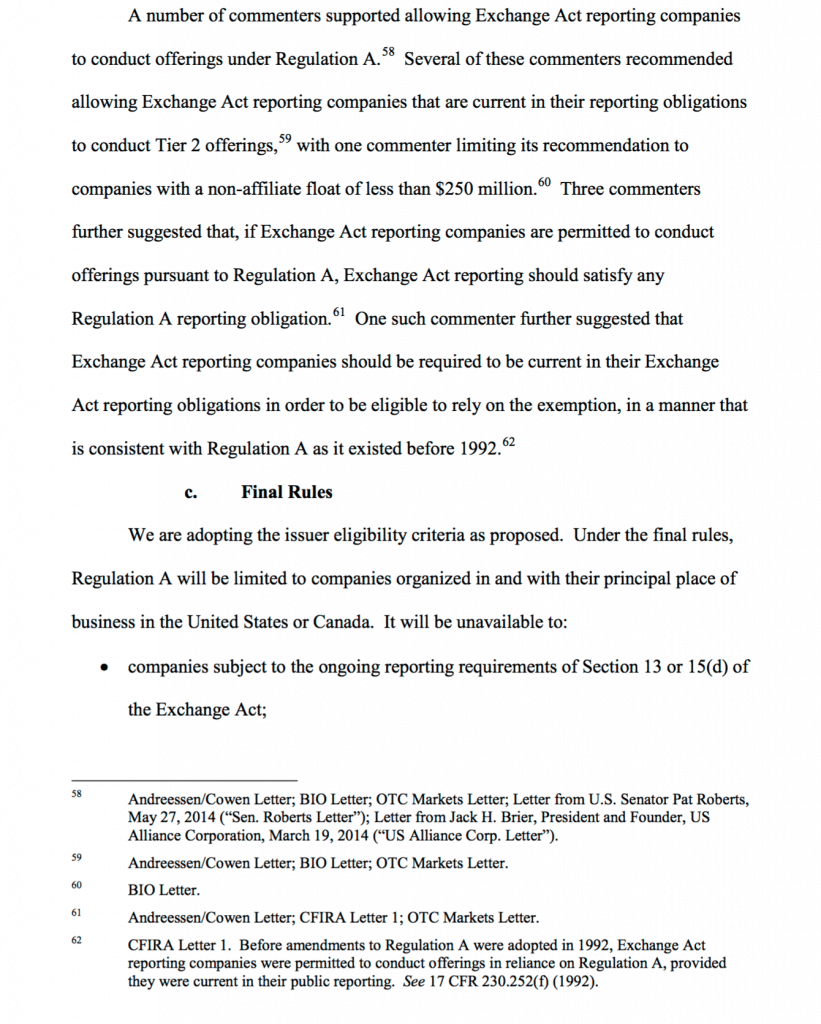
The entire rules from which the above excerpt was taken can be seen in the full document on the SEC's website. In addition, several local states pushed back as fully reporting SEC companies are regulated on a state level as well, and including them in the Tier 2 part of Regulation A would have required the necessary legislation and laws for them to be able to comply across all states under tier 2.
This may have been a key reason why the SEC reporting firms were initially excluded from the Reg A offering, even though they may be included later as the market evolves, as efforts such as OTC Markets petition are underway, as explained to Finance Magnates by people familiar.
Comments for inclusion
Two paragraphs from OTC Markets, noted in its petition, emphasize the benefits of an inclusion of SEC-reporting firms while noting that the decision to exclude them initially wasn't aligned with the JOBS Act mandate, as per the following related excerpt from the filing:
'The Regulation A+ Final Rules limit issuer eligibility based, among other things, upon whether a company is subject to the reporting requirements of Section 13(a) or 15(d) of the Exchange Act. The Commission noted that this was consistent with traditional Regulation A rules, and that it would prefer to wait until the Regulation A+ market developed before expanding the scope of issuers authorized to conduct Regulation A+ offerings.
The Commission’s decision to exclude otherwise qualified companies that meet the high disclosure requirements of full SEC reporting from Regulation A+ is counterintuitive, and inconsistent with the JOBS Act mandate to expand avenues of capital formation for small companies. Congress and the Commission developed Regulation A+ to revitalize an important offering exemption for small companies. Limiting the scope of Regulation A+ solely because it excluded fully SEC reporting companies in its prior, seldom used form, does not give effect to the Congressional intent behind the JOBS Act.'
Fighting to extend Reg. A+ to the thousands of smaller companies that have invested the time and resources in being fully SEC reporting is imperative, not only to these companies but to the American economy as a whole.
It's been less than a month since the tail-end of the JOBS Act went fully into effect in the United States on May 16th for crowdfunding, after rules were finalized last year for Regulation A+, and a petition was filed with the Securities and Exchange Commission (SEC) from OTC Markets Group Inc.
The petition requests further amendments that would enable SEC-reporting firms to participate in this new form of raising capital that went into effect last June and which could be a big part of the future for US capital markets amid changes in consumer trends and fintech convergences.
Currently, Regulation A+ under Title IV of the JOBS Act allows companies to raise up to either $20 million or $50 million, under tier 1 and tier 2 respectively, from individual investors, yet the guidelines exclude SEC reporting firms that already meet the high standards of SEC filings and related disclosures.
Regulation A+ securities offerings are tailor-made for smaller companies and investment banks to utilize technology to transparently offer shares online the way Amazon sells books.
Through its OTC Link LLC Alternative Trading System (ATS) regulated by the SEC, OTC Markets Group Inc. is a leading operator of trading venues including its OTCQX, OTCQB, and Pink markets which are home to 10,000 traded securities, with over $200 billion in volumes according to its prior annual report.
"Regulation A+ securities offerings are tailor-made for smaller companies and investment banks to utilize technology to transparently offer shares online the way Amazon sells books. By excluding SEC reporting companies, the SEC missed a critical opportunity to expand access to capital, drive costs lower and support small company growth," said R. Cromwell Coulson, president and CEO of OTC Markets Group, commenting in a corporate statement.
Mr. Coulson added: "Online capital raising better serves small public companies and their investors as opposed to the traditional opaque, private offering processes that are restricted to the wealthy and well connected. Fighting to extend Reg. A+ to the thousands of smaller companies that have invested the time and resources in being fully SEC reporting is imperative, not only to these companies but to the American economy as a whole. We must modernize securities regulations to embrace the efficiencies of the internet age."
Completely new industry
R. Cromwell Coulson Source: LinkedIn
Finance Magnates spoke with OTC Markets' CEO around the time of this article, who explained: "The great thing about Congress' foresight with the JOBS Act was that they created a lot of different optionality around capital raising that can be empowered by technology. Online capital raising is a completely new industry, and like every new industry - their product is not really developed yet."
He added: "The big opportunity now with fintech is in sales and distribution," and how, "we can see, that with small companies - primarily owned by individual investors - small investors primarily trade small companies, through their online brokers. Why can't they directly invest in those companies while raising capital through an online process? We are not there yet, but we will be. At OTC Markets, we've invested a significant effort ensuring that investors, both through online brokers and institutional brokers, have a great informational and trading experience.”
"Our goal is to educate the community on the issue and provide the intellectual leadership so we can move securities law forward to fit the internet age so investors and companies can realize the informational and transactional benefits in online capital raising," and implied regarding the petition, "how it takes place, whether the SEC does it, or whether congress makes them do it, we are agnostic, we haven't had any feedback to suggest it's a bad idea."
US capital markets
Thanks to increased competition and economic prosperity over the years, despite market crises, the US capital markets are increasingly sought by companies both domestic and foreign-based. Major exchanges like Nasdaq or NYSE and regional exchanges have high thresholds and listing requirements where small startups or mom-and-pop operations cannot afford or even qualify to go public anymore - compared to how it was 20 years ago. Nonetheless, companies still dream of going public on such exchanges and some continually take action towards that vision.
For this reason, venues like those offered via OTC Markets ATS provide a starting point, and accordingly the company has pioneered its experience in working with smaller-to-mid size firms - such as those that the Regulation A rules could accommodate in addition to the use of the new rules by larger companies listed on national exchanges.
Nearly two hundred companies that had initially become listed through its venues - as a starting point for their initial ventures - were able to later graduate to become listed at a National Market Systems (NMS) proving the usefulness of OTC Markets' venues as a stepping stone for smaller companies before they are able to go public on a traditional exchange.
SEC petition on Reg A
Tier one doesn't have the blue-sky pre-emption which means that it's limited on a state-by-state basis, whereas tier two provides for a national level offering under federal law- such as raising capital online in a crowdfunded manner, versus a tier 1 local offering.
It's important to note that companies raising funds via Regulation A - do indeed have reporting requirements with the SEC but they are purposefully lighter than the reporting obligations that fully reporting SEC firms have.
While this is designed to make it easier for companies to raise funds under Regulation A, it also leaves out firms that have already undergone full reporting requirements as SEC registered companies.
Fully reporting firms excluded
The thousands of firms fully reporting with the SEC are excluded from participating in this new form of capital raising - which may soon take place in the future in the same manner people trade merchandise or shop online.
Fintech innovations coupled with rules for online capital raising such as Reg A, and changes in consumption trends that are already evident in how investors and traders use financial products, point to a different future for a key part of financial markets - investing in securities.
Indeed, consumers want to do their own research nowadays and rely on reviews and online aggregated data - and this appears to be the thinking behind Congress' approach of providing so many options around capital raising, yet much of this is still newly emerging and ripe to evolve as companies start to raise capital under Regulation A amid the petition this week.
Change in consumer behavior
For various industries, for example, companies could connect with the same people that they are providing their services to, whether it's a bank, a multi-billion dollar pharmaceutical firm, or a brand-new startup company. If included, many SEC reporting firms could participate in such online capital raising regardless of their market capitalization as they could raise up to $50 million per year via the internet.
As transparency and disclosures could be enhanced in an online offering, the market's ability to right-size and price companies correctly could also improve, adding to market efficiency, compared with traditionally opaque details and pre-IPO documents that are only available to the wealthy and elite before a firm goes public.
The entire rules from which the above excerpt was taken can be seen in the full document on the SEC's website. In addition, several local states pushed back as fully reporting SEC companies are regulated on a state level as well, and including them in the Tier 2 part of Regulation A would have required the necessary legislation and laws for them to be able to comply across all states under tier 2.
This may have been a key reason why the SEC reporting firms were initially excluded from the Reg A offering, even though they may be included later as the market evolves, as efforts such as OTC Markets petition are underway, as explained to Finance Magnates by people familiar.
Comments for inclusion
Two paragraphs from OTC Markets, noted in its petition, emphasize the benefits of an inclusion of SEC-reporting firms while noting that the decision to exclude them initially wasn't aligned with the JOBS Act mandate, as per the following related excerpt from the filing:
'The Regulation A+ Final Rules limit issuer eligibility based, among other things, upon whether a company is subject to the reporting requirements of Section 13(a) or 15(d) of the Exchange Act. The Commission noted that this was consistent with traditional Regulation A rules, and that it would prefer to wait until the Regulation A+ market developed before expanding the scope of issuers authorized to conduct Regulation A+ offerings.
The Commission’s decision to exclude otherwise qualified companies that meet the high disclosure requirements of full SEC reporting from Regulation A+ is counterintuitive, and inconsistent with the JOBS Act mandate to expand avenues of capital formation for small companies. Congress and the Commission developed Regulation A+ to revitalize an important offering exemption for small companies. Limiting the scope of Regulation A+ solely because it excluded fully SEC reporting companies in its prior, seldom used form, does not give effect to the Congressional intent behind the JOBS Act.'
Fighting to extend Reg. A+ to the thousands of smaller companies that have invested the time and resources in being fully SEC reporting is imperative, not only to these companies but to the American economy as a whole.
Gemini Accounts in the UK, EU, and Australia Can Be Transferred to eToro Ahead of Closure
Featured Videos
Hannah Hill on Innovation, Branding & Award-Winning Technology | Executive Interview | AXI
Hannah Hill on Innovation, Branding & Award-Winning Technology | Executive Interview | AXI
Hannah Hill on Innovation, Branding & Award-Winning Technology | Executive Interview | AXI
Hannah Hill on Innovation, Branding & Award-Winning Technology | Executive Interview | AXI
Recorded live at FMLS:25, this executive interview features Hannah Hill, Head of Brand and Sponsorship at AXI, in conversation with Finance Magnates, following AXI’s win for Most Innovative Broker of the Year 2025.
In this wide-ranging discussion, Hannah shares insights on:
🔹What winning the Finance Magnates award means for AXI’s credibility and innovation
🔹How the launch of AXI Select, the capital allocation program, is redefining industry standards
🔹The development and rollout of the AXI trading app across multiple markets
🔹Driving brand evolution alongside technological advancements
🔹Encouraging and recognizing teams behind the scenes
🔹The role of marketing, content, and social media in building product awareness
Hannah explains why standout products, strategic branding, and a focus on innovation are key to growing visibility and staying ahead in a competitive brokerage landscape.
🏆 Award Highlight: Most Innovative Broker of the Year 2025
👉 Subscribe to Finance Magnates for more executive interviews, industry insights, and exclusive coverage from the world’s leading financial events.
#FMLS25 #FinanceMagnates #MostInnovativeBroker #TradingTechnology #FinTech #Brokerage #ExecutiveInterview #AXI
Recorded live at FMLS:25, this executive interview features Hannah Hill, Head of Brand and Sponsorship at AXI, in conversation with Finance Magnates, following AXI’s win for Most Innovative Broker of the Year 2025.
In this wide-ranging discussion, Hannah shares insights on:
🔹What winning the Finance Magnates award means for AXI’s credibility and innovation
🔹How the launch of AXI Select, the capital allocation program, is redefining industry standards
🔹The development and rollout of the AXI trading app across multiple markets
🔹Driving brand evolution alongside technological advancements
🔹Encouraging and recognizing teams behind the scenes
🔹The role of marketing, content, and social media in building product awareness
Hannah explains why standout products, strategic branding, and a focus on innovation are key to growing visibility and staying ahead in a competitive brokerage landscape.
🏆 Award Highlight: Most Innovative Broker of the Year 2025
👉 Subscribe to Finance Magnates for more executive interviews, industry insights, and exclusive coverage from the world’s leading financial events.
#FMLS25 #FinanceMagnates #MostInnovativeBroker #TradingTechnology #FinTech #Brokerage #ExecutiveInterview #AXI
Recorded live at FMLS:25, this executive interview features Hannah Hill, Head of Brand and Sponsorship at AXI, in conversation with Finance Magnates, following AXI’s win for Most Innovative Broker of the Year 2025.
In this wide-ranging discussion, Hannah shares insights on:
🔹What winning the Finance Magnates award means for AXI’s credibility and innovation
🔹How the launch of AXI Select, the capital allocation program, is redefining industry standards
🔹The development and rollout of the AXI trading app across multiple markets
🔹Driving brand evolution alongside technological advancements
🔹Encouraging and recognizing teams behind the scenes
🔹The role of marketing, content, and social media in building product awareness
Hannah explains why standout products, strategic branding, and a focus on innovation are key to growing visibility and staying ahead in a competitive brokerage landscape.
🏆 Award Highlight: Most Innovative Broker of the Year 2025
👉 Subscribe to Finance Magnates for more executive interviews, industry insights, and exclusive coverage from the world’s leading financial events.
#FMLS25 #FinanceMagnates #MostInnovativeBroker #TradingTechnology #FinTech #Brokerage #ExecutiveInterview #AXI
Recorded live at FMLS:25, this executive interview features Hannah Hill, Head of Brand and Sponsorship at AXI, in conversation with Finance Magnates, following AXI’s win for Most Innovative Broker of the Year 2025.
In this wide-ranging discussion, Hannah shares insights on:
🔹What winning the Finance Magnates award means for AXI’s credibility and innovation
🔹How the launch of AXI Select, the capital allocation program, is redefining industry standards
🔹The development and rollout of the AXI trading app across multiple markets
🔹Driving brand evolution alongside technological advancements
🔹Encouraging and recognizing teams behind the scenes
🔹The role of marketing, content, and social media in building product awareness
Hannah explains why standout products, strategic branding, and a focus on innovation are key to growing visibility and staying ahead in a competitive brokerage landscape.
🏆 Award Highlight: Most Innovative Broker of the Year 2025
👉 Subscribe to Finance Magnates for more executive interviews, industry insights, and exclusive coverage from the world’s leading financial events.
#FMLS25 #FinanceMagnates #MostInnovativeBroker #TradingTechnology #FinTech #Brokerage #ExecutiveInterview #AXI
Executive Interview | Dor Eligula | Co-Founder & Chief Business Officer, BridgeWise | FMLS:25
Executive Interview | Dor Eligula | Co-Founder & Chief Business Officer, BridgeWise | FMLS:25
Executive Interview | Dor Eligula | Co-Founder & Chief Business Officer, BridgeWise | FMLS:25
Executive Interview | Dor Eligula | Co-Founder & Chief Business Officer, BridgeWise | FMLS:25
Executive Interview | Dor Eligula | Co-Founder & Chief Business Officer, BridgeWise | FMLS:25
Executive Interview | Dor Eligula | Co-Founder & Chief Business Officer, BridgeWise | FMLS:25
In this session, Jonathan Fine form Ultimate Group speaks with Dor Eligula from Bridgewise, a fast-growing AI-powered research and analytics firm supporting brokers and exchanges worldwide.
We start with Dor’s reaction to the Summit and then move to broker growth and the quick wins brokers often overlook. Dor shares where he sees “blue ocean” growth across Asian markets and how local client behaviour shapes demand.
We also discuss the rollout of AI across investment research. Dor gives real examples of how automation and human judgment meet at Bridgewise — including moments when analysts corrected AI output, and times when AI prevented an error.
We close with a practical question: how retail investors can actually use AI without falling into common traps.
In this session, Jonathan Fine form Ultimate Group speaks with Dor Eligula from Bridgewise, a fast-growing AI-powered research and analytics firm supporting brokers and exchanges worldwide.
We start with Dor’s reaction to the Summit and then move to broker growth and the quick wins brokers often overlook. Dor shares where he sees “blue ocean” growth across Asian markets and how local client behaviour shapes demand.
We also discuss the rollout of AI across investment research. Dor gives real examples of how automation and human judgment meet at Bridgewise — including moments when analysts corrected AI output, and times when AI prevented an error.
We close with a practical question: how retail investors can actually use AI without falling into common traps.
In this session, Jonathan Fine form Ultimate Group speaks with Dor Eligula from Bridgewise, a fast-growing AI-powered research and analytics firm supporting brokers and exchanges worldwide.
We start with Dor’s reaction to the Summit and then move to broker growth and the quick wins brokers often overlook. Dor shares where he sees “blue ocean” growth across Asian markets and how local client behaviour shapes demand.
We also discuss the rollout of AI across investment research. Dor gives real examples of how automation and human judgment meet at Bridgewise — including moments when analysts corrected AI output, and times when AI prevented an error.
We close with a practical question: how retail investors can actually use AI without falling into common traps.
In this session, Jonathan Fine form Ultimate Group speaks with Dor Eligula from Bridgewise, a fast-growing AI-powered research and analytics firm supporting brokers and exchanges worldwide.
We start with Dor’s reaction to the Summit and then move to broker growth and the quick wins brokers often overlook. Dor shares where he sees “blue ocean” growth across Asian markets and how local client behaviour shapes demand.
We also discuss the rollout of AI across investment research. Dor gives real examples of how automation and human judgment meet at Bridgewise — including moments when analysts corrected AI output, and times when AI prevented an error.
We close with a practical question: how retail investors can actually use AI without falling into common traps.
In this session, Jonathan Fine form Ultimate Group speaks with Dor Eligula from Bridgewise, a fast-growing AI-powered research and analytics firm supporting brokers and exchanges worldwide.
We start with Dor’s reaction to the Summit and then move to broker growth and the quick wins brokers often overlook. Dor shares where he sees “blue ocean” growth across Asian markets and how local client behaviour shapes demand.
We also discuss the rollout of AI across investment research. Dor gives real examples of how automation and human judgment meet at Bridgewise — including moments when analysts corrected AI output, and times when AI prevented an error.
We close with a practical question: how retail investors can actually use AI without falling into common traps.
In this session, Jonathan Fine form Ultimate Group speaks with Dor Eligula from Bridgewise, a fast-growing AI-powered research and analytics firm supporting brokers and exchanges worldwide.
We start with Dor’s reaction to the Summit and then move to broker growth and the quick wins brokers often overlook. Dor shares where he sees “blue ocean” growth across Asian markets and how local client behaviour shapes demand.
We also discuss the rollout of AI across investment research. Dor gives real examples of how automation and human judgment meet at Bridgewise — including moments when analysts corrected AI output, and times when AI prevented an error.
We close with a practical question: how retail investors can actually use AI without falling into common traps.
Brendan Callan joined us fresh off the Summit’s most anticipated debate: “Is Prop Trading Good for the Industry?” Brendan argued against the motion — and the audience voted him the winner.
In this interview, Brendan explains the reasoning behind his position. He walks through the message he believes many firms avoid: that the current prop trading model is too dependent on fees, too loose on risk, and too confusing for retail audiences.
We discuss why he thinks the model grew fast, why it may run into walls, and what he believes is needed for a cleaner, more responsible version of prop trading.
This is Brendan at his frankest — sharp, grounded, and very clear about what changes are overdue.
Brendan Callan joined us fresh off the Summit’s most anticipated debate: “Is Prop Trading Good for the Industry?” Brendan argued against the motion — and the audience voted him the winner.
In this interview, Brendan explains the reasoning behind his position. He walks through the message he believes many firms avoid: that the current prop trading model is too dependent on fees, too loose on risk, and too confusing for retail audiences.
We discuss why he thinks the model grew fast, why it may run into walls, and what he believes is needed for a cleaner, more responsible version of prop trading.
This is Brendan at his frankest — sharp, grounded, and very clear about what changes are overdue.
Brendan Callan joined us fresh off the Summit’s most anticipated debate: “Is Prop Trading Good for the Industry?” Brendan argued against the motion — and the audience voted him the winner.
In this interview, Brendan explains the reasoning behind his position. He walks through the message he believes many firms avoid: that the current prop trading model is too dependent on fees, too loose on risk, and too confusing for retail audiences.
We discuss why he thinks the model grew fast, why it may run into walls, and what he believes is needed for a cleaner, more responsible version of prop trading.
This is Brendan at his frankest — sharp, grounded, and very clear about what changes are overdue.
Brendan Callan joined us fresh off the Summit’s most anticipated debate: “Is Prop Trading Good for the Industry?” Brendan argued against the motion — and the audience voted him the winner.
In this interview, Brendan explains the reasoning behind his position. He walks through the message he believes many firms avoid: that the current prop trading model is too dependent on fees, too loose on risk, and too confusing for retail audiences.
We discuss why he thinks the model grew fast, why it may run into walls, and what he believes is needed for a cleaner, more responsible version of prop trading.
This is Brendan at his frankest — sharp, grounded, and very clear about what changes are overdue.
Brendan Callan joined us fresh off the Summit’s most anticipated debate: “Is Prop Trading Good for the Industry?” Brendan argued against the motion — and the audience voted him the winner.
In this interview, Brendan explains the reasoning behind his position. He walks through the message he believes many firms avoid: that the current prop trading model is too dependent on fees, too loose on risk, and too confusing for retail audiences.
We discuss why he thinks the model grew fast, why it may run into walls, and what he believes is needed for a cleaner, more responsible version of prop trading.
This is Brendan at his frankest — sharp, grounded, and very clear about what changes are overdue.
Brendan Callan joined us fresh off the Summit’s most anticipated debate: “Is Prop Trading Good for the Industry?” Brendan argued against the motion — and the audience voted him the winner.
In this interview, Brendan explains the reasoning behind his position. He walks through the message he believes many firms avoid: that the current prop trading model is too dependent on fees, too loose on risk, and too confusing for retail audiences.
We discuss why he thinks the model grew fast, why it may run into walls, and what he believes is needed for a cleaner, more responsible version of prop trading.
This is Brendan at his frankest — sharp, grounded, and very clear about what changes are overdue.
Elina Pedersen on Growth, Stability & Ultra-Low Latency | Executive Interview | Your Bourse
Elina Pedersen on Growth, Stability & Ultra-Low Latency | Executive Interview | Your Bourse
Elina Pedersen on Growth, Stability & Ultra-Low Latency | Executive Interview | Your Bourse
Elina Pedersen on Growth, Stability & Ultra-Low Latency | Executive Interview | Your Bourse
Elina Pedersen on Growth, Stability & Ultra-Low Latency | Executive Interview | Your Bourse
Elina Pedersen on Growth, Stability & Ultra-Low Latency | Executive Interview | Your Bourse
Recorded live at FMLS:25 London, this executive interview features Elina Pedersen, in conversation with Finance Magnates, following her company’s win for Best Connectivity 2025.
🔹In this wide-ranging discussion, Elina shares insights on:
🔹What winning a Finance Magnates award means for credibility and reputation
🔹How broker demand for stability and reliability is driving rapid growth
🔹The launch of a new trade server enabling flexible front-end integrations
🔹Why ultra-low latency must be proven with data, not buzzwords
🔹Common mistakes brokers make when scaling globally
🔹Educating the industry through a newly launched Dealers Academy
🔹Where AI fits into trading infrastructure and where it doesn’t
Elina explains why resilient back-end infrastructure, deep client partnerships, and disciplined focus are critical for brokers looking to scale sustainably in today’s competitive market.
🏆 Award Highlight: Best Connectivity 2025
👉 Subscribe to Finance Magnates for more executive interviews, industry insights, and exclusive coverage from the world’s leading financial events.
#FMLS25 #FinanceMagnates #BestConnectivity #TradingTechnology #UltraLowLatency #FinTech #Brokerage #ExecutiveInterview
Recorded live at FMLS:25 London, this executive interview features Elina Pedersen, in conversation with Finance Magnates, following her company’s win for Best Connectivity 2025.
🔹In this wide-ranging discussion, Elina shares insights on:
🔹What winning a Finance Magnates award means for credibility and reputation
🔹How broker demand for stability and reliability is driving rapid growth
🔹The launch of a new trade server enabling flexible front-end integrations
🔹Why ultra-low latency must be proven with data, not buzzwords
🔹Common mistakes brokers make when scaling globally
🔹Educating the industry through a newly launched Dealers Academy
🔹Where AI fits into trading infrastructure and where it doesn’t
Elina explains why resilient back-end infrastructure, deep client partnerships, and disciplined focus are critical for brokers looking to scale sustainably in today’s competitive market.
🏆 Award Highlight: Best Connectivity 2025
👉 Subscribe to Finance Magnates for more executive interviews, industry insights, and exclusive coverage from the world’s leading financial events.
#FMLS25 #FinanceMagnates #BestConnectivity #TradingTechnology #UltraLowLatency #FinTech #Brokerage #ExecutiveInterview
Recorded live at FMLS:25 London, this executive interview features Elina Pedersen, in conversation with Finance Magnates, following her company’s win for Best Connectivity 2025.
🔹In this wide-ranging discussion, Elina shares insights on:
🔹What winning a Finance Magnates award means for credibility and reputation
🔹How broker demand for stability and reliability is driving rapid growth
🔹The launch of a new trade server enabling flexible front-end integrations
🔹Why ultra-low latency must be proven with data, not buzzwords
🔹Common mistakes brokers make when scaling globally
🔹Educating the industry through a newly launched Dealers Academy
🔹Where AI fits into trading infrastructure and where it doesn’t
Elina explains why resilient back-end infrastructure, deep client partnerships, and disciplined focus are critical for brokers looking to scale sustainably in today’s competitive market.
🏆 Award Highlight: Best Connectivity 2025
👉 Subscribe to Finance Magnates for more executive interviews, industry insights, and exclusive coverage from the world’s leading financial events.
#FMLS25 #FinanceMagnates #BestConnectivity #TradingTechnology #UltraLowLatency #FinTech #Brokerage #ExecutiveInterview
Recorded live at FMLS:25 London, this executive interview features Elina Pedersen, in conversation with Finance Magnates, following her company’s win for Best Connectivity 2025.
🔹In this wide-ranging discussion, Elina shares insights on:
🔹What winning a Finance Magnates award means for credibility and reputation
🔹How broker demand for stability and reliability is driving rapid growth
🔹The launch of a new trade server enabling flexible front-end integrations
🔹Why ultra-low latency must be proven with data, not buzzwords
🔹Common mistakes brokers make when scaling globally
🔹Educating the industry through a newly launched Dealers Academy
🔹Where AI fits into trading infrastructure and where it doesn’t
Elina explains why resilient back-end infrastructure, deep client partnerships, and disciplined focus are critical for brokers looking to scale sustainably in today’s competitive market.
🏆 Award Highlight: Best Connectivity 2025
👉 Subscribe to Finance Magnates for more executive interviews, industry insights, and exclusive coverage from the world’s leading financial events.
#FMLS25 #FinanceMagnates #BestConnectivity #TradingTechnology #UltraLowLatency #FinTech #Brokerage #ExecutiveInterview
Recorded live at FMLS:25 London, this executive interview features Elina Pedersen, in conversation with Finance Magnates, following her company’s win for Best Connectivity 2025.
🔹In this wide-ranging discussion, Elina shares insights on:
🔹What winning a Finance Magnates award means for credibility and reputation
🔹How broker demand for stability and reliability is driving rapid growth
🔹The launch of a new trade server enabling flexible front-end integrations
🔹Why ultra-low latency must be proven with data, not buzzwords
🔹Common mistakes brokers make when scaling globally
🔹Educating the industry through a newly launched Dealers Academy
🔹Where AI fits into trading infrastructure and where it doesn’t
Elina explains why resilient back-end infrastructure, deep client partnerships, and disciplined focus are critical for brokers looking to scale sustainably in today’s competitive market.
🏆 Award Highlight: Best Connectivity 2025
👉 Subscribe to Finance Magnates for more executive interviews, industry insights, and exclusive coverage from the world’s leading financial events.
#FMLS25 #FinanceMagnates #BestConnectivity #TradingTechnology #UltraLowLatency #FinTech #Brokerage #ExecutiveInterview
Recorded live at FMLS:25 London, this executive interview features Elina Pedersen, in conversation with Finance Magnates, following her company’s win for Best Connectivity 2025.
🔹In this wide-ranging discussion, Elina shares insights on:
🔹What winning a Finance Magnates award means for credibility and reputation
🔹How broker demand for stability and reliability is driving rapid growth
🔹The launch of a new trade server enabling flexible front-end integrations
🔹Why ultra-low latency must be proven with data, not buzzwords
🔹Common mistakes brokers make when scaling globally
🔹Educating the industry through a newly launched Dealers Academy
🔹Where AI fits into trading infrastructure and where it doesn’t
Elina explains why resilient back-end infrastructure, deep client partnerships, and disciplined focus are critical for brokers looking to scale sustainably in today’s competitive market.
🏆 Award Highlight: Best Connectivity 2025
👉 Subscribe to Finance Magnates for more executive interviews, industry insights, and exclusive coverage from the world’s leading financial events.
#FMLS25 #FinanceMagnates #BestConnectivity #TradingTechnology #UltraLowLatency #FinTech #Brokerage #ExecutiveInterview
In this video, we take an in-depth look at @BlueberryMarketsForex , a forex and CFD broker operating since 2016, offering access to multiple trading platforms, over 1,000 instruments, and flexible account types for different trading styles.
We break down Blueberry’s regulatory structure, including its Australian Financial Services License (AFSL), as well as its authorisation and registrations in other jurisdictions. The review also covers supported platforms such as MetaTrader 4, MetaTrader 5, cTrader, TradingView, Blueberry.X, and web-based trading.
You’ll learn about available instruments across forex, commodities, indices, share CFDs, and crypto CFDs, along with leverage options, minimum and maximum trade sizes, and how Blueberry structures its Standard and Raw accounts.
We also explain spreads, commissions, swap rates, swap-free account availability, funding and withdrawal methods, processing times, and what traders can expect from customer support and additional services.
Watch the full review to see whether Blueberry’s trading setup aligns with your experience level, strategy, and risk tolerance.
📣 Stay up to date with the latest in finance and trading. Follow Finance Magnates for industry news, insights, and global event coverage.
Connect with us:
🔗 LinkedIn: /financemagnates
👍 Facebook: /financemagnates
📸 Instagram: https://www.instagram.com/financemagnates
🐦 X: https://x.com/financemagnates
🎥 TikTok: https://www.tiktok.com/tag/financemagnates
▶️ YouTube: /@financemagnates_official
#Blueberry #BlueberryMarkets #BrokerReview #ForexBroker #CFDTrading #OnlineTrading #FinanceMagnates #TradingPlatforms #MarketInsights
In this video, we take an in-depth look at @BlueberryMarketsForex , a forex and CFD broker operating since 2016, offering access to multiple trading platforms, over 1,000 instruments, and flexible account types for different trading styles.
We break down Blueberry’s regulatory structure, including its Australian Financial Services License (AFSL), as well as its authorisation and registrations in other jurisdictions. The review also covers supported platforms such as MetaTrader 4, MetaTrader 5, cTrader, TradingView, Blueberry.X, and web-based trading.
You’ll learn about available instruments across forex, commodities, indices, share CFDs, and crypto CFDs, along with leverage options, minimum and maximum trade sizes, and how Blueberry structures its Standard and Raw accounts.
We also explain spreads, commissions, swap rates, swap-free account availability, funding and withdrawal methods, processing times, and what traders can expect from customer support and additional services.
Watch the full review to see whether Blueberry’s trading setup aligns with your experience level, strategy, and risk tolerance.
📣 Stay up to date with the latest in finance and trading. Follow Finance Magnates for industry news, insights, and global event coverage.
Connect with us:
🔗 LinkedIn: /financemagnates
👍 Facebook: /financemagnates
📸 Instagram: https://www.instagram.com/financemagnates
🐦 X: https://x.com/financemagnates
🎥 TikTok: https://www.tiktok.com/tag/financemagnates
▶️ YouTube: /@financemagnates_official
#Blueberry #BlueberryMarkets #BrokerReview #ForexBroker #CFDTrading #OnlineTrading #FinanceMagnates #TradingPlatforms #MarketInsights
In this video, we take an in-depth look at @BlueberryMarketsForex , a forex and CFD broker operating since 2016, offering access to multiple trading platforms, over 1,000 instruments, and flexible account types for different trading styles.
We break down Blueberry’s regulatory structure, including its Australian Financial Services License (AFSL), as well as its authorisation and registrations in other jurisdictions. The review also covers supported platforms such as MetaTrader 4, MetaTrader 5, cTrader, TradingView, Blueberry.X, and web-based trading.
You’ll learn about available instruments across forex, commodities, indices, share CFDs, and crypto CFDs, along with leverage options, minimum and maximum trade sizes, and how Blueberry structures its Standard and Raw accounts.
We also explain spreads, commissions, swap rates, swap-free account availability, funding and withdrawal methods, processing times, and what traders can expect from customer support and additional services.
Watch the full review to see whether Blueberry’s trading setup aligns with your experience level, strategy, and risk tolerance.
📣 Stay up to date with the latest in finance and trading. Follow Finance Magnates for industry news, insights, and global event coverage.
Connect with us:
🔗 LinkedIn: /financemagnates
👍 Facebook: /financemagnates
📸 Instagram: https://www.instagram.com/financemagnates
🐦 X: https://x.com/financemagnates
🎥 TikTok: https://www.tiktok.com/tag/financemagnates
▶️ YouTube: /@financemagnates_official
#Blueberry #BlueberryMarkets #BrokerReview #ForexBroker #CFDTrading #OnlineTrading #FinanceMagnates #TradingPlatforms #MarketInsights
In this video, we take an in-depth look at @BlueberryMarketsForex , a forex and CFD broker operating since 2016, offering access to multiple trading platforms, over 1,000 instruments, and flexible account types for different trading styles.
We break down Blueberry’s regulatory structure, including its Australian Financial Services License (AFSL), as well as its authorisation and registrations in other jurisdictions. The review also covers supported platforms such as MetaTrader 4, MetaTrader 5, cTrader, TradingView, Blueberry.X, and web-based trading.
You’ll learn about available instruments across forex, commodities, indices, share CFDs, and crypto CFDs, along with leverage options, minimum and maximum trade sizes, and how Blueberry structures its Standard and Raw accounts.
We also explain spreads, commissions, swap rates, swap-free account availability, funding and withdrawal methods, processing times, and what traders can expect from customer support and additional services.
Watch the full review to see whether Blueberry’s trading setup aligns with your experience level, strategy, and risk tolerance.
📣 Stay up to date with the latest in finance and trading. Follow Finance Magnates for industry news, insights, and global event coverage.
Connect with us:
🔗 LinkedIn: /financemagnates
👍 Facebook: /financemagnates
📸 Instagram: https://www.instagram.com/financemagnates
🐦 X: https://x.com/financemagnates
🎥 TikTok: https://www.tiktok.com/tag/financemagnates
▶️ YouTube: /@financemagnates_official
#Blueberry #BlueberryMarkets #BrokerReview #ForexBroker #CFDTrading #OnlineTrading #FinanceMagnates #TradingPlatforms #MarketInsights
In this video, we take an in-depth look at @BlueberryMarketsForex , a forex and CFD broker operating since 2016, offering access to multiple trading platforms, over 1,000 instruments, and flexible account types for different trading styles.
We break down Blueberry’s regulatory structure, including its Australian Financial Services License (AFSL), as well as its authorisation and registrations in other jurisdictions. The review also covers supported platforms such as MetaTrader 4, MetaTrader 5, cTrader, TradingView, Blueberry.X, and web-based trading.
You’ll learn about available instruments across forex, commodities, indices, share CFDs, and crypto CFDs, along with leverage options, minimum and maximum trade sizes, and how Blueberry structures its Standard and Raw accounts.
We also explain spreads, commissions, swap rates, swap-free account availability, funding and withdrawal methods, processing times, and what traders can expect from customer support and additional services.
Watch the full review to see whether Blueberry’s trading setup aligns with your experience level, strategy, and risk tolerance.
📣 Stay up to date with the latest in finance and trading. Follow Finance Magnates for industry news, insights, and global event coverage.
Connect with us:
🔗 LinkedIn: /financemagnates
👍 Facebook: /financemagnates
📸 Instagram: https://www.instagram.com/financemagnates
🐦 X: https://x.com/financemagnates
🎥 TikTok: https://www.tiktok.com/tag/financemagnates
▶️ YouTube: /@financemagnates_official
#Blueberry #BlueberryMarkets #BrokerReview #ForexBroker #CFDTrading #OnlineTrading #FinanceMagnates #TradingPlatforms #MarketInsights
In this video, we take an in-depth look at @BlueberryMarketsForex , a forex and CFD broker operating since 2016, offering access to multiple trading platforms, over 1,000 instruments, and flexible account types for different trading styles.
We break down Blueberry’s regulatory structure, including its Australian Financial Services License (AFSL), as well as its authorisation and registrations in other jurisdictions. The review also covers supported platforms such as MetaTrader 4, MetaTrader 5, cTrader, TradingView, Blueberry.X, and web-based trading.
You’ll learn about available instruments across forex, commodities, indices, share CFDs, and crypto CFDs, along with leverage options, minimum and maximum trade sizes, and how Blueberry structures its Standard and Raw accounts.
We also explain spreads, commissions, swap rates, swap-free account availability, funding and withdrawal methods, processing times, and what traders can expect from customer support and additional services.
Watch the full review to see whether Blueberry’s trading setup aligns with your experience level, strategy, and risk tolerance.
📣 Stay up to date with the latest in finance and trading. Follow Finance Magnates for industry news, insights, and global event coverage.
Connect with us:
🔗 LinkedIn: /financemagnates
👍 Facebook: /financemagnates
📸 Instagram: https://www.instagram.com/financemagnates
🐦 X: https://x.com/financemagnates
🎥 TikTok: https://www.tiktok.com/tag/financemagnates
▶️ YouTube: /@financemagnates_official
#Blueberry #BlueberryMarkets #BrokerReview #ForexBroker #CFDTrading #OnlineTrading #FinanceMagnates #TradingPlatforms #MarketInsights