The SEC adopted the final rules and forms on October 30, 2015, implementing the new Section 4(a)(6) of the Securities Act of 1933, as amended (the "Securities Act"), allowing issuers to sell securities to the public under certain circumstances without registering such securities with the SEC. But what will these new rules mean for small investors?
Basically, anyone will be able to invest, but given the risks involved by investing in early stage companies, there is an investment limit which depends on your net worth and annual income.
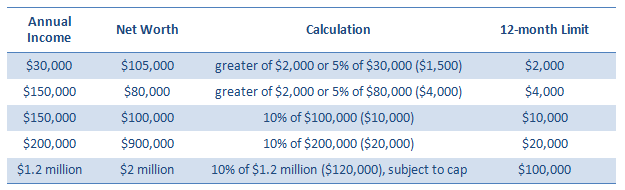
- If either your net worth or your annual income is < $100,000, then you can invest, in any 12 month period, up to the greater of either $2,000 or 5% of the lesser of your annual income or net worth
- If both your annual income and your net worth are = or > than $100,000, then you can invest, in any 12 month period, up to 10% of annual income or net worth, whichever is lesser. In any case you can't exceed $100,000 invested per year.
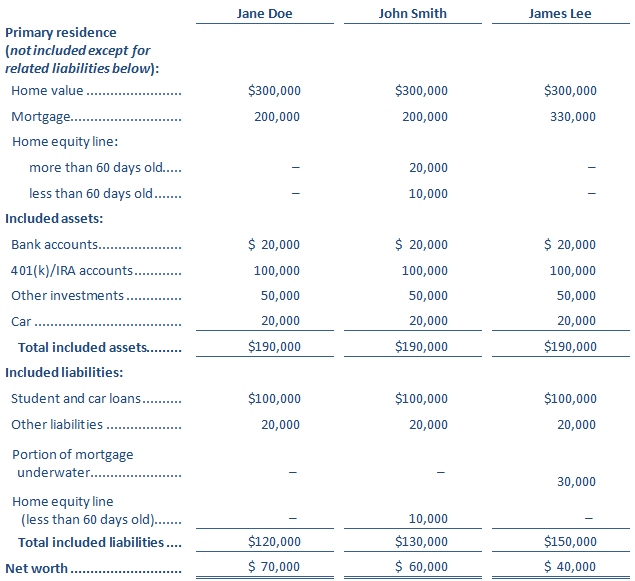
In order to calculate your net worth you should add all your assets and subtract all your liabilities. If you calculate your income or assets jointly with your spouse, each of your investments together cannot exceed the limit that would apply to an individual investor.
Examples of net worth calculations, in order to determine the investment limits, are showed in the following table:
Making an investment in a crowdfunding offering will be very easy. It will be just needed to open an account with the crowdfunding intermediary (broker-dealer or funding portal ).
Even if it's a great opportunity to invest early on in a promising startup, there are various risks that you should consider when you place your money in early stage ventures. The main risks are listed below:
1. This is a speculative investment and you should be able to afford to lose the entire amount invested.
2. It's an illiquid investment, as you will be limited in your ability to resell your investment for the first year. You may have to locate an interested buyer in order to resell your crowdfunded investment.
3. There are cancellation restrictions, but there are up to 48 hours prior to the end of the offer period to cancel your investment commitment for any reason.
4. The valuation of private companies is particularly difficult, and there is the risk to overpay the percentage of equity that you receive.
5. A part of your investment may be used as compensation of the company's employees, including its management.
6. As it happens with other investments, there is no guarantee that crowdfunding investments will be immune from fraud.
7. No early-stage investors, as for example angel investors and venture capital firms, can translate into a lack of professional guidance.
8. The required financial disclosure is limited compared to public listed companies.
This last point, about the limited disclosure required for a private company compared to a publicly listed company, is one of the main differences between a crowdfunding investor and a shareholder in a publicly traded company.
Public listed companies are generally required to disclose information about their performances every quarter, while private companies raising money through crowdfunding are required to disclose the results of their operations and financial statements on an annual basis. All the persons representing the company must identify themselves, and broker-dealers/funding portals are required to have transparent communication channels to allow the investors to discuss the pros and cons of an investment opportunity, as well as be able to ask questions directly to the management of the company.
Another big difference, in the points listed above, is the illiquidity of the shares you buy. You cannot resell your shares for the first year unless the shares are transferred:
- to the company that issued the securities;
- to an accredited investor;
- to a family member;
- in connection with your death or divorce or other similar circumstance;
- to a trust controlled by you or a trust created for the benefit of a family member;
- as part of an offering registered with the SEC.
Even if there are requirements and risks that you should think about when you consider investing your money through equity crowdfunding, the investment could be definitely worth it. E-Car Club, the UK's first entirely electric car sharing club for businesses and communities, is one of the most successful case so far, as the 63 investors which helped the company to raise £100,000 in 2013 have received a "multiple return" on their investment following the sale of the business to Europcar in July 2015.
Many more exits with big returns are expected in the year ahead, are you ready to place your bets?
The SEC adopted the final rules and forms on October 30, 2015, implementing the new Section 4(a)(6) of the Securities Act of 1933, as amended (the "Securities Act"), allowing issuers to sell securities to the public under certain circumstances without registering such securities with the SEC. But what will these new rules mean for small investors?
Basically, anyone will be able to invest, but given the risks involved by investing in early stage companies, there is an investment limit which depends on your net worth and annual income.
- If either your net worth or your annual income is < $100,000, then you can invest, in any 12 month period, up to the greater of either $2,000 or 5% of the lesser of your annual income or net worth
- If both your annual income and your net worth are = or > than $100,000, then you can invest, in any 12 month period, up to 10% of annual income or net worth, whichever is lesser. In any case you can't exceed $100,000 invested per year.
In order to calculate your net worth you should add all your assets and subtract all your liabilities. If you calculate your income or assets jointly with your spouse, each of your investments together cannot exceed the limit that would apply to an individual investor.
Examples of net worth calculations, in order to determine the investment limits, are showed in the following table:
Making an investment in a crowdfunding offering will be very easy. It will be just needed to open an account with the crowdfunding intermediary (broker-dealer or funding portal ).
Even if it's a great opportunity to invest early on in a promising startup, there are various risks that you should consider when you place your money in early stage ventures. The main risks are listed below:
1. This is a speculative investment and you should be able to afford to lose the entire amount invested.
2. It's an illiquid investment, as you will be limited in your ability to resell your investment for the first year. You may have to locate an interested buyer in order to resell your crowdfunded investment.
3. There are cancellation restrictions, but there are up to 48 hours prior to the end of the offer period to cancel your investment commitment for any reason.
4. The valuation of private companies is particularly difficult, and there is the risk to overpay the percentage of equity that you receive.
5. A part of your investment may be used as compensation of the company's employees, including its management.
6. As it happens with other investments, there is no guarantee that crowdfunding investments will be immune from fraud.
7. No early-stage investors, as for example angel investors and venture capital firms, can translate into a lack of professional guidance.
8. The required financial disclosure is limited compared to public listed companies.
This last point, about the limited disclosure required for a private company compared to a publicly listed company, is one of the main differences between a crowdfunding investor and a shareholder in a publicly traded company.
Public listed companies are generally required to disclose information about their performances every quarter, while private companies raising money through crowdfunding are required to disclose the results of their operations and financial statements on an annual basis. All the persons representing the company must identify themselves, and broker-dealers/funding portals are required to have transparent communication channels to allow the investors to discuss the pros and cons of an investment opportunity, as well as be able to ask questions directly to the management of the company.
Another big difference, in the points listed above, is the illiquidity of the shares you buy. You cannot resell your shares for the first year unless the shares are transferred:
- to the company that issued the securities;
- to an accredited investor;
- to a family member;
- in connection with your death or divorce or other similar circumstance;
- to a trust controlled by you or a trust created for the benefit of a family member;
- as part of an offering registered with the SEC.
Even if there are requirements and risks that you should think about when you consider investing your money through equity crowdfunding, the investment could be definitely worth it. E-Car Club, the UK's first entirely electric car sharing club for businesses and communities, is one of the most successful case so far, as the 63 investors which helped the company to raise £100,000 in 2013 have received a "multiple return" on their investment following the sale of the business to Europcar in July 2015.
Many more exits with big returns are expected in the year ahead, are you ready to place your bets?
In this conversation, we sit down with Drew Niv, CSO at ATFX Connect and one of the most influential figures in modern FX.
We speak about market structure, the institutional view on liquidity, and the sharp rise of prop trading, a sector Drew has been commenting on in recent months. Drew explains why he once dismissed prop trading, why his view changed, and what he now thinks the model means for brokers, clients and risk managers.
We explore subscription-fee dependency, the high reneging rate, and the long-term challenge: how brokers can build a more stable and honest version of the model. Drew also talks about the traffic advantage standalone prop firms have built and why brokers may still win in the long run if they take the right approach.
In this conversation, we sit down with Drew Niv, CSO at ATFX Connect and one of the most influential figures in modern FX.
We speak about market structure, the institutional view on liquidity, and the sharp rise of prop trading, a sector Drew has been commenting on in recent months. Drew explains why he once dismissed prop trading, why his view changed, and what he now thinks the model means for brokers, clients and risk managers.
We explore subscription-fee dependency, the high reneging rate, and the long-term challenge: how brokers can build a more stable and honest version of the model. Drew also talks about the traffic advantage standalone prop firms have built and why brokers may still win in the long run if they take the right approach.
In this conversation, we sit down with Drew Niv, CSO at ATFX Connect and one of the most influential figures in modern FX.
We speak about market structure, the institutional view on liquidity, and the sharp rise of prop trading, a sector Drew has been commenting on in recent months. Drew explains why he once dismissed prop trading, why his view changed, and what he now thinks the model means for brokers, clients and risk managers.
We explore subscription-fee dependency, the high reneging rate, and the long-term challenge: how brokers can build a more stable and honest version of the model. Drew also talks about the traffic advantage standalone prop firms have built and why brokers may still win in the long run if they take the right approach.
In this conversation, we sit down with Drew Niv, CSO at ATFX Connect and one of the most influential figures in modern FX.
We speak about market structure, the institutional view on liquidity, and the sharp rise of prop trading, a sector Drew has been commenting on in recent months. Drew explains why he once dismissed prop trading, why his view changed, and what he now thinks the model means for brokers, clients and risk managers.
We explore subscription-fee dependency, the high reneging rate, and the long-term challenge: how brokers can build a more stable and honest version of the model. Drew also talks about the traffic advantage standalone prop firms have built and why brokers may still win in the long run if they take the right approach.
Executive Interview | Remonda Z. Kirketerp Møller| CEO & Founder Muinmos | FMLS:25
In this interview, Remonda Z. Kirketerp Møller, founder of Muinmos, breaks down the state of AI in regtech and what responsible adoption really looks like for brokers. We talk about rising fragmentation, the pressures around compliance accuracy, and why most firms are still in the early stages of AI maturity.
Ramanda also shares insights on regulator sandboxes, shifting expectations around accountability, and the current reality of MiCA licensing and passporting in Europe.
A concise look at where compliance, onboarding, and AI-driven processes are heading next.
In this interview, Remonda Z. Kirketerp Møller, founder of Muinmos, breaks down the state of AI in regtech and what responsible adoption really looks like for brokers. We talk about rising fragmentation, the pressures around compliance accuracy, and why most firms are still in the early stages of AI maturity.
Ramanda also shares insights on regulator sandboxes, shifting expectations around accountability, and the current reality of MiCA licensing and passporting in Europe.
A concise look at where compliance, onboarding, and AI-driven processes are heading next.
In this interview, Remonda Z. Kirketerp Møller, founder of Muinmos, breaks down the state of AI in regtech and what responsible adoption really looks like for brokers. We talk about rising fragmentation, the pressures around compliance accuracy, and why most firms are still in the early stages of AI maturity.
Ramanda also shares insights on regulator sandboxes, shifting expectations around accountability, and the current reality of MiCA licensing and passporting in Europe.
A concise look at where compliance, onboarding, and AI-driven processes are heading next.
In this interview, Remonda Z. Kirketerp Møller, founder of Muinmos, breaks down the state of AI in regtech and what responsible adoption really looks like for brokers. We talk about rising fragmentation, the pressures around compliance accuracy, and why most firms are still in the early stages of AI maturity.
Ramanda also shares insights on regulator sandboxes, shifting expectations around accountability, and the current reality of MiCA licensing and passporting in Europe.
A concise look at where compliance, onboarding, and AI-driven processes are heading next.
In this interview, Remonda Z. Kirketerp Møller, founder of Muinmos, breaks down the state of AI in regtech and what responsible adoption really looks like for brokers. We talk about rising fragmentation, the pressures around compliance accuracy, and why most firms are still in the early stages of AI maturity.
Ramanda also shares insights on regulator sandboxes, shifting expectations around accountability, and the current reality of MiCA licensing and passporting in Europe.
A concise look at where compliance, onboarding, and AI-driven processes are heading next.
In this interview, Remonda Z. Kirketerp Møller, founder of Muinmos, breaks down the state of AI in regtech and what responsible adoption really looks like for brokers. We talk about rising fragmentation, the pressures around compliance accuracy, and why most firms are still in the early stages of AI maturity.
Ramanda also shares insights on regulator sandboxes, shifting expectations around accountability, and the current reality of MiCA licensing and passporting in Europe.
A concise look at where compliance, onboarding, and AI-driven processes are heading next.
In this conversation, we speak with Aydin Bonabi, CEO and co-founder of Surveill, a firm focused on fraud detection and AI-driven compliance tools for financial institutions.
We start with Aydin’s view of the Summit and the challenges brokers face as fraud tactics grow more complex. He explains how firms can stay ahead through real-time signals, data patterns, and early-stage detection.
We also talk about AI training and why compliance teams often struggle to keep models accurate, fair, and aligned with regulatory expectations. Aydin breaks down what “good” AI training looks like inside a financial environment, including the importance of clean data, domain expertise, and human oversight.
He closes with a clear message: fraud is scaling, and so must the tools that stop it.
In this conversation, we speak with Aydin Bonabi, CEO and co-founder of Surveill, a firm focused on fraud detection and AI-driven compliance tools for financial institutions.
We start with Aydin’s view of the Summit and the challenges brokers face as fraud tactics grow more complex. He explains how firms can stay ahead through real-time signals, data patterns, and early-stage detection.
We also talk about AI training and why compliance teams often struggle to keep models accurate, fair, and aligned with regulatory expectations. Aydin breaks down what “good” AI training looks like inside a financial environment, including the importance of clean data, domain expertise, and human oversight.
He closes with a clear message: fraud is scaling, and so must the tools that stop it.
In this conversation, we speak with Aydin Bonabi, CEO and co-founder of Surveill, a firm focused on fraud detection and AI-driven compliance tools for financial institutions.
We start with Aydin’s view of the Summit and the challenges brokers face as fraud tactics grow more complex. He explains how firms can stay ahead through real-time signals, data patterns, and early-stage detection.
We also talk about AI training and why compliance teams often struggle to keep models accurate, fair, and aligned with regulatory expectations. Aydin breaks down what “good” AI training looks like inside a financial environment, including the importance of clean data, domain expertise, and human oversight.
He closes with a clear message: fraud is scaling, and so must the tools that stop it.
In this conversation, we speak with Aydin Bonabi, CEO and co-founder of Surveill, a firm focused on fraud detection and AI-driven compliance tools for financial institutions.
We start with Aydin’s view of the Summit and the challenges brokers face as fraud tactics grow more complex. He explains how firms can stay ahead through real-time signals, data patterns, and early-stage detection.
We also talk about AI training and why compliance teams often struggle to keep models accurate, fair, and aligned with regulatory expectations. Aydin breaks down what “good” AI training looks like inside a financial environment, including the importance of clean data, domain expertise, and human oversight.
He closes with a clear message: fraud is scaling, and so must the tools that stop it.
In this conversation, we speak with Aydin Bonabi, CEO and co-founder of Surveill, a firm focused on fraud detection and AI-driven compliance tools for financial institutions.
We start with Aydin’s view of the Summit and the challenges brokers face as fraud tactics grow more complex. He explains how firms can stay ahead through real-time signals, data patterns, and early-stage detection.
We also talk about AI training and why compliance teams often struggle to keep models accurate, fair, and aligned with regulatory expectations. Aydin breaks down what “good” AI training looks like inside a financial environment, including the importance of clean data, domain expertise, and human oversight.
He closes with a clear message: fraud is scaling, and so must the tools that stop it.
In this conversation, we speak with Aydin Bonabi, CEO and co-founder of Surveill, a firm focused on fraud detection and AI-driven compliance tools for financial institutions.
We start with Aydin’s view of the Summit and the challenges brokers face as fraud tactics grow more complex. He explains how firms can stay ahead through real-time signals, data patterns, and early-stage detection.
We also talk about AI training and why compliance teams often struggle to keep models accurate, fair, and aligned with regulatory expectations. Aydin breaks down what “good” AI training looks like inside a financial environment, including the importance of clean data, domain expertise, and human oversight.
He closes with a clear message: fraud is scaling, and so must the tools that stop it.
Exness expands its presence in Africa: Inside our interview with Paul Margarites in Cape Town
Finance Magnates met with Paul Margarites, Exness regional commercial director for Sub-Saharan Africa, during a visit to the firm’s office opening in Cape Town. In this talk, led by Andrea Badiola Mateos, Co-CEO at Finance Magnates, Paul shares views on the South African trading space, local user behavior, mobile trends, regulation, team growth, and how Exness plans to grow in more markets across the region. @Exness
Read the article at: https://www.financemagnates.com/thought-leadership/exness-expands-its-presence-in-africa-inside-our-interview-with-paul-margarites/
#exness #financemagnates #exnesstrading #CFDtrading #tradeonline #africanews #capetown
Finance Magnates met with Paul Margarites, Exness regional commercial director for Sub-Saharan Africa, during a visit to the firm’s office opening in Cape Town. In this talk, led by Andrea Badiola Mateos, Co-CEO at Finance Magnates, Paul shares views on the South African trading space, local user behavior, mobile trends, regulation, team growth, and how Exness plans to grow in more markets across the region. @Exness
Read the article at: https://www.financemagnates.com/thought-leadership/exness-expands-its-presence-in-africa-inside-our-interview-with-paul-margarites/
#exness #financemagnates #exnesstrading #CFDtrading #tradeonline #africanews #capetown
Finance Magnates met with Paul Margarites, Exness regional commercial director for Sub-Saharan Africa, during a visit to the firm’s office opening in Cape Town. In this talk, led by Andrea Badiola Mateos, Co-CEO at Finance Magnates, Paul shares views on the South African trading space, local user behavior, mobile trends, regulation, team growth, and how Exness plans to grow in more markets across the region. @Exness
Read the article at: https://www.financemagnates.com/thought-leadership/exness-expands-its-presence-in-africa-inside-our-interview-with-paul-margarites/
#exness #financemagnates #exnesstrading #CFDtrading #tradeonline #africanews #capetown
Finance Magnates met with Paul Margarites, Exness regional commercial director for Sub-Saharan Africa, during a visit to the firm’s office opening in Cape Town. In this talk, led by Andrea Badiola Mateos, Co-CEO at Finance Magnates, Paul shares views on the South African trading space, local user behavior, mobile trends, regulation, team growth, and how Exness plans to grow in more markets across the region. @Exness
Read the article at: https://www.financemagnates.com/thought-leadership/exness-expands-its-presence-in-africa-inside-our-interview-with-paul-margarites/
#exness #financemagnates #exnesstrading #CFDtrading #tradeonline #africanews #capetown
Finance Magnates met with Paul Margarites, Exness regional commercial director for Sub-Saharan Africa, during a visit to the firm’s office opening in Cape Town. In this talk, led by Andrea Badiola Mateos, Co-CEO at Finance Magnates, Paul shares views on the South African trading space, local user behavior, mobile trends, regulation, team growth, and how Exness plans to grow in more markets across the region. @Exness
Read the article at: https://www.financemagnates.com/thought-leadership/exness-expands-its-presence-in-africa-inside-our-interview-with-paul-margarites/
#exness #financemagnates #exnesstrading #CFDtrading #tradeonline #africanews #capetown
Finance Magnates met with Paul Margarites, Exness regional commercial director for Sub-Saharan Africa, during a visit to the firm’s office opening in Cape Town. In this talk, led by Andrea Badiola Mateos, Co-CEO at Finance Magnates, Paul shares views on the South African trading space, local user behavior, mobile trends, regulation, team growth, and how Exness plans to grow in more markets across the region. @Exness
Read the article at: https://www.financemagnates.com/thought-leadership/exness-expands-its-presence-in-africa-inside-our-interview-with-paul-margarites/
#exness #financemagnates #exnesstrading #CFDtrading #tradeonline #africanews #capetown
Executive Interview | Jas Shah | FMLS:25
Interview with Jas Shah
Builder | Adviser | Fintech Writer | Product Strategist
In this episode, Jonathan Fine sat down with Jas Shah, one of the most thoughtful voices in global fintech. Known for his work across advisory, product, stablecoins, and his widely read writing, Jas brings a rare combination of industry insight and plain-spoken clarity.
We talk about his first impression of the Summit, the projects that keep him busy today, and how they connect to the stablecoin panel he joined. Jas shares his view on the link between fintech, wealthtech and retail brokers, especially as firms like Revolut, eToro and Trading212 blur long-standing lines in the market.
We also explore what stablecoin adoption might look like for retail investment platforms, including a few product and UX angles that are not obvious at first glance.
To close, Jas explains how he thinks about writing, and how he approaches “shipping” pieces that spark debate across the industry.
Interview with Jas Shah
Builder | Adviser | Fintech Writer | Product Strategist
In this episode, Jonathan Fine sat down with Jas Shah, one of the most thoughtful voices in global fintech. Known for his work across advisory, product, stablecoins, and his widely read writing, Jas brings a rare combination of industry insight and plain-spoken clarity.
We talk about his first impression of the Summit, the projects that keep him busy today, and how they connect to the stablecoin panel he joined. Jas shares his view on the link between fintech, wealthtech and retail brokers, especially as firms like Revolut, eToro and Trading212 blur long-standing lines in the market.
We also explore what stablecoin adoption might look like for retail investment platforms, including a few product and UX angles that are not obvious at first glance.
To close, Jas explains how he thinks about writing, and how he approaches “shipping” pieces that spark debate across the industry.
Interview with Jas Shah
Builder | Adviser | Fintech Writer | Product Strategist
In this episode, Jonathan Fine sat down with Jas Shah, one of the most thoughtful voices in global fintech. Known for his work across advisory, product, stablecoins, and his widely read writing, Jas brings a rare combination of industry insight and plain-spoken clarity.
We talk about his first impression of the Summit, the projects that keep him busy today, and how they connect to the stablecoin panel he joined. Jas shares his view on the link between fintech, wealthtech and retail brokers, especially as firms like Revolut, eToro and Trading212 blur long-standing lines in the market.
We also explore what stablecoin adoption might look like for retail investment platforms, including a few product and UX angles that are not obvious at first glance.
To close, Jas explains how he thinks about writing, and how he approaches “shipping” pieces that spark debate across the industry.
Interview with Jas Shah
Builder | Adviser | Fintech Writer | Product Strategist
In this episode, Jonathan Fine sat down with Jas Shah, one of the most thoughtful voices in global fintech. Known for his work across advisory, product, stablecoins, and his widely read writing, Jas brings a rare combination of industry insight and plain-spoken clarity.
We talk about his first impression of the Summit, the projects that keep him busy today, and how they connect to the stablecoin panel he joined. Jas shares his view on the link between fintech, wealthtech and retail brokers, especially as firms like Revolut, eToro and Trading212 blur long-standing lines in the market.
We also explore what stablecoin adoption might look like for retail investment platforms, including a few product and UX angles that are not obvious at first glance.
To close, Jas explains how he thinks about writing, and how he approaches “shipping” pieces that spark debate across the industry.
Interview with Jas Shah
Builder | Adviser | Fintech Writer | Product Strategist
In this episode, Jonathan Fine sat down with Jas Shah, one of the most thoughtful voices in global fintech. Known for his work across advisory, product, stablecoins, and his widely read writing, Jas brings a rare combination of industry insight and plain-spoken clarity.
We talk about his first impression of the Summit, the projects that keep him busy today, and how they connect to the stablecoin panel he joined. Jas shares his view on the link between fintech, wealthtech and retail brokers, especially as firms like Revolut, eToro and Trading212 blur long-standing lines in the market.
We also explore what stablecoin adoption might look like for retail investment platforms, including a few product and UX angles that are not obvious at first glance.
To close, Jas explains how he thinks about writing, and how he approaches “shipping” pieces that spark debate across the industry.
Interview with Jas Shah
Builder | Adviser | Fintech Writer | Product Strategist
In this episode, Jonathan Fine sat down with Jas Shah, one of the most thoughtful voices in global fintech. Known for his work across advisory, product, stablecoins, and his widely read writing, Jas brings a rare combination of industry insight and plain-spoken clarity.
We talk about his first impression of the Summit, the projects that keep him busy today, and how they connect to the stablecoin panel he joined. Jas shares his view on the link between fintech, wealthtech and retail brokers, especially as firms like Revolut, eToro and Trading212 blur long-standing lines in the market.
We also explore what stablecoin adoption might look like for retail investment platforms, including a few product and UX angles that are not obvious at first glance.
To close, Jas explains how he thinks about writing, and how he approaches “shipping” pieces that spark debate across the industry.