
At the same time the technology of the blockchain is also being used for disrupting many other sectors of the economy at such a speed that it’s hard to keep up with all the daily updates. For this we have chosen just four big stories that dominated the news this year and spanned 2016 as backdrop to everything else.
Ethereum
After a long period in which no altcoin got even remotely close to bitcoin in terms of adoption and market share, an innovative new contender emerged in 2016 in the form of the smart contracts cryptocurrency, Ethereum.
On January 1st 2016 the price of Ether was around 93 cents, and its total market cap was just over $70 million. On March 31st the price of Ether was about $12 and its total market cap was around $910 million. This astounding growth forced 'bitcoin only' diehards to adapt to the new situation.
By mid-June the price reached $19, the market cap of Ethereum topped $1.5 billion and it seemed that the creators of the smart contracts blockchain could do nothing wrong. But then the DAO came along.
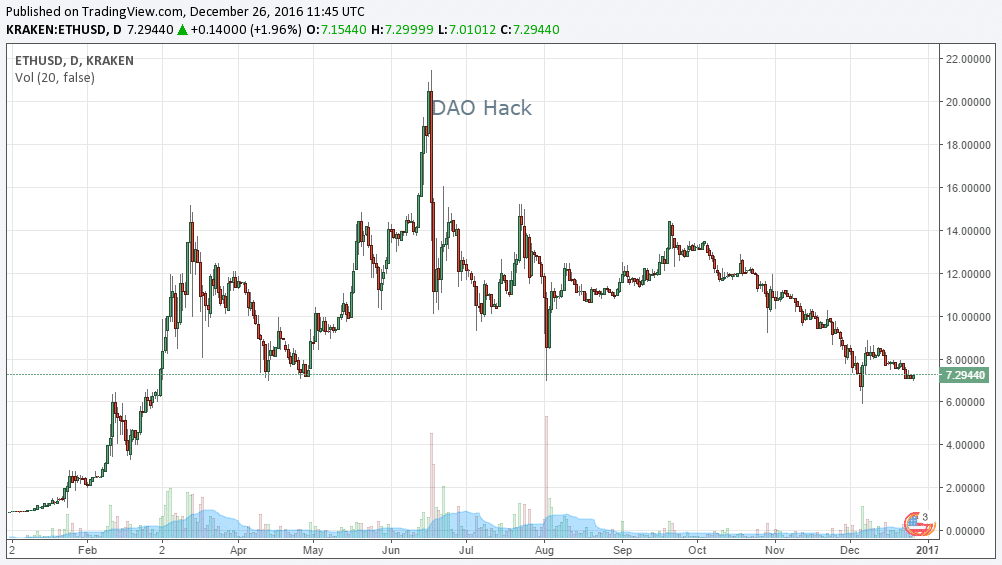
Looking to create an investment fund for early stage Ethereum ventures, such as its Ethereum Computer, Slock.it created the DAO (Decentralized Autonomous Organization). During its 28 day crowdsale in May the DAO raised over $150 million in ETH from over 11,000 investors and the future couldn’t have looked brighter for Slock.it, the DAO and Ethereum.
In early June an Ethereum developer wrote publicly that he found a flaw that would allow hackers to target the DAO. On June 17th the attack began and the DAO was bleeding money fast.
Reacting fast, the creator of Ethereum, Vitalik Buterin, called on everyone to spam the system to prevent any further transactions from taking place and called on miners to increase the gas price. The attack indeed stopped but not before the hackers siphoned away 3.6 million ETH.
After the DAO debacle, the Ethereum blockchain underwent a hard fork under the leadership of Vitalik Buterin, as a measure to reset the system to its state before the DAO hack, but a renegade group of users refused to honor the new branch and splintered off.
Now the Ethereum community is split between the official Ethereum (ETH) and the new ‘Ethereum Classic’ (ETC) with many accusations of foul play from both sides. Due to this the market value of Ethereum (ETH) sits at just $635 million at the end of 2016. Even with Ethereum Classic (ETC), which controls a market cap of $91 million, the two cryptocurrencies combined are nowhere close to the pre-DAO value.
ICOs
One of the most interesting and important stories in the blockchain sphere that remains almost completely under the radar of mainstream financial newspapers is how entrepreneurs created an alternative path to raise public funds with cryptocurrencies and tokens instead of stocks.
Initial Coin Offerings (ICOs) are a new way to raise money via crowd-funding process. The process works by selling blockchain tokens that carry an inherit value within the system, or even part of the ownership of the venture, to fund its development.
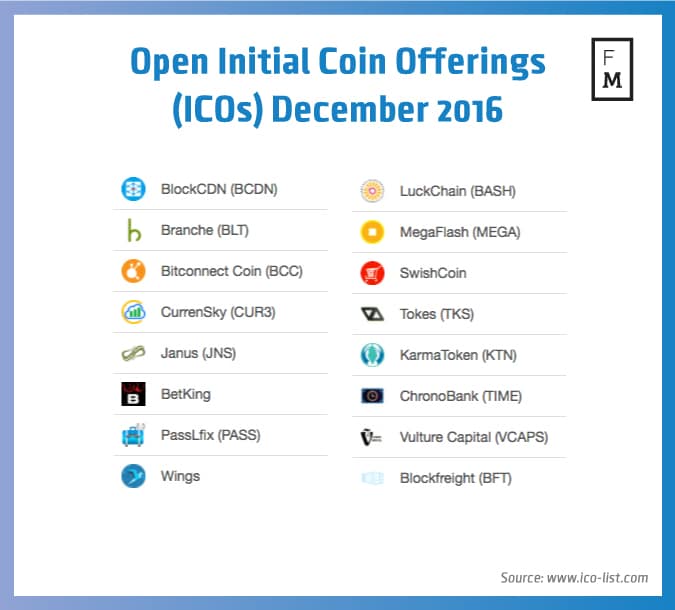
If this sounds a bit like an initial public offering (IPO) that’s no coincidence, but an ICO carries none of the legal requirements or any stock exchange or issuer scrutiny, and therefore it is much faster to set up.
Among the most successful examples of ICOs were blockchain FX exchange and bitcoin wallet Lykke which raised $1 million, Incent, a merchant backed loyalty platform with $1 million , Synereo which raised $4.7 million for decentralized computation, Antshares, a Shanghai-based open-source blockchain project, with over $4.5 million, ICONOMI, a fund management platform for blockchains and cryptocurrencies, with approximately $10.5 million, Golem which raised $8.6 million in 20 minutes to fund its ‘Airbnb for Computers’ and the FirstBlood decentralized eSports reward platform which raised $6 million in mere seconds.
Bitcoin: strife and advancement
The first cryptocurrency has seen a very turbulent 2016 with different sections of the ecosystem at each other’s throats. The biggest example for this was when veteran bitcoin programmer, Mike Hearn, publicly announced that bitcoin is a failed experiment, actually worse than the current financial system and on the brink of collapse.
The underlying reason for most of the current issues is the ongoing clash between those who think increasing block sizes is critical and should have already occurred, such as Hearn, and those saying that a resolution of the issue can be postponed further until it is widely adopted. The consequences of this civil war led to influential online forums censoring all information on alternative solutions that they did not agree with as well as massive cyber-attacks on competing implementations.
A possible light at the end of the tunnel has appeared with the release of SegWit, but the matter is far from over.
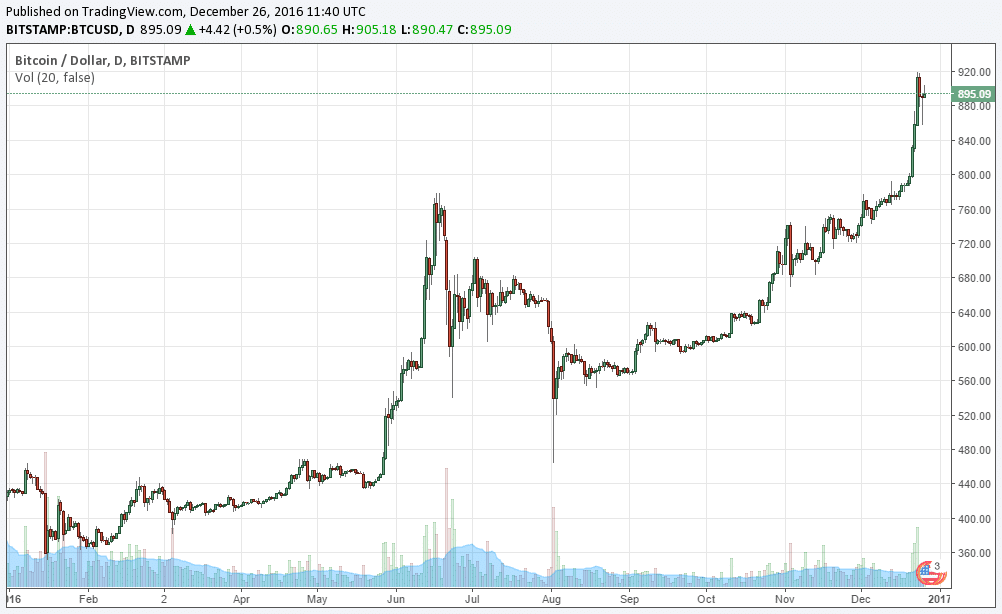
Despite all of this, the price of bitcoin recovered a lot of ground in 2016 and even set new total value records due to supporting outside factors.
Starting at $430 on January 1st, the price more than doubled by December 23rd as the BTC/USD exchange rate hit $900. This marketed a return to the levels of the heyday at the start of 2014, almost three years prior. The high price, in addition to the newly mined bitcoins added to circulation, brought the overall market capitalization of the original blockchain to $14.5 billion for the first time ever.
The factors that mostly contributed to this were severe and unforeseen economic changes that injected volatility into the markets and sent scared people to bitcoin as a sort of safe haven. Yuan devaluation in China. Brexit. The election of Donald Trump as the next US president. All were factors.
In the background was also the 'war on cash', as governments and central banks were considering phasing out paper money. This global push for a cashless society was most exemplified in India, where the Prime Minister Narendra Modi announced without prior warning that high-denomination rupee notes, representing about 80% of all cash holdings, are to be taken out of circulation immediately.
Blockchain goes mainstream
The 2016 trend that will probably have the most lasting effect on the financial world in years to come is the eager adoption of the underlying infrastructure of bitcoin, the blockchain, by banks and other institutions.
This year we have seen blockchain technology tested and adapted for seemingly every aspect of digital transactions in the business world. This was cheered by mainstream publications such as FT and The Economist as having the potential to completely disrupt and revolutionize all industries. By the end of the year it has already led to calls of the danger of over-hype and letting the air out of the bubble.
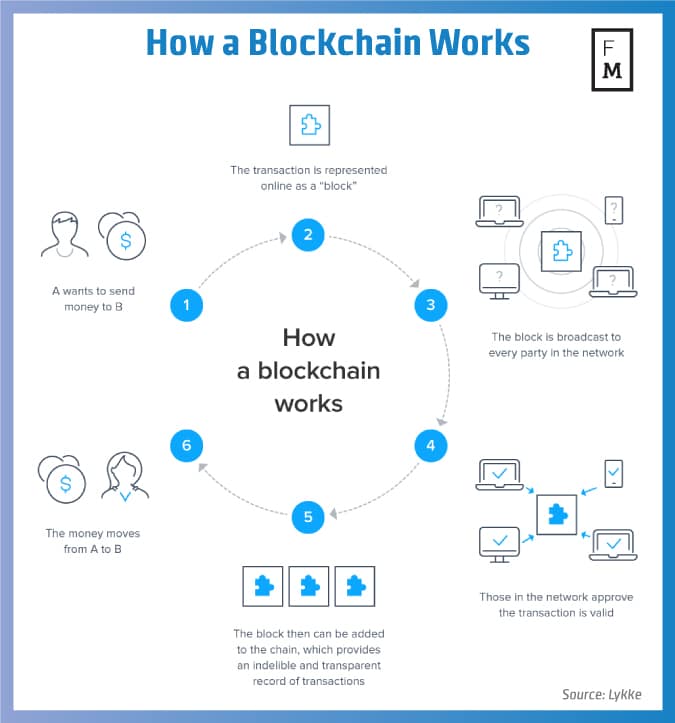
Still, this is without question a technology that will change the way trade is executed and recorded.
An incredible number of corporations have announced that they are testing the technology for their needs, far too many to list here. A number of notable examples of blockchain uses created in 2016 include: distributed loans, loyalty programs, bond trading, global payments, AML KYC, margin calls, data management, commodities trading, mini-bonds, private stocks, corporate identity, shipping, gold trading, energy trading, cheque digitalization, trade financing, letters of credit, transactions reporting, swaps, derivatives and securities recording.
Predictions for 2017
Making any kind of gamble on the price or even trajectory of bitcoin in any particular period has proven to be very hard so I will spare you mine. However, it is possible to give educated guesses as to where the technology and ecosystem is headed based on current trends.
We seem to be at the peak of hype for blockchain in finance so we can safely expect a backlash in 2017 in accordance with the common life cycle for all technologies. We might see the folding of all the firms that jumped on the bandwagon just because they thought they can get money from investors on the back of a popular buzzword. Meanwhile the real useful applications of the technology could be developed in quiet until a resurgence occurs.
ICOs will continue on pace as they offer a way to finance any project without much hassle. No big scandals in the field have come to light in 2016 regarding ICOs, but with the widespread fad attracting all sorts of people that see it as an opportunity to make money fast, it might not be long before something explodes and brings more scrutiny to the ecosystem.
Bitcoin seems to be moving farther away from being a method for quick and frictionless online transactions and more toward a store of wealth, like digital gold. Complementing solutions and other cryptocurrencies will continue to evolve in order to fill the vacuum for microtransactions and fast execution until this changes. In the meantime it will remain primarily a tool for Chinese traders to speculate to protect against the devaluation of their funds and as the easiest on ramp for hackers to get cryptocurrency from ransomware.
At the same time the technology of the blockchain is also being used for disrupting many other sectors of the economy at such a speed that it’s hard to keep up with all the daily updates. For this we have chosen just four big stories that dominated the news this year and spanned 2016 as backdrop to everything else.
Ethereum
After a long period in which no altcoin got even remotely close to bitcoin in terms of adoption and market share, an innovative new contender emerged in 2016 in the form of the smart contracts cryptocurrency, Ethereum.
On January 1st 2016 the price of Ether was around 93 cents, and its total market cap was just over $70 million. On March 31st the price of Ether was about $12 and its total market cap was around $910 million. This astounding growth forced 'bitcoin only' diehards to adapt to the new situation.
By mid-June the price reached $19, the market cap of Ethereum topped $1.5 billion and it seemed that the creators of the smart contracts blockchain could do nothing wrong. But then the DAO came along.
Looking to create an investment fund for early stage Ethereum ventures, such as its Ethereum Computer, Slock.it created the DAO (Decentralized Autonomous Organization). During its 28 day crowdsale in May the DAO raised over $150 million in ETH from over 11,000 investors and the future couldn’t have looked brighter for Slock.it, the DAO and Ethereum.
In early June an Ethereum developer wrote publicly that he found a flaw that would allow hackers to target the DAO. On June 17th the attack began and the DAO was bleeding money fast.
Reacting fast, the creator of Ethereum, Vitalik Buterin, called on everyone to spam the system to prevent any further transactions from taking place and called on miners to increase the gas price. The attack indeed stopped but not before the hackers siphoned away 3.6 million ETH.
After the DAO debacle, the Ethereum blockchain underwent a hard fork under the leadership of Vitalik Buterin, as a measure to reset the system to its state before the DAO hack, but a renegade group of users refused to honor the new branch and splintered off.
Now the Ethereum community is split between the official Ethereum (ETH) and the new ‘Ethereum Classic’ (ETC) with many accusations of foul play from both sides. Due to this the market value of Ethereum (ETH) sits at just $635 million at the end of 2016. Even with Ethereum Classic (ETC), which controls a market cap of $91 million, the two cryptocurrencies combined are nowhere close to the pre-DAO value.
ICOs
One of the most interesting and important stories in the blockchain sphere that remains almost completely under the radar of mainstream financial newspapers is how entrepreneurs created an alternative path to raise public funds with cryptocurrencies and tokens instead of stocks.
Initial Coin Offerings (ICOs) are a new way to raise money via crowd-funding process. The process works by selling blockchain tokens that carry an inherit value within the system, or even part of the ownership of the venture, to fund its development.
If this sounds a bit like an initial public offering (IPO) that’s no coincidence, but an ICO carries none of the legal requirements or any stock exchange or issuer scrutiny, and therefore it is much faster to set up.
Among the most successful examples of ICOs were blockchain FX exchange and bitcoin wallet Lykke which raised $1 million, Incent, a merchant backed loyalty platform with $1 million , Synereo which raised $4.7 million for decentralized computation, Antshares, a Shanghai-based open-source blockchain project, with over $4.5 million, ICONOMI, a fund management platform for blockchains and cryptocurrencies, with approximately $10.5 million, Golem which raised $8.6 million in 20 minutes to fund its ‘Airbnb for Computers’ and the FirstBlood decentralized eSports reward platform which raised $6 million in mere seconds.
Bitcoin: strife and advancement
The first cryptocurrency has seen a very turbulent 2016 with different sections of the ecosystem at each other’s throats. The biggest example for this was when veteran bitcoin programmer, Mike Hearn, publicly announced that bitcoin is a failed experiment, actually worse than the current financial system and on the brink of collapse.
The underlying reason for most of the current issues is the ongoing clash between those who think increasing block sizes is critical and should have already occurred, such as Hearn, and those saying that a resolution of the issue can be postponed further until it is widely adopted. The consequences of this civil war led to influential online forums censoring all information on alternative solutions that they did not agree with as well as massive cyber-attacks on competing implementations.
A possible light at the end of the tunnel has appeared with the release of SegWit, but the matter is far from over.
Despite all of this, the price of bitcoin recovered a lot of ground in 2016 and even set new total value records due to supporting outside factors.
Starting at $430 on January 1st, the price more than doubled by December 23rd as the BTC/USD exchange rate hit $900. This marketed a return to the levels of the heyday at the start of 2014, almost three years prior. The high price, in addition to the newly mined bitcoins added to circulation, brought the overall market capitalization of the original blockchain to $14.5 billion for the first time ever.
The factors that mostly contributed to this were severe and unforeseen economic changes that injected volatility into the markets and sent scared people to bitcoin as a sort of safe haven. Yuan devaluation in China. Brexit. The election of Donald Trump as the next US president. All were factors.
In the background was also the 'war on cash', as governments and central banks were considering phasing out paper money. This global push for a cashless society was most exemplified in India, where the Prime Minister Narendra Modi announced without prior warning that high-denomination rupee notes, representing about 80% of all cash holdings, are to be taken out of circulation immediately.
Blockchain goes mainstream
The 2016 trend that will probably have the most lasting effect on the financial world in years to come is the eager adoption of the underlying infrastructure of bitcoin, the blockchain, by banks and other institutions.
This year we have seen blockchain technology tested and adapted for seemingly every aspect of digital transactions in the business world. This was cheered by mainstream publications such as FT and The Economist as having the potential to completely disrupt and revolutionize all industries. By the end of the year it has already led to calls of the danger of over-hype and letting the air out of the bubble.
Still, this is without question a technology that will change the way trade is executed and recorded.
An incredible number of corporations have announced that they are testing the technology for their needs, far too many to list here. A number of notable examples of blockchain uses created in 2016 include: distributed loans, loyalty programs, bond trading, global payments, AML KYC, margin calls, data management, commodities trading, mini-bonds, private stocks, corporate identity, shipping, gold trading, energy trading, cheque digitalization, trade financing, letters of credit, transactions reporting, swaps, derivatives and securities recording.
Predictions for 2017
Making any kind of gamble on the price or even trajectory of bitcoin in any particular period has proven to be very hard so I will spare you mine. However, it is possible to give educated guesses as to where the technology and ecosystem is headed based on current trends.
We seem to be at the peak of hype for blockchain in finance so we can safely expect a backlash in 2017 in accordance with the common life cycle for all technologies. We might see the folding of all the firms that jumped on the bandwagon just because they thought they can get money from investors on the back of a popular buzzword. Meanwhile the real useful applications of the technology could be developed in quiet until a resurgence occurs.
ICOs will continue on pace as they offer a way to finance any project without much hassle. No big scandals in the field have come to light in 2016 regarding ICOs, but with the widespread fad attracting all sorts of people that see it as an opportunity to make money fast, it might not be long before something explodes and brings more scrutiny to the ecosystem.
Bitcoin seems to be moving farther away from being a method for quick and frictionless online transactions and more toward a store of wealth, like digital gold. Complementing solutions and other cryptocurrencies will continue to evolve in order to fill the vacuum for microtransactions and fast execution until this changes. In the meantime it will remain primarily a tool for Chinese traders to speculate to protect against the devaluation of their funds and as the easiest on ramp for hackers to get cryptocurrency from ransomware.
Dormant Silk Road-Linked Crypto Wallets Come Back to Life With $3M in Bitcoin Transfers
Featured Videos
Exness expands its presence in Africa: Inside our interview with Paul Margarites in Cape Town
Finance Magnates met with Paul Margarites, Exness regional commercial director for Sub-Saharan Africa, during a visit to the firm’s office opening in Cape Town. In this talk, led by Andrea Badiola Mateos, Co-CEO at Finance Magnates, Paul shares views on the South African trading space, local user behavior, mobile trends, regulation, team growth, and how Exness plans to grow in more markets across the region. @Exness
Read the article at: https://www.financemagnates.com/thought-leadership/exness-expands-its-presence-in-africa-inside-our-interview-with-paul-margarites/
#exness #financemagnates #exnesstrading #CFDtrading #tradeonline #africanews #capetown
Finance Magnates met with Paul Margarites, Exness regional commercial director for Sub-Saharan Africa, during a visit to the firm’s office opening in Cape Town. In this talk, led by Andrea Badiola Mateos, Co-CEO at Finance Magnates, Paul shares views on the South African trading space, local user behavior, mobile trends, regulation, team growth, and how Exness plans to grow in more markets across the region. @Exness
Read the article at: https://www.financemagnates.com/thought-leadership/exness-expands-its-presence-in-africa-inside-our-interview-with-paul-margarites/
#exness #financemagnates #exnesstrading #CFDtrading #tradeonline #africanews #capetown
Finance Magnates met with Paul Margarites, Exness regional commercial director for Sub-Saharan Africa, during a visit to the firm’s office opening in Cape Town. In this talk, led by Andrea Badiola Mateos, Co-CEO at Finance Magnates, Paul shares views on the South African trading space, local user behavior, mobile trends, regulation, team growth, and how Exness plans to grow in more markets across the region. @Exness
Read the article at: https://www.financemagnates.com/thought-leadership/exness-expands-its-presence-in-africa-inside-our-interview-with-paul-margarites/
#exness #financemagnates #exnesstrading #CFDtrading #tradeonline #africanews #capetown
Finance Magnates met with Paul Margarites, Exness regional commercial director for Sub-Saharan Africa, during a visit to the firm’s office opening in Cape Town. In this talk, led by Andrea Badiola Mateos, Co-CEO at Finance Magnates, Paul shares views on the South African trading space, local user behavior, mobile trends, regulation, team growth, and how Exness plans to grow in more markets across the region. @Exness
Read the article at: https://www.financemagnates.com/thought-leadership/exness-expands-its-presence-in-africa-inside-our-interview-with-paul-margarites/
#exness #financemagnates #exnesstrading #CFDtrading #tradeonline #africanews #capetown
Interview with Jas Shah
Builder | Adviser | Fintech Writer | Product Strategist
In this episode, Jonathan Fine sat down with Jas Shah, one of the most thoughtful voices in global fintech. Known for his work across advisory, product, stablecoins, and his widely read writing, Jas brings a rare combination of industry insight and plain-spoken clarity.
We talk about his first impression of the Summit, the projects that keep him busy today, and how they connect to the stablecoin panel he joined. Jas shares his view on the link between fintech, wealthtech and retail brokers, especially as firms like Revolut, eToro and Trading212 blur long-standing lines in the market.
We also explore what stablecoin adoption might look like for retail investment platforms, including a few product and UX angles that are not obvious at first glance.
To close, Jas explains how he thinks about writing, and how he approaches “shipping” pieces that spark debate across the industry.
Interview with Jas Shah
Builder | Adviser | Fintech Writer | Product Strategist
In this episode, Jonathan Fine sat down with Jas Shah, one of the most thoughtful voices in global fintech. Known for his work across advisory, product, stablecoins, and his widely read writing, Jas brings a rare combination of industry insight and plain-spoken clarity.
We talk about his first impression of the Summit, the projects that keep him busy today, and how they connect to the stablecoin panel he joined. Jas shares his view on the link between fintech, wealthtech and retail brokers, especially as firms like Revolut, eToro and Trading212 blur long-standing lines in the market.
We also explore what stablecoin adoption might look like for retail investment platforms, including a few product and UX angles that are not obvious at first glance.
To close, Jas explains how he thinks about writing, and how he approaches “shipping” pieces that spark debate across the industry.
Interview with Jas Shah
Builder | Adviser | Fintech Writer | Product Strategist
In this episode, Jonathan Fine sat down with Jas Shah, one of the most thoughtful voices in global fintech. Known for his work across advisory, product, stablecoins, and his widely read writing, Jas brings a rare combination of industry insight and plain-spoken clarity.
We talk about his first impression of the Summit, the projects that keep him busy today, and how they connect to the stablecoin panel he joined. Jas shares his view on the link between fintech, wealthtech and retail brokers, especially as firms like Revolut, eToro and Trading212 blur long-standing lines in the market.
We also explore what stablecoin adoption might look like for retail investment platforms, including a few product and UX angles that are not obvious at first glance.
To close, Jas explains how he thinks about writing, and how he approaches “shipping” pieces that spark debate across the industry.
Interview with Jas Shah
Builder | Adviser | Fintech Writer | Product Strategist
In this episode, Jonathan Fine sat down with Jas Shah, one of the most thoughtful voices in global fintech. Known for his work across advisory, product, stablecoins, and his widely read writing, Jas brings a rare combination of industry insight and plain-spoken clarity.
We talk about his first impression of the Summit, the projects that keep him busy today, and how they connect to the stablecoin panel he joined. Jas shares his view on the link between fintech, wealthtech and retail brokers, especially as firms like Revolut, eToro and Trading212 blur long-standing lines in the market.
We also explore what stablecoin adoption might look like for retail investment platforms, including a few product and UX angles that are not obvious at first glance.
To close, Jas explains how he thinks about writing, and how he approaches “shipping” pieces that spark debate across the industry.
Interview with Jas Shah
Builder | Adviser | Fintech Writer | Product Strategist
In this episode, Jonathan Fine sat down with Jas Shah, one of the most thoughtful voices in global fintech. Known for his work across advisory, product, stablecoins, and his widely read writing, Jas brings a rare combination of industry insight and plain-spoken clarity.
We talk about his first impression of the Summit, the projects that keep him busy today, and how they connect to the stablecoin panel he joined. Jas shares his view on the link between fintech, wealthtech and retail brokers, especially as firms like Revolut, eToro and Trading212 blur long-standing lines in the market.
We also explore what stablecoin adoption might look like for retail investment platforms, including a few product and UX angles that are not obvious at first glance.
To close, Jas explains how he thinks about writing, and how he approaches “shipping” pieces that spark debate across the industry.
Interview with Jas Shah
Builder | Adviser | Fintech Writer | Product Strategist
In this episode, Jonathan Fine sat down with Jas Shah, one of the most thoughtful voices in global fintech. Known for his work across advisory, product, stablecoins, and his widely read writing, Jas brings a rare combination of industry insight and plain-spoken clarity.
We talk about his first impression of the Summit, the projects that keep him busy today, and how they connect to the stablecoin panel he joined. Jas shares his view on the link between fintech, wealthtech and retail brokers, especially as firms like Revolut, eToro and Trading212 blur long-standing lines in the market.
We also explore what stablecoin adoption might look like for retail investment platforms, including a few product and UX angles that are not obvious at first glance.
To close, Jas explains how he thinks about writing, and how he approaches “shipping” pieces that spark debate across the industry.
Vitalii Bulynin Talks About Versus Trade, New Pairs, and Big Plans
In this interview, Versus Trade Co-Founder Vitalii Bulynin explains how the company got its license fast, why its trading pairs are fresh and fun, and what the team will build next.
He also discusses the most active pairs, the IB and MIB plans, and hiring needs for new markets.
Watch the whole talk to learn more about how Versus Trade works and where it is heading.
#financemagnates #VersusTrade #TradingPairs #BTCvsGold #goldtrading #innovation
In this interview, Versus Trade Co-Founder Vitalii Bulynin explains how the company got its license fast, why its trading pairs are fresh and fun, and what the team will build next.
He also discusses the most active pairs, the IB and MIB plans, and hiring needs for new markets.
Watch the whole talk to learn more about how Versus Trade works and where it is heading.
#financemagnates #VersusTrade #TradingPairs #BTCvsGold #goldtrading #innovation
In this interview, Versus Trade Co-Founder Vitalii Bulynin explains how the company got its license fast, why its trading pairs are fresh and fun, and what the team will build next.
He also discusses the most active pairs, the IB and MIB plans, and hiring needs for new markets.
Watch the whole talk to learn more about how Versus Trade works and where it is heading.
#financemagnates #VersusTrade #TradingPairs #BTCvsGold #goldtrading #innovation
In this interview, Versus Trade Co-Founder Vitalii Bulynin explains how the company got its license fast, why its trading pairs are fresh and fun, and what the team will build next.
He also discusses the most active pairs, the IB and MIB plans, and hiring needs for new markets.
Watch the whole talk to learn more about how Versus Trade works and where it is heading.
#financemagnates #VersusTrade #TradingPairs #BTCvsGold #goldtrading #innovation
In this interview, Versus Trade Co-Founder Vitalii Bulynin explains how the company got its license fast, why its trading pairs are fresh and fun, and what the team will build next.
He also discusses the most active pairs, the IB and MIB plans, and hiring needs for new markets.
Watch the whole talk to learn more about how Versus Trade works and where it is heading.
#financemagnates #VersusTrade #TradingPairs #BTCvsGold #goldtrading #innovation
In this interview, Versus Trade Co-Founder Vitalii Bulynin explains how the company got its license fast, why its trading pairs are fresh and fun, and what the team will build next.
He also discusses the most active pairs, the IB and MIB plans, and hiring needs for new markets.
Watch the whole talk to learn more about how Versus Trade works and where it is heading.
#financemagnates #VersusTrade #TradingPairs #BTCvsGold #goldtrading #innovation
Marketing in 2026 Audiences, Costs, and Smarter AI
As brokers eye B2B business and compete with fintechs and crypto exchanges alike, marketers need to act wisely with often limited budgets. AI can offer scalable solutions, but only if used properly.
Join seasoned marketing executives and specialists as they discuss the main challenges they identify in financial services in 2026 and how they address them.
Attendees of this session will walk away with:
- A nuts-and-bolts account of acquisition costs across platforms and geos
- Analysis of today’s multi-layered audience segments and differences in behaviour
- First-hand account of how global brokers balance consistency and local flavour
- Notes from the field about intelligently using AI and automation in marketing
Speakers:
-Yam Yehoshua, Editor-In-Chief at Finance Magnates
-Federico Paderni, Managing Director for Growth Markets in Europe at X
-Jo Benton, Chief Marketing Officer, Consulting | Fractional CMO
-Itai Levitan, Head of Strategy at investingLive
-Roberto Napolitano, CMO at Innovate Finance
-Tony Cross, Director at Monk Communications
#fmls #fmls25 #fmevents #FintechMarketing #AI #DigitalStrategy #Fintech #Innovation
Connect with us at:
🔗 LinkedIn: / financemagnates-events
👍 Facebook: / financemagnatesevents
📸 Instagram: / fmevents_official
🐦 Twitter: / f_m_events
🎥 TikTok: / fmevents_official
As brokers eye B2B business and compete with fintechs and crypto exchanges alike, marketers need to act wisely with often limited budgets. AI can offer scalable solutions, but only if used properly.
Join seasoned marketing executives and specialists as they discuss the main challenges they identify in financial services in 2026 and how they address them.
Attendees of this session will walk away with:
- A nuts-and-bolts account of acquisition costs across platforms and geos
- Analysis of today’s multi-layered audience segments and differences in behaviour
- First-hand account of how global brokers balance consistency and local flavour
- Notes from the field about intelligently using AI and automation in marketing
Speakers:
-Yam Yehoshua, Editor-In-Chief at Finance Magnates
-Federico Paderni, Managing Director for Growth Markets in Europe at X
-Jo Benton, Chief Marketing Officer, Consulting | Fractional CMO
-Itai Levitan, Head of Strategy at investingLive
-Roberto Napolitano, CMO at Innovate Finance
-Tony Cross, Director at Monk Communications
#fmls #fmls25 #fmevents #FintechMarketing #AI #DigitalStrategy #Fintech #Innovation
Connect with us at:
🔗 LinkedIn: / financemagnates-events
👍 Facebook: / financemagnatesevents
📸 Instagram: / fmevents_official
🐦 Twitter: / f_m_events
🎥 TikTok: / fmevents_official
As brokers eye B2B business and compete with fintechs and crypto exchanges alike, marketers need to act wisely with often limited budgets. AI can offer scalable solutions, but only if used properly.
Join seasoned marketing executives and specialists as they discuss the main challenges they identify in financial services in 2026 and how they address them.
Attendees of this session will walk away with:
- A nuts-and-bolts account of acquisition costs across platforms and geos
- Analysis of today’s multi-layered audience segments and differences in behaviour
- First-hand account of how global brokers balance consistency and local flavour
- Notes from the field about intelligently using AI and automation in marketing
Speakers:
-Yam Yehoshua, Editor-In-Chief at Finance Magnates
-Federico Paderni, Managing Director for Growth Markets in Europe at X
-Jo Benton, Chief Marketing Officer, Consulting | Fractional CMO
-Itai Levitan, Head of Strategy at investingLive
-Roberto Napolitano, CMO at Innovate Finance
-Tony Cross, Director at Monk Communications
#fmls #fmls25 #fmevents #FintechMarketing #AI #DigitalStrategy #Fintech #Innovation
Connect with us at:
🔗 LinkedIn: / financemagnates-events
👍 Facebook: / financemagnatesevents
📸 Instagram: / fmevents_official
🐦 Twitter: / f_m_events
🎥 TikTok: / fmevents_official
As brokers eye B2B business and compete with fintechs and crypto exchanges alike, marketers need to act wisely with often limited budgets. AI can offer scalable solutions, but only if used properly.
Join seasoned marketing executives and specialists as they discuss the main challenges they identify in financial services in 2026 and how they address them.
Attendees of this session will walk away with:
- A nuts-and-bolts account of acquisition costs across platforms and geos
- Analysis of today’s multi-layered audience segments and differences in behaviour
- First-hand account of how global brokers balance consistency and local flavour
- Notes from the field about intelligently using AI and automation in marketing
Speakers:
-Yam Yehoshua, Editor-In-Chief at Finance Magnates
-Federico Paderni, Managing Director for Growth Markets in Europe at X
-Jo Benton, Chief Marketing Officer, Consulting | Fractional CMO
-Itai Levitan, Head of Strategy at investingLive
-Roberto Napolitano, CMO at Innovate Finance
-Tony Cross, Director at Monk Communications
#fmls #fmls25 #fmevents #FintechMarketing #AI #DigitalStrategy #Fintech #Innovation
Connect with us at:
🔗 LinkedIn: / financemagnates-events
👍 Facebook: / financemagnatesevents
📸 Instagram: / fmevents_official
🐦 Twitter: / f_m_events
🎥 TikTok: / fmevents_official
As brokers eye B2B business and compete with fintechs and crypto exchanges alike, marketers need to act wisely with often limited budgets. AI can offer scalable solutions, but only if used properly.
Join seasoned marketing executives and specialists as they discuss the main challenges they identify in financial services in 2026 and how they address them.
Attendees of this session will walk away with:
- A nuts-and-bolts account of acquisition costs across platforms and geos
- Analysis of today’s multi-layered audience segments and differences in behaviour
- First-hand account of how global brokers balance consistency and local flavour
- Notes from the field about intelligently using AI and automation in marketing
Speakers:
-Yam Yehoshua, Editor-In-Chief at Finance Magnates
-Federico Paderni, Managing Director for Growth Markets in Europe at X
-Jo Benton, Chief Marketing Officer, Consulting | Fractional CMO
-Itai Levitan, Head of Strategy at investingLive
-Roberto Napolitano, CMO at Innovate Finance
-Tony Cross, Director at Monk Communications
#fmls #fmls25 #fmevents #FintechMarketing #AI #DigitalStrategy #Fintech #Innovation
Connect with us at:
🔗 LinkedIn: / financemagnates-events
👍 Facebook: / financemagnatesevents
📸 Instagram: / fmevents_official
🐦 Twitter: / f_m_events
🎥 TikTok: / fmevents_official
As brokers eye B2B business and compete with fintechs and crypto exchanges alike, marketers need to act wisely with often limited budgets. AI can offer scalable solutions, but only if used properly.
Join seasoned marketing executives and specialists as they discuss the main challenges they identify in financial services in 2026 and how they address them.
Attendees of this session will walk away with:
- A nuts-and-bolts account of acquisition costs across platforms and geos
- Analysis of today’s multi-layered audience segments and differences in behaviour
- First-hand account of how global brokers balance consistency and local flavour
- Notes from the field about intelligently using AI and automation in marketing
Speakers:
-Yam Yehoshua, Editor-In-Chief at Finance Magnates
-Federico Paderni, Managing Director for Growth Markets in Europe at X
-Jo Benton, Chief Marketing Officer, Consulting | Fractional CMO
-Itai Levitan, Head of Strategy at investingLive
-Roberto Napolitano, CMO at Innovate Finance
-Tony Cross, Director at Monk Communications
#fmls #fmls25 #fmevents #FintechMarketing #AI #DigitalStrategy #Fintech #Innovation
Connect with us at:
🔗 LinkedIn: / financemagnates-events
👍 Facebook: / financemagnatesevents
📸 Instagram: / fmevents_official
🐦 Twitter: / f_m_events
🎥 TikTok: / fmevents_official
Fail Better Trading Tech to Tackle Industry Risks
Much like their traders in the market, brokers must diversify to manage risk and stay resilient. But that can get costly, clunky, and lengthy.
This candid panel brings together builders across the trading infrastructure space to uncover the shifting dynamics behind tools, interfaces, and full-stack ambitions.
Attendees will hear:
-Why platform dependency has become one of the most overlooked risks in the trading business?
-Buy vs. build: What do hybrid models look like, and why are industry graveyards filled with failed ‘killer apps’?
-How AI is already changing execution, risk, and reporting—and what’s next?
-Which features, assets, and tools gain the most traction, and where brokers should look for tech-driven retention?
Speakers:
-Stephen Miles, Chief Revenue Officer at FYNXT
-John Morris, Co-Founder at FXBlue
-Matthew Smith, Group Chair & CEO at EC Markets
-Tom Higgins, Founder & CEO at Gold-i
-Gil Ben Hur, Founder at 5% Group
#fmls #fmls25 #fmevents #Brokers #Trading #Fintech #FintechInnovation #TradingTechnology #Innovation
Connect with us at:
🔗 LinkedIn: / financemagnates-events
👍 Facebook: / financemagnatesevents
📸 Instagram: / fmevents_official
🐦 Twitter: / f_m_events
🎥 TikTok: / fmevents_official
Much like their traders in the market, brokers must diversify to manage risk and stay resilient. But that can get costly, clunky, and lengthy.
This candid panel brings together builders across the trading infrastructure space to uncover the shifting dynamics behind tools, interfaces, and full-stack ambitions.
Attendees will hear:
-Why platform dependency has become one of the most overlooked risks in the trading business?
-Buy vs. build: What do hybrid models look like, and why are industry graveyards filled with failed ‘killer apps’?
-How AI is already changing execution, risk, and reporting—and what’s next?
-Which features, assets, and tools gain the most traction, and where brokers should look for tech-driven retention?
Speakers:
-Stephen Miles, Chief Revenue Officer at FYNXT
-John Morris, Co-Founder at FXBlue
-Matthew Smith, Group Chair & CEO at EC Markets
-Tom Higgins, Founder & CEO at Gold-i
-Gil Ben Hur, Founder at 5% Group
#fmls #fmls25 #fmevents #Brokers #Trading #Fintech #FintechInnovation #TradingTechnology #Innovation
Connect with us at:
🔗 LinkedIn: / financemagnates-events
👍 Facebook: / financemagnatesevents
📸 Instagram: / fmevents_official
🐦 Twitter: / f_m_events
🎥 TikTok: / fmevents_official
Much like their traders in the market, brokers must diversify to manage risk and stay resilient. But that can get costly, clunky, and lengthy.
This candid panel brings together builders across the trading infrastructure space to uncover the shifting dynamics behind tools, interfaces, and full-stack ambitions.
Attendees will hear:
-Why platform dependency has become one of the most overlooked risks in the trading business?
-Buy vs. build: What do hybrid models look like, and why are industry graveyards filled with failed ‘killer apps’?
-How AI is already changing execution, risk, and reporting—and what’s next?
-Which features, assets, and tools gain the most traction, and where brokers should look for tech-driven retention?
Speakers:
-Stephen Miles, Chief Revenue Officer at FYNXT
-John Morris, Co-Founder at FXBlue
-Matthew Smith, Group Chair & CEO at EC Markets
-Tom Higgins, Founder & CEO at Gold-i
-Gil Ben Hur, Founder at 5% Group
#fmls #fmls25 #fmevents #Brokers #Trading #Fintech #FintechInnovation #TradingTechnology #Innovation
Connect with us at:
🔗 LinkedIn: / financemagnates-events
👍 Facebook: / financemagnatesevents
📸 Instagram: / fmevents_official
🐦 Twitter: / f_m_events
🎥 TikTok: / fmevents_official
Much like their traders in the market, brokers must diversify to manage risk and stay resilient. But that can get costly, clunky, and lengthy.
This candid panel brings together builders across the trading infrastructure space to uncover the shifting dynamics behind tools, interfaces, and full-stack ambitions.
Attendees will hear:
-Why platform dependency has become one of the most overlooked risks in the trading business?
-Buy vs. build: What do hybrid models look like, and why are industry graveyards filled with failed ‘killer apps’?
-How AI is already changing execution, risk, and reporting—and what’s next?
-Which features, assets, and tools gain the most traction, and where brokers should look for tech-driven retention?
Speakers:
-Stephen Miles, Chief Revenue Officer at FYNXT
-John Morris, Co-Founder at FXBlue
-Matthew Smith, Group Chair & CEO at EC Markets
-Tom Higgins, Founder & CEO at Gold-i
-Gil Ben Hur, Founder at 5% Group
#fmls #fmls25 #fmevents #Brokers #Trading #Fintech #FintechInnovation #TradingTechnology #Innovation
Connect with us at:
🔗 LinkedIn: / financemagnates-events
👍 Facebook: / financemagnatesevents
📸 Instagram: / fmevents_official
🐦 Twitter: / f_m_events
🎥 TikTok: / fmevents_official
Much like their traders in the market, brokers must diversify to manage risk and stay resilient. But that can get costly, clunky, and lengthy.
This candid panel brings together builders across the trading infrastructure space to uncover the shifting dynamics behind tools, interfaces, and full-stack ambitions.
Attendees will hear:
-Why platform dependency has become one of the most overlooked risks in the trading business?
-Buy vs. build: What do hybrid models look like, and why are industry graveyards filled with failed ‘killer apps’?
-How AI is already changing execution, risk, and reporting—and what’s next?
-Which features, assets, and tools gain the most traction, and where brokers should look for tech-driven retention?
Speakers:
-Stephen Miles, Chief Revenue Officer at FYNXT
-John Morris, Co-Founder at FXBlue
-Matthew Smith, Group Chair & CEO at EC Markets
-Tom Higgins, Founder & CEO at Gold-i
-Gil Ben Hur, Founder at 5% Group
#fmls #fmls25 #fmevents #Brokers #Trading #Fintech #FintechInnovation #TradingTechnology #Innovation
Connect with us at:
🔗 LinkedIn: / financemagnates-events
👍 Facebook: / financemagnatesevents
📸 Instagram: / fmevents_official
🐦 Twitter: / f_m_events
🎥 TikTok: / fmevents_official
Much like their traders in the market, brokers must diversify to manage risk and stay resilient. But that can get costly, clunky, and lengthy.
This candid panel brings together builders across the trading infrastructure space to uncover the shifting dynamics behind tools, interfaces, and full-stack ambitions.
Attendees will hear:
-Why platform dependency has become one of the most overlooked risks in the trading business?
-Buy vs. build: What do hybrid models look like, and why are industry graveyards filled with failed ‘killer apps’?
-How AI is already changing execution, risk, and reporting—and what’s next?
-Which features, assets, and tools gain the most traction, and where brokers should look for tech-driven retention?
Speakers:
-Stephen Miles, Chief Revenue Officer at FYNXT
-John Morris, Co-Founder at FXBlue
-Matthew Smith, Group Chair & CEO at EC Markets
-Tom Higgins, Founder & CEO at Gold-i
-Gil Ben Hur, Founder at 5% Group
#fmls #fmls25 #fmevents #Brokers #Trading #Fintech #FintechInnovation #TradingTechnology #Innovation
Connect with us at:
🔗 LinkedIn: / financemagnates-events
👍 Facebook: / financemagnatesevents
📸 Instagram: / fmevents_official
🐦 Twitter: / f_m_events
🎥 TikTok: / fmevents_official