The announcement initially drove Bitcoin’s price above $94,000, but market volatility caused a brief dip below $85,000.
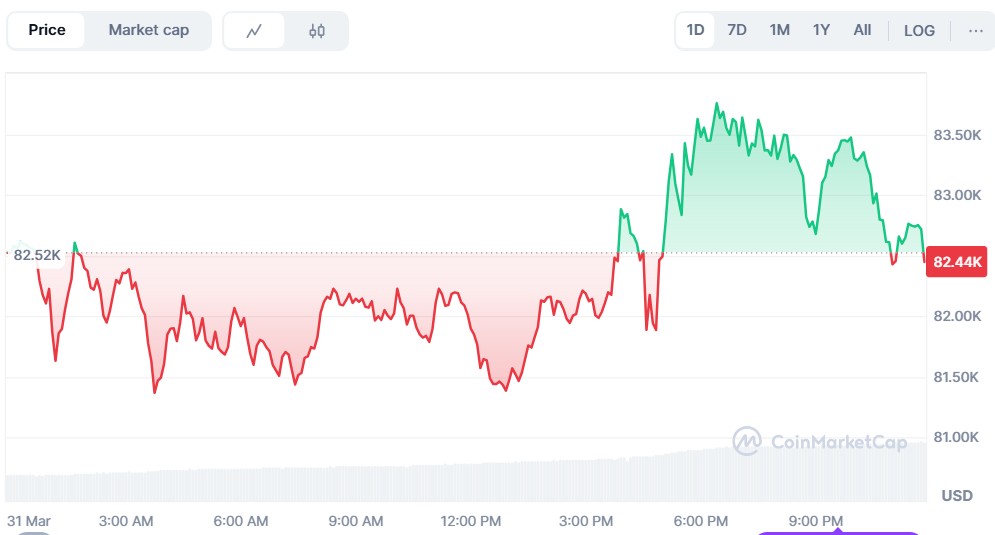
At the time of publication, Bitcoin is changing hands for $82K after a 6% drop in the weekly chart.
The cryptocurrency market is reeling from a historic
shift with Bitcoin now being a recognized U.S. strategic asset. President
Donald Trump’s recent executive order prevents the government from selling its
200,000 BTC holdings, according to research by global brokerage firm FBS.
The move initially sent Bitcoin soaring past $94,000,
but details of the plan led to market volatility, with prices briefly dipping
below $85,000. Investors are now questioning whether this marks the beginning
of a new financial era or a strategic political maneuver.
From Euphoria to Volatility
When Trump first hinted at a government-backed crypto
reserve on March 2, Bitcoin jumped over 10%, while Ether surged 13%. The market
added over $300 billion in value within hours, with investors interpreting the
move as a strong endorsement of crypto adoption.
Bitcoin Price Chart, Source: CoinMarketCap
However, when the White House clarified that the
reserve would only include confiscated Bitcoin without immediate purchases, the
market corrected. By March 7, Bitcoin briefly dropped below $85,000. Yet, the
downturn was short-lived, and Bitcoin rebounded to near $89,000 the following
day.
Despite the pullback, Bitcoin remains at historically
high levels, benefiting from the 2024 halving, which cut Bitcoin’s mining
reward from 6.25 BTC to 3.125 BTC, historically a key driver of long-term price
appreciation.
Bitcoin Joins the U.S. Reserve Strategy
Observers are drawing comparisons to the launch of Bitcoin ETFs, which boosted institutional adoption, and to historical halvings, which have driven long-term bull cycles. They also compare the move to El Salvador’s
Bitcoin adoption, though the scale is vastly different.
El Salvador has accumulated 6,100 BTC, whereas the
U.S. reserve starts with over 200,000 BTC. Some see this as an important moment,
akin to the U.S. establishing its Strategic Petroleum Reserve in the 1970s, a
step that reshaped global energy markets.
The U.S. decision is prompting international
reactions. Japan, a pioneer in crypto regulation, may consider similar
policies. European policymakers are also weighing whether to integrate Bitcoin into
reserve strategies to avoid being left behind.
Some geopolitical rivals, however, view the move with
suspicion. China, which has banned Bitcoin trading, is doubling down on its
digital yuan initiative. Russia, already exploring crypto for sanctions
evasion, might see the U.S. reserve as a reason to accelerate its own digital
asset strategies.
Long-Term Impact: A Game Changer for Crypto?
Looking ahead, the U.S. Bitcoin reserve could drive wider adoption. Standard Chartered has projected Bitcoin to reach $200,000 by
2025 and even $500,000 by 2028 under the right conditions. Institutional
investors, spurred by government endorsement, may accelerate their Bitcoin
holdings.
Besides that, Trump’s move could also push regulatory agencies to
fast-track approvals for more crypto ETFs, expanding access to Bitcoin and
potentially other cryptocurrencies.
The cryptocurrency market is reeling from a historic
shift with Bitcoin now being a recognized U.S. strategic asset. President
Donald Trump’s recent executive order prevents the government from selling its
200,000 BTC holdings, according to research by global brokerage firm FBS.
The move initially sent Bitcoin soaring past $94,000,
but details of the plan led to market volatility, with prices briefly dipping
below $85,000. Investors are now questioning whether this marks the beginning
of a new financial era or a strategic political maneuver.
From Euphoria to Volatility
When Trump first hinted at a government-backed crypto
reserve on March 2, Bitcoin jumped over 10%, while Ether surged 13%. The market
added over $300 billion in value within hours, with investors interpreting the
move as a strong endorsement of crypto adoption.
Bitcoin Price Chart, Source: CoinMarketCap
However, when the White House clarified that the
reserve would only include confiscated Bitcoin without immediate purchases, the
market corrected. By March 7, Bitcoin briefly dropped below $85,000. Yet, the
downturn was short-lived, and Bitcoin rebounded to near $89,000 the following
day.
Despite the pullback, Bitcoin remains at historically
high levels, benefiting from the 2024 halving, which cut Bitcoin’s mining
reward from 6.25 BTC to 3.125 BTC, historically a key driver of long-term price
appreciation.
Bitcoin Joins the U.S. Reserve Strategy
Observers are drawing comparisons to the launch of Bitcoin ETFs, which boosted institutional adoption, and to historical halvings, which have driven long-term bull cycles. They also compare the move to El Salvador’s
Bitcoin adoption, though the scale is vastly different.
El Salvador has accumulated 6,100 BTC, whereas the
U.S. reserve starts with over 200,000 BTC. Some see this as an important moment,
akin to the U.S. establishing its Strategic Petroleum Reserve in the 1970s, a
step that reshaped global energy markets.
The U.S. decision is prompting international
reactions. Japan, a pioneer in crypto regulation, may consider similar
policies. European policymakers are also weighing whether to integrate Bitcoin into
reserve strategies to avoid being left behind.
Some geopolitical rivals, however, view the move with
suspicion. China, which has banned Bitcoin trading, is doubling down on its
digital yuan initiative. Russia, already exploring crypto for sanctions
evasion, might see the U.S. reserve as a reason to accelerate its own digital
asset strategies.
Long-Term Impact: A Game Changer for Crypto?
Looking ahead, the U.S. Bitcoin reserve could drive wider adoption. Standard Chartered has projected Bitcoin to reach $200,000 by
2025 and even $500,000 by 2028 under the right conditions. Institutional
investors, spurred by government endorsement, may accelerate their Bitcoin
holdings.
Besides that, Trump’s move could also push regulatory agencies to
fast-track approvals for more crypto ETFs, expanding access to Bitcoin and
potentially other cryptocurrencies.
Jared Kirui is an Editor at Finance Magnates with more than five years of experience in financial journalism. He covers online trading, fintech, payments, and crypto industries with a focus on companies, regulation and compliance, executive moves, trading technology, and market analysis.
His work has been featured in other media outlets, including Benzinga, ZyCrypto, The Distributed, and The Daily Hodl.
Education:
Bachelor of Commerce degree (Finance option), University of Nairobi
Inside the Prediction Markets: $1.6B Institutional Inflow Meets a Federal Crackdown
FP Markets Winner Spotlight 🏆 | Global Broker of the Year 2025 #Trading #Broker #Innovation #Shorts
FP Markets Winner Spotlight 🏆 | Global Broker of the Year 2025 #Trading #Broker #Innovation #Shorts
FP Markets takes the spotlight as Global Broker of the Year 2025 at the Finance Magnates Awards.
Martin Stoilov, Head of Client Experience, shares that trust, innovation, and people played a key role in the company’s success, supported by a strong foundation of integrity and client-centricity.
Following this milestone, FP Markets continues to focus on growth, technology investment, and its core values of transparency and excellence.
👉 Be part of FM Awards 2026: https://awards.financemagnates.com/#nominate
FP Markets takes the spotlight as Global Broker of the Year 2025 at the Finance Magnates Awards.
Martin Stoilov, Head of Client Experience, shares that trust, innovation, and people played a key role in the company’s success, supported by a strong foundation of integrity and client-centricity.
Following this milestone, FP Markets continues to focus on growth, technology investment, and its core values of transparency and excellence.
👉 Be part of FM Awards 2026: https://awards.financemagnates.com/#nominate
In this video, we review @HolaPrimeMarketsOfficial, a multi-asset forex and CFDs broker offering different account types, trading platforms, and flexible trading conditions.
We cover the broker’s overall offering, including account options, trading environment, platforms like MT4 and MT5, and additional services such as managed accounts and fast withdrawals.
Watch the full video to see if Hola Prime Markets fits your trading needs.
📣 Stay up to date with the latest in finance and trading. Follow Finance Magnates for industry news, insights, and global event coverage.
Connect with us:
🔗 LinkedIn: /financemagnates
👍 Facebook: /financemagnates
📸 Instagram: https://www.instagram.com/financemagnates
🐦 X: https://x.com/financemagnates
🎥 TikTok: https://www.tiktok.com/tag/financemagnates
▶️ YouTube: /@financemagnates_official
#HolaPrime #ForexBroker #CFDTrading #FinanceMagnates #Trading #Forex #BrokerReview
In this video, we review @HolaPrimeMarketsOfficial, a multi-asset forex and CFDs broker offering different account types, trading platforms, and flexible trading conditions.
We cover the broker’s overall offering, including account options, trading environment, platforms like MT4 and MT5, and additional services such as managed accounts and fast withdrawals.
Watch the full video to see if Hola Prime Markets fits your trading needs.
📣 Stay up to date with the latest in finance and trading. Follow Finance Magnates for industry news, insights, and global event coverage.
Connect with us:
🔗 LinkedIn: /financemagnates
👍 Facebook: /financemagnates
📸 Instagram: https://www.instagram.com/financemagnates
🐦 X: https://x.com/financemagnates
🎥 TikTok: https://www.tiktok.com/tag/financemagnates
▶️ YouTube: /@financemagnates_official
#HolaPrime #ForexBroker #CFDTrading #FinanceMagnates #Trading #Forex #BrokerReview
Hola Prime Review: What You Need to Know | Full Breakdown by Finance Magnates
Hola Prime Review: What You Need to Know | Full Breakdown by Finance Magnates
In this video, we review @HolaPrime_Global, a proprietary trading firm offering evaluation programs and performance-based payouts in simulated market environments.
We cover how the challenge model works, including account types, profit splits (up to 95%), trading rules, and what it takes to reach a funded account. You’ll also learn about available platforms like MT4, MT5, cTrader, and more, along with insights into payouts, support, and trading conditions.
Watch the full video to see if Hola Prime fits your trading style.
📣 Stay up to date with the latest in finance and trading. Follow Finance Magnates for industry news, insights, and global event coverage.
Connect with us:
🔗 LinkedIn: /financemagnates
👍 Facebook: /financemagnates
📸 Instagram: https://www.instagram.com/financemagnates
🐦 X: https://x.com/financemagnates
🎥 TikTok: https://www.tiktok.com/tag/financemagnates
▶️ YouTube: /@financemagnates_official
#HolaPrime #PropFirm #Trading #FinanceMagnates #Forex #FuturesTrading #TradingReview #PropFirmReview
In this video, we review @HolaPrime_Global, a proprietary trading firm offering evaluation programs and performance-based payouts in simulated market environments.
We cover how the challenge model works, including account types, profit splits (up to 95%), trading rules, and what it takes to reach a funded account. You’ll also learn about available platforms like MT4, MT5, cTrader, and more, along with insights into payouts, support, and trading conditions.
Watch the full video to see if Hola Prime fits your trading style.
📣 Stay up to date with the latest in finance and trading. Follow Finance Magnates for industry news, insights, and global event coverage.
Connect with us:
🔗 LinkedIn: /financemagnates
👍 Facebook: /financemagnates
📸 Instagram: https://www.instagram.com/financemagnates
🐦 X: https://x.com/financemagnates
🎥 TikTok: https://www.tiktok.com/tag/financemagnates
▶️ YouTube: /@financemagnates_official
#HolaPrime #PropFirm #Trading #FinanceMagnates #Forex #FuturesTrading #TradingReview #PropFirmReview
Axi Winner Spotlight 🏆 | Global Most Innovative Broker 2025 #Innovation #Trading #Fintech #Broker
Axi Winner Spotlight 🏆 | Global Most Innovative Broker 2025 #Innovation #Trading #Fintech #Broker
Axi takes the spotlight at the Finance Magnates Awards, winning Global Most Innovative Broker 2025.
Olivia Xenofontos and Ivanna Openko share how the team will feel: proud, motivated, and ready to keep delivering.
They also describe the night as well-organized, focused, and enjoyable for all.
👉 Be part of FM Awards 2026.
Axi takes the spotlight at the Finance Magnates Awards, winning Global Most Innovative Broker 2025.
Olivia Xenofontos and Ivanna Openko share how the team will feel: proud, motivated, and ready to keep delivering.
They also describe the night as well-organized, focused, and enjoyable for all.
👉 Be part of FM Awards 2026.
Recognition that matters.
Built on transparency.
Driven by the industry.
The Finance Magnates Awards 2026.
Nominations are now open.
🔗 https://awards.financemagnates.com/?utm_source=SM&utm_medium=social&utm_campaign=recognition-matters
Recognition that matters.
Built on transparency.
Driven by the industry.
The Finance Magnates Awards 2026.
Nominations are now open.
🔗 https://awards.financemagnates.com/?utm_source=SM&utm_medium=social&utm_campaign=recognition-matters