Meta stock sinks in 2025 as Metaverse costs and AI investments weigh on Meta Platforms’ share price.
Meta Platforms stock falls amid 2025 tech tumble, with Nasdaq and inflation hitting share price.
Stock price prediction for 2025, however, are still mostly bullish and analysts calls the current move a healthy correction.
Mark Zuckerberg's Meta appears to be about to pivot toward AI.
Meta
Platforms Inc. (NASDAQ: META), the tech giant behind social media platforms
like Facebook, Instagram, and WhatsApp, has seen its stock take a noticeable
tumble in 2025. As of March 19, 2025, Meta stock is sinking today, trading at
$581.83 per share, reflecting a decline of about 18.8% over the past month and
erasing its year-to-date gains.
Investors
and analysts alike are questioning why Meta stock is down today, especially as
it becomes the last of the so-called “Magnificent Seven” stocks to tumble into
negative territory for the year.
This
article dives into the reasons behind Meta Platforms stock’s decline, explores
current price targets, and offers a Meta stock prediction for its future amid a
volatile Nasdaq and broader market trends.
Meta Stock Price Today
Hits November 2024 Lows
As reported
by real-time financial data, Meta Platforms stock opened at $581.484 on March
19, 2025, in pre-market trading, with a daily high of $582.933 and a low of
$581.45.
This marks
a drop from its previous session close of $582.36 on Tuesday and a significant
retreat from its 52-week high of $740.91. The company’s market cap stands at
$1.475 trillion, but its share price has been under pressure, reflecting
broader tech sector woes.
Compared to
its February 18 peak, Meta’s share price has shed 22% in value, signaling a
sell-off that has investors reevaluating their portfolios.
What is Meta stock price today? Source: Tradingview.com
The Nasdaq
Composite, a key index for tech stocks, has also faced volatility, contributing
to Meta’s decline. Inflation, rising interest rates, and recession fears have
created a challenging environment for growth stocks like Meta Platforms.
Despite
these headwinds, Meta’s AI investments and its massive user base of nearly 4
billion monthly active users across its apps offer hope for a recovery—but not
without hurdles.
Why META Is Sinking Today?
Meta Platforms Stock and Earnings:
One major
factor driving the question “why Meta stock is down” is its recent
earnings performance—or lack thereof. While Meta reported strong Q4 2024
profits, its outlook for Q1 2025 has disappointed investors.
Analysts
cite a weak turnover prediction, with advertising revenue—a cornerstone of
Meta’s business—showing signs of slowing amid economic uncertainty. Bloomberg
notes that Meta Platforms Inc. tumbled into negative territory on March 18,
losing 3.7% in a single day and wiping out its 26% gain from earlier in 2025.
The company
reported robust year-over-year growth in prior quarters, but the latest
guidance suggests monetization challenges. Earnings per share (EPS) for the
last quarter hit $8.02, beating the estimate of $6.76, yet the forward-looking
EPS for Q1 2025 is pegged at $5.25, raising concerns about sustainability.
Investors believe Meta’s heavy capital expenditures—projected at $60-$65
billion in 2025 for AI infrastructure—could strain cash flow if revenue growth
falters.
AI Integration and Meta’s
AI Investments: A Double-Edged Sword
Meta’s AI
push, led by CEO Mark Zuckerberg, has been a focal point for both optimism and
skepticism. The company’s open-source Llama models and Meta AI chatbot have
surpassed 1 billion downloads, a milestone celebrated in early March 2025.
Zuckerberg aims for Meta AI to serve over 1 billion users by year-end, backed
by plans to deploy 1.3 million GPUs. However, as Investors.com reports, this AI
milestone hasn’t stemmed the stock’s decline, with shares approaching a 3-month
low of $581.616.
Analysts
argue that Meta’s AI investments, while innovative, are increasing fixed costs
at a time when flexibility is crucial. KeyBanc Capital Markets downgraded its
price target on Meta from $750 to $710, citing “greater macro uncertainty” and
competitive pressures from rivals like Microsoft and new AI chatbot entrants
such as Manus. The experiment with artificial intelligence is a long-term bet,
but short-term returns remain elusive, contributing to the current sell-off.
Metaverse Costs: A
Persistent Drag on Meta Platforms Stock
The
Metaverse, once hailed as Meta’s future, continues to weigh on its financial
health. Reality Labs, the division behind virtual reality (VR) and augmented
reality (AR) efforts like Oculus, has racked up significant losses—$13.7
billion in 2022 alone—with no clear end in sight.
Despite
Zuckerberg’s vision of a virtual world enhancing user engagement, investor
sentiment has soured on these costly experiments. The Globe and Mail highlights
that Meta’s share price struggles partly stem from this unprofitable venture,
as the company balances its social media dominance with unproven bets.
Nasdaq and Tech Tumble:
Broader Market Pressures in 2025
Meta
Platforms stock isn’t sinking in isolation; it’s part of a broader tech tumble.
The S&P 500 and Nasdaq Composite have faced corrections, with the latter
down 7.3% year-to-date and over 12% from its peak.
Inflation and Federal Reserve policies on
interest rates have hit growth stocks hard, and Meta, as one of the last of the
so-called Magnificent Seven stocks (alongside Apple, Amazon, Microsoft, Nvidia,
Tesla, and Alphabet), has not been immune. Bloomberg reports that the Bloomberg
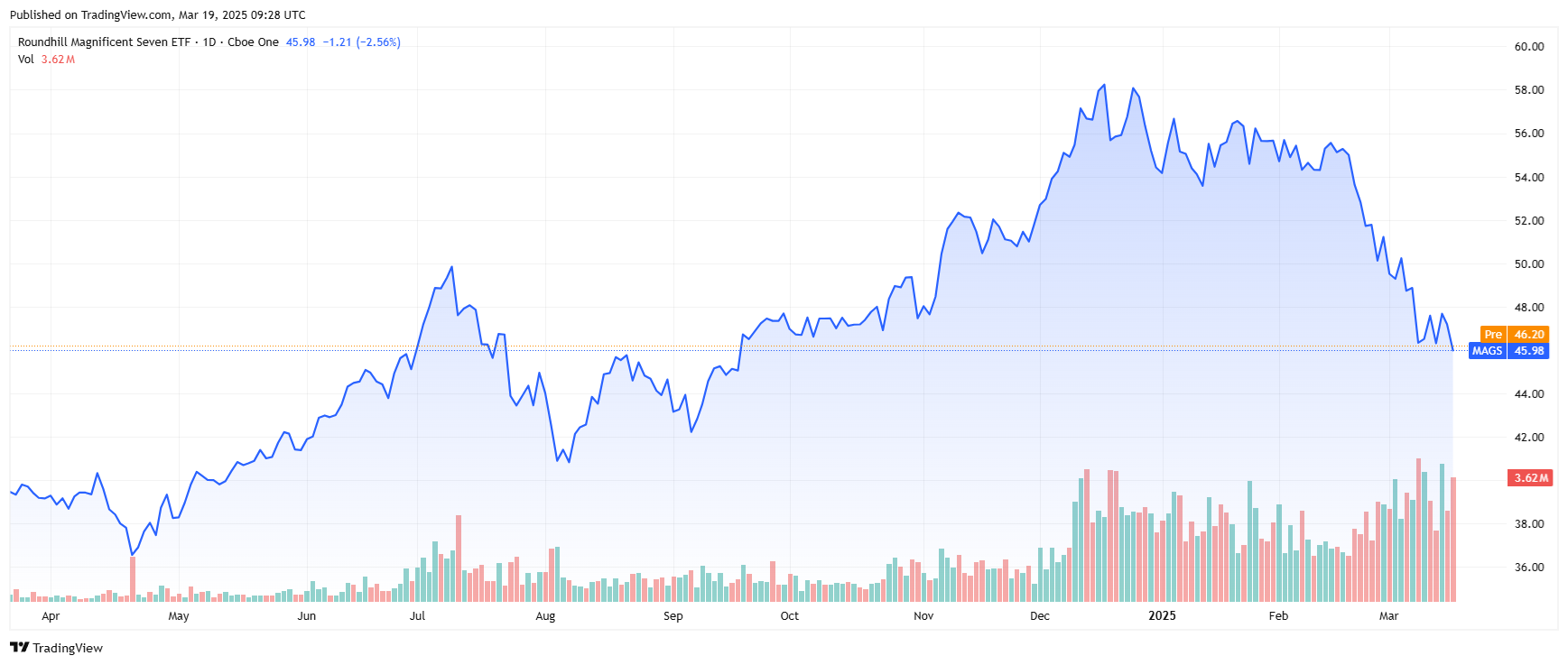
Magnificent 7 Total Return Index is down 16% in 2025, with Meta becoming the
final member to turn negative.
This
broader market decline amplifies Meta’s challenges, as investors take profits
amid recession fears and shifting sentiment. The company’s high
price-to-earnings ratio, while attractive during bullish periods, now signals
overvaluation to some, prompting a reevaluation of its investment upside.
Meta Stock Technical
Analysis: Will Meta Stock Go Up?
Based on my
technical analysis, the recent 20% correction in META stock price represents a
“healthy” movement after a very long uptrend period.
The market
is currently returning to the 200 EMA, the moving average that separates bull
and bear trends, allowing for a reset of recent overvaluation. The current
confluence of support around the $582 level may be a potential buying point.
Will Meta stock go up? Technical analysis of META stock price chart. Source: Tradingview.com
However, if
META drops below and breaks the trend line—which has been drawn and maintained
since 2022—then bulls may have a problem. In such a case, I wouldn't rule out a
decline to around $500, which represents the current six-month lows.
Resistance levels identified at:
$600: maximums that formed
important resistance at the end of 2024
$635: peaks from December and
early January 2025
$741: ATH (All-Time High)
reached in mid-February 2025
Support levels visible at:
$582: current 200 EMA path,
local bottoms and December minimums, and the long-term trend line drawn
from 2022 lows
$580–550: broader zone defined
by November lows, the upward line from September, and July and August
maximums from last year
$500: round psychological
level, coinciding with September minimums
Analyst Ratings and Price
Targets for Meta Stock in 2025
Despite the
downturn, analysts remain cautiously optimistic about Meta Platforms stock. The
consensus price target, per Yahoo Finance and MarketBeat, hovers around
$714–$738, suggesting an upside of 23–27% from the current price of $581.616.
Ratings
range from “Strong Buy” (47 analysts) to a low estimate of $505 and a high of
$935. Evercore ISI recently raised its target to $725, citing Meta’s AI
integration and monetization potential, while KeyBanc’s downgrade reflects
shorter-term concerns.
Analyst Firm
Price Target
Rating
Date
KeyBanc Capital
$710
Hold
March 2025
Evercore ISI
$725
Buy
February 2025
MarketBeat Consensus
$714
Strong Buy
March 2025
Zacks
$738.08
Strong Buy
February 2025
Table 1.
META stock price targets
Cathie
Wood’s ARK Invest sold over $7 million in Meta stock (12,000 shares) on March
18, its first sell-off in nearly a year, per Bloomberg and The Globe and Mail.
This move by a prominent investor known for backing tech giants like Tesla has
fueled bearish sentiment, though ARK’s shift to GitLab and Tempus AI suggests a
portfolio rebalancing rather than a total loss of faith in Meta.
Competition and Regulatory
Headwinds: Instagram, WhatsApp, and Beyond
Meta faces
stiff competition from TikTok and Snapchat, which are stealing user attention
and ad dollars. Additionally, an upcoming FTC trial on April 14, 2025, could
force Meta to divest Instagram and WhatsApp, spooking investors further.
Regulatory scrutiny, including antitrust lawsuits and privacy concerns tied to
past scandals like Cambridge Analytica, adds to the pressure. These external
threats erode Meta’s market share and complicate its growth narrative.
So, should
you buy Meta stock amid this sell-off? The prediction hinges on several
factors. On the bullish side, Meta’s dominance in social media platforms, its
3.98 billion monthly active users, and AI-driven engagement (e.g., Instagram’s
6% time increase in 2024) provide a solid foundation. The company’s profile as
a tech leader, bolstered by Zuckerberg and his sister Randi Zuckerberg’s
influence, supports long-term optimism.
However,
challenges like Metaverse losses, AI costs, and a potential recession could
extend the decline. Analysts recommend Meta Platforms for its upside potential,
but caution that near-term volatility may persist.
Meta Stock Forecast and
Prediction Table for 2025
Date/Period
Predicted Price
Upside/Downside from Current ($581.616)
Key Factors Influencing Prediction
Source/Analyst Consensus
March 31, 2025
$586.00
+0.76%
Stabilization
at
$580–$586
support
level;
potential
rebound
from
AI
milestone
(1B
downloads).
Real-time
data;
Investors.com
June 30, 2025
$630.00
+8.33%
Expected
Q1
earnings
impact;
AI
integration
boosting
Instagram
engagement
(+6%
YTD);
macro
recovery.
MarketBeat
($719.26
avg
target);
Evercore
ISI
September 30, 2025
$688.56
+18.39%
Revenue
growth
from
ads
($41.47B
Q2
est.);
Meta
AI
user
growth
toward
1B;
metaverse
cost
concerns.
LiteFinance;
Yahoo
Finance
December 31, 2025
$738.08
+26.91%
Strong
ad
monetization;
S&P
500
recovery;
Zuckerberg’s
AI
goal
(1B
users);
analyst
“Strong
Buy”
rating.
Zacks;
StockAnalysis
($714
avg
target)
Worst-Case Scenario
$505.00
-13.17%
Bearish
trend
continues;
Nasdaq
composite
decline;
regulatory
risks
(FTC
trial);
AI
competition.
MarketBeat
(low
estimate)
Best-Case Scenario
$935.00
+60.76%
Bullish
broader
market;
AI
infrastructure
success;
metaverse
gains
traction;
$187.46B
revenue
est.
MarketBeat
(high
estimate);
Exla
Resources
Table 2:
Meta stock predictions
Why Meta Platforms Stock
Is Down and What’s Next
Meta
stock’s tumble in 2025 reflects a perfect storm of earnings concerns, Metaverse
skepticism, AI investment costs, and a Nasdaq tech tumble. As the last of the
so-called Magnificent Seven stocks to falter, Meta Platforms Inc. faces a
pivotal moment.
While its
current price of $581.616 is well below analyst price targets, the road to
recovery depends on Zuckerberg’s ability to balance innovation with
profitability. For investors, the question remains: Is this a dip to buy, or a
trend signaling deeper trouble? Monitoring Meta’s next earnings, AI integration
progress, and broader market conditions will be key to answering that in 2025.
FAQ: Understanding Meta
Stock in 2025
Why Was Meta Stock Down
Today?
As of March
19, 2025, Meta stock closed at $581.616, down slightly from its previous close
of $582.36, continuing a broader decline of 18.8% over the past month from
$715.9699. Several factors contributed to this drop. Bloomberg reported a 3.7%
tumble on March 18, erasing Meta’s 26% year-to-date gain, driven by investor
unease after Cathie Wood’s ARK Invest sold over $7 million in shares—the first
such sell-off in nearly a year.
Is It Good to Buy Meta
Stock Now?
Yes. At its
current price of $581.616, Meta is trading well below its 52-week high of
$740.91 and the analyst consensus price target of $763.7. This suggests a
potential upside of 31.31%, making it attractive for long-term investors.
Analysts maintain a “Strong Buy” recommendation, with 44 of 48 rating it
positively. citing Meta’s dominance in social media (3.98 billion users) and AI
growth potential.
Will Meta Continue to
Rise?
Analysts
from Zacks ($738.08 target) and MarketBeat ($719.26 average price target)
predict growth, driven by ad revenue ($187.46B estimated for 2025, Exla
Resources) and AI innovations like Llama and Meta AI, which aims for 1 billion
users by year-end.
Is It Too Late to Buy
Meta?
No, it’s
not necessarily too late to buy Meta stock. At $581.616, the average price over
the past month has dropped significantly from its February peak, offering an
entry point below analyst targets like Evercore ISI’s $725 or TipRanks’
$763.71. Meta also benefits from its massive user base across Facebook,
Instagram, and WhatsApp, plus AI-driven engagement gains.
Will META Stock Reach
$1000?
Reaching
$1,000 by the end of 2025 is ambitious but not impossible, according to some
analyst outlooks. TipRanks and MarketBeat’s highest estimate is $935, implying
a 60.76% upside from $581.616. LiteFinance’s upper range of $1,022 supports
this possibility, driven by a bullish scenario: AI success (e.g., Llama 4,
multimodal models), metaverse monetization, and a strong broader market
recovery on the NYSE.
Meta
Platforms Inc. (NASDAQ: META), the tech giant behind social media platforms
like Facebook, Instagram, and WhatsApp, has seen its stock take a noticeable
tumble in 2025. As of March 19, 2025, Meta stock is sinking today, trading at
$581.83 per share, reflecting a decline of about 18.8% over the past month and
erasing its year-to-date gains.
Investors
and analysts alike are questioning why Meta stock is down today, especially as
it becomes the last of the so-called “Magnificent Seven” stocks to tumble into
negative territory for the year.
This
article dives into the reasons behind Meta Platforms stock’s decline, explores
current price targets, and offers a Meta stock prediction for its future amid a
volatile Nasdaq and broader market trends.
Meta Stock Price Today
Hits November 2024 Lows
As reported
by real-time financial data, Meta Platforms stock opened at $581.484 on March
19, 2025, in pre-market trading, with a daily high of $582.933 and a low of
$581.45.
This marks
a drop from its previous session close of $582.36 on Tuesday and a significant
retreat from its 52-week high of $740.91. The company’s market cap stands at
$1.475 trillion, but its share price has been under pressure, reflecting
broader tech sector woes.
Compared to
its February 18 peak, Meta’s share price has shed 22% in value, signaling a
sell-off that has investors reevaluating their portfolios.
What is Meta stock price today? Source: Tradingview.com
The Nasdaq
Composite, a key index for tech stocks, has also faced volatility, contributing
to Meta’s decline. Inflation, rising interest rates, and recession fears have
created a challenging environment for growth stocks like Meta Platforms.
Despite
these headwinds, Meta’s AI investments and its massive user base of nearly 4
billion monthly active users across its apps offer hope for a recovery—but not
without hurdles.
Why META Is Sinking Today?
Meta Platforms Stock and Earnings:
One major
factor driving the question “why Meta stock is down” is its recent
earnings performance—or lack thereof. While Meta reported strong Q4 2024
profits, its outlook for Q1 2025 has disappointed investors.
Analysts
cite a weak turnover prediction, with advertising revenue—a cornerstone of
Meta’s business—showing signs of slowing amid economic uncertainty. Bloomberg
notes that Meta Platforms Inc. tumbled into negative territory on March 18,
losing 3.7% in a single day and wiping out its 26% gain from earlier in 2025.
The company
reported robust year-over-year growth in prior quarters, but the latest
guidance suggests monetization challenges. Earnings per share (EPS) for the
last quarter hit $8.02, beating the estimate of $6.76, yet the forward-looking
EPS for Q1 2025 is pegged at $5.25, raising concerns about sustainability.
Investors believe Meta’s heavy capital expenditures—projected at $60-$65
billion in 2025 for AI infrastructure—could strain cash flow if revenue growth
falters.
AI Integration and Meta’s
AI Investments: A Double-Edged Sword
Meta’s AI
push, led by CEO Mark Zuckerberg, has been a focal point for both optimism and
skepticism. The company’s open-source Llama models and Meta AI chatbot have
surpassed 1 billion downloads, a milestone celebrated in early March 2025.
Zuckerberg aims for Meta AI to serve over 1 billion users by year-end, backed
by plans to deploy 1.3 million GPUs. However, as Investors.com reports, this AI
milestone hasn’t stemmed the stock’s decline, with shares approaching a 3-month
low of $581.616.
Analysts
argue that Meta’s AI investments, while innovative, are increasing fixed costs
at a time when flexibility is crucial. KeyBanc Capital Markets downgraded its
price target on Meta from $750 to $710, citing “greater macro uncertainty” and
competitive pressures from rivals like Microsoft and new AI chatbot entrants
such as Manus. The experiment with artificial intelligence is a long-term bet,
but short-term returns remain elusive, contributing to the current sell-off.
Metaverse Costs: A
Persistent Drag on Meta Platforms Stock
The
Metaverse, once hailed as Meta’s future, continues to weigh on its financial
health. Reality Labs, the division behind virtual reality (VR) and augmented
reality (AR) efforts like Oculus, has racked up significant losses—$13.7
billion in 2022 alone—with no clear end in sight.
Despite
Zuckerberg’s vision of a virtual world enhancing user engagement, investor
sentiment has soured on these costly experiments. The Globe and Mail highlights
that Meta’s share price struggles partly stem from this unprofitable venture,
as the company balances its social media dominance with unproven bets.
Nasdaq and Tech Tumble:
Broader Market Pressures in 2025
Meta
Platforms stock isn’t sinking in isolation; it’s part of a broader tech tumble.
The S&P 500 and Nasdaq Composite have faced corrections, with the latter
down 7.3% year-to-date and over 12% from its peak.
Inflation and Federal Reserve policies on
interest rates have hit growth stocks hard, and Meta, as one of the last of the
so-called Magnificent Seven stocks (alongside Apple, Amazon, Microsoft, Nvidia,
Tesla, and Alphabet), has not been immune. Bloomberg reports that the Bloomberg
Magnificent 7 Total Return Index is down 16% in 2025, with Meta becoming the
final member to turn negative.
This
broader market decline amplifies Meta’s challenges, as investors take profits
amid recession fears and shifting sentiment. The company’s high
price-to-earnings ratio, while attractive during bullish periods, now signals
overvaluation to some, prompting a reevaluation of its investment upside.
Meta Stock Technical
Analysis: Will Meta Stock Go Up?
Based on my
technical analysis, the recent 20% correction in META stock price represents a
“healthy” movement after a very long uptrend period.
The market
is currently returning to the 200 EMA, the moving average that separates bull
and bear trends, allowing for a reset of recent overvaluation. The current
confluence of support around the $582 level may be a potential buying point.
Will Meta stock go up? Technical analysis of META stock price chart. Source: Tradingview.com
However, if
META drops below and breaks the trend line—which has been drawn and maintained
since 2022—then bulls may have a problem. In such a case, I wouldn't rule out a
decline to around $500, which represents the current six-month lows.
Resistance levels identified at:
$600: maximums that formed
important resistance at the end of 2024
$635: peaks from December and
early January 2025
$741: ATH (All-Time High)
reached in mid-February 2025
Support levels visible at:
$582: current 200 EMA path,
local bottoms and December minimums, and the long-term trend line drawn
from 2022 lows
$580–550: broader zone defined
by November lows, the upward line from September, and July and August
maximums from last year
$500: round psychological
level, coinciding with September minimums
Analyst Ratings and Price
Targets for Meta Stock in 2025
Despite the
downturn, analysts remain cautiously optimistic about Meta Platforms stock. The
consensus price target, per Yahoo Finance and MarketBeat, hovers around
$714–$738, suggesting an upside of 23–27% from the current price of $581.616.
Ratings
range from “Strong Buy” (47 analysts) to a low estimate of $505 and a high of
$935. Evercore ISI recently raised its target to $725, citing Meta’s AI
integration and monetization potential, while KeyBanc’s downgrade reflects
shorter-term concerns.
Analyst Firm
Price Target
Rating
Date
KeyBanc Capital
$710
Hold
March 2025
Evercore ISI
$725
Buy
February 2025
MarketBeat Consensus
$714
Strong Buy
March 2025
Zacks
$738.08
Strong Buy
February 2025
Table 1.
META stock price targets
Cathie
Wood’s ARK Invest sold over $7 million in Meta stock (12,000 shares) on March
18, its first sell-off in nearly a year, per Bloomberg and The Globe and Mail.
This move by a prominent investor known for backing tech giants like Tesla has
fueled bearish sentiment, though ARK’s shift to GitLab and Tempus AI suggests a
portfolio rebalancing rather than a total loss of faith in Meta.
Competition and Regulatory
Headwinds: Instagram, WhatsApp, and Beyond
Meta faces
stiff competition from TikTok and Snapchat, which are stealing user attention
and ad dollars. Additionally, an upcoming FTC trial on April 14, 2025, could
force Meta to divest Instagram and WhatsApp, spooking investors further.
Regulatory scrutiny, including antitrust lawsuits and privacy concerns tied to
past scandals like Cambridge Analytica, adds to the pressure. These external
threats erode Meta’s market share and complicate its growth narrative.
So, should
you buy Meta stock amid this sell-off? The prediction hinges on several
factors. On the bullish side, Meta’s dominance in social media platforms, its
3.98 billion monthly active users, and AI-driven engagement (e.g., Instagram’s
6% time increase in 2024) provide a solid foundation. The company’s profile as
a tech leader, bolstered by Zuckerberg and his sister Randi Zuckerberg’s
influence, supports long-term optimism.
However,
challenges like Metaverse losses, AI costs, and a potential recession could
extend the decline. Analysts recommend Meta Platforms for its upside potential,
but caution that near-term volatility may persist.
Meta Stock Forecast and
Prediction Table for 2025
Date/Period
Predicted Price
Upside/Downside from Current ($581.616)
Key Factors Influencing Prediction
Source/Analyst Consensus
March 31, 2025
$586.00
+0.76%
Stabilization
at
$580–$586
support
level;
potential
rebound
from
AI
milestone
(1B
downloads).
Real-time
data;
Investors.com
June 30, 2025
$630.00
+8.33%
Expected
Q1
earnings
impact;
AI
integration
boosting
Instagram
engagement
(+6%
YTD);
macro
recovery.
MarketBeat
($719.26
avg
target);
Evercore
ISI
September 30, 2025
$688.56
+18.39%
Revenue
growth
from
ads
($41.47B
Q2
est.);
Meta
AI
user
growth
toward
1B;
metaverse
cost
concerns.
LiteFinance;
Yahoo
Finance
December 31, 2025
$738.08
+26.91%
Strong
ad
monetization;
S&P
500
recovery;
Zuckerberg’s
AI
goal
(1B
users);
analyst
“Strong
Buy”
rating.
Zacks;
StockAnalysis
($714
avg
target)
Worst-Case Scenario
$505.00
-13.17%
Bearish
trend
continues;
Nasdaq
composite
decline;
regulatory
risks
(FTC
trial);
AI
competition.
MarketBeat
(low
estimate)
Best-Case Scenario
$935.00
+60.76%
Bullish
broader
market;
AI
infrastructure
success;
metaverse
gains
traction;
$187.46B
revenue
est.
MarketBeat
(high
estimate);
Exla
Resources
Table 2:
Meta stock predictions
Why Meta Platforms Stock
Is Down and What’s Next
Meta
stock’s tumble in 2025 reflects a perfect storm of earnings concerns, Metaverse
skepticism, AI investment costs, and a Nasdaq tech tumble. As the last of the
so-called Magnificent Seven stocks to falter, Meta Platforms Inc. faces a
pivotal moment.
While its
current price of $581.616 is well below analyst price targets, the road to
recovery depends on Zuckerberg’s ability to balance innovation with
profitability. For investors, the question remains: Is this a dip to buy, or a
trend signaling deeper trouble? Monitoring Meta’s next earnings, AI integration
progress, and broader market conditions will be key to answering that in 2025.
FAQ: Understanding Meta
Stock in 2025
Why Was Meta Stock Down
Today?
As of March
19, 2025, Meta stock closed at $581.616, down slightly from its previous close
of $582.36, continuing a broader decline of 18.8% over the past month from
$715.9699. Several factors contributed to this drop. Bloomberg reported a 3.7%
tumble on March 18, erasing Meta’s 26% year-to-date gain, driven by investor
unease after Cathie Wood’s ARK Invest sold over $7 million in shares—the first
such sell-off in nearly a year.
Is It Good to Buy Meta
Stock Now?
Yes. At its
current price of $581.616, Meta is trading well below its 52-week high of
$740.91 and the analyst consensus price target of $763.7. This suggests a
potential upside of 31.31%, making it attractive for long-term investors.
Analysts maintain a “Strong Buy” recommendation, with 44 of 48 rating it
positively. citing Meta’s dominance in social media (3.98 billion users) and AI
growth potential.
Will Meta Continue to
Rise?
Analysts
from Zacks ($738.08 target) and MarketBeat ($719.26 average price target)
predict growth, driven by ad revenue ($187.46B estimated for 2025, Exla
Resources) and AI innovations like Llama and Meta AI, which aims for 1 billion
users by year-end.
Is It Too Late to Buy
Meta?
No, it’s
not necessarily too late to buy Meta stock. At $581.616, the average price over
the past month has dropped significantly from its February peak, offering an
entry point below analyst targets like Evercore ISI’s $725 or TipRanks’
$763.71. Meta also benefits from its massive user base across Facebook,
Instagram, and WhatsApp, plus AI-driven engagement gains.
Will META Stock Reach
$1000?
Reaching
$1,000 by the end of 2025 is ambitious but not impossible, according to some
analyst outlooks. TipRanks and MarketBeat’s highest estimate is $935, implying
a 60.76% upside from $581.616. LiteFinance’s upper range of $1,022 supports
this possibility, driven by a bullish scenario: AI success (e.g., Llama 4,
multimodal models), metaverse monetization, and a strong broader market
recovery on the NYSE.
Damian Chmiel is a Senior Analyst & Editor at Finance Magnates with more than 15 years of experience in the CFD and online trading industry. Active as both a trader and journalist since 2010, he focuses on broker coverage, fintech innovation, and regulatory developments across Europe, the Middle East, and Asia.
His work includes interviews with C-level leaders at major brokerages and fintech platforms, as well as co-authoring Finance Magnates’ quarterly industry benchmarking reports. Damian’s reporting is data-driven, market-aware, and grounded in direct industry engagement. His analysis and commentary have also been cited by external media outlets, including Investing.com, Binance, The Asset, Stockhead, and Dispatch.
Education:
MA in Finance and Accounting, Cracow University of Economics
Inside the Prediction Markets: $1.6B Institutional Inflow Meets a Federal Crackdown
FP Markets Winner Spotlight 🏆 | Global Broker of the Year 2025 #Trading #Broker #Innovation #Shorts
FP Markets Winner Spotlight 🏆 | Global Broker of the Year 2025 #Trading #Broker #Innovation #Shorts
FP Markets takes the spotlight as Global Broker of the Year 2025 at the Finance Magnates Awards.
Martin Stoilov, Head of Client Experience, shares that trust, innovation, and people played a key role in the company’s success, supported by a strong foundation of integrity and client-centricity.
Following this milestone, FP Markets continues to focus on growth, technology investment, and its core values of transparency and excellence.
👉 Be part of FM Awards 2026: https://awards.financemagnates.com/#nominate
FP Markets takes the spotlight as Global Broker of the Year 2025 at the Finance Magnates Awards.
Martin Stoilov, Head of Client Experience, shares that trust, innovation, and people played a key role in the company’s success, supported by a strong foundation of integrity and client-centricity.
Following this milestone, FP Markets continues to focus on growth, technology investment, and its core values of transparency and excellence.
👉 Be part of FM Awards 2026: https://awards.financemagnates.com/#nominate
In this video, we review @HolaPrimeMarketsOfficial, a multi-asset forex and CFDs broker offering different account types, trading platforms, and flexible trading conditions.
We cover the broker’s overall offering, including account options, trading environment, platforms like MT4 and MT5, and additional services such as managed accounts and fast withdrawals.
Watch the full video to see if Hola Prime Markets fits your trading needs.
📣 Stay up to date with the latest in finance and trading. Follow Finance Magnates for industry news, insights, and global event coverage.
Connect with us:
🔗 LinkedIn: /financemagnates
👍 Facebook: /financemagnates
📸 Instagram: https://www.instagram.com/financemagnates
🐦 X: https://x.com/financemagnates
🎥 TikTok: https://www.tiktok.com/tag/financemagnates
▶️ YouTube: /@financemagnates_official
#HolaPrime #ForexBroker #CFDTrading #FinanceMagnates #Trading #Forex #BrokerReview
In this video, we review @HolaPrimeMarketsOfficial, a multi-asset forex and CFDs broker offering different account types, trading platforms, and flexible trading conditions.
We cover the broker’s overall offering, including account options, trading environment, platforms like MT4 and MT5, and additional services such as managed accounts and fast withdrawals.
Watch the full video to see if Hola Prime Markets fits your trading needs.
📣 Stay up to date with the latest in finance and trading. Follow Finance Magnates for industry news, insights, and global event coverage.
Connect with us:
🔗 LinkedIn: /financemagnates
👍 Facebook: /financemagnates
📸 Instagram: https://www.instagram.com/financemagnates
🐦 X: https://x.com/financemagnates
🎥 TikTok: https://www.tiktok.com/tag/financemagnates
▶️ YouTube: /@financemagnates_official
#HolaPrime #ForexBroker #CFDTrading #FinanceMagnates #Trading #Forex #BrokerReview
Hola Prime Review: What You Need to Know | Full Breakdown by Finance Magnates
Hola Prime Review: What You Need to Know | Full Breakdown by Finance Magnates
In this video, we review @HolaPrime_Global, a proprietary trading firm offering evaluation programs and performance-based payouts in simulated market environments.
We cover how the challenge model works, including account types, profit splits (up to 95%), trading rules, and what it takes to reach a funded account. You’ll also learn about available platforms like MT4, MT5, cTrader, and more, along with insights into payouts, support, and trading conditions.
Watch the full video to see if Hola Prime fits your trading style.
📣 Stay up to date with the latest in finance and trading. Follow Finance Magnates for industry news, insights, and global event coverage.
Connect with us:
🔗 LinkedIn: /financemagnates
👍 Facebook: /financemagnates
📸 Instagram: https://www.instagram.com/financemagnates
🐦 X: https://x.com/financemagnates
🎥 TikTok: https://www.tiktok.com/tag/financemagnates
▶️ YouTube: /@financemagnates_official
#HolaPrime #PropFirm #Trading #FinanceMagnates #Forex #FuturesTrading #TradingReview #PropFirmReview
In this video, we review @HolaPrime_Global, a proprietary trading firm offering evaluation programs and performance-based payouts in simulated market environments.
We cover how the challenge model works, including account types, profit splits (up to 95%), trading rules, and what it takes to reach a funded account. You’ll also learn about available platforms like MT4, MT5, cTrader, and more, along with insights into payouts, support, and trading conditions.
Watch the full video to see if Hola Prime fits your trading style.
📣 Stay up to date with the latest in finance and trading. Follow Finance Magnates for industry news, insights, and global event coverage.
Connect with us:
🔗 LinkedIn: /financemagnates
👍 Facebook: /financemagnates
📸 Instagram: https://www.instagram.com/financemagnates
🐦 X: https://x.com/financemagnates
🎥 TikTok: https://www.tiktok.com/tag/financemagnates
▶️ YouTube: /@financemagnates_official
#HolaPrime #PropFirm #Trading #FinanceMagnates #Forex #FuturesTrading #TradingReview #PropFirmReview
Axi Winner Spotlight 🏆 | Global Most Innovative Broker 2025 #Innovation #Trading #Fintech #Broker
Axi Winner Spotlight 🏆 | Global Most Innovative Broker 2025 #Innovation #Trading #Fintech #Broker
Axi takes the spotlight at the Finance Magnates Awards, winning Global Most Innovative Broker 2025.
Olivia Xenofontos and Ivanna Openko share how the team will feel: proud, motivated, and ready to keep delivering.
They also describe the night as well-organized, focused, and enjoyable for all.
👉 Be part of FM Awards 2026.
Axi takes the spotlight at the Finance Magnates Awards, winning Global Most Innovative Broker 2025.
Olivia Xenofontos and Ivanna Openko share how the team will feel: proud, motivated, and ready to keep delivering.
They also describe the night as well-organized, focused, and enjoyable for all.
👉 Be part of FM Awards 2026.
Recognition that matters.
Built on transparency.
Driven by the industry.
The Finance Magnates Awards 2026.
Nominations are now open.
🔗 https://awards.financemagnates.com/?utm_source=SM&utm_medium=social&utm_campaign=recognition-matters
Recognition that matters.
Built on transparency.
Driven by the industry.
The Finance Magnates Awards 2026.
Nominations are now open.
🔗 https://awards.financemagnates.com/?utm_source=SM&utm_medium=social&utm_campaign=recognition-matters