Bitcoin price plummets to seven-week lows below $110K as whale sells $2.7B worth of BTC, triggering massive liquidations across crypto markets.
Technical breakdown confirms bearish sentiment with BTC falling below 100-day moving average and Ichimoku cloud for first time since April 2025.
Market liquidations exceed $900 million as overleveraged positions get squeezed, while analysts eye key support levels and deeper corrections.
Let's check why Bitcoin price is going down today and current BTC price predictions
The answer
to "Why is Bitcoin going down today?" lies in a perfect
storm of technical breakdowns, massive whale selling, and overleveraged
positioning that has sent Bitcoin (BTC) price tumbling to
its lowest levels in seven weeks.
The
cryptocurrency has already tested levels below 109,000 dollars, and although it
has rebounded above local support, the newest BTC price predictions and my
technical analysis suggest that at this point Bitcoin may still have room for
further declines.
Bitcoin Price Today:
Current Market Data
As of today
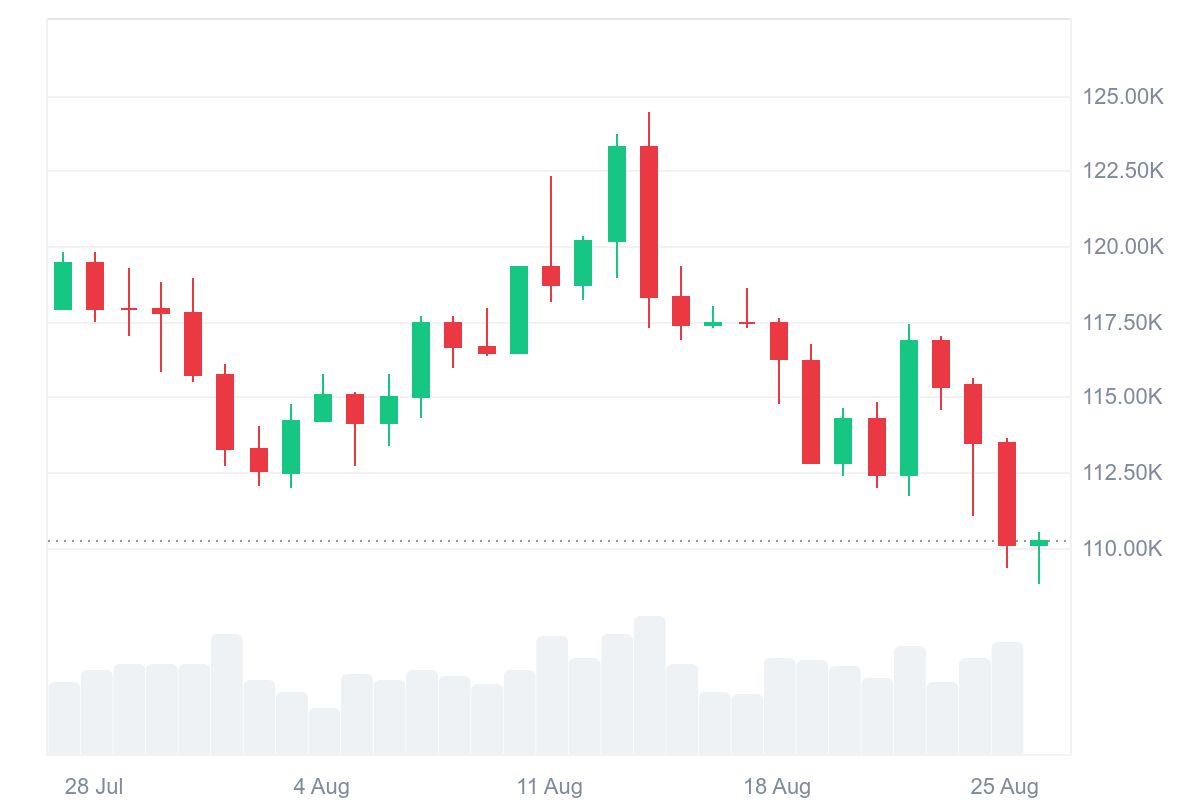
(Tuesday), August 26, 2025, Bitcoin trades at $110,185, down 2.83% from
yesterday and marking an 11% decline from its August 14 all-time high of
$124,533.
Market cap impact: Nearly $200 billion
wiped from crypto markets
Bitcoin price today. Source: CoinMarketCap.com
The selloff
triggered the largest liquidation event of the year, with $900 million in
leveraged positions getting forcibly closed across crypto derivatives
markets.
Why is Bitcoin Price Going
Down Today? 5 Main Reason
1.
Whale
Selling Triggers Flash Crash
eToro
analyst Simon Peters confirms the primary catalyst: "Bitcoin has slumped
lower and is now trading at $110,000 after a whale reportedly sold over 24,000
bitcoin (approximately $2.4 billion) on Sunday triggering a flash-crash".
This whale, likely an early Bitcoin adopter from the "Satoshi era,"
had purchased Bitcoin at around $10 or lower, making current prices extremely
profitable for exit strategies.
Yesterday saw one of the largest #Bitcoin long liquidation events since Dec 2024, with over $150M in longs wiped out as price moved lower. pic.twitter.com/okCNBMWl0j
Simon Peters, crypto analyst at eToro, Source: LinekdIn
2.
Technical
Breakdown Confirms Bearish Shift
Bitcoin's
technical outlook deteriorated significantly, with the cryptocurrency falling
below the 100-day simple moving average for the first time since April 22,
2025. The price also dropped below the Ichimoku cloud, indicating a bearish
shift in momentum. These dual breakdowns mirror the February pattern that
preceded a deeper selloff to $75,000.
3.
Overleveraged
Positioning Gets Squeezed
The sharp
move resulted from overleveraged positioning particularly following
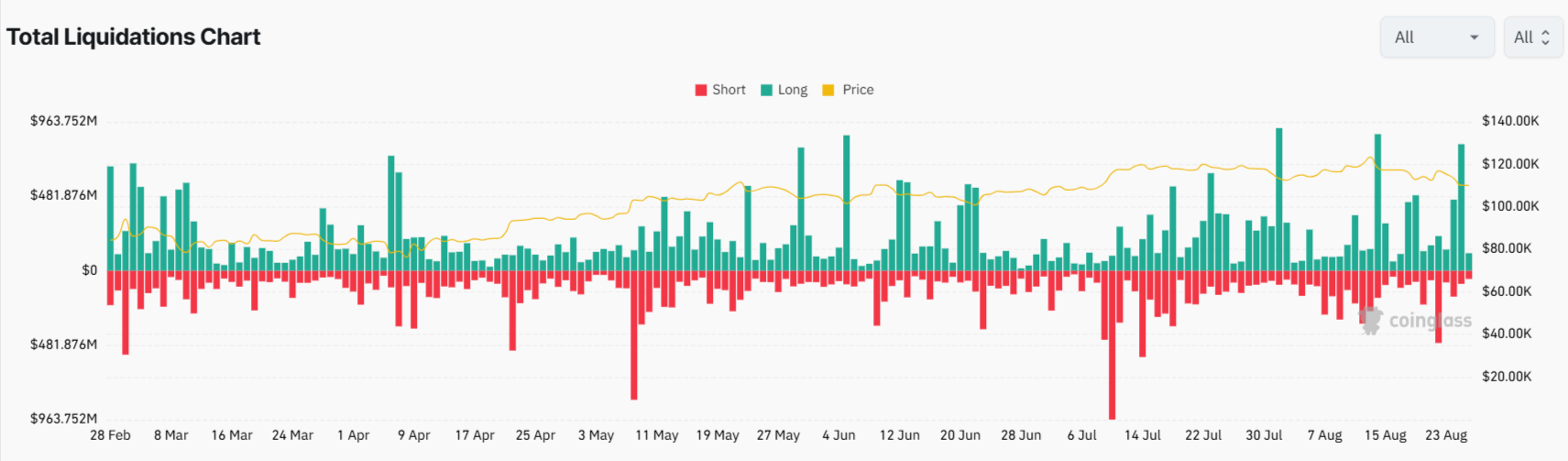
recent run-ups. Bitcoin traders faced $277 million in forced liquidations,
while Ethereum saw $320 million wiped out. Total liquidations across all
cryptocurrencies exceeded $900 million, with 90% being long positions betting
on higher prices.
4.
Market
Structure Reveals Fragility
Source: CoinGlass.com
Jamie Elkaleh, Chief Marketing Officer at Bitget Wallet
Jamie
Elkaleh, Chief Marketing Officer at Bitget Wallet, explains the deeper issue:
"Bitcoin's flash crash highlighted the market's ongoing liquidity
challenges. ETF outflows and weaker on-chain activity have left order books
thin, meaning large transactions, like August's $2.7B whale sale, can quickly
trigger cascading liquidations in over-leveraged futures markets."
5.
Seasonal
Headwinds Add Pressure
Peters
notes an ominous pattern: "September tends to be a month of the year, more
often than not, which has seen a negative performance for the bitcoin
price." Historical data shows September brings the weakest returns
for BTC with average losses of 3.77% during bull market years.
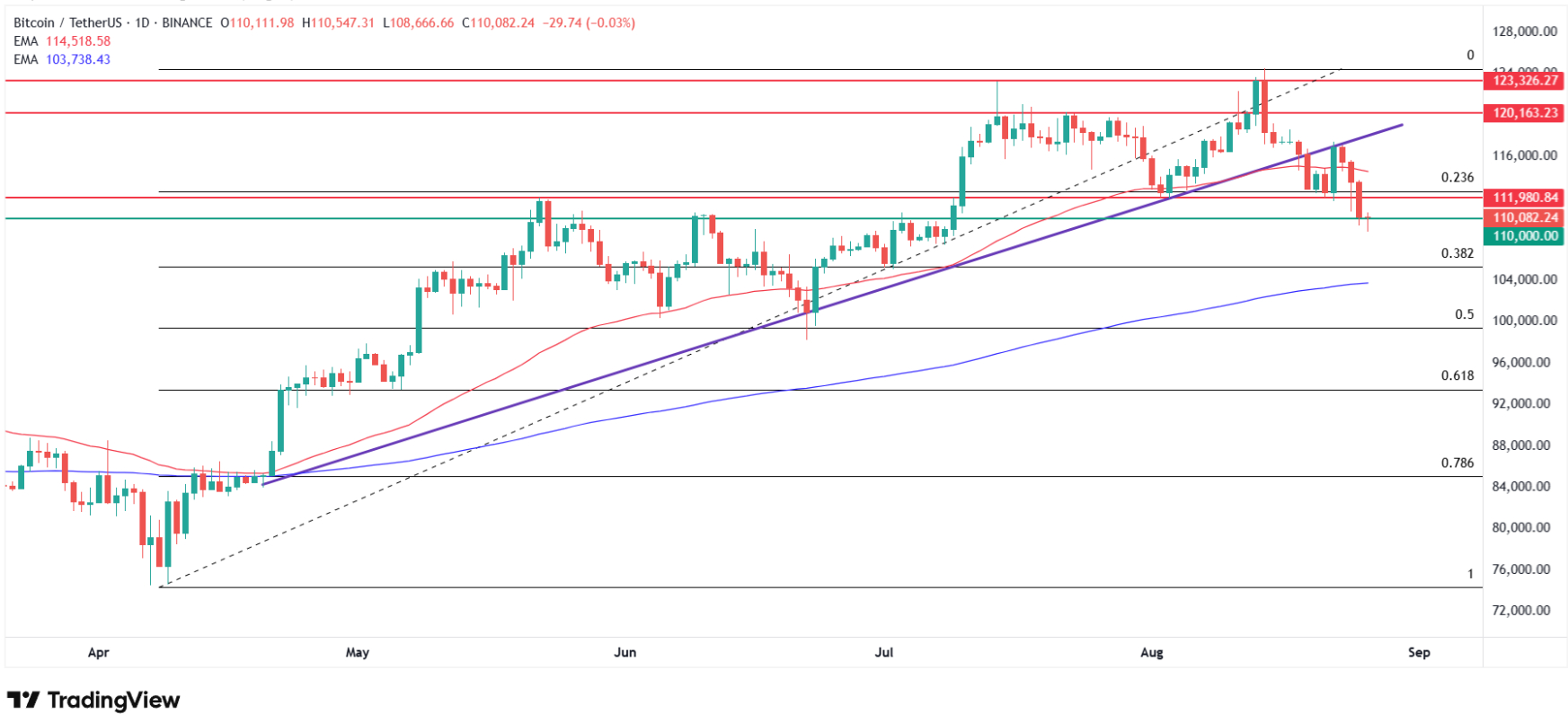
Based on my
technical analysis, since breaking the trendline drawn from the April lows, bears
have temporarily taken control of the BTC chart. At the moment, Bitcoin is
testing the support zone located between 110,000 and 112,000 dollars.
If this
zone is decisively breached, in my view, Bitcoin could open the way toward the
200 EMA, just below 104,000 dollars, and ultimately to the 50% Fibonacci
retracement, which coincides with the psychological 100,000-dollar level.
Bitcoin to USDT technical analysis on daily chart. Source: Tradingview.com
Ethereum And XRP Price
Down: Altcoins Are Falling Too
XRP
held better ground, remaining above its 100-day moving average though stuck
within the Ichimoku cloud, a zone of uncertainty. Solana (SOL) also
maintained its position above key technical levels, suggesting potential
outperformance if risk appetite returns.
The
divergence suggests potential rotation from Bitcoin to altcoins, with
analysts expecting Ethereum and SOL to outperform BTC if markets stabilize.
Bitcoin Price Prediction:
Institutional vs Retail Divide
Bearish Scenarios Dominate
Technical
analysts point to several downside targets if current support levels fail:
$105,300 (38.2%
Fibonacci retracement)
$100,000 (psychological
support and 200-day SMA)
$75,000 (aggressive bear
target, echoing Peter Schiff's prediction)
Market
pricing shows 35% implied odds for Bitcoin to revisit $100,000 by
September-end, up from 20% last week.
"The weakness in the near-term conviction among retail traders has not recalibrated the conviction of institutional and sovereign buyers, who are quietly using this dip period to scale in and extend their BTC exposure," Leo
Zhao, Investment Director at MEXC Ventures, commented. "Bitcoin now sits at a critical inflexion point, where it could enter a period of consolidation between $110,000 and $120,000. The
long-term picture, however, remains underpinned by institutional accumulation. Bitcoin retains the structural foundation for another
attempt at record highs of $130,000 before the EOY."
Institutional Accumulation Continues
Despite
retail liquidations, Elkaleh notes a key divergence: "The split between
retail liquidations and institutional accumulation reflects a market that is
maturing. Retail traders, often exposed to high leverage, are forced out during
corrections, while institutions use these episodes to accumulate
strategically."
MicroStrategy's
continued buying exemplifies this trend, with the company having
accumulated over 628,000 Bitcoin worth more than $71 billion at current prices.
Their strategy of buying near highs demonstrates institutional confidence in
Bitcoin's long-term trajectory.
Economic Data Could
Provide Relief
Peters sees
potential catalysts ahead: "There may be some hope for the crypto markets
to mark a comeback this week though, as we have more economic data in the form
of GDP figures, unemployment claims and PCE inflation data coming out from the
US. A slowing economy, higher unemployment claims and cooling inflation may
boost cryptoasset prices."
FAQ: Bitcoin Price Decline
Why did Bitcoin crash
below $110K today?
A whale
sold $2.7B worth of Bitcoin, triggering massive liquidations and technical
breakdowns below key moving averages.
What are the key support
levels for Bitcoin?
$105,390
(38.2% Fibonacci) and $100,928 (200-day SMA) represent critical support zones.
Could Bitcoin fall
further?
Yes. Technical
patterns suggest potential drops to $100K or lower if current supports fail,
with some targeting $75K.
The answer
to "Why is Bitcoin going down today?" lies in a perfect
storm of technical breakdowns, massive whale selling, and overleveraged
positioning that has sent Bitcoin (BTC) price tumbling to
its lowest levels in seven weeks.
The
cryptocurrency has already tested levels below 109,000 dollars, and although it
has rebounded above local support, the newest BTC price predictions and my
technical analysis suggest that at this point Bitcoin may still have room for
further declines.
Bitcoin Price Today:
Current Market Data
As of today
(Tuesday), August 26, 2025, Bitcoin trades at $110,185, down 2.83% from
yesterday and marking an 11% decline from its August 14 all-time high of
$124,533.
Market cap impact: Nearly $200 billion
wiped from crypto markets
Bitcoin price today. Source: CoinMarketCap.com
The selloff
triggered the largest liquidation event of the year, with $900 million in
leveraged positions getting forcibly closed across crypto derivatives
markets.
Why is Bitcoin Price Going
Down Today? 5 Main Reason
1.
Whale
Selling Triggers Flash Crash
eToro
analyst Simon Peters confirms the primary catalyst: "Bitcoin has slumped
lower and is now trading at $110,000 after a whale reportedly sold over 24,000
bitcoin (approximately $2.4 billion) on Sunday triggering a flash-crash".
This whale, likely an early Bitcoin adopter from the "Satoshi era,"
had purchased Bitcoin at around $10 or lower, making current prices extremely
profitable for exit strategies.
Yesterday saw one of the largest #Bitcoin long liquidation events since Dec 2024, with over $150M in longs wiped out as price moved lower. pic.twitter.com/okCNBMWl0j
Simon Peters, crypto analyst at eToro, Source: LinekdIn
2.
Technical
Breakdown Confirms Bearish Shift
Bitcoin's
technical outlook deteriorated significantly, with the cryptocurrency falling
below the 100-day simple moving average for the first time since April 22,
2025. The price also dropped below the Ichimoku cloud, indicating a bearish
shift in momentum. These dual breakdowns mirror the February pattern that
preceded a deeper selloff to $75,000.
3.
Overleveraged
Positioning Gets Squeezed
The sharp
move resulted from overleveraged positioning particularly following
recent run-ups. Bitcoin traders faced $277 million in forced liquidations,
while Ethereum saw $320 million wiped out. Total liquidations across all
cryptocurrencies exceeded $900 million, with 90% being long positions betting
on higher prices.
4.
Market
Structure Reveals Fragility
Source: CoinGlass.com
Jamie Elkaleh, Chief Marketing Officer at Bitget Wallet
Jamie
Elkaleh, Chief Marketing Officer at Bitget Wallet, explains the deeper issue:
"Bitcoin's flash crash highlighted the market's ongoing liquidity
challenges. ETF outflows and weaker on-chain activity have left order books
thin, meaning large transactions, like August's $2.7B whale sale, can quickly
trigger cascading liquidations in over-leveraged futures markets."
5.
Seasonal
Headwinds Add Pressure
Peters
notes an ominous pattern: "September tends to be a month of the year, more
often than not, which has seen a negative performance for the bitcoin
price." Historical data shows September brings the weakest returns
for BTC with average losses of 3.77% during bull market years.
Based on my
technical analysis, since breaking the trendline drawn from the April lows, bears
have temporarily taken control of the BTC chart. At the moment, Bitcoin is
testing the support zone located between 110,000 and 112,000 dollars.
If this
zone is decisively breached, in my view, Bitcoin could open the way toward the
200 EMA, just below 104,000 dollars, and ultimately to the 50% Fibonacci
retracement, which coincides with the psychological 100,000-dollar level.
Bitcoin to USDT technical analysis on daily chart. Source: Tradingview.com
Ethereum And XRP Price
Down: Altcoins Are Falling Too
XRP
held better ground, remaining above its 100-day moving average though stuck
within the Ichimoku cloud, a zone of uncertainty. Solana (SOL) also
maintained its position above key technical levels, suggesting potential
outperformance if risk appetite returns.
The
divergence suggests potential rotation from Bitcoin to altcoins, with
analysts expecting Ethereum and SOL to outperform BTC if markets stabilize.
Bitcoin Price Prediction:
Institutional vs Retail Divide
Bearish Scenarios Dominate
Technical
analysts point to several downside targets if current support levels fail:
$105,300 (38.2%
Fibonacci retracement)
$100,000 (psychological
support and 200-day SMA)
$75,000 (aggressive bear
target, echoing Peter Schiff's prediction)
Market
pricing shows 35% implied odds for Bitcoin to revisit $100,000 by
September-end, up from 20% last week.
"The weakness in the near-term conviction among retail traders has not recalibrated the conviction of institutional and sovereign buyers, who are quietly using this dip period to scale in and extend their BTC exposure," Leo
Zhao, Investment Director at MEXC Ventures, commented. "Bitcoin now sits at a critical inflexion point, where it could enter a period of consolidation between $110,000 and $120,000. The
long-term picture, however, remains underpinned by institutional accumulation. Bitcoin retains the structural foundation for another
attempt at record highs of $130,000 before the EOY."
Institutional Accumulation Continues
Despite
retail liquidations, Elkaleh notes a key divergence: "The split between
retail liquidations and institutional accumulation reflects a market that is
maturing. Retail traders, often exposed to high leverage, are forced out during
corrections, while institutions use these episodes to accumulate
strategically."
MicroStrategy's
continued buying exemplifies this trend, with the company having
accumulated over 628,000 Bitcoin worth more than $71 billion at current prices.
Their strategy of buying near highs demonstrates institutional confidence in
Bitcoin's long-term trajectory.
Economic Data Could
Provide Relief
Peters sees
potential catalysts ahead: "There may be some hope for the crypto markets
to mark a comeback this week though, as we have more economic data in the form
of GDP figures, unemployment claims and PCE inflation data coming out from the
US. A slowing economy, higher unemployment claims and cooling inflation may
boost cryptoasset prices."
FAQ: Bitcoin Price Decline
Why did Bitcoin crash
below $110K today?
A whale
sold $2.7B worth of Bitcoin, triggering massive liquidations and technical
breakdowns below key moving averages.
What are the key support
levels for Bitcoin?
$105,390
(38.2% Fibonacci) and $100,928 (200-day SMA) represent critical support zones.
Could Bitcoin fall
further?
Yes. Technical
patterns suggest potential drops to $100K or lower if current supports fail,
with some targeting $75K.
Damian Chmiel is a Senior Analyst & Editor at Finance Magnates with more than 15 years of experience in the CFD and online trading industry. Active as both a trader and journalist since 2010, he focuses on broker coverage, fintech innovation, and regulatory developments across Europe, the Middle East, and Asia.
His work includes interviews with C-level leaders at major brokerages and fintech platforms, as well as co-authoring Finance Magnates’ quarterly industry benchmarking reports. Damian’s reporting is data-driven, market-aware, and grounded in direct industry engagement. His analysis and commentary have also been cited by external media outlets, including Investing.com, Binance, The Asset, Stockhead, and Dispatch.
Education:
MA in Finance and Accounting, Cracow University of Economics
In this video, we review @HolaPrimeMarketsOfficial, a multi-asset forex and CFDs broker offering different account types, trading platforms, and flexible trading conditions.
We cover the broker’s overall offering, including account options, trading environment, platforms like MT4 and MT5, and additional services such as managed accounts and fast withdrawals.
Watch the full video to see if Hola Prime Markets fits your trading needs.
📣 Stay up to date with the latest in finance and trading. Follow Finance Magnates for industry news, insights, and global event coverage.
Connect with us:
🔗 LinkedIn: /financemagnates
👍 Facebook: /financemagnates
📸 Instagram: https://www.instagram.com/financemagnates
🐦 X: https://x.com/financemagnates
🎥 TikTok: https://www.tiktok.com/tag/financemagnates
▶️ YouTube: /@financemagnates_official
#HolaPrime #ForexBroker #CFDTrading #FinanceMagnates #Trading #Forex #BrokerReview
In this video, we review @HolaPrimeMarketsOfficial, a multi-asset forex and CFDs broker offering different account types, trading platforms, and flexible trading conditions.
We cover the broker’s overall offering, including account options, trading environment, platforms like MT4 and MT5, and additional services such as managed accounts and fast withdrawals.
Watch the full video to see if Hola Prime Markets fits your trading needs.
📣 Stay up to date with the latest in finance and trading. Follow Finance Magnates for industry news, insights, and global event coverage.
Connect with us:
🔗 LinkedIn: /financemagnates
👍 Facebook: /financemagnates
📸 Instagram: https://www.instagram.com/financemagnates
🐦 X: https://x.com/financemagnates
🎥 TikTok: https://www.tiktok.com/tag/financemagnates
▶️ YouTube: /@financemagnates_official
#HolaPrime #ForexBroker #CFDTrading #FinanceMagnates #Trading #Forex #BrokerReview
In this video, we review @HolaPrimeMarketsOfficial, a multi-asset forex and CFDs broker offering different account types, trading platforms, and flexible trading conditions.
We cover the broker’s overall offering, including account options, trading environment, platforms like MT4 and MT5, and additional services such as managed accounts and fast withdrawals.
Watch the full video to see if Hola Prime Markets fits your trading needs.
📣 Stay up to date with the latest in finance and trading. Follow Finance Magnates for industry news, insights, and global event coverage.
Connect with us:
🔗 LinkedIn: /financemagnates
👍 Facebook: /financemagnates
📸 Instagram: https://www.instagram.com/financemagnates
🐦 X: https://x.com/financemagnates
🎥 TikTok: https://www.tiktok.com/tag/financemagnates
▶️ YouTube: /@financemagnates_official
#HolaPrime #ForexBroker #CFDTrading #FinanceMagnates #Trading #Forex #BrokerReview
In this video, we review @HolaPrimeMarketsOfficial, a multi-asset forex and CFDs broker offering different account types, trading platforms, and flexible trading conditions.
We cover the broker’s overall offering, including account options, trading environment, platforms like MT4 and MT5, and additional services such as managed accounts and fast withdrawals.
Watch the full video to see if Hola Prime Markets fits your trading needs.
📣 Stay up to date with the latest in finance and trading. Follow Finance Magnates for industry news, insights, and global event coverage.
Connect with us:
🔗 LinkedIn: /financemagnates
👍 Facebook: /financemagnates
📸 Instagram: https://www.instagram.com/financemagnates
🐦 X: https://x.com/financemagnates
🎥 TikTok: https://www.tiktok.com/tag/financemagnates
▶️ YouTube: /@financemagnates_official
#HolaPrime #ForexBroker #CFDTrading #FinanceMagnates #Trading #Forex #BrokerReview
Hola Prime Review: What You Need to Know | Full Breakdown by Finance Magnates
Hola Prime Review: What You Need to Know | Full Breakdown by Finance Magnates
Hola Prime Review: What You Need to Know | Full Breakdown by Finance Magnates
Hola Prime Review: What You Need to Know | Full Breakdown by Finance Magnates
Hola Prime Review: What You Need to Know | Full Breakdown by Finance Magnates
Hola Prime Review: What You Need to Know | Full Breakdown by Finance Magnates
In this video, we review @HolaPrime_Global, a proprietary trading firm offering evaluation programs and performance-based payouts in simulated market environments.
We cover how the challenge model works, including account types, profit splits (up to 95%), trading rules, and what it takes to reach a funded account. You’ll also learn about available platforms like MT4, MT5, cTrader, and more, along with insights into payouts, support, and trading conditions.
Watch the full video to see if Hola Prime fits your trading style.
📣 Stay up to date with the latest in finance and trading. Follow Finance Magnates for industry news, insights, and global event coverage.
Connect with us:
🔗 LinkedIn: /financemagnates
👍 Facebook: /financemagnates
📸 Instagram: https://www.instagram.com/financemagnates
🐦 X: https://x.com/financemagnates
🎥 TikTok: https://www.tiktok.com/tag/financemagnates
▶️ YouTube: /@financemagnates_official
#HolaPrime #PropFirm #Trading #FinanceMagnates #Forex #FuturesTrading #TradingReview #PropFirmReview
In this video, we review @HolaPrime_Global, a proprietary trading firm offering evaluation programs and performance-based payouts in simulated market environments.
We cover how the challenge model works, including account types, profit splits (up to 95%), trading rules, and what it takes to reach a funded account. You’ll also learn about available platforms like MT4, MT5, cTrader, and more, along with insights into payouts, support, and trading conditions.
Watch the full video to see if Hola Prime fits your trading style.
📣 Stay up to date with the latest in finance and trading. Follow Finance Magnates for industry news, insights, and global event coverage.
Connect with us:
🔗 LinkedIn: /financemagnates
👍 Facebook: /financemagnates
📸 Instagram: https://www.instagram.com/financemagnates
🐦 X: https://x.com/financemagnates
🎥 TikTok: https://www.tiktok.com/tag/financemagnates
▶️ YouTube: /@financemagnates_official
#HolaPrime #PropFirm #Trading #FinanceMagnates #Forex #FuturesTrading #TradingReview #PropFirmReview
In this video, we review @HolaPrime_Global, a proprietary trading firm offering evaluation programs and performance-based payouts in simulated market environments.
We cover how the challenge model works, including account types, profit splits (up to 95%), trading rules, and what it takes to reach a funded account. You’ll also learn about available platforms like MT4, MT5, cTrader, and more, along with insights into payouts, support, and trading conditions.
Watch the full video to see if Hola Prime fits your trading style.
📣 Stay up to date with the latest in finance and trading. Follow Finance Magnates for industry news, insights, and global event coverage.
Connect with us:
🔗 LinkedIn: /financemagnates
👍 Facebook: /financemagnates
📸 Instagram: https://www.instagram.com/financemagnates
🐦 X: https://x.com/financemagnates
🎥 TikTok: https://www.tiktok.com/tag/financemagnates
▶️ YouTube: /@financemagnates_official
#HolaPrime #PropFirm #Trading #FinanceMagnates #Forex #FuturesTrading #TradingReview #PropFirmReview
In this video, we review @HolaPrime_Global, a proprietary trading firm offering evaluation programs and performance-based payouts in simulated market environments.
We cover how the challenge model works, including account types, profit splits (up to 95%), trading rules, and what it takes to reach a funded account. You’ll also learn about available platforms like MT4, MT5, cTrader, and more, along with insights into payouts, support, and trading conditions.
Watch the full video to see if Hola Prime fits your trading style.
📣 Stay up to date with the latest in finance and trading. Follow Finance Magnates for industry news, insights, and global event coverage.
Connect with us:
🔗 LinkedIn: /financemagnates
👍 Facebook: /financemagnates
📸 Instagram: https://www.instagram.com/financemagnates
🐦 X: https://x.com/financemagnates
🎥 TikTok: https://www.tiktok.com/tag/financemagnates
▶️ YouTube: /@financemagnates_official
#HolaPrime #PropFirm #Trading #FinanceMagnates #Forex #FuturesTrading #TradingReview #PropFirmReview
In this video, we review @HolaPrime_Global, a proprietary trading firm offering evaluation programs and performance-based payouts in simulated market environments.
We cover how the challenge model works, including account types, profit splits (up to 95%), trading rules, and what it takes to reach a funded account. You’ll also learn about available platforms like MT4, MT5, cTrader, and more, along with insights into payouts, support, and trading conditions.
Watch the full video to see if Hola Prime fits your trading style.
📣 Stay up to date with the latest in finance and trading. Follow Finance Magnates for industry news, insights, and global event coverage.
Connect with us:
🔗 LinkedIn: /financemagnates
👍 Facebook: /financemagnates
📸 Instagram: https://www.instagram.com/financemagnates
🐦 X: https://x.com/financemagnates
🎥 TikTok: https://www.tiktok.com/tag/financemagnates
▶️ YouTube: /@financemagnates_official
#HolaPrime #PropFirm #Trading #FinanceMagnates #Forex #FuturesTrading #TradingReview #PropFirmReview
In this video, we review @HolaPrime_Global, a proprietary trading firm offering evaluation programs and performance-based payouts in simulated market environments.
We cover how the challenge model works, including account types, profit splits (up to 95%), trading rules, and what it takes to reach a funded account. You’ll also learn about available platforms like MT4, MT5, cTrader, and more, along with insights into payouts, support, and trading conditions.
Watch the full video to see if Hola Prime fits your trading style.
📣 Stay up to date with the latest in finance and trading. Follow Finance Magnates for industry news, insights, and global event coverage.
Connect with us:
🔗 LinkedIn: /financemagnates
👍 Facebook: /financemagnates
📸 Instagram: https://www.instagram.com/financemagnates
🐦 X: https://x.com/financemagnates
🎥 TikTok: https://www.tiktok.com/tag/financemagnates
▶️ YouTube: /@financemagnates_official
#HolaPrime #PropFirm #Trading #FinanceMagnates #Forex #FuturesTrading #TradingReview #PropFirmReview
Axi Winner Spotlight 🏆 | Global Most Innovative Broker 2025 #Innovation #Trading #Fintech #Broker
Axi Winner Spotlight 🏆 | Global Most Innovative Broker 2025 #Innovation #Trading #Fintech #Broker
Axi Winner Spotlight 🏆 | Global Most Innovative Broker 2025 #Innovation #Trading #Fintech #Broker
Axi Winner Spotlight 🏆 | Global Most Innovative Broker 2025 #Innovation #Trading #Fintech #Broker
Axi Winner Spotlight 🏆 | Global Most Innovative Broker 2025 #Innovation #Trading #Fintech #Broker
Axi Winner Spotlight 🏆 | Global Most Innovative Broker 2025 #Innovation #Trading #Fintech #Broker
Axi takes the spotlight at the Finance Magnates Awards, winning Global Most Innovative Broker 2025.
Olivia Xenofontos and Ivanna Openko share how the team will feel: proud, motivated, and ready to keep delivering.
They also describe the night as well-organized, focused, and enjoyable for all.
👉 Be part of FM Awards 2026.
Axi takes the spotlight at the Finance Magnates Awards, winning Global Most Innovative Broker 2025.
Olivia Xenofontos and Ivanna Openko share how the team will feel: proud, motivated, and ready to keep delivering.
They also describe the night as well-organized, focused, and enjoyable for all.
👉 Be part of FM Awards 2026.
Axi takes the spotlight at the Finance Magnates Awards, winning Global Most Innovative Broker 2025.
Olivia Xenofontos and Ivanna Openko share how the team will feel: proud, motivated, and ready to keep delivering.
They also describe the night as well-organized, focused, and enjoyable for all.
👉 Be part of FM Awards 2026.
Axi takes the spotlight at the Finance Magnates Awards, winning Global Most Innovative Broker 2025.
Olivia Xenofontos and Ivanna Openko share how the team will feel: proud, motivated, and ready to keep delivering.
They also describe the night as well-organized, focused, and enjoyable for all.
👉 Be part of FM Awards 2026.
Axi takes the spotlight at the Finance Magnates Awards, winning Global Most Innovative Broker 2025.
Olivia Xenofontos and Ivanna Openko share how the team will feel: proud, motivated, and ready to keep delivering.
They also describe the night as well-organized, focused, and enjoyable for all.
👉 Be part of FM Awards 2026.
Axi takes the spotlight at the Finance Magnates Awards, winning Global Most Innovative Broker 2025.
Olivia Xenofontos and Ivanna Openko share how the team will feel: proud, motivated, and ready to keep delivering.
They also describe the night as well-organized, focused, and enjoyable for all.
👉 Be part of FM Awards 2026.
Recognition that matters.
Built on transparency.
Driven by the industry.
The Finance Magnates Awards 2026.
Nominations are now open.
🔗 https://awards.financemagnates.com/?utm_source=SM&utm_medium=social&utm_campaign=recognition-matters
Recognition that matters.
Built on transparency.
Driven by the industry.
The Finance Magnates Awards 2026.
Nominations are now open.
🔗 https://awards.financemagnates.com/?utm_source=SM&utm_medium=social&utm_campaign=recognition-matters
Recognition that matters.
Built on transparency.
Driven by the industry.
The Finance Magnates Awards 2026.
Nominations are now open.
🔗 https://awards.financemagnates.com/?utm_source=SM&utm_medium=social&utm_campaign=recognition-matters
Recognition that matters.
Built on transparency.
Driven by the industry.
The Finance Magnates Awards 2026.
Nominations are now open.
🔗 https://awards.financemagnates.com/?utm_source=SM&utm_medium=social&utm_campaign=recognition-matters
Recognition that matters.
Built on transparency.
Driven by the industry.
The Finance Magnates Awards 2026.
Nominations are now open.
🔗 https://awards.financemagnates.com/?utm_source=SM&utm_medium=social&utm_campaign=recognition-matters
Recognition that matters.
Built on transparency.
Driven by the industry.
The Finance Magnates Awards 2026.
Nominations are now open.
🔗 https://awards.financemagnates.com/?utm_source=SM&utm_medium=social&utm_campaign=recognition-matters
Tickmill Winner Spotlight | Broker of the Year 2025 (LATAM) 🏆 | Finance Magnates Awards #Trading
Tickmill Winner Spotlight | Broker of the Year 2025 (LATAM) 🏆 | Finance Magnates Awards #Trading
Tickmill Winner Spotlight | Broker of the Year 2025 (LATAM) 🏆 | Finance Magnates Awards #Trading
Tickmill Winner Spotlight | Broker of the Year 2025 (LATAM) 🏆 | Finance Magnates Awards #Trading
Tickmill Winner Spotlight | Broker of the Year 2025 (LATAM) 🏆 | Finance Magnates Awards #Trading
Tickmill Winner Spotlight | Broker of the Year 2025 (LATAM) 🏆 | Finance Magnates Awards #Trading
What helped Tickmill stand out this year?
In this Winner Spotlight, Johnny Khalil, Executive Director at Tickmill Europe, shares how listening closely to clients and delivering strong trading conditions made the difference.
A big thank you to the community whose support continues to drive progress every day.
👉 Think your brand has what it takes? Nominate for the 2026 Finance Magnates Awards: https://awards.financemagnates.com/#nominate
What helped Tickmill stand out this year?
In this Winner Spotlight, Johnny Khalil, Executive Director at Tickmill Europe, shares how listening closely to clients and delivering strong trading conditions made the difference.
A big thank you to the community whose support continues to drive progress every day.
👉 Think your brand has what it takes? Nominate for the 2026 Finance Magnates Awards: https://awards.financemagnates.com/#nominate
What helped Tickmill stand out this year?
In this Winner Spotlight, Johnny Khalil, Executive Director at Tickmill Europe, shares how listening closely to clients and delivering strong trading conditions made the difference.
A big thank you to the community whose support continues to drive progress every day.
👉 Think your brand has what it takes? Nominate for the 2026 Finance Magnates Awards: https://awards.financemagnates.com/#nominate
What helped Tickmill stand out this year?
In this Winner Spotlight, Johnny Khalil, Executive Director at Tickmill Europe, shares how listening closely to clients and delivering strong trading conditions made the difference.
A big thank you to the community whose support continues to drive progress every day.
👉 Think your brand has what it takes? Nominate for the 2026 Finance Magnates Awards: https://awards.financemagnates.com/#nominate
What helped Tickmill stand out this year?
In this Winner Spotlight, Johnny Khalil, Executive Director at Tickmill Europe, shares how listening closely to clients and delivering strong trading conditions made the difference.
A big thank you to the community whose support continues to drive progress every day.
👉 Think your brand has what it takes? Nominate for the 2026 Finance Magnates Awards: https://awards.financemagnates.com/#nominate
What helped Tickmill stand out this year?
In this Winner Spotlight, Johnny Khalil, Executive Director at Tickmill Europe, shares how listening closely to clients and delivering strong trading conditions made the difference.
A big thank you to the community whose support continues to drive progress every day.
👉 Think your brand has what it takes? Nominate for the 2026 Finance Magnates Awards: https://awards.financemagnates.com/#nominate