Financial and Business News

Weak Guidance Exposes AI Lag at Salesforce

Thursday, 04/09/2025 | 08:53 GMT by Louis Parks
  • Salesforce guides revenue below estimates, shares slip , investors question AI payback.
  • Agentforce wins demos, not dollars yet, and is yet to impress investors.
  • Market wants proof of priced AI adoption and upsell, not promises for the future.
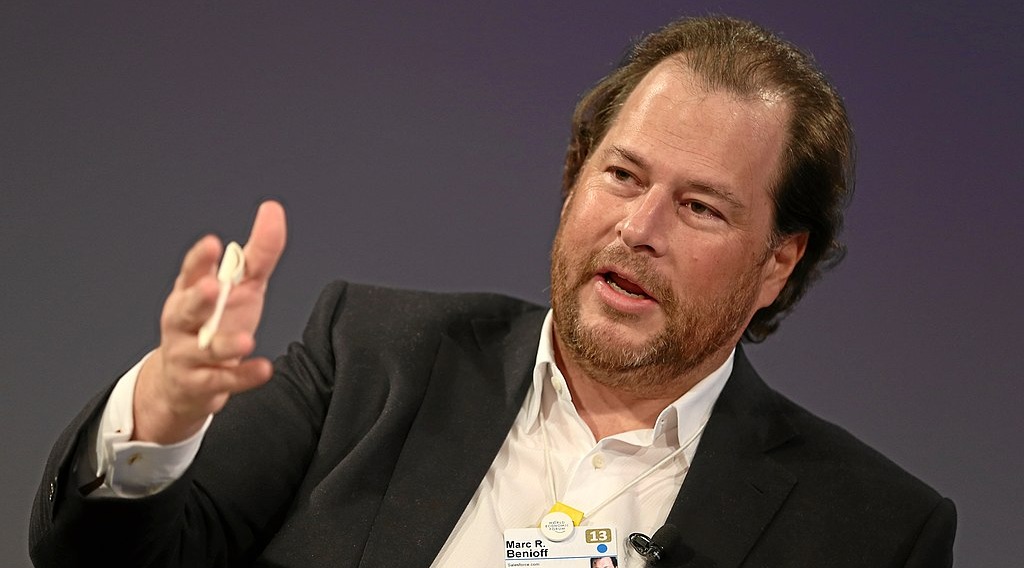
Salesforce CEO Marc Benioff AI
Salesforce CEO Marc Benioff had touted the impact of AI at the company (Wiki, Creative Commons).

Salesforce’s Q3 revenue outlook trails the Street, shares sag in after-hours, and a bigger buyback does little to paper over a slower payoff from Agentforce-style AI.

The Headline number that Hit the Stock

Salesforce, the company behind untold millions of businesses’ CRMs, told investors to expect Q3 revenue of $10.24 billion to $10.29 billion. The midpoint sits below the average analyst estimate, and traders did not love it. Shares fell more than 5% in extended trading after the release. The company also guided adjusted EPS to $2.84 to $2.86 for the quarter, roughly in line with expectations.

An AI promise is Still a Promise

Many are seeing the miss as a monetization story. Salesforce has rolled out its Agentforce platform and woven artificial intelligence (AI ) across clouds, yet analysts highlighted that payback is taking longer than investors hoped. The company even pointed to efficiency gains from AI internally. Speaking on The Logan Bartlett Show last week, Salesforce CEO Marc Benioff said AI-driven efficiencies let the company trim 4,000 customer support roles from a 9,000-person team. According to Reuters, AI now accounts for roughly 30% to 50% of its work. Great for margins, less convincing for near-term top line acceleration.

What This Says About Broader Market Trends

The Salesforce wobble is a microcosm of 2025’s software tape. Investors have become allergic to stories that lean on “AI soon” rather than “AI now.” Hardware and infra players have booked the obvious early gains.

Application-layer vendors need to prove two things to get a rerating: that AI features are priced as products rather than freebies inside bundles, and that customers are deploying at scale rather than running pilots forever. Salesforce’s guide implies deal cycles still feel macro drag and AI add-ons are not yet a material second engine. That is not unique to CRM, but because Salesforce is the category bellwether, the patience bar is lower and the scrutiny bar is higher.

The Street’s Message in Plain English

Investors can live with flat to slightly lower growth if visibility improves. They cannot live with lower growth and fuzzy AI monetization timing. The after-hours slide tells you that buybacks are table stakes, not catalysts, and that the market wants a clean line from Agentforce usage to upsell to dollars. Until then, every software guide gets graded on two curves: macro and AI conversion. Salesforce just showed how unforgiving that curve is when you come in light.

Where Salesforce Goes from Here

There are levers. The company still posted a revenue beat for the prior quarter, it continues to push AI throughout the stack, and it is not shy about cost discipline. But the next phase requires pricing power on AI features, proof that autonomous service agents reduce churn or unlock new seats, and fewer headlines about layoffs and more about large customers going wall-to-wall with paid AI bundles. If Salesforce can show that on the next call, the stock reaction will look very different. If not, expect buybacks to keep doing more heavy lifting than investors care to admit.

For more stories of tech around the edges of finance, follow our Trending pages.

Salesforce’s Q3 revenue outlook trails the Street, shares sag in after-hours, and a bigger buyback does little to paper over a slower payoff from Agentforce-style AI.

The Headline number that Hit the Stock

Salesforce, the company behind untold millions of businesses’ CRMs, told investors to expect Q3 revenue of $10.24 billion to $10.29 billion. The midpoint sits below the average analyst estimate, and traders did not love it. Shares fell more than 5% in extended trading after the release. The company also guided adjusted EPS to $2.84 to $2.86 for the quarter, roughly in line with expectations.

An AI promise is Still a Promise

Many are seeing the miss as a monetization story. Salesforce has rolled out its Agentforce platform and woven artificial intelligence (AI ) across clouds, yet analysts highlighted that payback is taking longer than investors hoped. The company even pointed to efficiency gains from AI internally. Speaking on The Logan Bartlett Show last week, Salesforce CEO Marc Benioff said AI-driven efficiencies let the company trim 4,000 customer support roles from a 9,000-person team. According to Reuters, AI now accounts for roughly 30% to 50% of its work. Great for margins, less convincing for near-term top line acceleration.

What This Says About Broader Market Trends

The Salesforce wobble is a microcosm of 2025’s software tape. Investors have become allergic to stories that lean on “AI soon” rather than “AI now.” Hardware and infra players have booked the obvious early gains.

Application-layer vendors need to prove two things to get a rerating: that AI features are priced as products rather than freebies inside bundles, and that customers are deploying at scale rather than running pilots forever. Salesforce’s guide implies deal cycles still feel macro drag and AI add-ons are not yet a material second engine. That is not unique to CRM, but because Salesforce is the category bellwether, the patience bar is lower and the scrutiny bar is higher.

The Street’s Message in Plain English

Investors can live with flat to slightly lower growth if visibility improves. They cannot live with lower growth and fuzzy AI monetization timing. The after-hours slide tells you that buybacks are table stakes, not catalysts, and that the market wants a clean line from Agentforce usage to upsell to dollars. Until then, every software guide gets graded on two curves: macro and AI conversion. Salesforce just showed how unforgiving that curve is when you come in light.

Where Salesforce Goes from Here

There are levers. The company still posted a revenue beat for the prior quarter, it continues to push AI throughout the stack, and it is not shy about cost discipline. But the next phase requires pricing power on AI features, proof that autonomous service agents reduce churn or unlock new seats, and fewer headlines about layoffs and more about large customers going wall-to-wall with paid AI bundles. If Salesforce can show that on the next call, the stock reaction will look very different. If not, expect buybacks to keep doing more heavy lifting than investors care to admit.

For more stories of tech around the edges of finance, follow our Trending pages.

About the Author: Louis Parks
Louis Parks
  • 430 Articles
  • 9 Followers
Louis Parks has lived and worked in and around the Middle East for much of his professional career. He writes about the meeting of the tech and finance worlds.

More from the Author

Trending