Financial and Business News

Snap Stock Surges After Snap OS 2.0 Reveal, Spectacles Coming in 2026

Monday, 22/09/2025 | 07:35 GMT by Louis Parks
  • Snap stock jumps ~5-6% on news of Snap OS 2.0 and Spectacles’ 2026 release.
  • Update includes WebXR support, widgets, voice and gesture controls hinting at VR future.
  • Investors see both upside and risk in a notoriously hard to grasp sector.
Snap SnapChat
Snap's OS 2.0 is a bet on the VR/AR future of social media and the stock is rising (Snap).

Investors are betting that Snap’s leap into AR, browser tools, and native WebXR will reshape social media, and its stock price.

Snap’s Stock Surge: What Just Happened

Snap Inc (NYSE: SNAP), the parent company of social media platform Snapchat, closed at $8.44, up 5.63% on heavy trading, 186.9 million shares versus its three-month average of 59 million. That spike came just after Snap revealed Snap OS 2.0 and confirmed its plan to release consumer-ready Spectacles in 2026.

Investors aren’t just excited about an update; they’re buying into the hardware-plus-platform vision. Compared to its social media peers, Snap outpaced Meta and Reddit on that day.

What’s New in Snap OS 2.0 and Spectacles

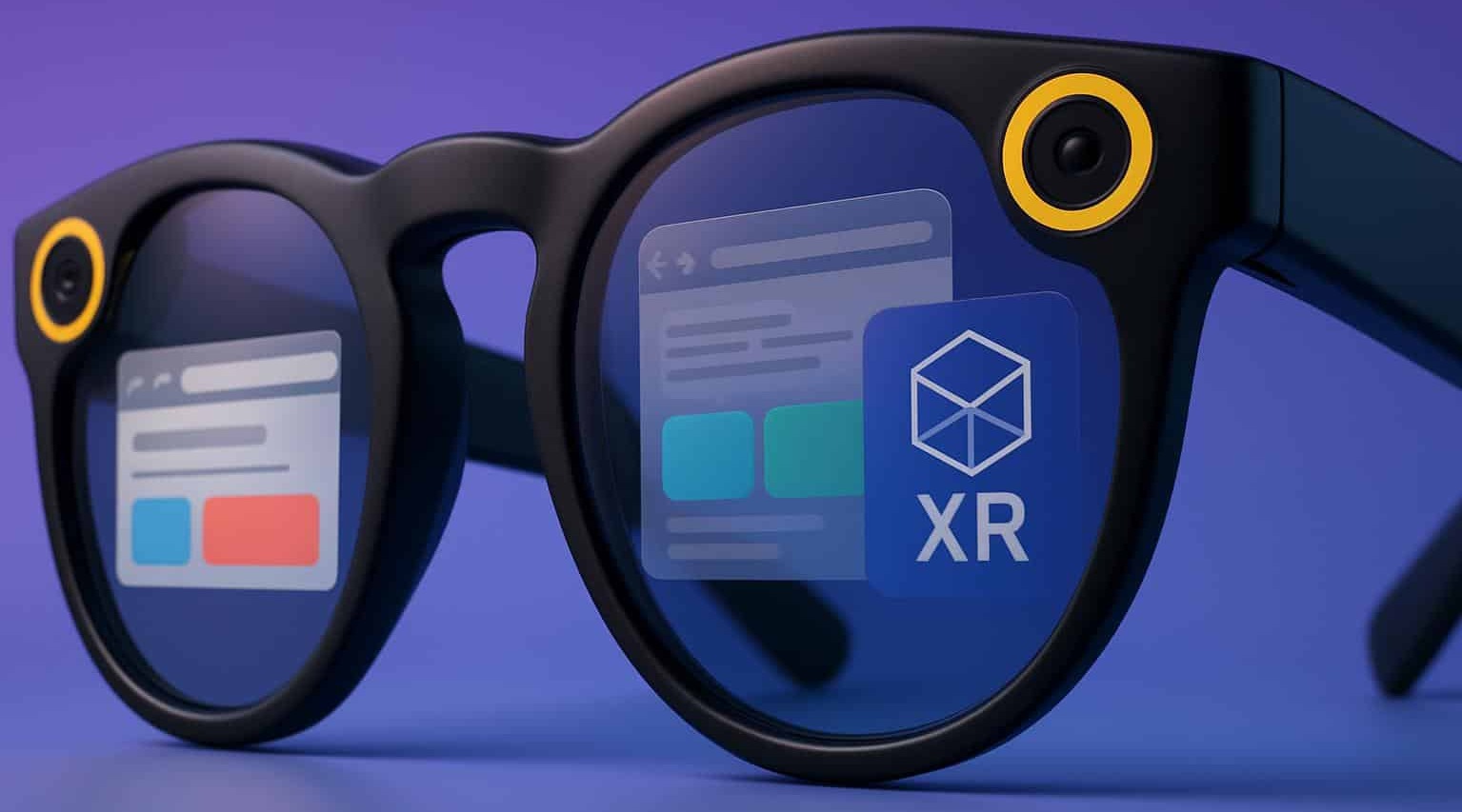
Snap OS is the operating system behind Spectacles, the AR glasses that Snap has been refining. The 2.0 version brings in a lot:

  • A redesigned browser with WebXR support, meaning web-based immersive/augmented reality content can run more smoothly.
  • New home screen widgets, bookmarks, an updated toolbar letting you type or speak URLs, navigate history, refresh, resize windows.
  • A reimagined Spotlight Lens that overlays content in your real world. Watch a video while doing chores, literally.
  • Travel Mode to keep AR experiences stable when the user is in motion, i.e. on trains or planes

The Spectacles remain in development; the consumer version is expected in 2026.

Why Are Investors Excited?

Snap is not just updating its app; it’s building an ecosystem that leans into AR and WebXR. The ability to browse immersive content, interact with it hands-free or by voice, plus gadgetry like Spectacles, pushes toward a social experience beyond the flat screen. That could change not just how we use Snapchat, but how we socialize, consume video, or even shop.

Launching hardware (Spectacles) is expensive and challenging. Snap’s previous efforts got mixed reviews. But OS 2.0 demonstrates a more mature, integrated stack: software features plus AR hardware. If adoption picks up, there’s a bundling, monetization, and user engagement upside that could outsize traditional ad-based growth.

The roughly 5-6% jump isn’t trivial. It shows confidence among traders that Snap OS 2.0 is more than just cosmetic. The trading volume being about three times its three-month average suggests this isn’t a whisper campaign, it’s noise with substance.

But keep in mind: it's momentum, not a guarantee. Snap has yet to prove that Spectacles in 2026 will sell well, or that WebXR/AR experiences will drive enough monetization to offset expenses.

Spectacles and How Use Patterns May Shift

Snap OS 2.0 bets that we, the users, will want less phone, more world-augmented. Widgets, voice and gesture, stable AR while moving, all these encourage more time with hardware like Spectacles instead of screens. Maybe in-home, maybe out: imagine checking weather, social content, or streaming hands-free in mixed reality settings.

We could see a gradual migration of certain content consumption (video, social posts, calls) from phones/tablets to AR glasses. That could shift what kinds of content get made (more immersive, more 3D, more spatial). Also could disrupt how advertisers think about ads: instead of feed placements, maybe lenses/workflows in AR.

All this has investors salivating.

Potential Hurdles

While the potential is relatively easy to understand, there are a number of issues at play:

  • Cost and margins: Hardware margins are thin; AR hardware is especially costly. If Spectacles fail to achieve scale, the investment might remain a weight.
  • User adoption: Glasses wearables have struggled historically (Google Glass, anyone?). Comfort, utility, aesthetics all matter. Will enough people use Spectacles outside early adopters?
  • Competition: Meta, Apple, Google are all pushing AR/VR. Snap needs strong differentiation.
  • Monetization challenge: It’s easier to build eye-catching features than to turn them into sustained revenue. Ads in AR, content monetization, hardware pricing, all are tricky.

A Bet on the Evolution of Social Media

If you believe the future of social media is immersive, spatial, and Artificial Intelligence (AI )-generated, Snap OS 2.0 + the Spectacles roadmap might justify adding Snap now. The stock has reacted strongly, the roadmap is ambitious, and Snap has been showing user growth and ad platform innovation.

If you’re more cautious: maybe wait to see how initial user feedback is, how early hardware units perform, and whether Snap can keep its burn under control. Upside is large, but downside risk is real.

Overall, this is a bet on social media,. And social media is an incredibly challenging domain in which to make predictions and there's plenty of volatility there. What is certain is that interactivity (combined with artificial intelligence) is the next frontier. The question is, is Snap the company to get it right…?

For more current stories of tech, stocks and finance, visit our dedicated pages.

Investors are betting that Snap’s leap into AR, browser tools, and native WebXR will reshape social media, and its stock price.

Snap’s Stock Surge: What Just Happened

Snap Inc (NYSE: SNAP), the parent company of social media platform Snapchat, closed at $8.44, up 5.63% on heavy trading, 186.9 million shares versus its three-month average of 59 million. That spike came just after Snap revealed Snap OS 2.0 and confirmed its plan to release consumer-ready Spectacles in 2026.

Investors aren’t just excited about an update; they’re buying into the hardware-plus-platform vision. Compared to its social media peers, Snap outpaced Meta and Reddit on that day.

What’s New in Snap OS 2.0 and Spectacles

Snap OS is the operating system behind Spectacles, the AR glasses that Snap has been refining. The 2.0 version brings in a lot:

  • A redesigned browser with WebXR support, meaning web-based immersive/augmented reality content can run more smoothly.
  • New home screen widgets, bookmarks, an updated toolbar letting you type or speak URLs, navigate history, refresh, resize windows.
  • A reimagined Spotlight Lens that overlays content in your real world. Watch a video while doing chores, literally.
  • Travel Mode to keep AR experiences stable when the user is in motion, i.e. on trains or planes

The Spectacles remain in development; the consumer version is expected in 2026.

Why Are Investors Excited?

Snap is not just updating its app; it’s building an ecosystem that leans into AR and WebXR. The ability to browse immersive content, interact with it hands-free or by voice, plus gadgetry like Spectacles, pushes toward a social experience beyond the flat screen. That could change not just how we use Snapchat, but how we socialize, consume video, or even shop.

Launching hardware (Spectacles) is expensive and challenging. Snap’s previous efforts got mixed reviews. But OS 2.0 demonstrates a more mature, integrated stack: software features plus AR hardware. If adoption picks up, there’s a bundling, monetization, and user engagement upside that could outsize traditional ad-based growth.

The roughly 5-6% jump isn’t trivial. It shows confidence among traders that Snap OS 2.0 is more than just cosmetic. The trading volume being about three times its three-month average suggests this isn’t a whisper campaign, it’s noise with substance.

But keep in mind: it's momentum, not a guarantee. Snap has yet to prove that Spectacles in 2026 will sell well, or that WebXR/AR experiences will drive enough monetization to offset expenses.

Spectacles and How Use Patterns May Shift

Snap OS 2.0 bets that we, the users, will want less phone, more world-augmented. Widgets, voice and gesture, stable AR while moving, all these encourage more time with hardware like Spectacles instead of screens. Maybe in-home, maybe out: imagine checking weather, social content, or streaming hands-free in mixed reality settings.

We could see a gradual migration of certain content consumption (video, social posts, calls) from phones/tablets to AR glasses. That could shift what kinds of content get made (more immersive, more 3D, more spatial). Also could disrupt how advertisers think about ads: instead of feed placements, maybe lenses/workflows in AR.

All this has investors salivating.

Potential Hurdles

While the potential is relatively easy to understand, there are a number of issues at play:

  • Cost and margins: Hardware margins are thin; AR hardware is especially costly. If Spectacles fail to achieve scale, the investment might remain a weight.
  • User adoption: Glasses wearables have struggled historically (Google Glass, anyone?). Comfort, utility, aesthetics all matter. Will enough people use Spectacles outside early adopters?
  • Competition: Meta, Apple, Google are all pushing AR/VR. Snap needs strong differentiation.
  • Monetization challenge: It’s easier to build eye-catching features than to turn them into sustained revenue. Ads in AR, content monetization, hardware pricing, all are tricky.

A Bet on the Evolution of Social Media

If you believe the future of social media is immersive, spatial, and Artificial Intelligence (AI )-generated, Snap OS 2.0 + the Spectacles roadmap might justify adding Snap now. The stock has reacted strongly, the roadmap is ambitious, and Snap has been showing user growth and ad platform innovation.

If you’re more cautious: maybe wait to see how initial user feedback is, how early hardware units perform, and whether Snap can keep its burn under control. Upside is large, but downside risk is real.

Overall, this is a bet on social media,. And social media is an incredibly challenging domain in which to make predictions and there's plenty of volatility there. What is certain is that interactivity (combined with artificial intelligence) is the next frontier. The question is, is Snap the company to get it right…?

For more current stories of tech, stocks and finance, visit our dedicated pages.

About the Author: Louis Parks
Louis Parks
  • 430 Articles
  • 9 Followers
Louis Parks has lived and worked in and around the Middle East for much of his professional career. He writes about the meeting of the tech and finance worlds.

More from the Author

Trending