CEO Brad Garlinghouse confirmed Ripple owns over $100 billion in XRP.
The recent transfer is larger than the total amount it sent in December 2024.
Ripple, a San Francisco-based blockchain company, recently
transferred $682 million worth of XRP to an unknown wallet, according to data
from Whale Alert, a service that tracks large cryptocurrency transactions.
Meanwhile, XRPUSD has been moving upward on the intraday
charts following a decline yesterday (Thursday).
XRP Transfer Marks First Major Move Since December
This marks the company's first major transfer since December
21, when it sent over $200 million XRP in two transactions. The latest transfer
surpasses the total amount Ripple sent in December.
Ripple's CEO Brad Garlinghouse has confirmed the company holds
more than $100 billion worth of XRP tokens, which he suggests should be
considered when valuing the company, as reported by U.Today.
XRPUSD Holds Support, Eyes Bullish Rebound
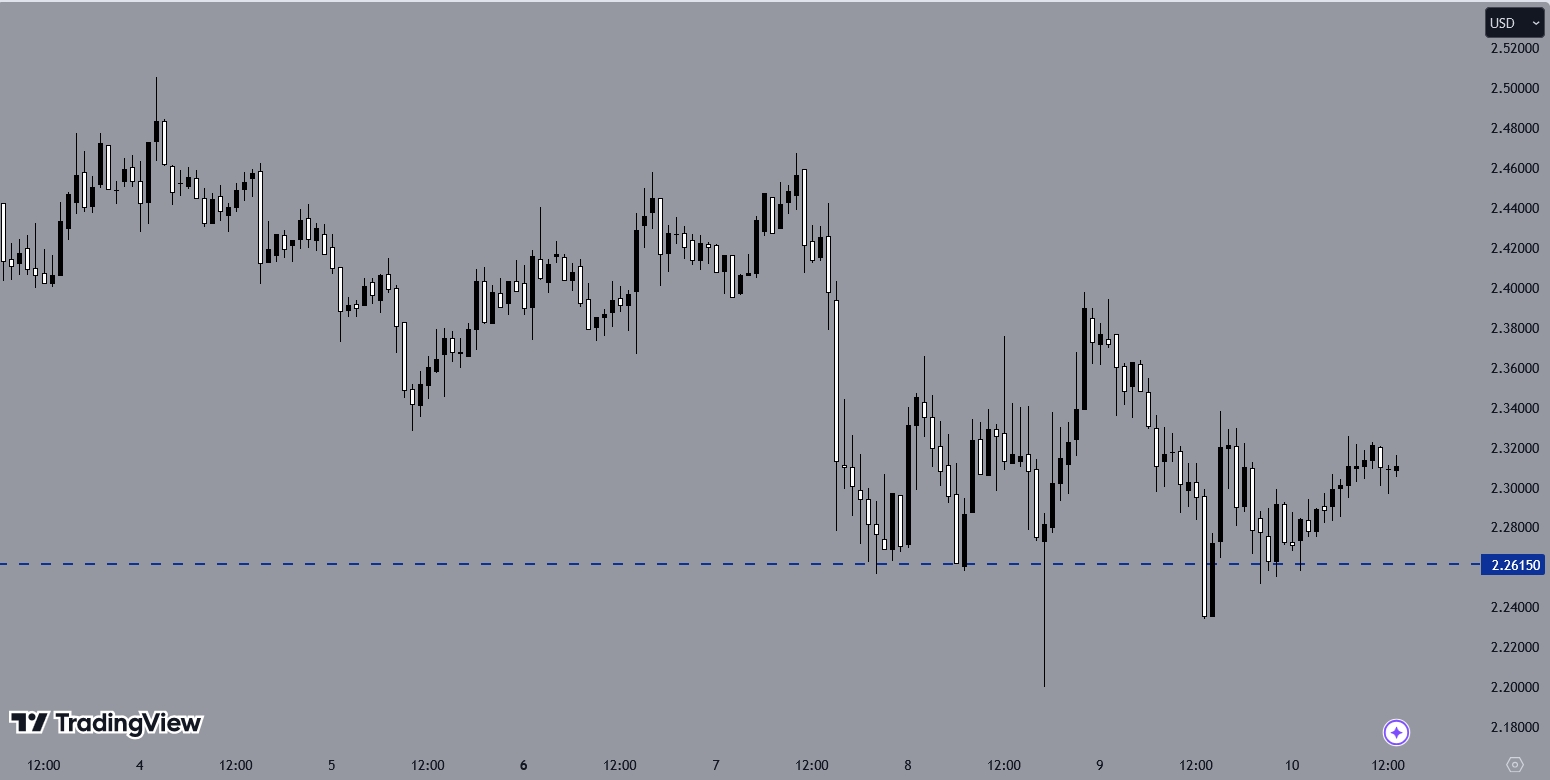
XRPUSD experienced a bearish session yesterday. On the H1
chart, the price attempted to breach the 2.26150 level but retreated to the
support level. Currently, the price is moving upward at a moderate pace. A
bearish breakout below 2.26150 could push the price lower. However, if the
support holds, XRPUSD may end up having a bullish day.
XRPUSD, H1 Chart, Source: TradingView
Ripple's Developments: High-Profile Meetings and
Strategic Partnerships
This high-profile meeting has sparked further speculation
about Ripple’s ongoing legal battle with the US Securities and Exchange
Commission (SEC), which filed a lawsuit against the company in December 2020.
The lawsuit accuses Ripple of selling XRP tokens as unregistered securities,
and the case’s outcome could have significant implications for the regulation
of digital assets in the US.
In another major development, all
banks in Japan are set to adopt Ripple’s XRP Ledger in 2025. The
integration with the Interledger Protocol (ILP), announced by SBI CEO Yoshitaka
Kitao, aims to streamline cross-border payments and currency conversions,
offering a more efficient and cost-effective solution for international
remittances.
Ripple has also made strides in the decentralized
finance (DeFi) space through its partnership with Chainlink. This
collaboration, launched on the Ethereum blockchain, integrates Ripple's RLUSD
stablecoin with DeFi applications such as trading and lending. The RLUSD
stablecoin, pegged to the US dollar, was introduced on both the Ethereum and
XRP Ledger networks last month, with a market capitalization of $72 million,
according to CoinGecko.
Ripple, a San Francisco-based blockchain company, recently
transferred $682 million worth of XRP to an unknown wallet, according to data
from Whale Alert, a service that tracks large cryptocurrency transactions.
Meanwhile, XRPUSD has been moving upward on the intraday
charts following a decline yesterday (Thursday).
XRP Transfer Marks First Major Move Since December
This marks the company's first major transfer since December
21, when it sent over $200 million XRP in two transactions. The latest transfer
surpasses the total amount Ripple sent in December.
Ripple's CEO Brad Garlinghouse has confirmed the company holds
more than $100 billion worth of XRP tokens, which he suggests should be
considered when valuing the company, as reported by U.Today.
XRPUSD Holds Support, Eyes Bullish Rebound
XRPUSD experienced a bearish session yesterday. On the H1
chart, the price attempted to breach the 2.26150 level but retreated to the
support level. Currently, the price is moving upward at a moderate pace. A
bearish breakout below 2.26150 could push the price lower. However, if the
support holds, XRPUSD may end up having a bullish day.
XRPUSD, H1 Chart, Source: TradingView
Ripple's Developments: High-Profile Meetings and
Strategic Partnerships
This high-profile meeting has sparked further speculation
about Ripple’s ongoing legal battle with the US Securities and Exchange
Commission (SEC), which filed a lawsuit against the company in December 2020.
The lawsuit accuses Ripple of selling XRP tokens as unregistered securities,
and the case’s outcome could have significant implications for the regulation
of digital assets in the US.
In another major development, all
banks in Japan are set to adopt Ripple’s XRP Ledger in 2025. The
integration with the Interledger Protocol (ILP), announced by SBI CEO Yoshitaka
Kitao, aims to streamline cross-border payments and currency conversions,
offering a more efficient and cost-effective solution for international
remittances.
Ripple has also made strides in the decentralized
finance (DeFi) space through its partnership with Chainlink. This
collaboration, launched on the Ethereum blockchain, integrates Ripple's RLUSD
stablecoin with DeFi applications such as trading and lending. The RLUSD
stablecoin, pegged to the US dollar, was introduced on both the Ethereum and
XRP Ledger networks last month, with a market capitalization of $72 million,
according to CoinGecko.
Tareq is a financial writer with 15 years of experience covering global markets. His work spans technical analysis, forex broker reviews, and market sentiment, with a focus on topics relevant to retail traders. He joined Finance Magnates in 2023.
At Finance Magnates, he serves as News Editor, covering retail forex and CFD brokers, cryptocurrency exchanges, fintech firms, and regulatory developments shaping the trading industry. He holds an Honours degree in Information Technology from Anfell College, London.
Education:
Honours degree Information Technology, Anfell College, London
Inside the Prediction Markets: $1.6B Institutional Inflow Meets a Federal Crackdown
FP Markets Winner Spotlight 🏆 | Global Broker of the Year 2025 #Trading #Broker #Innovation #Shorts
FP Markets Winner Spotlight 🏆 | Global Broker of the Year 2025 #Trading #Broker #Innovation #Shorts
FP Markets takes the spotlight as Global Broker of the Year 2025 at the Finance Magnates Awards.
Martin Stoilov, Head of Client Experience, shares that trust, innovation, and people played a key role in the company’s success, supported by a strong foundation of integrity and client-centricity.
Following this milestone, FP Markets continues to focus on growth, technology investment, and its core values of transparency and excellence.
👉 Be part of FM Awards 2026: https://awards.financemagnates.com/#nominate
FP Markets takes the spotlight as Global Broker of the Year 2025 at the Finance Magnates Awards.
Martin Stoilov, Head of Client Experience, shares that trust, innovation, and people played a key role in the company’s success, supported by a strong foundation of integrity and client-centricity.
Following this milestone, FP Markets continues to focus on growth, technology investment, and its core values of transparency and excellence.
👉 Be part of FM Awards 2026: https://awards.financemagnates.com/#nominate
In this video, we review @HolaPrimeMarketsOfficial, a multi-asset forex and CFDs broker offering different account types, trading platforms, and flexible trading conditions.
We cover the broker’s overall offering, including account options, trading environment, platforms like MT4 and MT5, and additional services such as managed accounts and fast withdrawals.
Watch the full video to see if Hola Prime Markets fits your trading needs.
📣 Stay up to date with the latest in finance and trading. Follow Finance Magnates for industry news, insights, and global event coverage.
Connect with us:
🔗 LinkedIn: /financemagnates
👍 Facebook: /financemagnates
📸 Instagram: https://www.instagram.com/financemagnates
🐦 X: https://x.com/financemagnates
🎥 TikTok: https://www.tiktok.com/tag/financemagnates
▶️ YouTube: /@financemagnates_official
#HolaPrime #ForexBroker #CFDTrading #FinanceMagnates #Trading #Forex #BrokerReview
In this video, we review @HolaPrimeMarketsOfficial, a multi-asset forex and CFDs broker offering different account types, trading platforms, and flexible trading conditions.
We cover the broker’s overall offering, including account options, trading environment, platforms like MT4 and MT5, and additional services such as managed accounts and fast withdrawals.
Watch the full video to see if Hola Prime Markets fits your trading needs.
📣 Stay up to date with the latest in finance and trading. Follow Finance Magnates for industry news, insights, and global event coverage.
Connect with us:
🔗 LinkedIn: /financemagnates
👍 Facebook: /financemagnates
📸 Instagram: https://www.instagram.com/financemagnates
🐦 X: https://x.com/financemagnates
🎥 TikTok: https://www.tiktok.com/tag/financemagnates
▶️ YouTube: /@financemagnates_official
#HolaPrime #ForexBroker #CFDTrading #FinanceMagnates #Trading #Forex #BrokerReview
Hola Prime Review: What You Need to Know | Full Breakdown by Finance Magnates
Hola Prime Review: What You Need to Know | Full Breakdown by Finance Magnates
In this video, we review @HolaPrime_Global, a proprietary trading firm offering evaluation programs and performance-based payouts in simulated market environments.
We cover how the challenge model works, including account types, profit splits (up to 95%), trading rules, and what it takes to reach a funded account. You’ll also learn about available platforms like MT4, MT5, cTrader, and more, along with insights into payouts, support, and trading conditions.
Watch the full video to see if Hola Prime fits your trading style.
📣 Stay up to date with the latest in finance and trading. Follow Finance Magnates for industry news, insights, and global event coverage.
Connect with us:
🔗 LinkedIn: /financemagnates
👍 Facebook: /financemagnates
📸 Instagram: https://www.instagram.com/financemagnates
🐦 X: https://x.com/financemagnates
🎥 TikTok: https://www.tiktok.com/tag/financemagnates
▶️ YouTube: /@financemagnates_official
#HolaPrime #PropFirm #Trading #FinanceMagnates #Forex #FuturesTrading #TradingReview #PropFirmReview
In this video, we review @HolaPrime_Global, a proprietary trading firm offering evaluation programs and performance-based payouts in simulated market environments.
We cover how the challenge model works, including account types, profit splits (up to 95%), trading rules, and what it takes to reach a funded account. You’ll also learn about available platforms like MT4, MT5, cTrader, and more, along with insights into payouts, support, and trading conditions.
Watch the full video to see if Hola Prime fits your trading style.
📣 Stay up to date with the latest in finance and trading. Follow Finance Magnates for industry news, insights, and global event coverage.
Connect with us:
🔗 LinkedIn: /financemagnates
👍 Facebook: /financemagnates
📸 Instagram: https://www.instagram.com/financemagnates
🐦 X: https://x.com/financemagnates
🎥 TikTok: https://www.tiktok.com/tag/financemagnates
▶️ YouTube: /@financemagnates_official
#HolaPrime #PropFirm #Trading #FinanceMagnates #Forex #FuturesTrading #TradingReview #PropFirmReview
Axi Winner Spotlight 🏆 | Global Most Innovative Broker 2025 #Innovation #Trading #Fintech #Broker
Axi Winner Spotlight 🏆 | Global Most Innovative Broker 2025 #Innovation #Trading #Fintech #Broker
Axi takes the spotlight at the Finance Magnates Awards, winning Global Most Innovative Broker 2025.
Olivia Xenofontos and Ivanna Openko share how the team will feel: proud, motivated, and ready to keep delivering.
They also describe the night as well-organized, focused, and enjoyable for all.
👉 Be part of FM Awards 2026.
Axi takes the spotlight at the Finance Magnates Awards, winning Global Most Innovative Broker 2025.
Olivia Xenofontos and Ivanna Openko share how the team will feel: proud, motivated, and ready to keep delivering.
They also describe the night as well-organized, focused, and enjoyable for all.
👉 Be part of FM Awards 2026.
Recognition that matters.
Built on transparency.
Driven by the industry.
The Finance Magnates Awards 2026.
Nominations are now open.
🔗 https://awards.financemagnates.com/?utm_source=SM&utm_medium=social&utm_campaign=recognition-matters
Recognition that matters.
Built on transparency.
Driven by the industry.
The Finance Magnates Awards 2026.
Nominations are now open.
🔗 https://awards.financemagnates.com/?utm_source=SM&utm_medium=social&utm_campaign=recognition-matters