MrBeast (Jimmy Donaldson) becomes the youngest self-made billionaire at 27.
He built his $1B empire through viral videos, brand deals, and Beast businesses.
He says his goal is still simple: give it all away to help others.
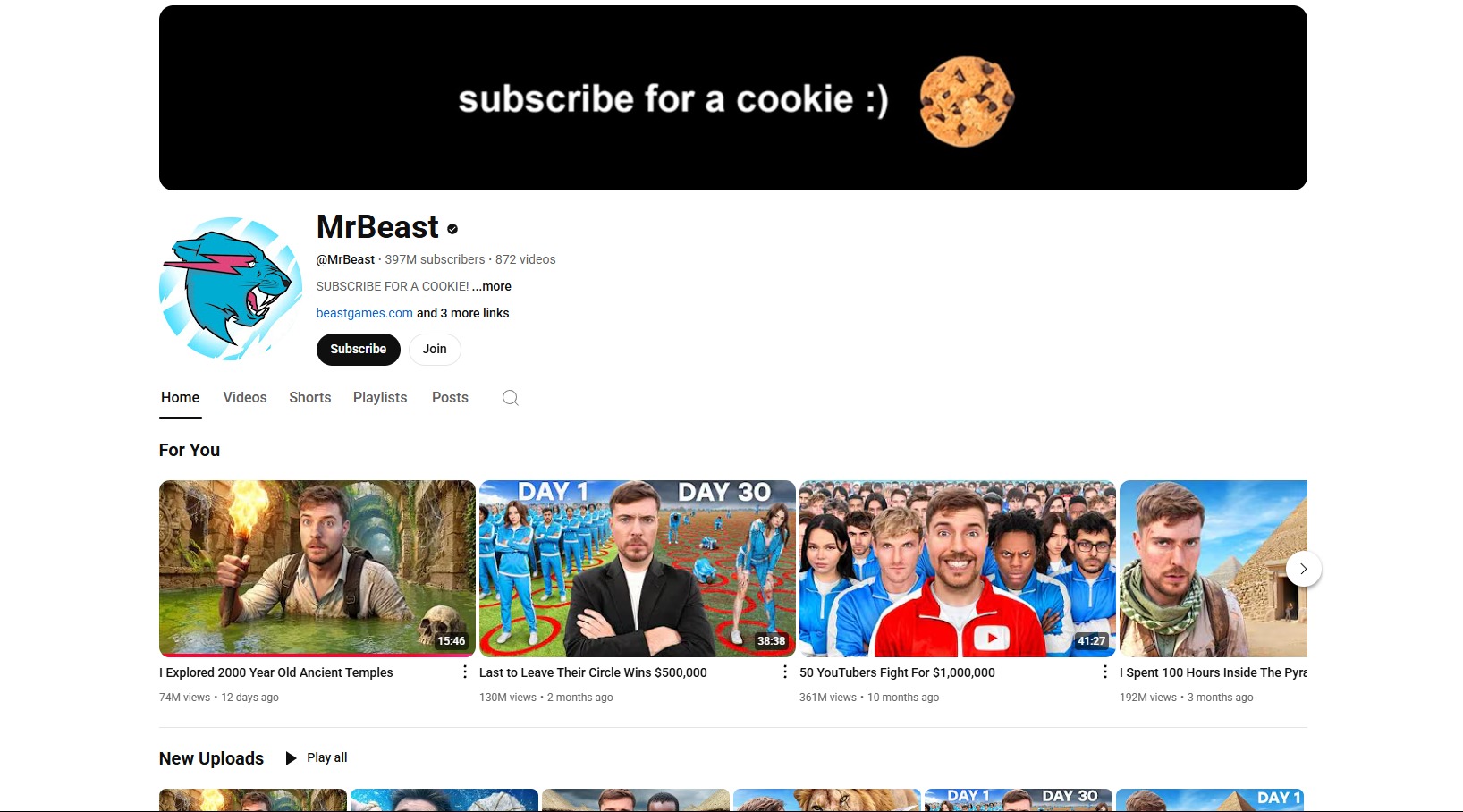
MrBeast's main Youtube channel.
At 27, Youtuber MrBeast, aka Jimmy Donaldson, becomes the world’s youngest
self-made billionaire through giveaways, memes and countless videos.
MrBeast: From Viral Pranks to a Billion-Dollar Bankroll
Move over tech bros and hedge funders, the YouTube crowd just minted
its first proper billionaire—and no, it’s not some metaverse guru or AI
whisperer. It’s a guy who gave away a private island on camera and once
recreated Squid Game with real people (minus the murder). Jimmy Donaldson,
better known as MrBeast, has officially joined the billionaire club, and at
just 27, he now holds the title of world’s youngest self-made billionaire.
MrBeast’s estimated net worth recently crossed the $1 billion mark. But
the real twist? He’s not hoarding it. His master plan is to give most of it
away, just
like a certain Mr. Gates.
From Small-Town Nerd to Global YouTube Royalty
MrBeast in 2023, by Steven Khan – Own work, CC BY 4.0 (Wikipedia)
MrBeast didn’t inherit a trust fund or cash out on crypto at the right
time. He built his empire on pure internet obsession. Starting with Minecraft
videos as a teen in North Carolina, Donaldson hit gold by figuring out the
YouTube algorithm before most people could spell “monetization.” His breakout
video in 2017—counting to 100,000—was equal parts mind-numbing and genius.
It racked up millions of views, and more importantly, cracked the code on what
people would actually watch.
From there, he escalated—fast. Giving away $10,000 to strangers?
Filming it. Tipping delivery drivers with houses? Filming it. Launching a
real-life Willy Wonka chocolate factory? Yup, filming that too. Each video
became bigger, louder, and more generous, turning his channel into a
philanthropic content juggernaut.
Today, MrBeast’s YouTube channels have over 450 million subscribers
combined. His video views? In the tens of billions.
The Beast Business Model: Entertaining Generosity
MrBeast isn’t just a YouTuber anymore. He’s a vertically integrated
media brand with multiple revenue streams sharper than Elon Musk’s jawline.
According to the reports, his income includes:
Feastables: A snack brand that
generated more than $10 million in its first few months.
Brand deals and ad revenue: Bringing in tens of millions annually.
Merch sales: Because of course you want merch
from the guy who built a Squid Game set.
It’s not just content, it’s commerce.
Donations for Everyone!
Becoming a billionaire before 30 is already rare. Doing it by giving
away millions is almost mythic. But that’s exactly what MrBeast has done. And
it doesn’t sound like he’s about to slow down.
“I know most people prob won’t believe this but my main goal in life is
to just make a bunch of money, and then give it all away while doing as much
good as possible before I die. I just don’t want to live a meaningless life, I
want to make an impact and be content when I’m older!” he posted on X (Twitter)
in 2019.
Unlike many billionaires who spend their fortunes defending their yacht
choices on Twitter, MrBeast has made philanthropy part of the product. His
charitable foundation, Beast
Philanthropy, runs a food bank, builds houses, and tackles large-scale
humanitarian efforts. It's YouTube meets Red Cross—but filmed in 4K.
The Billionaire Blueprint No One Saw Coming
For a generation that grew up online, MrBeast represents a different
kind of mogul. He’s not selling you a fake dream of passive income or flexing
from a private jet. He’s planting trees, funding cataract surgeries, and
pushing the boundaries of how kindness and capitalism can coexist.
Is it sustainable? Maybe. Is it inspiring? Absolutely. And as the
youngest self-made billionaire in history, he’s just getting started.
With TikTok stars and crypto bros flaming out left and right, MrBeast
has built a billion-dollar brand not by promising the moon—but by filming
himself giving it away.
For more stories around the edges of finance, visit our Trending pages.
At 27, Youtuber MrBeast, aka Jimmy Donaldson, becomes the world’s youngest
self-made billionaire through giveaways, memes and countless videos.
MrBeast: From Viral Pranks to a Billion-Dollar Bankroll
Move over tech bros and hedge funders, the YouTube crowd just minted
its first proper billionaire—and no, it’s not some metaverse guru or AI
whisperer. It’s a guy who gave away a private island on camera and once
recreated Squid Game with real people (minus the murder). Jimmy Donaldson,
better known as MrBeast, has officially joined the billionaire club, and at
just 27, he now holds the title of world’s youngest self-made billionaire.
MrBeast’s estimated net worth recently crossed the $1 billion mark. But
the real twist? He’s not hoarding it. His master plan is to give most of it
away, just
like a certain Mr. Gates.
From Small-Town Nerd to Global YouTube Royalty
MrBeast in 2023, by Steven Khan – Own work, CC BY 4.0 (Wikipedia)
MrBeast didn’t inherit a trust fund or cash out on crypto at the right
time. He built his empire on pure internet obsession. Starting with Minecraft
videos as a teen in North Carolina, Donaldson hit gold by figuring out the
YouTube algorithm before most people could spell “monetization.” His breakout
video in 2017—counting to 100,000—was equal parts mind-numbing and genius.
It racked up millions of views, and more importantly, cracked the code on what
people would actually watch.
From there, he escalated—fast. Giving away $10,000 to strangers?
Filming it. Tipping delivery drivers with houses? Filming it. Launching a
real-life Willy Wonka chocolate factory? Yup, filming that too. Each video
became bigger, louder, and more generous, turning his channel into a
philanthropic content juggernaut.
Today, MrBeast’s YouTube channels have over 450 million subscribers
combined. His video views? In the tens of billions.
The Beast Business Model: Entertaining Generosity
MrBeast isn’t just a YouTuber anymore. He’s a vertically integrated
media brand with multiple revenue streams sharper than Elon Musk’s jawline.
According to the reports, his income includes:
Feastables: A snack brand that
generated more than $10 million in its first few months.
Brand deals and ad revenue: Bringing in tens of millions annually.
Merch sales: Because of course you want merch
from the guy who built a Squid Game set.
It’s not just content, it’s commerce.
Donations for Everyone!
Becoming a billionaire before 30 is already rare. Doing it by giving
away millions is almost mythic. But that’s exactly what MrBeast has done. And
it doesn’t sound like he’s about to slow down.
“I know most people prob won’t believe this but my main goal in life is
to just make a bunch of money, and then give it all away while doing as much
good as possible before I die. I just don’t want to live a meaningless life, I
want to make an impact and be content when I’m older!” he posted on X (Twitter)
in 2019.
Unlike many billionaires who spend their fortunes defending their yacht
choices on Twitter, MrBeast has made philanthropy part of the product. His
charitable foundation, Beast
Philanthropy, runs a food bank, builds houses, and tackles large-scale
humanitarian efforts. It's YouTube meets Red Cross—but filmed in 4K.
The Billionaire Blueprint No One Saw Coming
For a generation that grew up online, MrBeast represents a different
kind of mogul. He’s not selling you a fake dream of passive income or flexing
from a private jet. He’s planting trees, funding cataract surgeries, and
pushing the boundaries of how kindness and capitalism can coexist.
Is it sustainable? Maybe. Is it inspiring? Absolutely. And as the
youngest self-made billionaire in history, he’s just getting started.
With TikTok stars and crypto bros flaming out left and right, MrBeast
has built a billion-dollar brand not by promising the moon—but by filming
himself giving it away.
For more stories around the edges of finance, visit our Trending pages.
Louis Parks has lived and worked in and around the Middle East for much of his professional career. He writes about the meeting of the tech and finance worlds.
Inside the Prediction Markets: $1.6B Institutional Inflow Meets a Federal Crackdown
FP Markets Winner Spotlight 🏆 | Global Broker of the Year 2025 #Trading #Broker #Innovation #Shorts
FP Markets Winner Spotlight 🏆 | Global Broker of the Year 2025 #Trading #Broker #Innovation #Shorts
FP Markets takes the spotlight as Global Broker of the Year 2025 at the Finance Magnates Awards.
Martin Stoilov, Head of Client Experience, shares that trust, innovation, and people played a key role in the company’s success, supported by a strong foundation of integrity and client-centricity.
Following this milestone, FP Markets continues to focus on growth, technology investment, and its core values of transparency and excellence.
👉 Be part of FM Awards 2026: https://awards.financemagnates.com/#nominate
FP Markets takes the spotlight as Global Broker of the Year 2025 at the Finance Magnates Awards.
Martin Stoilov, Head of Client Experience, shares that trust, innovation, and people played a key role in the company’s success, supported by a strong foundation of integrity and client-centricity.
Following this milestone, FP Markets continues to focus on growth, technology investment, and its core values of transparency and excellence.
👉 Be part of FM Awards 2026: https://awards.financemagnates.com/#nominate
In this video, we review @HolaPrimeMarketsOfficial, a multi-asset forex and CFDs broker offering different account types, trading platforms, and flexible trading conditions.
We cover the broker’s overall offering, including account options, trading environment, platforms like MT4 and MT5, and additional services such as managed accounts and fast withdrawals.
Watch the full video to see if Hola Prime Markets fits your trading needs.
📣 Stay up to date with the latest in finance and trading. Follow Finance Magnates for industry news, insights, and global event coverage.
Connect with us:
🔗 LinkedIn: /financemagnates
👍 Facebook: /financemagnates
📸 Instagram: https://www.instagram.com/financemagnates
🐦 X: https://x.com/financemagnates
🎥 TikTok: https://www.tiktok.com/tag/financemagnates
▶️ YouTube: /@financemagnates_official
#HolaPrime #ForexBroker #CFDTrading #FinanceMagnates #Trading #Forex #BrokerReview
In this video, we review @HolaPrimeMarketsOfficial, a multi-asset forex and CFDs broker offering different account types, trading platforms, and flexible trading conditions.
We cover the broker’s overall offering, including account options, trading environment, platforms like MT4 and MT5, and additional services such as managed accounts and fast withdrawals.
Watch the full video to see if Hola Prime Markets fits your trading needs.
📣 Stay up to date with the latest in finance and trading. Follow Finance Magnates for industry news, insights, and global event coverage.
Connect with us:
🔗 LinkedIn: /financemagnates
👍 Facebook: /financemagnates
📸 Instagram: https://www.instagram.com/financemagnates
🐦 X: https://x.com/financemagnates
🎥 TikTok: https://www.tiktok.com/tag/financemagnates
▶️ YouTube: /@financemagnates_official
#HolaPrime #ForexBroker #CFDTrading #FinanceMagnates #Trading #Forex #BrokerReview
Hola Prime Review: What You Need to Know | Full Breakdown by Finance Magnates
Hola Prime Review: What You Need to Know | Full Breakdown by Finance Magnates
In this video, we review @HolaPrime_Global, a proprietary trading firm offering evaluation programs and performance-based payouts in simulated market environments.
We cover how the challenge model works, including account types, profit splits (up to 95%), trading rules, and what it takes to reach a funded account. You’ll also learn about available platforms like MT4, MT5, cTrader, and more, along with insights into payouts, support, and trading conditions.
Watch the full video to see if Hola Prime fits your trading style.
📣 Stay up to date with the latest in finance and trading. Follow Finance Magnates for industry news, insights, and global event coverage.
Connect with us:
🔗 LinkedIn: /financemagnates
👍 Facebook: /financemagnates
📸 Instagram: https://www.instagram.com/financemagnates
🐦 X: https://x.com/financemagnates
🎥 TikTok: https://www.tiktok.com/tag/financemagnates
▶️ YouTube: /@financemagnates_official
#HolaPrime #PropFirm #Trading #FinanceMagnates #Forex #FuturesTrading #TradingReview #PropFirmReview
In this video, we review @HolaPrime_Global, a proprietary trading firm offering evaluation programs and performance-based payouts in simulated market environments.
We cover how the challenge model works, including account types, profit splits (up to 95%), trading rules, and what it takes to reach a funded account. You’ll also learn about available platforms like MT4, MT5, cTrader, and more, along with insights into payouts, support, and trading conditions.
Watch the full video to see if Hola Prime fits your trading style.
📣 Stay up to date with the latest in finance and trading. Follow Finance Magnates for industry news, insights, and global event coverage.
Connect with us:
🔗 LinkedIn: /financemagnates
👍 Facebook: /financemagnates
📸 Instagram: https://www.instagram.com/financemagnates
🐦 X: https://x.com/financemagnates
🎥 TikTok: https://www.tiktok.com/tag/financemagnates
▶️ YouTube: /@financemagnates_official
#HolaPrime #PropFirm #Trading #FinanceMagnates #Forex #FuturesTrading #TradingReview #PropFirmReview
Axi Winner Spotlight 🏆 | Global Most Innovative Broker 2025 #Innovation #Trading #Fintech #Broker
Axi Winner Spotlight 🏆 | Global Most Innovative Broker 2025 #Innovation #Trading #Fintech #Broker
Axi takes the spotlight at the Finance Magnates Awards, winning Global Most Innovative Broker 2025.
Olivia Xenofontos and Ivanna Openko share how the team will feel: proud, motivated, and ready to keep delivering.
They also describe the night as well-organized, focused, and enjoyable for all.
👉 Be part of FM Awards 2026.
Axi takes the spotlight at the Finance Magnates Awards, winning Global Most Innovative Broker 2025.
Olivia Xenofontos and Ivanna Openko share how the team will feel: proud, motivated, and ready to keep delivering.
They also describe the night as well-organized, focused, and enjoyable for all.
👉 Be part of FM Awards 2026.
Recognition that matters.
Built on transparency.
Driven by the industry.
The Finance Magnates Awards 2026.
Nominations are now open.
🔗 https://awards.financemagnates.com/?utm_source=SM&utm_medium=social&utm_campaign=recognition-matters
Recognition that matters.
Built on transparency.
Driven by the industry.
The Finance Magnates Awards 2026.
Nominations are now open.
🔗 https://awards.financemagnates.com/?utm_source=SM&utm_medium=social&utm_campaign=recognition-matters