The Melania Trump meme coin is down 98% since January 2025.
Whales cashed out early, profiting before the inevitable price crash.
The meme coin crash highlights the dangers of "pump and dump" schemes in the crypto world.
The coin launched in January and has cratered since then.
The Melania Trump meme coin crash highlights the dangers of "pump and dump"
schemes in the crypto world.
A Meme Coin's Meteoric Rise... and Fall
It was supposed to be a big deal: Melania Trump's meme coin (site), launched with the promise of
transforming the meme coin market, caught fire earlier this year. But like a
firework bursting in the sky, it fizzled out just as quickly. Fast forward to
now, and the coin is down 98%
from its highs in January 2025.
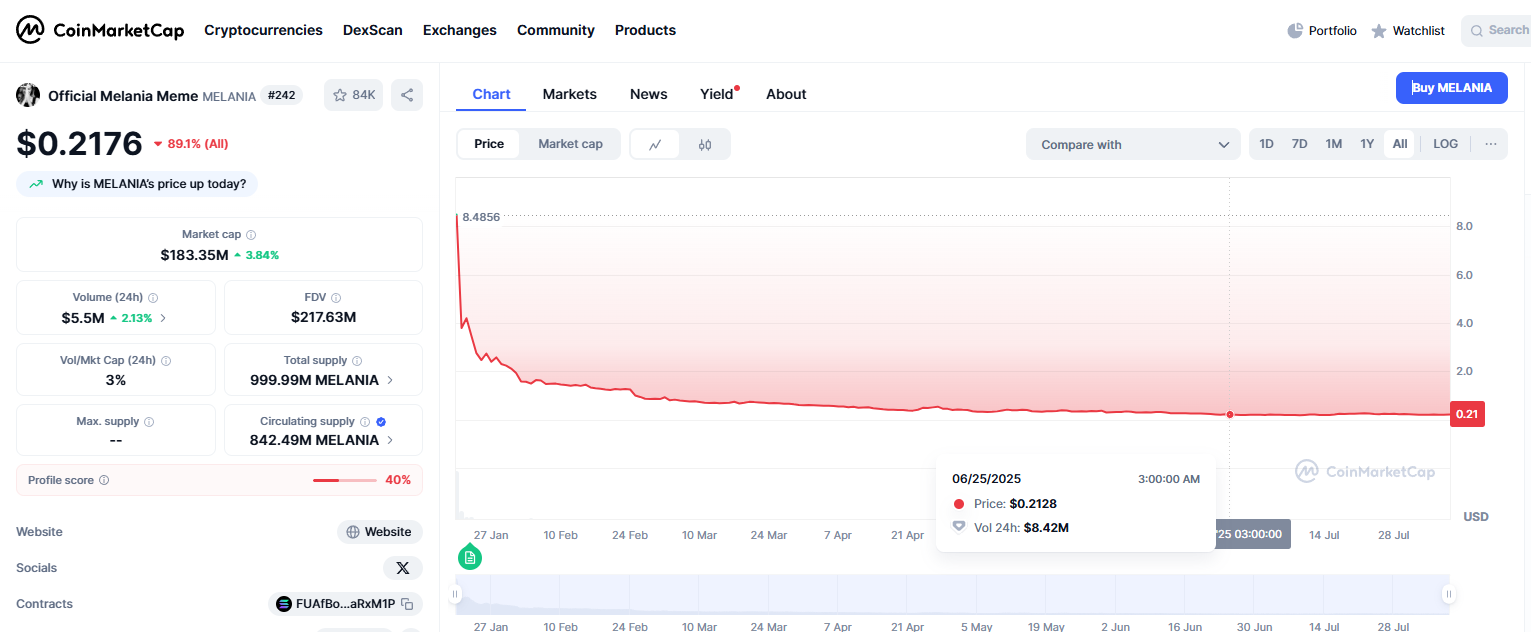
At the time of writing, the Melania meme coin has collapsed to the
point where investors are left scratching their heads. Currently valued at
$0.21, the coin initially launched at just shy of $8.5.
At the start of 2025, the coin made waves with celebrity endorsements
and a heavy social media presence. Many investors jumped in hoping it would
repeat the meteoric rise of other meme coins like Dogecoin or Shiba Inu.
Instead, it saw a swift crash, leaving many with substantial losses.
The coin’s dramatic plunge has shocked its once-enthusiastic community,
who now find themselves watching their investments sink into oblivion, though
seasoned meme coin watchers might not be so surprised. The narrative was
familiar: a viral marketing campaign, wild speculation, and a spike in
volume—but in the end, the same fate as most meme coins: disappointment.
The coin's value has collapsed since launching in January (screenshot 08/08/25)
But while the dramatic crash of the coin left many investors high and
dry, it's far from an unusual story in the world of cryptocurrencies. This is
what happens when a token is essentially built on the foundation of a meme, a
joke, and sustained by a community that can quickly lose interest.
As with all speculative bubbles, once the hype dies down, prices
plummet. It's a familiar cycle, and the Melania meme coin was no different.
However, the real story may be deeper, especially when we take a look at the
actions of the whales.
This phenomenon—where larger investors manipulate the market by buying
in low and selling high—is often referred to as a "pump
and dump" scheme. Many around the coin created artificial demand by
hyping it, making it look like a legitimate investment opportunity. As soon as
enough smaller investors were onboard, they cashed out, leaving the newcomers
holding worthless tokens.
In a typical pump and dump play the price is artificially inflated,
often through coordinated social media activity or celebrity endorsements,
until it reaches a peak. Once the whales sell off their holdings, the price
plummets, leaving the less-informed investors stuck with worthless assets.
The All-Too-Familiar Pattern
The Melania meme coin may be just another chapter in the long history of
pump and dump schemes, but it serves as a sharp reminder of the risks involved
in trading speculative tokens. These coins often operate like a casino, with
outcomes driven by hype and a lack of underlying value.
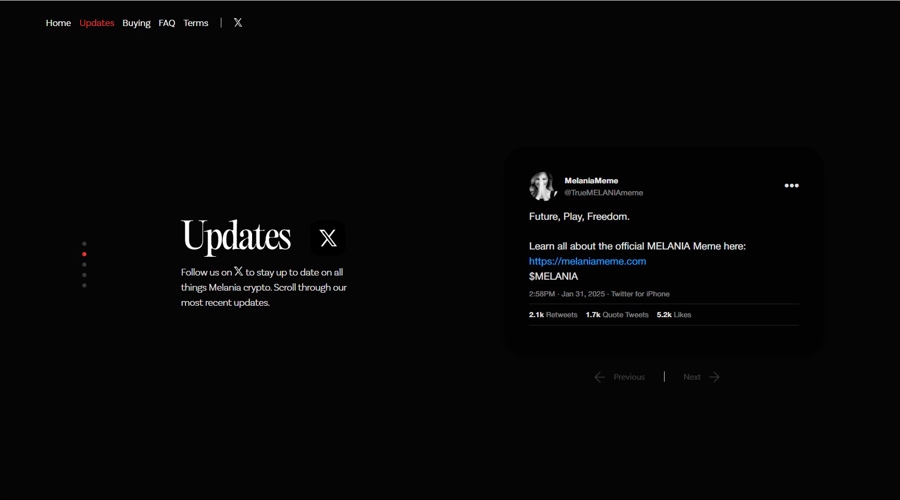
The "Updates" section of melaniameme.com, with one "update" from January (screenshot)
Investors looking to enter the market for meme coins often get swept up
in the enthusiasm and the fear of missing out (FOMO). But without the stability
of fundamentals or real-world application, it’s all too easy to get burned. The
fate of Melania Trump’s meme coin serves as a cautionary tale for anyone
considering jumping into the meme coin frenzy: it’s not just about luck; it’s
about being aware of the risks posed by larger investors who hold the power to
send prices spiraling.
What Happens Next?
While Melania Trump’s meme coin has been dealt a heavy blow, its crash
isn’t necessarily the end of the road for the world of meme coins. Investors
may have learned some valuable lessons about the volatility of these tokens,
but the space remains ripe for similar hype-driven ventures. However, it must
be noted that the Securities and Exchange Commission (SEC) does
not view meme coins as securities, meaning that there’s less regulation,
and ultimately less protection for buyers.
For those holding Melania meme coins, the aftermath will likely mean a
painful realization about the nature of speculative investments. Whether the
coin ever recovers—or becomes a cautionary tale—remains to be seen.
This crash wasn’t an isolated event—it’s part of a broader pattern of
volatility seen in the meme coin world. As always, the big players cash out,
and the rest are left to pick up the pieces. If you’re thinking about jumping
into meme coins, just remember: you’re playing with fire.
For more stories making waves in finance and tech, visit our Trending pages.
The Melania Trump meme coin crash highlights the dangers of "pump and dump"
schemes in the crypto world.
A Meme Coin's Meteoric Rise... and Fall
It was supposed to be a big deal: Melania Trump's meme coin (site), launched with the promise of
transforming the meme coin market, caught fire earlier this year. But like a
firework bursting in the sky, it fizzled out just as quickly. Fast forward to
now, and the coin is down 98%
from its highs in January 2025.
At the time of writing, the Melania meme coin has collapsed to the
point where investors are left scratching their heads. Currently valued at
$0.21, the coin initially launched at just shy of $8.5.
At the start of 2025, the coin made waves with celebrity endorsements
and a heavy social media presence. Many investors jumped in hoping it would
repeat the meteoric rise of other meme coins like Dogecoin or Shiba Inu.
Instead, it saw a swift crash, leaving many with substantial losses.
The coin’s dramatic plunge has shocked its once-enthusiastic community,
who now find themselves watching their investments sink into oblivion, though
seasoned meme coin watchers might not be so surprised. The narrative was
familiar: a viral marketing campaign, wild speculation, and a spike in
volume—but in the end, the same fate as most meme coins: disappointment.
The coin's value has collapsed since launching in January (screenshot 08/08/25)
But while the dramatic crash of the coin left many investors high and
dry, it's far from an unusual story in the world of cryptocurrencies. This is
what happens when a token is essentially built on the foundation of a meme, a
joke, and sustained by a community that can quickly lose interest.
As with all speculative bubbles, once the hype dies down, prices
plummet. It's a familiar cycle, and the Melania meme coin was no different.
However, the real story may be deeper, especially when we take a look at the
actions of the whales.
This phenomenon—where larger investors manipulate the market by buying
in low and selling high—is often referred to as a "pump
and dump" scheme. Many around the coin created artificial demand by
hyping it, making it look like a legitimate investment opportunity. As soon as
enough smaller investors were onboard, they cashed out, leaving the newcomers
holding worthless tokens.
In a typical pump and dump play the price is artificially inflated,
often through coordinated social media activity or celebrity endorsements,
until it reaches a peak. Once the whales sell off their holdings, the price
plummets, leaving the less-informed investors stuck with worthless assets.
The All-Too-Familiar Pattern
The Melania meme coin may be just another chapter in the long history of
pump and dump schemes, but it serves as a sharp reminder of the risks involved
in trading speculative tokens. These coins often operate like a casino, with
outcomes driven by hype and a lack of underlying value.
The "Updates" section of melaniameme.com, with one "update" from January (screenshot)
Investors looking to enter the market for meme coins often get swept up
in the enthusiasm and the fear of missing out (FOMO). But without the stability
of fundamentals or real-world application, it’s all too easy to get burned. The
fate of Melania Trump’s meme coin serves as a cautionary tale for anyone
considering jumping into the meme coin frenzy: it’s not just about luck; it’s
about being aware of the risks posed by larger investors who hold the power to
send prices spiraling.
What Happens Next?
While Melania Trump’s meme coin has been dealt a heavy blow, its crash
isn’t necessarily the end of the road for the world of meme coins. Investors
may have learned some valuable lessons about the volatility of these tokens,
but the space remains ripe for similar hype-driven ventures. However, it must
be noted that the Securities and Exchange Commission (SEC) does
not view meme coins as securities, meaning that there’s less regulation,
and ultimately less protection for buyers.
For those holding Melania meme coins, the aftermath will likely mean a
painful realization about the nature of speculative investments. Whether the
coin ever recovers—or becomes a cautionary tale—remains to be seen.
This crash wasn’t an isolated event—it’s part of a broader pattern of
volatility seen in the meme coin world. As always, the big players cash out,
and the rest are left to pick up the pieces. If you’re thinking about jumping
into meme coins, just remember: you’re playing with fire.
For more stories making waves in finance and tech, visit our Trending pages.
Louis Parks has lived and worked in and around the Middle East for much of his professional career. He writes about the meeting of the tech and finance worlds.
Inside the Prediction Markets: $1.6B Institutional Inflow Meets a Federal Crackdown
Featured Videos
FP Markets Winner Spotlight 🏆 | Global Broker of the Year 2025 #Trading #Broker #Innovation #Shorts
FP Markets Winner Spotlight 🏆 | Global Broker of the Year 2025 #Trading #Broker #Innovation #Shorts
FP Markets Winner Spotlight 🏆 | Global Broker of the Year 2025 #Trading #Broker #Innovation #Shorts
FP Markets Winner Spotlight 🏆 | Global Broker of the Year 2025 #Trading #Broker #Innovation #Shorts
FP Markets takes the spotlight as Global Broker of the Year 2025 at the Finance Magnates Awards.
Martin Stoilov, Head of Client Experience, shares that trust, innovation, and people played a key role in the company’s success, supported by a strong foundation of integrity and client-centricity.
Following this milestone, FP Markets continues to focus on growth, technology investment, and its core values of transparency and excellence.
👉 Be part of FM Awards 2026: https://awards.financemagnates.com/#nominate
FP Markets takes the spotlight as Global Broker of the Year 2025 at the Finance Magnates Awards.
Martin Stoilov, Head of Client Experience, shares that trust, innovation, and people played a key role in the company’s success, supported by a strong foundation of integrity and client-centricity.
Following this milestone, FP Markets continues to focus on growth, technology investment, and its core values of transparency and excellence.
👉 Be part of FM Awards 2026: https://awards.financemagnates.com/#nominate
FP Markets takes the spotlight as Global Broker of the Year 2025 at the Finance Magnates Awards.
Martin Stoilov, Head of Client Experience, shares that trust, innovation, and people played a key role in the company’s success, supported by a strong foundation of integrity and client-centricity.
Following this milestone, FP Markets continues to focus on growth, technology investment, and its core values of transparency and excellence.
👉 Be part of FM Awards 2026: https://awards.financemagnates.com/#nominate
FP Markets takes the spotlight as Global Broker of the Year 2025 at the Finance Magnates Awards.
Martin Stoilov, Head of Client Experience, shares that trust, innovation, and people played a key role in the company’s success, supported by a strong foundation of integrity and client-centricity.
Following this milestone, FP Markets continues to focus on growth, technology investment, and its core values of transparency and excellence.
👉 Be part of FM Awards 2026: https://awards.financemagnates.com/#nominate
In this video, we review @HolaPrimeMarketsOfficial, a multi-asset forex and CFDs broker offering different account types, trading platforms, and flexible trading conditions.
We cover the broker’s overall offering, including account options, trading environment, platforms like MT4 and MT5, and additional services such as managed accounts and fast withdrawals.
Watch the full video to see if Hola Prime Markets fits your trading needs.
📣 Stay up to date with the latest in finance and trading. Follow Finance Magnates for industry news, insights, and global event coverage.
Connect with us:
🔗 LinkedIn: /financemagnates
👍 Facebook: /financemagnates
📸 Instagram: https://www.instagram.com/financemagnates
🐦 X: https://x.com/financemagnates
🎥 TikTok: https://www.tiktok.com/tag/financemagnates
▶️ YouTube: /@financemagnates_official
#HolaPrime #ForexBroker #CFDTrading #FinanceMagnates #Trading #Forex #BrokerReview
In this video, we review @HolaPrimeMarketsOfficial, a multi-asset forex and CFDs broker offering different account types, trading platforms, and flexible trading conditions.
We cover the broker’s overall offering, including account options, trading environment, platforms like MT4 and MT5, and additional services such as managed accounts and fast withdrawals.
Watch the full video to see if Hola Prime Markets fits your trading needs.
📣 Stay up to date with the latest in finance and trading. Follow Finance Magnates for industry news, insights, and global event coverage.
Connect with us:
🔗 LinkedIn: /financemagnates
👍 Facebook: /financemagnates
📸 Instagram: https://www.instagram.com/financemagnates
🐦 X: https://x.com/financemagnates
🎥 TikTok: https://www.tiktok.com/tag/financemagnates
▶️ YouTube: /@financemagnates_official
#HolaPrime #ForexBroker #CFDTrading #FinanceMagnates #Trading #Forex #BrokerReview
In this video, we review @HolaPrimeMarketsOfficial, a multi-asset forex and CFDs broker offering different account types, trading platforms, and flexible trading conditions.
We cover the broker’s overall offering, including account options, trading environment, platforms like MT4 and MT5, and additional services such as managed accounts and fast withdrawals.
Watch the full video to see if Hola Prime Markets fits your trading needs.
📣 Stay up to date with the latest in finance and trading. Follow Finance Magnates for industry news, insights, and global event coverage.
Connect with us:
🔗 LinkedIn: /financemagnates
👍 Facebook: /financemagnates
📸 Instagram: https://www.instagram.com/financemagnates
🐦 X: https://x.com/financemagnates
🎥 TikTok: https://www.tiktok.com/tag/financemagnates
▶️ YouTube: /@financemagnates_official
#HolaPrime #ForexBroker #CFDTrading #FinanceMagnates #Trading #Forex #BrokerReview
In this video, we review @HolaPrimeMarketsOfficial, a multi-asset forex and CFDs broker offering different account types, trading platforms, and flexible trading conditions.
We cover the broker’s overall offering, including account options, trading environment, platforms like MT4 and MT5, and additional services such as managed accounts and fast withdrawals.
Watch the full video to see if Hola Prime Markets fits your trading needs.
📣 Stay up to date with the latest in finance and trading. Follow Finance Magnates for industry news, insights, and global event coverage.
Connect with us:
🔗 LinkedIn: /financemagnates
👍 Facebook: /financemagnates
📸 Instagram: https://www.instagram.com/financemagnates
🐦 X: https://x.com/financemagnates
🎥 TikTok: https://www.tiktok.com/tag/financemagnates
▶️ YouTube: /@financemagnates_official
#HolaPrime #ForexBroker #CFDTrading #FinanceMagnates #Trading #Forex #BrokerReview
In this video, we review @HolaPrimeMarketsOfficial, a multi-asset forex and CFDs broker offering different account types, trading platforms, and flexible trading conditions.
We cover the broker’s overall offering, including account options, trading environment, platforms like MT4 and MT5, and additional services such as managed accounts and fast withdrawals.
Watch the full video to see if Hola Prime Markets fits your trading needs.
📣 Stay up to date with the latest in finance and trading. Follow Finance Magnates for industry news, insights, and global event coverage.
Connect with us:
🔗 LinkedIn: /financemagnates
👍 Facebook: /financemagnates
📸 Instagram: https://www.instagram.com/financemagnates
🐦 X: https://x.com/financemagnates
🎥 TikTok: https://www.tiktok.com/tag/financemagnates
▶️ YouTube: /@financemagnates_official
#HolaPrime #ForexBroker #CFDTrading #FinanceMagnates #Trading #Forex #BrokerReview
In this video, we review @HolaPrimeMarketsOfficial, a multi-asset forex and CFDs broker offering different account types, trading platforms, and flexible trading conditions.
We cover the broker’s overall offering, including account options, trading environment, platforms like MT4 and MT5, and additional services such as managed accounts and fast withdrawals.
Watch the full video to see if Hola Prime Markets fits your trading needs.
📣 Stay up to date with the latest in finance and trading. Follow Finance Magnates for industry news, insights, and global event coverage.
Connect with us:
🔗 LinkedIn: /financemagnates
👍 Facebook: /financemagnates
📸 Instagram: https://www.instagram.com/financemagnates
🐦 X: https://x.com/financemagnates
🎥 TikTok: https://www.tiktok.com/tag/financemagnates
▶️ YouTube: /@financemagnates_official
#HolaPrime #ForexBroker #CFDTrading #FinanceMagnates #Trading #Forex #BrokerReview
Hola Prime Review: What You Need to Know | Full Breakdown by Finance Magnates
Hola Prime Review: What You Need to Know | Full Breakdown by Finance Magnates
Hola Prime Review: What You Need to Know | Full Breakdown by Finance Magnates
Hola Prime Review: What You Need to Know | Full Breakdown by Finance Magnates
Hola Prime Review: What You Need to Know | Full Breakdown by Finance Magnates
Hola Prime Review: What You Need to Know | Full Breakdown by Finance Magnates
In this video, we review @HolaPrime_Global, a proprietary trading firm offering evaluation programs and performance-based payouts in simulated market environments.
We cover how the challenge model works, including account types, profit splits (up to 95%), trading rules, and what it takes to reach a funded account. You’ll also learn about available platforms like MT4, MT5, cTrader, and more, along with insights into payouts, support, and trading conditions.
Watch the full video to see if Hola Prime fits your trading style.
📣 Stay up to date with the latest in finance and trading. Follow Finance Magnates for industry news, insights, and global event coverage.
Connect with us:
🔗 LinkedIn: /financemagnates
👍 Facebook: /financemagnates
📸 Instagram: https://www.instagram.com/financemagnates
🐦 X: https://x.com/financemagnates
🎥 TikTok: https://www.tiktok.com/tag/financemagnates
▶️ YouTube: /@financemagnates_official
#HolaPrime #PropFirm #Trading #FinanceMagnates #Forex #FuturesTrading #TradingReview #PropFirmReview
In this video, we review @HolaPrime_Global, a proprietary trading firm offering evaluation programs and performance-based payouts in simulated market environments.
We cover how the challenge model works, including account types, profit splits (up to 95%), trading rules, and what it takes to reach a funded account. You’ll also learn about available platforms like MT4, MT5, cTrader, and more, along with insights into payouts, support, and trading conditions.
Watch the full video to see if Hola Prime fits your trading style.
📣 Stay up to date with the latest in finance and trading. Follow Finance Magnates for industry news, insights, and global event coverage.
Connect with us:
🔗 LinkedIn: /financemagnates
👍 Facebook: /financemagnates
📸 Instagram: https://www.instagram.com/financemagnates
🐦 X: https://x.com/financemagnates
🎥 TikTok: https://www.tiktok.com/tag/financemagnates
▶️ YouTube: /@financemagnates_official
#HolaPrime #PropFirm #Trading #FinanceMagnates #Forex #FuturesTrading #TradingReview #PropFirmReview
In this video, we review @HolaPrime_Global, a proprietary trading firm offering evaluation programs and performance-based payouts in simulated market environments.
We cover how the challenge model works, including account types, profit splits (up to 95%), trading rules, and what it takes to reach a funded account. You’ll also learn about available platforms like MT4, MT5, cTrader, and more, along with insights into payouts, support, and trading conditions.
Watch the full video to see if Hola Prime fits your trading style.
📣 Stay up to date with the latest in finance and trading. Follow Finance Magnates for industry news, insights, and global event coverage.
Connect with us:
🔗 LinkedIn: /financemagnates
👍 Facebook: /financemagnates
📸 Instagram: https://www.instagram.com/financemagnates
🐦 X: https://x.com/financemagnates
🎥 TikTok: https://www.tiktok.com/tag/financemagnates
▶️ YouTube: /@financemagnates_official
#HolaPrime #PropFirm #Trading #FinanceMagnates #Forex #FuturesTrading #TradingReview #PropFirmReview
In this video, we review @HolaPrime_Global, a proprietary trading firm offering evaluation programs and performance-based payouts in simulated market environments.
We cover how the challenge model works, including account types, profit splits (up to 95%), trading rules, and what it takes to reach a funded account. You’ll also learn about available platforms like MT4, MT5, cTrader, and more, along with insights into payouts, support, and trading conditions.
Watch the full video to see if Hola Prime fits your trading style.
📣 Stay up to date with the latest in finance and trading. Follow Finance Magnates for industry news, insights, and global event coverage.
Connect with us:
🔗 LinkedIn: /financemagnates
👍 Facebook: /financemagnates
📸 Instagram: https://www.instagram.com/financemagnates
🐦 X: https://x.com/financemagnates
🎥 TikTok: https://www.tiktok.com/tag/financemagnates
▶️ YouTube: /@financemagnates_official
#HolaPrime #PropFirm #Trading #FinanceMagnates #Forex #FuturesTrading #TradingReview #PropFirmReview
In this video, we review @HolaPrime_Global, a proprietary trading firm offering evaluation programs and performance-based payouts in simulated market environments.
We cover how the challenge model works, including account types, profit splits (up to 95%), trading rules, and what it takes to reach a funded account. You’ll also learn about available platforms like MT4, MT5, cTrader, and more, along with insights into payouts, support, and trading conditions.
Watch the full video to see if Hola Prime fits your trading style.
📣 Stay up to date with the latest in finance and trading. Follow Finance Magnates for industry news, insights, and global event coverage.
Connect with us:
🔗 LinkedIn: /financemagnates
👍 Facebook: /financemagnates
📸 Instagram: https://www.instagram.com/financemagnates
🐦 X: https://x.com/financemagnates
🎥 TikTok: https://www.tiktok.com/tag/financemagnates
▶️ YouTube: /@financemagnates_official
#HolaPrime #PropFirm #Trading #FinanceMagnates #Forex #FuturesTrading #TradingReview #PropFirmReview
In this video, we review @HolaPrime_Global, a proprietary trading firm offering evaluation programs and performance-based payouts in simulated market environments.
We cover how the challenge model works, including account types, profit splits (up to 95%), trading rules, and what it takes to reach a funded account. You’ll also learn about available platforms like MT4, MT5, cTrader, and more, along with insights into payouts, support, and trading conditions.
Watch the full video to see if Hola Prime fits your trading style.
📣 Stay up to date with the latest in finance and trading. Follow Finance Magnates for industry news, insights, and global event coverage.
Connect with us:
🔗 LinkedIn: /financemagnates
👍 Facebook: /financemagnates
📸 Instagram: https://www.instagram.com/financemagnates
🐦 X: https://x.com/financemagnates
🎥 TikTok: https://www.tiktok.com/tag/financemagnates
▶️ YouTube: /@financemagnates_official
#HolaPrime #PropFirm #Trading #FinanceMagnates #Forex #FuturesTrading #TradingReview #PropFirmReview
Axi Winner Spotlight 🏆 | Global Most Innovative Broker 2025 #Innovation #Trading #Fintech #Broker
Axi Winner Spotlight 🏆 | Global Most Innovative Broker 2025 #Innovation #Trading #Fintech #Broker
Axi Winner Spotlight 🏆 | Global Most Innovative Broker 2025 #Innovation #Trading #Fintech #Broker
Axi Winner Spotlight 🏆 | Global Most Innovative Broker 2025 #Innovation #Trading #Fintech #Broker
Axi Winner Spotlight 🏆 | Global Most Innovative Broker 2025 #Innovation #Trading #Fintech #Broker
Axi Winner Spotlight 🏆 | Global Most Innovative Broker 2025 #Innovation #Trading #Fintech #Broker
Axi takes the spotlight at the Finance Magnates Awards, winning Global Most Innovative Broker 2025.
Olivia Xenofontos and Ivanna Openko share how the team will feel: proud, motivated, and ready to keep delivering.
They also describe the night as well-organized, focused, and enjoyable for all.
👉 Be part of FM Awards 2026.
Axi takes the spotlight at the Finance Magnates Awards, winning Global Most Innovative Broker 2025.
Olivia Xenofontos and Ivanna Openko share how the team will feel: proud, motivated, and ready to keep delivering.
They also describe the night as well-organized, focused, and enjoyable for all.
👉 Be part of FM Awards 2026.
Axi takes the spotlight at the Finance Magnates Awards, winning Global Most Innovative Broker 2025.
Olivia Xenofontos and Ivanna Openko share how the team will feel: proud, motivated, and ready to keep delivering.
They also describe the night as well-organized, focused, and enjoyable for all.
👉 Be part of FM Awards 2026.
Axi takes the spotlight at the Finance Magnates Awards, winning Global Most Innovative Broker 2025.
Olivia Xenofontos and Ivanna Openko share how the team will feel: proud, motivated, and ready to keep delivering.
They also describe the night as well-organized, focused, and enjoyable for all.
👉 Be part of FM Awards 2026.
Axi takes the spotlight at the Finance Magnates Awards, winning Global Most Innovative Broker 2025.
Olivia Xenofontos and Ivanna Openko share how the team will feel: proud, motivated, and ready to keep delivering.
They also describe the night as well-organized, focused, and enjoyable for all.
👉 Be part of FM Awards 2026.
Axi takes the spotlight at the Finance Magnates Awards, winning Global Most Innovative Broker 2025.
Olivia Xenofontos and Ivanna Openko share how the team will feel: proud, motivated, and ready to keep delivering.
They also describe the night as well-organized, focused, and enjoyable for all.
👉 Be part of FM Awards 2026.
Recognition that matters.
Built on transparency.
Driven by the industry.
The Finance Magnates Awards 2026.
Nominations are now open.
🔗 https://awards.financemagnates.com/?utm_source=SM&utm_medium=social&utm_campaign=recognition-matters
Recognition that matters.
Built on transparency.
Driven by the industry.
The Finance Magnates Awards 2026.
Nominations are now open.
🔗 https://awards.financemagnates.com/?utm_source=SM&utm_medium=social&utm_campaign=recognition-matters
Recognition that matters.
Built on transparency.
Driven by the industry.
The Finance Magnates Awards 2026.
Nominations are now open.
🔗 https://awards.financemagnates.com/?utm_source=SM&utm_medium=social&utm_campaign=recognition-matters
Recognition that matters.
Built on transparency.
Driven by the industry.
The Finance Magnates Awards 2026.
Nominations are now open.
🔗 https://awards.financemagnates.com/?utm_source=SM&utm_medium=social&utm_campaign=recognition-matters
Recognition that matters.
Built on transparency.
Driven by the industry.
The Finance Magnates Awards 2026.
Nominations are now open.
🔗 https://awards.financemagnates.com/?utm_source=SM&utm_medium=social&utm_campaign=recognition-matters
Recognition that matters.
Built on transparency.
Driven by the industry.
The Finance Magnates Awards 2026.
Nominations are now open.
🔗 https://awards.financemagnates.com/?utm_source=SM&utm_medium=social&utm_campaign=recognition-matters