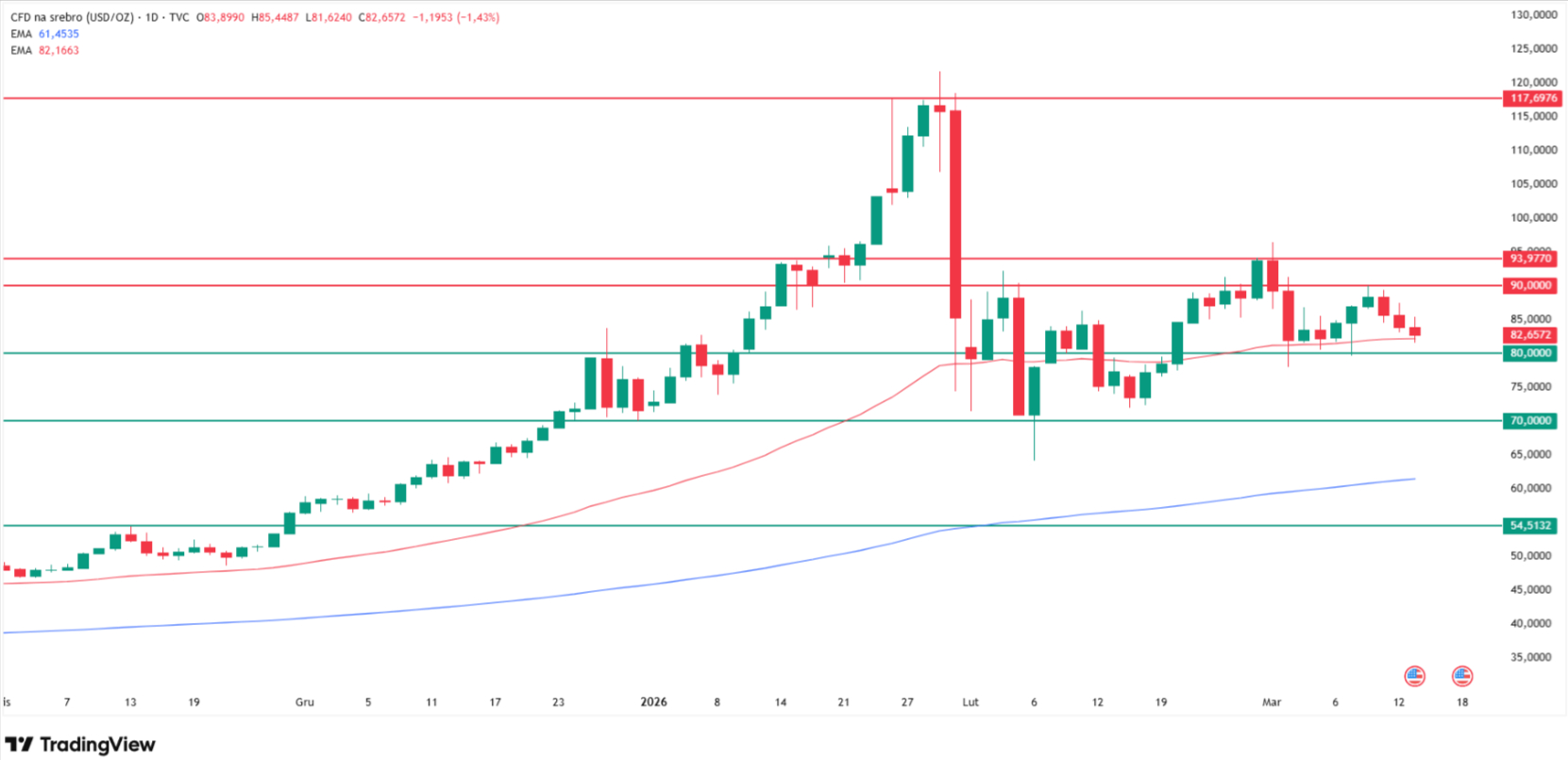
Silver is dropping for the third consecutive session on Friday, March 13, testing below $82 per ounce and probing the 50-day EMA.
The technical analysis shows silver still trapped in the same $70-$94 consolidation since early February.
The bearish silver price forecasts range from $60 to $50 per ounce, but the bull case to $120 and beyond remains structurally intact.
Why silver price is going down today and what are the newest silver price forecasts?
Silver price
is falling for the third straight session on Friday March 13,
testing below $82 per ounce and the 50-day EMA, as the market gives back a
portion of the gains built on this week's geopolitical tailwind. The white
metal is now in a consolidation that could resolve in either direction, and the
stakes are significant.
In this
article, I will break down XAG/USD technical analysis, examine the bearish case
for silver that a growing number of analysts are making, and compile the key
silver price predictions for the rest of 2026. Based on my over 15 years of
experience as an analyst and retail investor, here is what I am watching.
Follow
me on X for real-time crypto market analysis: @ChmielDk
Why Silver Is Going Down?
Three Sessions of Selling
The
immediate trigger for this week's selling is straightforward: the risk
premium is unwinding. Silver surged toward
$90 earlier this week on
the back of US-Iran geopolitical tensions and safe-haven demand, but as those
tensions show no signs of immediate escalation, the hot money that drove the
move is rotating back out. The dollar has also firmed, adding mechanical
pressure to dollar-denominated commodities including silver.
There is a
deeper structural problem sitting underneath the weekly noise. Silver rose
nearly $50 in a single month at the start of 2026, hitting the
all-time high of $121.62 in January. It then lost the entire move in just
two trading sessions - the most violent drawdown on this market since
the 1980s Hunt Brothers episode.
That kind
of price action leaves psychological damage. Traders who chased the rally and
were caught by the reversal are still sitting on losses, and many are using
bounces to reduce exposure rather than add to it. As my earlier
analysis of the 13% two-day collapse noted, the CME margin hike from 15% to 18%
accelerated the forced liquidation cascade and broke the speculative momentum
that had been building since October 2025.
Silver Technical Analysis:
The Same Box, Now Testing the Floor
As my
technical analysis shows, silver has been falling for three consecutive
sessions and is on Friday March 13 testing below $82 per ounce -
the level of the 50-day EMA. That is a meaningful test, but it
changes very little about the broader chart structure.
Why silver price is going down? Source: Tradingview.com
The two
scenarios on my chart are clear and the outcomes diverge sharply. A
break above $94 with volume opens the path back toward the all-time
high near $120 with no meaningful technical resistance between
those two levels - blue sky territory. A break below $70 activates
a very different story: the path to the 200-day EMA at $60, and
ultimately toward the October 2025 highs near $55, which together
form a substantial structural support zone. From current levels, that downside
scenario represents a decline of at least 35%.
The 50 EMA
at $82 is the immediate battle line. A daily close back above it on Friday or
early next week would ease the near-term selling pressure and keep the
consolidation symmetrical. A close below it would tilt the near-term bias
toward testing $80 - the mid-channel support where the December 2025 historical
highs also cluster - before any decision on the $70 boundary becomes relevant.
Level
Type
Notes
$121.62
All-time high (Jan 2026)
Full
rally retraced in 2 sessions
$90-$94
Upper consolidation band
Tested
twice in March, rejected
$82
Current price (Mar 13)
50 EMA
test, third red session
$80
Mid-channel support
Dec 2025 highs, 50 EMA cluster
$70
Lower consolidation band
The
critical line in the sand
$60
Bear target 1
200-day EMA
$55
Bear target 2
Oct 2025 highs, -35% from current
$50
Extreme bear
JP Morgan Kolanovic target
The Bearish Case: Who Is
Calling for Lower Prices
The silver
bull community has dominated the narrative for most of 2025-2026, but a
meaningful minority of analysts and market observers are making the opposite
case - and their arguments deserve honest examination.
Former JP
Morgan Chief Strategist Marko Kolanovic is the most prominent institutional
bear. He predicts silver could crash back to $50 per ounce in
2026, roughly half the January highs, arguing the rally was "driven by
speculation rather than fundamentals" and that 50% drops are
historically normal after such rapid gains.
He is not
wrong about the historical pattern - silver has a long track record of
spectacular advances followed by equally spectacular collapses when the
speculative overhang unwinds.
On X, Arya
Yalmmanian warns of "significant suffering for silver investors over the
next 12 months," citing long-term sentiment models that show downside
ahead. The note of humility is worth highlighting: he added he hopes his models
are wrong this time.
My long-term models, which are based exclusively on sentiment indicators, show that silver investors will suffer considerably over the next 12 months. I would like nothing more than for them to be wrong this time.
He is the
most cynical: "technicals and fundamentals are obsolete - bankers control
the price." That framing is common in the silver community and is partly
informed by the decades-long history of position concentration in silver
futures among a handful of large financial institutions.
Patrick technicals or fundamentals are obsolete right now . For silver, everything is bearish. Margins increase or decrease, shortages, solar panels etc don't matter. Bangsters can drive the price down whenever they decide to. To any level.
The most
measured bearish scenario comes from Sanju Lakshya who sees silver bottoming
near the $60-$70 support zone and then spending extended time
in a $60-$80 range rather than mounting a sustained recovery.
That view aligns closely with my own chart's 200-day EMA target of $60 as the
floor of the bear case and is perhaps the most technically grounded of the
bearish views.
#Silver forecast : I see bottoming near 60-70 Support Zone , and one more attempt to 95-105 before seeing long term consolidation in 60-80 Zone
The bearish
views above represent a genuine minority amid broader optimism, and it is
important to provide balance. The physical supply deficit that drove silver to
$121 in January has not disappeared. The Silver Institute's data shows annual
supply shortfalls running at 110-300 million ounces, and COMEX registered
inventories remain severely depleted after the January
delivery squeeze withdrew
33.45 million ounces in a single week.
Bank of
America's Michael Widmer maintains his $135-$309 target and the structural thesis
behind it - gold-to-silver ratio compression, industrial demand from solar and
AI infrastructure, and Eastern market buying - remains intact. Citi's $150
three-month forecast issued in late January was premised on "relentless Chinese
buying and dollar weakness." The Chinese demand story has not changed.
What changed is the dollar, which has partially recovered from its four-year
lows.
The
critical point on my chart is $70. As long as silver holds above
that lower consolidation boundary, the bull and bear cases remain evenly
balanced and the upside to $120 is technically just as valid as the downside to
$55. The break will tell us which story this market is telling.
Silver Price Predictions
2026: From $50 to $309
The
forecast range for silver in 2026 remains one of the widest of any major asset
class, reflecting genuine uncertainty about whether the physical market can
sustain prices at multiples of historic norms.
Source
Silver Target
Timeframe
Marko Kolanovic (ex-JPMorgan)
$50
2026, speculative unwind
HSBC
$68 average
Full year 2026
JP Morgan base case
$81 average
Full year 2026
Sanju Lakshya
$60-$80 range
Extended consolidation
My bear target
$55-$60
If $70 breaks
MEXC technical model
$100-$121
Mid-2026 if $94 breaks
Bank of America (Widmer)
$135-$309
Full year 2026
Jochen Staiger
$111 → $146 → $185
12-18 months
My bull target
$120
If $94 breaks with volume
FAQ, Silver Price Analysis
How low can silver go in
2026?
As shown on
my chart, a break below the $70 lower consolidation boundary opens
the path to the 200-day EMA at $60, and ultimately toward the
October 2025 highs near $55 - representing at least a 35%
decline from Friday's $82 price.
Why is silver going down
this week?
Silver is
falling for a third consecutive session as the geopolitical risk premium built
up earlier this week unwinds, the dollar firms from multi-year lows, and
traders who chased the January $121 all-time high continue using bounces to
reduce exposure.
What is the silver price
prediction for the rest of 2026?
The range
of credible forecasts spans from JP Morgan's $81 average and Kolanovic's $50
crash scenario at the bearish end to Bank of America's $135-$309 target and
independent analyst Jochen Staiger's $185 projection at the bull end. My
technical analysis identifies the $70 lower boundary as the pivotal
level - above it, both scenarios remain open. Below it, the bear case
accelerates toward $60 and then $55. A break above $94 opens the path back to
$120 with no technical resistance in between.
Is the silver bull market
over?
Not yet -
but it is on notice. The supply deficit of 110-300 million ounces annually and
the depleted COMEX registered inventories provide genuine structural support.
The 50 EMA at $82 must hold on a closing basis for the near-term technical
picture to remain neutral.
Silver price
is falling for the third straight session on Friday March 13,
testing below $82 per ounce and the 50-day EMA, as the market gives back a
portion of the gains built on this week's geopolitical tailwind. The white
metal is now in a consolidation that could resolve in either direction, and the
stakes are significant.
In this
article, I will break down XAG/USD technical analysis, examine the bearish case
for silver that a growing number of analysts are making, and compile the key
silver price predictions for the rest of 2026. Based on my over 15 years of
experience as an analyst and retail investor, here is what I am watching.
Follow
me on X for real-time crypto market analysis: @ChmielDk
Why Silver Is Going Down?
Three Sessions of Selling
The
immediate trigger for this week's selling is straightforward: the risk
premium is unwinding. Silver surged toward
$90 earlier this week on
the back of US-Iran geopolitical tensions and safe-haven demand, but as those
tensions show no signs of immediate escalation, the hot money that drove the
move is rotating back out. The dollar has also firmed, adding mechanical
pressure to dollar-denominated commodities including silver.
There is a
deeper structural problem sitting underneath the weekly noise. Silver rose
nearly $50 in a single month at the start of 2026, hitting the
all-time high of $121.62 in January. It then lost the entire move in just
two trading sessions - the most violent drawdown on this market since
the 1980s Hunt Brothers episode.
That kind
of price action leaves psychological damage. Traders who chased the rally and
were caught by the reversal are still sitting on losses, and many are using
bounces to reduce exposure rather than add to it. As my earlier
analysis of the 13% two-day collapse noted, the CME margin hike from 15% to 18%
accelerated the forced liquidation cascade and broke the speculative momentum
that had been building since October 2025.
Silver Technical Analysis:
The Same Box, Now Testing the Floor
As my
technical analysis shows, silver has been falling for three consecutive
sessions and is on Friday March 13 testing below $82 per ounce -
the level of the 50-day EMA. That is a meaningful test, but it
changes very little about the broader chart structure.
Why silver price is going down? Source: Tradingview.com
The two
scenarios on my chart are clear and the outcomes diverge sharply. A
break above $94 with volume opens the path back toward the all-time
high near $120 with no meaningful technical resistance between
those two levels - blue sky territory. A break below $70 activates
a very different story: the path to the 200-day EMA at $60, and
ultimately toward the October 2025 highs near $55, which together
form a substantial structural support zone. From current levels, that downside
scenario represents a decline of at least 35%.
The 50 EMA
at $82 is the immediate battle line. A daily close back above it on Friday or
early next week would ease the near-term selling pressure and keep the
consolidation symmetrical. A close below it would tilt the near-term bias
toward testing $80 - the mid-channel support where the December 2025 historical
highs also cluster - before any decision on the $70 boundary becomes relevant.
Level
Type
Notes
$121.62
All-time high (Jan 2026)
Full
rally retraced in 2 sessions
$90-$94
Upper consolidation band
Tested
twice in March, rejected
$82
Current price (Mar 13)
50 EMA
test, third red session
$80
Mid-channel support
Dec 2025 highs, 50 EMA cluster
$70
Lower consolidation band
The
critical line in the sand
$60
Bear target 1
200-day EMA
$55
Bear target 2
Oct 2025 highs, -35% from current
$50
Extreme bear
JP Morgan Kolanovic target
The Bearish Case: Who Is
Calling for Lower Prices
The silver
bull community has dominated the narrative for most of 2025-2026, but a
meaningful minority of analysts and market observers are making the opposite
case - and their arguments deserve honest examination.
Former JP
Morgan Chief Strategist Marko Kolanovic is the most prominent institutional
bear. He predicts silver could crash back to $50 per ounce in
2026, roughly half the January highs, arguing the rally was "driven by
speculation rather than fundamentals" and that 50% drops are
historically normal after such rapid gains.
He is not
wrong about the historical pattern - silver has a long track record of
spectacular advances followed by equally spectacular collapses when the
speculative overhang unwinds.
On X, Arya
Yalmmanian warns of "significant suffering for silver investors over the
next 12 months," citing long-term sentiment models that show downside
ahead. The note of humility is worth highlighting: he added he hopes his models
are wrong this time.
My long-term models, which are based exclusively on sentiment indicators, show that silver investors will suffer considerably over the next 12 months. I would like nothing more than for them to be wrong this time.
He is the
most cynical: "technicals and fundamentals are obsolete - bankers control
the price." That framing is common in the silver community and is partly
informed by the decades-long history of position concentration in silver
futures among a handful of large financial institutions.
Patrick technicals or fundamentals are obsolete right now . For silver, everything is bearish. Margins increase or decrease, shortages, solar panels etc don't matter. Bangsters can drive the price down whenever they decide to. To any level.
The most
measured bearish scenario comes from Sanju Lakshya who sees silver bottoming
near the $60-$70 support zone and then spending extended time
in a $60-$80 range rather than mounting a sustained recovery.
That view aligns closely with my own chart's 200-day EMA target of $60 as the
floor of the bear case and is perhaps the most technically grounded of the
bearish views.
#Silver forecast : I see bottoming near 60-70 Support Zone , and one more attempt to 95-105 before seeing long term consolidation in 60-80 Zone
The bearish
views above represent a genuine minority amid broader optimism, and it is
important to provide balance. The physical supply deficit that drove silver to
$121 in January has not disappeared. The Silver Institute's data shows annual
supply shortfalls running at 110-300 million ounces, and COMEX registered
inventories remain severely depleted after the January
delivery squeeze withdrew
33.45 million ounces in a single week.
Bank of
America's Michael Widmer maintains his $135-$309 target and the structural thesis
behind it - gold-to-silver ratio compression, industrial demand from solar and
AI infrastructure, and Eastern market buying - remains intact. Citi's $150
three-month forecast issued in late January was premised on "relentless Chinese
buying and dollar weakness." The Chinese demand story has not changed.
What changed is the dollar, which has partially recovered from its four-year
lows.
The
critical point on my chart is $70. As long as silver holds above
that lower consolidation boundary, the bull and bear cases remain evenly
balanced and the upside to $120 is technically just as valid as the downside to
$55. The break will tell us which story this market is telling.
Silver Price Predictions
2026: From $50 to $309
The
forecast range for silver in 2026 remains one of the widest of any major asset
class, reflecting genuine uncertainty about whether the physical market can
sustain prices at multiples of historic norms.
Source
Silver Target
Timeframe
Marko Kolanovic (ex-JPMorgan)
$50
2026, speculative unwind
HSBC
$68 average
Full year 2026
JP Morgan base case
$81 average
Full year 2026
Sanju Lakshya
$60-$80 range
Extended consolidation
My bear target
$55-$60
If $70 breaks
MEXC technical model
$100-$121
Mid-2026 if $94 breaks
Bank of America (Widmer)
$135-$309
Full year 2026
Jochen Staiger
$111 → $146 → $185
12-18 months
My bull target
$120
If $94 breaks with volume
FAQ, Silver Price Analysis
How low can silver go in
2026?
As shown on
my chart, a break below the $70 lower consolidation boundary opens
the path to the 200-day EMA at $60, and ultimately toward the
October 2025 highs near $55 - representing at least a 35%
decline from Friday's $82 price.
Why is silver going down
this week?
Silver is
falling for a third consecutive session as the geopolitical risk premium built
up earlier this week unwinds, the dollar firms from multi-year lows, and
traders who chased the January $121 all-time high continue using bounces to
reduce exposure.
What is the silver price
prediction for the rest of 2026?
The range
of credible forecasts spans from JP Morgan's $81 average and Kolanovic's $50
crash scenario at the bearish end to Bank of America's $135-$309 target and
independent analyst Jochen Staiger's $185 projection at the bull end. My
technical analysis identifies the $70 lower boundary as the pivotal
level - above it, both scenarios remain open. Below it, the bear case
accelerates toward $60 and then $55. A break above $94 opens the path back to
$120 with no technical resistance in between.
Is the silver bull market
over?
Not yet -
but it is on notice. The supply deficit of 110-300 million ounces annually and
the depleted COMEX registered inventories provide genuine structural support.
The 50 EMA at $82 must hold on a closing basis for the near-term technical
picture to remain neutral.
Damian Chmiel is a Senior Analyst & Editor at Finance Magnates with more than 15 years of experience in the CFD and online trading industry. Active as both a trader and journalist since 2010, he focuses on broker coverage, fintech innovation, and regulatory developments across Europe, the Middle East, and Asia.
His work includes interviews with C-level leaders at major brokerages and fintech platforms, as well as co-authoring Finance Magnates’ quarterly industry benchmarking reports. Damian’s reporting is data-driven, market-aware, and grounded in direct industry engagement. His analysis and commentary have also been cited by external media outlets, including Investing.com, Binance, The Asset, Stockhead, and Dispatch.
Education:
MA in Finance and Accounting, Cracow University of Economics
Exness sees trust as the key theme for growth in MENA Trading Growth for 2026
Exness sees trust as the key theme for growth in MENA Trading Growth for 2026
Exness sees trust as the key theme for growth in MENA Trading Growth for 2026
Exness sees trust as the key theme for growth in MENA Trading Growth for 2026
Mohammad Amer, Regional Commercial Director at Exness, sits down to discuss the booming MENA financial trading market. Find out why Dubai is key to the company's growth strategy, how a mobile-first generation is changing expectations, and why trust will be the defining theme for traders in 2026.
In this interview, you'll learn:
* Why Dubai and the MENA region are critical growth markets for fintech and online trading.
* How Exness is addressing the demands of mobile-first, younger traders through engineering, platform stability, and transparent conditions.
* The essential role local talent plays in providing a culturally relevant and compliant user experience.
* Mohammad Amer's outlook on the future of the online trading industry and why stronger controls and systems are necessary.
* Why "trust" isn't just a brand value, but has commercial value—and why he predicts 2026 will be the "Year of Trust."
Key Takeaways:
➡️ The MENA region is rapidly shaping global financial markets.
➡️ New traders expect stability, precise execution, and transparency.
➡️ Local expertise is key to regulatory compliance and user experience.
➡️ Future success belongs to firms capable of meeting rising standards across regulation and platform consistency.
Read the full article at: https://www.financemagnates.com/thought-leadership/exness-sees-trust-as-the-key-theme-for-growth-in-mena-trading-growth-for-2026/
#Exness #MENA #Trading #FinTech #Dubai #OnlineTrading #FinanceMagnates #MohammadAmer #Trust #MobileTrading
Mohammad Amer, Regional Commercial Director at Exness, sits down to discuss the booming MENA financial trading market. Find out why Dubai is key to the company's growth strategy, how a mobile-first generation is changing expectations, and why trust will be the defining theme for traders in 2026.
In this interview, you'll learn:
* Why Dubai and the MENA region are critical growth markets for fintech and online trading.
* How Exness is addressing the demands of mobile-first, younger traders through engineering, platform stability, and transparent conditions.
* The essential role local talent plays in providing a culturally relevant and compliant user experience.
* Mohammad Amer's outlook on the future of the online trading industry and why stronger controls and systems are necessary.
* Why "trust" isn't just a brand value, but has commercial value—and why he predicts 2026 will be the "Year of Trust."
Key Takeaways:
➡️ The MENA region is rapidly shaping global financial markets.
➡️ New traders expect stability, precise execution, and transparency.
➡️ Local expertise is key to regulatory compliance and user experience.
➡️ Future success belongs to firms capable of meeting rising standards across regulation and platform consistency.
Read the full article at: https://www.financemagnates.com/thought-leadership/exness-sees-trust-as-the-key-theme-for-growth-in-mena-trading-growth-for-2026/
#Exness #MENA #Trading #FinTech #Dubai #OnlineTrading #FinanceMagnates #MohammadAmer #Trust #MobileTrading
Mohammad Amer, Regional Commercial Director at Exness, sits down to discuss the booming MENA financial trading market. Find out why Dubai is key to the company's growth strategy, how a mobile-first generation is changing expectations, and why trust will be the defining theme for traders in 2026.
In this interview, you'll learn:
* Why Dubai and the MENA region are critical growth markets for fintech and online trading.
* How Exness is addressing the demands of mobile-first, younger traders through engineering, platform stability, and transparent conditions.
* The essential role local talent plays in providing a culturally relevant and compliant user experience.
* Mohammad Amer's outlook on the future of the online trading industry and why stronger controls and systems are necessary.
* Why "trust" isn't just a brand value, but has commercial value—and why he predicts 2026 will be the "Year of Trust."
Key Takeaways:
➡️ The MENA region is rapidly shaping global financial markets.
➡️ New traders expect stability, precise execution, and transparency.
➡️ Local expertise is key to regulatory compliance and user experience.
➡️ Future success belongs to firms capable of meeting rising standards across regulation and platform consistency.
Read the full article at: https://www.financemagnates.com/thought-leadership/exness-sees-trust-as-the-key-theme-for-growth-in-mena-trading-growth-for-2026/
#Exness #MENA #Trading #FinTech #Dubai #OnlineTrading #FinanceMagnates #MohammadAmer #Trust #MobileTrading
Mohammad Amer, Regional Commercial Director at Exness, sits down to discuss the booming MENA financial trading market. Find out why Dubai is key to the company's growth strategy, how a mobile-first generation is changing expectations, and why trust will be the defining theme for traders in 2026.
In this interview, you'll learn:
* Why Dubai and the MENA region are critical growth markets for fintech and online trading.
* How Exness is addressing the demands of mobile-first, younger traders through engineering, platform stability, and transparent conditions.
* The essential role local talent plays in providing a culturally relevant and compliant user experience.
* Mohammad Amer's outlook on the future of the online trading industry and why stronger controls and systems are necessary.
* Why "trust" isn't just a brand value, but has commercial value—and why he predicts 2026 will be the "Year of Trust."
Key Takeaways:
➡️ The MENA region is rapidly shaping global financial markets.
➡️ New traders expect stability, precise execution, and transparency.
➡️ Local expertise is key to regulatory compliance and user experience.
➡️ Future success belongs to firms capable of meeting rising standards across regulation and platform consistency.
Read the full article at: https://www.financemagnates.com/thought-leadership/exness-sees-trust-as-the-key-theme-for-growth-in-mena-trading-growth-for-2026/
#Exness #MENA #Trading #FinTech #Dubai #OnlineTrading #FinanceMagnates #MohammadAmer #Trust #MobileTrading
Paytiko CEO Razi Salih on Why Payment Orchestration is a MUST-HAVE for Brokers in 2026
Paytiko CEO Razi Salih on Why Payment Orchestration is a MUST-HAVE for Brokers in 2026
Paytiko CEO Razi Salih on Why Payment Orchestration is a MUST-HAVE for Brokers in 2026
Paytiko CEO Razi Salih on Why Payment Orchestration is a MUST-HAVE for Brokers in 2026
Paytiko CEO Razi Salih on Why Payment Orchestration is a MUST-HAVE for Brokers in 2026
Paytiko CEO Razi Salih on Why Payment Orchestration is a MUST-HAVE for Brokers in 2026
At iFX Expo Dubai, Finance Magnates spoke with Razi Salih, CEO at Paytiko, about the evolution of the payments ecosystem and why payment orchestration has shifted from an option to a necessity for brokers, prop firms, and exchanges.
Mr. Salih explains how global expansion, the need for deep localisation, and the sheer number of new payment methods, from instant banking to stablecoins, are driving this critical infrastructure shift.
#PaymentOrchestration #Fintech #Brokerage #TradingPayments #RaziSalih #Paytiko #iFXExpoDubai #Stablecoins #AIinFintech
At iFX Expo Dubai, Finance Magnates spoke with Razi Salih, CEO at Paytiko, about the evolution of the payments ecosystem and why payment orchestration has shifted from an option to a necessity for brokers, prop firms, and exchanges.
Mr. Salih explains how global expansion, the need for deep localisation, and the sheer number of new payment methods, from instant banking to stablecoins, are driving this critical infrastructure shift.
#PaymentOrchestration #Fintech #Brokerage #TradingPayments #RaziSalih #Paytiko #iFXExpoDubai #Stablecoins #AIinFintech
At iFX Expo Dubai, Finance Magnates spoke with Razi Salih, CEO at Paytiko, about the evolution of the payments ecosystem and why payment orchestration has shifted from an option to a necessity for brokers, prop firms, and exchanges.
Mr. Salih explains how global expansion, the need for deep localisation, and the sheer number of new payment methods, from instant banking to stablecoins, are driving this critical infrastructure shift.
#PaymentOrchestration #Fintech #Brokerage #TradingPayments #RaziSalih #Paytiko #iFXExpoDubai #Stablecoins #AIinFintech
At iFX Expo Dubai, Finance Magnates spoke with Razi Salih, CEO at Paytiko, about the evolution of the payments ecosystem and why payment orchestration has shifted from an option to a necessity for brokers, prop firms, and exchanges.
Mr. Salih explains how global expansion, the need for deep localisation, and the sheer number of new payment methods, from instant banking to stablecoins, are driving this critical infrastructure shift.
#PaymentOrchestration #Fintech #Brokerage #TradingPayments #RaziSalih #Paytiko #iFXExpoDubai #Stablecoins #AIinFintech
At iFX Expo Dubai, Finance Magnates spoke with Razi Salih, CEO at Paytiko, about the evolution of the payments ecosystem and why payment orchestration has shifted from an option to a necessity for brokers, prop firms, and exchanges.
Mr. Salih explains how global expansion, the need for deep localisation, and the sheer number of new payment methods, from instant banking to stablecoins, are driving this critical infrastructure shift.
#PaymentOrchestration #Fintech #Brokerage #TradingPayments #RaziSalih #Paytiko #iFXExpoDubai #Stablecoins #AIinFintech
At iFX Expo Dubai, Finance Magnates spoke with Razi Salih, CEO at Paytiko, about the evolution of the payments ecosystem and why payment orchestration has shifted from an option to a necessity for brokers, prop firms, and exchanges.
Mr. Salih explains how global expansion, the need for deep localisation, and the sheer number of new payment methods, from instant banking to stablecoins, are driving this critical infrastructure shift.
#PaymentOrchestration #Fintech #Brokerage #TradingPayments #RaziSalih #Paytiko #iFXExpoDubai #Stablecoins #AIinFintech
Altima CTO Sunil Jadhav: Solving Data Fragmentation & Lag for Brokers & Prop Firms
Altima CTO Sunil Jadhav: Solving Data Fragmentation & Lag for Brokers & Prop Firms
Altima CTO Sunil Jadhav: Solving Data Fragmentation & Lag for Brokers & Prop Firms
Altima CTO Sunil Jadhav: Solving Data Fragmentation & Lag for Brokers & Prop Firms
Altima CTO Sunil Jadhav: Solving Data Fragmentation & Lag for Brokers & Prop Firms
Altima CTO Sunil Jadhav: Solving Data Fragmentation & Lag for Brokers & Prop Firms
Altima CTO Sunil Jadhav sits down with Finance Magnates to discuss the core technology challenges facing CFD brokers and proprietary trading firms today.
Jadhav explains how the industry's reliance on batch processing and fragmented systems (where CRMs, risk tools, and trading platforms operate with separate 'sources of truth') leads to delayed data and inconsistent operational decisions. He argues that real-time event processing is essential for managing fast-moving trading activity and risk.
Learn how Altima's unified, event-driven architecture, connecting Altima CRM, Altima Prop, IB systems, and risk management through a single backbone, is designed to provide synchronous data and better operational coordination for modern brokerage and prop firm stacks.
Key Topics:
- Broker and Prop Firm Data Challenges
- The problem of delayed data processing (batch processing vs. real-time events)
- Fragmented systems and conflicting data sources
- Altima's unified, event-driven solution architecture
- The concept of a "risk-aware CRM"
- Built-in risk management in Altima Prop
#Altima #financemagnates #iFXDubai #FinTech #BrokerTech #PropFirm #CFDBroker #TradingTechnology #RealTimeData #RiskManagement #CRM #FinancialMarkets #EventDrivenArchitecture
Altima CTO Sunil Jadhav sits down with Finance Magnates to discuss the core technology challenges facing CFD brokers and proprietary trading firms today.
Jadhav explains how the industry's reliance on batch processing and fragmented systems (where CRMs, risk tools, and trading platforms operate with separate 'sources of truth') leads to delayed data and inconsistent operational decisions. He argues that real-time event processing is essential for managing fast-moving trading activity and risk.
Learn how Altima's unified, event-driven architecture, connecting Altima CRM, Altima Prop, IB systems, and risk management through a single backbone, is designed to provide synchronous data and better operational coordination for modern brokerage and prop firm stacks.
Key Topics:
- Broker and Prop Firm Data Challenges
- The problem of delayed data processing (batch processing vs. real-time events)
- Fragmented systems and conflicting data sources
- Altima's unified, event-driven solution architecture
- The concept of a "risk-aware CRM"
- Built-in risk management in Altima Prop
#Altima #financemagnates #iFXDubai #FinTech #BrokerTech #PropFirm #CFDBroker #TradingTechnology #RealTimeData #RiskManagement #CRM #FinancialMarkets #EventDrivenArchitecture
Altima CTO Sunil Jadhav sits down with Finance Magnates to discuss the core technology challenges facing CFD brokers and proprietary trading firms today.
Jadhav explains how the industry's reliance on batch processing and fragmented systems (where CRMs, risk tools, and trading platforms operate with separate 'sources of truth') leads to delayed data and inconsistent operational decisions. He argues that real-time event processing is essential for managing fast-moving trading activity and risk.
Learn how Altima's unified, event-driven architecture, connecting Altima CRM, Altima Prop, IB systems, and risk management through a single backbone, is designed to provide synchronous data and better operational coordination for modern brokerage and prop firm stacks.
Key Topics:
- Broker and Prop Firm Data Challenges
- The problem of delayed data processing (batch processing vs. real-time events)
- Fragmented systems and conflicting data sources
- Altima's unified, event-driven solution architecture
- The concept of a "risk-aware CRM"
- Built-in risk management in Altima Prop
#Altima #financemagnates #iFXDubai #FinTech #BrokerTech #PropFirm #CFDBroker #TradingTechnology #RealTimeData #RiskManagement #CRM #FinancialMarkets #EventDrivenArchitecture
Altima CTO Sunil Jadhav sits down with Finance Magnates to discuss the core technology challenges facing CFD brokers and proprietary trading firms today.
Jadhav explains how the industry's reliance on batch processing and fragmented systems (where CRMs, risk tools, and trading platforms operate with separate 'sources of truth') leads to delayed data and inconsistent operational decisions. He argues that real-time event processing is essential for managing fast-moving trading activity and risk.
Learn how Altima's unified, event-driven architecture, connecting Altima CRM, Altima Prop, IB systems, and risk management through a single backbone, is designed to provide synchronous data and better operational coordination for modern brokerage and prop firm stacks.
Key Topics:
- Broker and Prop Firm Data Challenges
- The problem of delayed data processing (batch processing vs. real-time events)
- Fragmented systems and conflicting data sources
- Altima's unified, event-driven solution architecture
- The concept of a "risk-aware CRM"
- Built-in risk management in Altima Prop
#Altima #financemagnates #iFXDubai #FinTech #BrokerTech #PropFirm #CFDBroker #TradingTechnology #RealTimeData #RiskManagement #CRM #FinancialMarkets #EventDrivenArchitecture
Altima CTO Sunil Jadhav sits down with Finance Magnates to discuss the core technology challenges facing CFD brokers and proprietary trading firms today.
Jadhav explains how the industry's reliance on batch processing and fragmented systems (where CRMs, risk tools, and trading platforms operate with separate 'sources of truth') leads to delayed data and inconsistent operational decisions. He argues that real-time event processing is essential for managing fast-moving trading activity and risk.
Learn how Altima's unified, event-driven architecture, connecting Altima CRM, Altima Prop, IB systems, and risk management through a single backbone, is designed to provide synchronous data and better operational coordination for modern brokerage and prop firm stacks.
Key Topics:
- Broker and Prop Firm Data Challenges
- The problem of delayed data processing (batch processing vs. real-time events)
- Fragmented systems and conflicting data sources
- Altima's unified, event-driven solution architecture
- The concept of a "risk-aware CRM"
- Built-in risk management in Altima Prop
#Altima #financemagnates #iFXDubai #FinTech #BrokerTech #PropFirm #CFDBroker #TradingTechnology #RealTimeData #RiskManagement #CRM #FinancialMarkets #EventDrivenArchitecture
Altima CTO Sunil Jadhav sits down with Finance Magnates to discuss the core technology challenges facing CFD brokers and proprietary trading firms today.
Jadhav explains how the industry's reliance on batch processing and fragmented systems (where CRMs, risk tools, and trading platforms operate with separate 'sources of truth') leads to delayed data and inconsistent operational decisions. He argues that real-time event processing is essential for managing fast-moving trading activity and risk.
Learn how Altima's unified, event-driven architecture, connecting Altima CRM, Altima Prop, IB systems, and risk management through a single backbone, is designed to provide synchronous data and better operational coordination for modern brokerage and prop firm stacks.
Key Topics:
- Broker and Prop Firm Data Challenges
- The problem of delayed data processing (batch processing vs. real-time events)
- Fragmented systems and conflicting data sources
- Altima's unified, event-driven solution architecture
- The concept of a "risk-aware CRM"
- Built-in risk management in Altima Prop
#Altima #financemagnates #iFXDubai #FinTech #BrokerTech #PropFirm #CFDBroker #TradingTechnology #RealTimeData #RiskManagement #CRM #FinancialMarkets #EventDrivenArchitecture
Why Brokers Choose Modular Platforms: Scale Trade on Fast Launch & 'Control Without Complexity'
Why Brokers Choose Modular Platforms: Scale Trade on Fast Launch & 'Control Without Complexity'
Why Brokers Choose Modular Platforms: Scale Trade on Fast Launch & 'Control Without Complexity'
Why Brokers Choose Modular Platforms: Scale Trade on Fast Launch & 'Control Without Complexity'
Why Brokers Choose Modular Platforms: Scale Trade on Fast Launch & 'Control Without Complexity'
Why Brokers Choose Modular Platforms: Scale Trade on Fast Launch & 'Control Without Complexity'
At iFX Dubai, Scale Trade CEO Arutyun Iskandaryan and Senior Sales Manager Daniel Kovalenko break down why brokerages are ditching the "build-it-yourself" approach for modular, self-hosted trading platforms like ST Trader. @scaletrade2101
Discover what the fastest route to market looks like for new and established brokers seeking control without complexity.
In this executive interview, you'll learn:
- Why the demand for multi-asset trading and tighter regulation is forcing brokers to adopt flexible, scalable platforms.
- How Scale Trade ensures fast launch (1-2 weeks) and seamless migration without operational downtime.
- The key regional differences driving platform requirements (Compliance in Europe, Mobile in Asia, Payments in the Middle East).
- Scale Trade's four major trends shaping broker technology, including the role of AI in risk management.
Scale Trade's ready-made, self-hosted ecosystem delivers everything a broker needs—from price feeds and risk management to flexible liquidity, allowing them to focus on business growth, not becoming a software company.
#financemagnates #ScaleTrade #BrokerTechnology #TradingPlatform #FinTech #ModularPlatform #STTrader #GoToMarket
At iFX Dubai, Scale Trade CEO Arutyun Iskandaryan and Senior Sales Manager Daniel Kovalenko break down why brokerages are ditching the "build-it-yourself" approach for modular, self-hosted trading platforms like ST Trader. @scaletrade2101
Discover what the fastest route to market looks like for new and established brokers seeking control without complexity.
In this executive interview, you'll learn:
- Why the demand for multi-asset trading and tighter regulation is forcing brokers to adopt flexible, scalable platforms.
- How Scale Trade ensures fast launch (1-2 weeks) and seamless migration without operational downtime.
- The key regional differences driving platform requirements (Compliance in Europe, Mobile in Asia, Payments in the Middle East).
- Scale Trade's four major trends shaping broker technology, including the role of AI in risk management.
Scale Trade's ready-made, self-hosted ecosystem delivers everything a broker needs—from price feeds and risk management to flexible liquidity, allowing them to focus on business growth, not becoming a software company.
#financemagnates #ScaleTrade #BrokerTechnology #TradingPlatform #FinTech #ModularPlatform #STTrader #GoToMarket
At iFX Dubai, Scale Trade CEO Arutyun Iskandaryan and Senior Sales Manager Daniel Kovalenko break down why brokerages are ditching the "build-it-yourself" approach for modular, self-hosted trading platforms like ST Trader. @scaletrade2101
Discover what the fastest route to market looks like for new and established brokers seeking control without complexity.
In this executive interview, you'll learn:
- Why the demand for multi-asset trading and tighter regulation is forcing brokers to adopt flexible, scalable platforms.
- How Scale Trade ensures fast launch (1-2 weeks) and seamless migration without operational downtime.
- The key regional differences driving platform requirements (Compliance in Europe, Mobile in Asia, Payments in the Middle East).
- Scale Trade's four major trends shaping broker technology, including the role of AI in risk management.
Scale Trade's ready-made, self-hosted ecosystem delivers everything a broker needs—from price feeds and risk management to flexible liquidity, allowing them to focus on business growth, not becoming a software company.
#financemagnates #ScaleTrade #BrokerTechnology #TradingPlatform #FinTech #ModularPlatform #STTrader #GoToMarket
At iFX Dubai, Scale Trade CEO Arutyun Iskandaryan and Senior Sales Manager Daniel Kovalenko break down why brokerages are ditching the "build-it-yourself" approach for modular, self-hosted trading platforms like ST Trader. @scaletrade2101
Discover what the fastest route to market looks like for new and established brokers seeking control without complexity.
In this executive interview, you'll learn:
- Why the demand for multi-asset trading and tighter regulation is forcing brokers to adopt flexible, scalable platforms.
- How Scale Trade ensures fast launch (1-2 weeks) and seamless migration without operational downtime.
- The key regional differences driving platform requirements (Compliance in Europe, Mobile in Asia, Payments in the Middle East).
- Scale Trade's four major trends shaping broker technology, including the role of AI in risk management.
Scale Trade's ready-made, self-hosted ecosystem delivers everything a broker needs—from price feeds and risk management to flexible liquidity, allowing them to focus on business growth, not becoming a software company.
#financemagnates #ScaleTrade #BrokerTechnology #TradingPlatform #FinTech #ModularPlatform #STTrader #GoToMarket
At iFX Dubai, Scale Trade CEO Arutyun Iskandaryan and Senior Sales Manager Daniel Kovalenko break down why brokerages are ditching the "build-it-yourself" approach for modular, self-hosted trading platforms like ST Trader. @scaletrade2101
Discover what the fastest route to market looks like for new and established brokers seeking control without complexity.
In this executive interview, you'll learn:
- Why the demand for multi-asset trading and tighter regulation is forcing brokers to adopt flexible, scalable platforms.
- How Scale Trade ensures fast launch (1-2 weeks) and seamless migration without operational downtime.
- The key regional differences driving platform requirements (Compliance in Europe, Mobile in Asia, Payments in the Middle East).
- Scale Trade's four major trends shaping broker technology, including the role of AI in risk management.
Scale Trade's ready-made, self-hosted ecosystem delivers everything a broker needs—from price feeds and risk management to flexible liquidity, allowing them to focus on business growth, not becoming a software company.
#financemagnates #ScaleTrade #BrokerTechnology #TradingPlatform #FinTech #ModularPlatform #STTrader #GoToMarket
At iFX Dubai, Scale Trade CEO Arutyun Iskandaryan and Senior Sales Manager Daniel Kovalenko break down why brokerages are ditching the "build-it-yourself" approach for modular, self-hosted trading platforms like ST Trader. @scaletrade2101
Discover what the fastest route to market looks like for new and established brokers seeking control without complexity.
In this executive interview, you'll learn:
- Why the demand for multi-asset trading and tighter regulation is forcing brokers to adopt flexible, scalable platforms.
- How Scale Trade ensures fast launch (1-2 weeks) and seamless migration without operational downtime.
- The key regional differences driving platform requirements (Compliance in Europe, Mobile in Asia, Payments in the Middle East).
- Scale Trade's four major trends shaping broker technology, including the role of AI in risk management.
Scale Trade's ready-made, self-hosted ecosystem delivers everything a broker needs—from price feeds and risk management to flexible liquidity, allowing them to focus on business growth, not becoming a software company.
#financemagnates #ScaleTrade #BrokerTechnology #TradingPlatform #FinTech #ModularPlatform #STTrader #GoToMarket
How Prop Firms Scale Without Breaking Tech Stacks | Axcera Executive Interview
How Prop Firms Scale Without Breaking Tech Stacks | Axcera Executive Interview
How Prop Firms Scale Without Breaking Tech Stacks | Axcera Executive Interview
How Prop Firms Scale Without Breaking Tech Stacks | Axcera Executive Interview
How Prop Firms Scale Without Breaking Tech Stacks | Axcera Executive Interview
How Prop Firms Scale Without Breaking Tech Stacks | Axcera Executive Interview
In this Finance Magnates executive interview, Dora Christofi, Head of Marketing at Finance Magnates, speaks with Herman Shaho, Co-Founder & CPO at Axcera, about what prop firms often get wrong when scaling, and how the right CRM infrastructure can support growth.
Shaho explains why many prop firms break once they grow beyond the early stage, after stacking too many disconnected tools. He also shares how Axcera approaches customisation, with technology that fits the firm’s needs rather than forcing the firm to fit a template.
“The firm doesn’t need to adapt to the software, our software adapts to the firm,” Shaho says.
The interview follows Axcera’s recognition at the Finance Magnates Awards 2025, where the company won Best Prop Trading Technology Provider.
#FinanceMagnates #axcera #PropTrading #ProprietaryTrading #PropFirms #Fintech #TradingTechnology #CRM #Brokerage #WhiteLabel #Automation #AIinFintech #RiskManagement #DubaiFintech #CyprusFintech
In this Finance Magnates executive interview, Dora Christofi, Head of Marketing at Finance Magnates, speaks with Herman Shaho, Co-Founder & CPO at Axcera, about what prop firms often get wrong when scaling, and how the right CRM infrastructure can support growth.
Shaho explains why many prop firms break once they grow beyond the early stage, after stacking too many disconnected tools. He also shares how Axcera approaches customisation, with technology that fits the firm’s needs rather than forcing the firm to fit a template.
“The firm doesn’t need to adapt to the software, our software adapts to the firm,” Shaho says.
The interview follows Axcera’s recognition at the Finance Magnates Awards 2025, where the company won Best Prop Trading Technology Provider.
#FinanceMagnates #axcera #PropTrading #ProprietaryTrading #PropFirms #Fintech #TradingTechnology #CRM #Brokerage #WhiteLabel #Automation #AIinFintech #RiskManagement #DubaiFintech #CyprusFintech
In this Finance Magnates executive interview, Dora Christofi, Head of Marketing at Finance Magnates, speaks with Herman Shaho, Co-Founder & CPO at Axcera, about what prop firms often get wrong when scaling, and how the right CRM infrastructure can support growth.
Shaho explains why many prop firms break once they grow beyond the early stage, after stacking too many disconnected tools. He also shares how Axcera approaches customisation, with technology that fits the firm’s needs rather than forcing the firm to fit a template.
“The firm doesn’t need to adapt to the software, our software adapts to the firm,” Shaho says.
The interview follows Axcera’s recognition at the Finance Magnates Awards 2025, where the company won Best Prop Trading Technology Provider.
#FinanceMagnates #axcera #PropTrading #ProprietaryTrading #PropFirms #Fintech #TradingTechnology #CRM #Brokerage #WhiteLabel #Automation #AIinFintech #RiskManagement #DubaiFintech #CyprusFintech
In this Finance Magnates executive interview, Dora Christofi, Head of Marketing at Finance Magnates, speaks with Herman Shaho, Co-Founder & CPO at Axcera, about what prop firms often get wrong when scaling, and how the right CRM infrastructure can support growth.
Shaho explains why many prop firms break once they grow beyond the early stage, after stacking too many disconnected tools. He also shares how Axcera approaches customisation, with technology that fits the firm’s needs rather than forcing the firm to fit a template.
“The firm doesn’t need to adapt to the software, our software adapts to the firm,” Shaho says.
The interview follows Axcera’s recognition at the Finance Magnates Awards 2025, where the company won Best Prop Trading Technology Provider.
#FinanceMagnates #axcera #PropTrading #ProprietaryTrading #PropFirms #Fintech #TradingTechnology #CRM #Brokerage #WhiteLabel #Automation #AIinFintech #RiskManagement #DubaiFintech #CyprusFintech
In this Finance Magnates executive interview, Dora Christofi, Head of Marketing at Finance Magnates, speaks with Herman Shaho, Co-Founder & CPO at Axcera, about what prop firms often get wrong when scaling, and how the right CRM infrastructure can support growth.
Shaho explains why many prop firms break once they grow beyond the early stage, after stacking too many disconnected tools. He also shares how Axcera approaches customisation, with technology that fits the firm’s needs rather than forcing the firm to fit a template.
“The firm doesn’t need to adapt to the software, our software adapts to the firm,” Shaho says.
The interview follows Axcera’s recognition at the Finance Magnates Awards 2025, where the company won Best Prop Trading Technology Provider.
#FinanceMagnates #axcera #PropTrading #ProprietaryTrading #PropFirms #Fintech #TradingTechnology #CRM #Brokerage #WhiteLabel #Automation #AIinFintech #RiskManagement #DubaiFintech #CyprusFintech
In this Finance Magnates executive interview, Dora Christofi, Head of Marketing at Finance Magnates, speaks with Herman Shaho, Co-Founder & CPO at Axcera, about what prop firms often get wrong when scaling, and how the right CRM infrastructure can support growth.
Shaho explains why many prop firms break once they grow beyond the early stage, after stacking too many disconnected tools. He also shares how Axcera approaches customisation, with technology that fits the firm’s needs rather than forcing the firm to fit a template.
“The firm doesn’t need to adapt to the software, our software adapts to the firm,” Shaho says.
The interview follows Axcera’s recognition at the Finance Magnates Awards 2025, where the company won Best Prop Trading Technology Provider.
#FinanceMagnates #axcera #PropTrading #ProprietaryTrading #PropFirms #Fintech #TradingTechnology #CRM #Brokerage #WhiteLabel #Automation #AIinFintech #RiskManagement #DubaiFintech #CyprusFintech