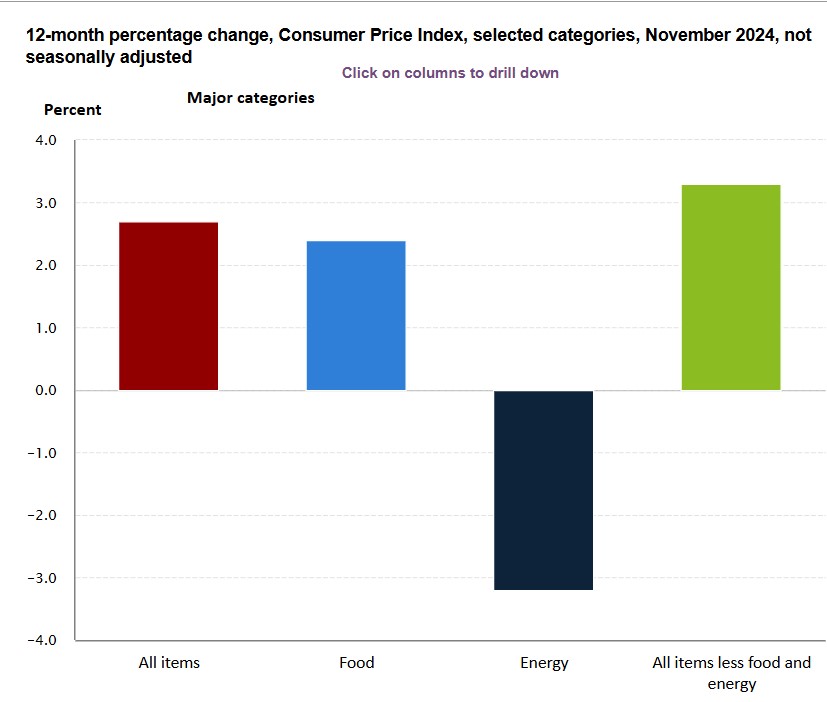
Rising food and energy costs significantly contributed to inflation in November.
The Federal Reserve now faces the challenge of balancing between promoting employment and price stability as inflation persists.
In September, the Federal Reserve cut its benchmark
interest rate by half a percentage point (the first reduction in more than four years), signaling confidence that inflation
was under control. However, the November data suggest they might have acted too soon.
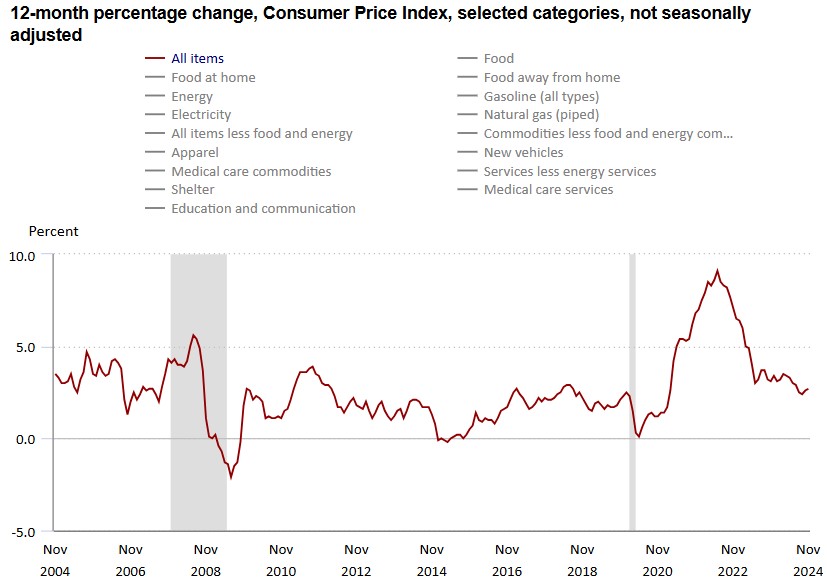
Inflation gained fresh momentum last month, adding new
challenges to an already uncertain economic outlook. Consumer prices rose by
2.7% over the past 12 months, marking the steepest increase since July,
according to the latest data from the US Bureau of Labor Statistics.
What is Next for the Fed?
While rising costs for food and energy played a
significant role, the Federal Reserve remains on track to lower interest rates
in the coming days. For much of the year, shelter-related costs dominated
inflation reports. However, in November, the narrative shifted. Shelter prices rose by 0.3% and accounted for 40% of
the monthly inflation gain, down from previous months, where they made up as
much as 90%.
Source: US Bureau of Labor Statistics
Instead, food prices climbed 0.4%, while energy costs
posted their first increase in six months at 0.2%. These categories carry
significant weight in consumer budgets, especially for lower-income households.
In November, core inflation, which does not factor in food and energy prices, rose by 0.3% for the fourth consecutive
month, holding steady at an annual rate of 3.3%.
This highlights a new challenge of bringing inflation
closer to the Federal Reserve's 2% target. Progress has stalled despite cooling
trends in areas like rent and motor vehicle insurance, which posted their
slowest increases in years, CNN reported.
Economic Uncertainty
Despite the rise in inflation, the Federal Reserve is
expected to cut interest rates for the third consecutive time next week.
Policymakers aim to support a labor market that has shown signs of slowing
while keeping a close eye on inflation metrics.
Rents, one of the stickiest inflation components, are
cooling, and other categories like motor vehicle insurance show signs of
moderation. However, volatility in food and energy prices continues to inject
uncertainty into economic forecasts.
Source: U.S. Bureau of Labor Statistics
In September, the Federal Open Market Committee said:
“The Committee seeks to achieve maximum employment and inflation at the
rate of 2 percent over the longer run. The Committee has gained greater
confidence that inflation is moving sustainably toward 2 percent and judges
that the risks to achieving its employment and inflation goals are roughly in
balance.”
Federal Reserve is now faced with the test of balance, its dual mandate of promoting employment and maintaining price stability. With
inflation showing signs of stubbornness, the economic journey ahead could prove
more challenging than anticipated.
In September, the Federal Reserve cut its benchmark
interest rate by half a percentage point (the first reduction in more than four years), signaling confidence that inflation
was under control. However, the November data suggest they might have acted too soon.
Inflation gained fresh momentum last month, adding new
challenges to an already uncertain economic outlook. Consumer prices rose by
2.7% over the past 12 months, marking the steepest increase since July,
according to the latest data from the US Bureau of Labor Statistics.
What is Next for the Fed?
While rising costs for food and energy played a
significant role, the Federal Reserve remains on track to lower interest rates
in the coming days. For much of the year, shelter-related costs dominated
inflation reports. However, in November, the narrative shifted. Shelter prices rose by 0.3% and accounted for 40% of
the monthly inflation gain, down from previous months, where they made up as
much as 90%.
Source: US Bureau of Labor Statistics
Instead, food prices climbed 0.4%, while energy costs
posted their first increase in six months at 0.2%. These categories carry
significant weight in consumer budgets, especially for lower-income households.
In November, core inflation, which does not factor in food and energy prices, rose by 0.3% for the fourth consecutive
month, holding steady at an annual rate of 3.3%.
This highlights a new challenge of bringing inflation
closer to the Federal Reserve's 2% target. Progress has stalled despite cooling
trends in areas like rent and motor vehicle insurance, which posted their
slowest increases in years, CNN reported.
Economic Uncertainty
Despite the rise in inflation, the Federal Reserve is
expected to cut interest rates for the third consecutive time next week.
Policymakers aim to support a labor market that has shown signs of slowing
while keeping a close eye on inflation metrics.
Rents, one of the stickiest inflation components, are
cooling, and other categories like motor vehicle insurance show signs of
moderation. However, volatility in food and energy prices continues to inject
uncertainty into economic forecasts.
Source: U.S. Bureau of Labor Statistics
In September, the Federal Open Market Committee said:
“The Committee seeks to achieve maximum employment and inflation at the
rate of 2 percent over the longer run. The Committee has gained greater
confidence that inflation is moving sustainably toward 2 percent and judges
that the risks to achieving its employment and inflation goals are roughly in
balance.”
Federal Reserve is now faced with the test of balance, its dual mandate of promoting employment and maintaining price stability. With
inflation showing signs of stubbornness, the economic journey ahead could prove
more challenging than anticipated.
Jared Kirui is an Editor at Finance Magnates with more than five years of experience in financial journalism. He covers online trading, fintech, payments, and crypto industries with a focus on companies, regulation and compliance, executive moves, trading technology, and market analysis.
His work has been featured in other media outlets, including Benzinga, ZyCrypto, The Distributed, and The Daily Hodl.
Education:
Bachelor of Commerce degree (Finance option), University of Nairobi
Inside the Prediction Markets: $1.6B Institutional Inflow Meets a Federal Crackdown
FP Markets Winner Spotlight 🏆 | Global Broker of the Year 2025 #Trading #Broker #Innovation #Shorts
FP Markets Winner Spotlight 🏆 | Global Broker of the Year 2025 #Trading #Broker #Innovation #Shorts
FP Markets takes the spotlight as Global Broker of the Year 2025 at the Finance Magnates Awards.
Martin Stoilov, Head of Client Experience, shares that trust, innovation, and people played a key role in the company’s success, supported by a strong foundation of integrity and client-centricity.
Following this milestone, FP Markets continues to focus on growth, technology investment, and its core values of transparency and excellence.
👉 Be part of FM Awards 2026: https://awards.financemagnates.com/#nominate
FP Markets takes the spotlight as Global Broker of the Year 2025 at the Finance Magnates Awards.
Martin Stoilov, Head of Client Experience, shares that trust, innovation, and people played a key role in the company’s success, supported by a strong foundation of integrity and client-centricity.
Following this milestone, FP Markets continues to focus on growth, technology investment, and its core values of transparency and excellence.
👉 Be part of FM Awards 2026: https://awards.financemagnates.com/#nominate
In this video, we review @HolaPrimeMarketsOfficial, a multi-asset forex and CFDs broker offering different account types, trading platforms, and flexible trading conditions.
We cover the broker’s overall offering, including account options, trading environment, platforms like MT4 and MT5, and additional services such as managed accounts and fast withdrawals.
Watch the full video to see if Hola Prime Markets fits your trading needs.
📣 Stay up to date with the latest in finance and trading. Follow Finance Magnates for industry news, insights, and global event coverage.
Connect with us:
🔗 LinkedIn: /financemagnates
👍 Facebook: /financemagnates
📸 Instagram: https://www.instagram.com/financemagnates
🐦 X: https://x.com/financemagnates
🎥 TikTok: https://www.tiktok.com/tag/financemagnates
▶️ YouTube: /@financemagnates_official
#HolaPrime #ForexBroker #CFDTrading #FinanceMagnates #Trading #Forex #BrokerReview
In this video, we review @HolaPrimeMarketsOfficial, a multi-asset forex and CFDs broker offering different account types, trading platforms, and flexible trading conditions.
We cover the broker’s overall offering, including account options, trading environment, platforms like MT4 and MT5, and additional services such as managed accounts and fast withdrawals.
Watch the full video to see if Hola Prime Markets fits your trading needs.
📣 Stay up to date with the latest in finance and trading. Follow Finance Magnates for industry news, insights, and global event coverage.
Connect with us:
🔗 LinkedIn: /financemagnates
👍 Facebook: /financemagnates
📸 Instagram: https://www.instagram.com/financemagnates
🐦 X: https://x.com/financemagnates
🎥 TikTok: https://www.tiktok.com/tag/financemagnates
▶️ YouTube: /@financemagnates_official
#HolaPrime #ForexBroker #CFDTrading #FinanceMagnates #Trading #Forex #BrokerReview
Hola Prime Review: What You Need to Know | Full Breakdown by Finance Magnates
Hola Prime Review: What You Need to Know | Full Breakdown by Finance Magnates
In this video, we review @HolaPrime_Global, a proprietary trading firm offering evaluation programs and performance-based payouts in simulated market environments.
We cover how the challenge model works, including account types, profit splits (up to 95%), trading rules, and what it takes to reach a funded account. You’ll also learn about available platforms like MT4, MT5, cTrader, and more, along with insights into payouts, support, and trading conditions.
Watch the full video to see if Hola Prime fits your trading style.
📣 Stay up to date with the latest in finance and trading. Follow Finance Magnates for industry news, insights, and global event coverage.
Connect with us:
🔗 LinkedIn: /financemagnates
👍 Facebook: /financemagnates
📸 Instagram: https://www.instagram.com/financemagnates
🐦 X: https://x.com/financemagnates
🎥 TikTok: https://www.tiktok.com/tag/financemagnates
▶️ YouTube: /@financemagnates_official
#HolaPrime #PropFirm #Trading #FinanceMagnates #Forex #FuturesTrading #TradingReview #PropFirmReview
In this video, we review @HolaPrime_Global, a proprietary trading firm offering evaluation programs and performance-based payouts in simulated market environments.
We cover how the challenge model works, including account types, profit splits (up to 95%), trading rules, and what it takes to reach a funded account. You’ll also learn about available platforms like MT4, MT5, cTrader, and more, along with insights into payouts, support, and trading conditions.
Watch the full video to see if Hola Prime fits your trading style.
📣 Stay up to date with the latest in finance and trading. Follow Finance Magnates for industry news, insights, and global event coverage.
Connect with us:
🔗 LinkedIn: /financemagnates
👍 Facebook: /financemagnates
📸 Instagram: https://www.instagram.com/financemagnates
🐦 X: https://x.com/financemagnates
🎥 TikTok: https://www.tiktok.com/tag/financemagnates
▶️ YouTube: /@financemagnates_official
#HolaPrime #PropFirm #Trading #FinanceMagnates #Forex #FuturesTrading #TradingReview #PropFirmReview
Axi Winner Spotlight 🏆 | Global Most Innovative Broker 2025 #Innovation #Trading #Fintech #Broker
Axi Winner Spotlight 🏆 | Global Most Innovative Broker 2025 #Innovation #Trading #Fintech #Broker
Axi takes the spotlight at the Finance Magnates Awards, winning Global Most Innovative Broker 2025.
Olivia Xenofontos and Ivanna Openko share how the team will feel: proud, motivated, and ready to keep delivering.
They also describe the night as well-organized, focused, and enjoyable for all.
👉 Be part of FM Awards 2026.
Axi takes the spotlight at the Finance Magnates Awards, winning Global Most Innovative Broker 2025.
Olivia Xenofontos and Ivanna Openko share how the team will feel: proud, motivated, and ready to keep delivering.
They also describe the night as well-organized, focused, and enjoyable for all.
👉 Be part of FM Awards 2026.
Recognition that matters.
Built on transparency.
Driven by the industry.
The Finance Magnates Awards 2026.
Nominations are now open.
🔗 https://awards.financemagnates.com/?utm_source=SM&utm_medium=social&utm_campaign=recognition-matters
Recognition that matters.
Built on transparency.
Driven by the industry.
The Finance Magnates Awards 2026.
Nominations are now open.
🔗 https://awards.financemagnates.com/?utm_source=SM&utm_medium=social&utm_campaign=recognition-matters