Public sector involvement with Bitcoin will be restricted, and Chivo wallet will be phased out.
A survey shows 92% of Salvadorans don’t use Bitcoin for transactions.
El Salvador has agreed to make merchant acceptance of
Bitcoin voluntary as part of a $1.4 billion loan agreement with the
International Monetary Fund (IMF). Meanwhile, Bitcoin made a bearish move
yesterday (Wednesday), causing its price to drop to $100000. The cryptocurrency
had reached an all-time high of $108,000 the day before.
The country will also scale back its involvement with the
Chivo wallet, which has seen limited use, and restrict public sector
participation in Bitcoin-related activities. These changes are aimed at
reducing El Salvador's debt-to-GDP ratio, according to an IMF statement on
December 18.
IMF Agreement Limits Bitcoin Use
The agreement, set to last 40 months, requires El Salvador
to implement legal reforms, making Bitcoin acceptance voluntary for the private
sector. Additionally, public sector engagement with Bitcoin will be confined,
with taxes to be paid in US dollars, the country’s official currency. The IMF
noted that government involvement in Chivo will be gradually phased out.
“The potential risks of the Bitcoin project will be
diminished significantly in line with Fund policies. Legal reforms will make
acceptance of Bitcoin by the private sector voluntary,” the IMF said.
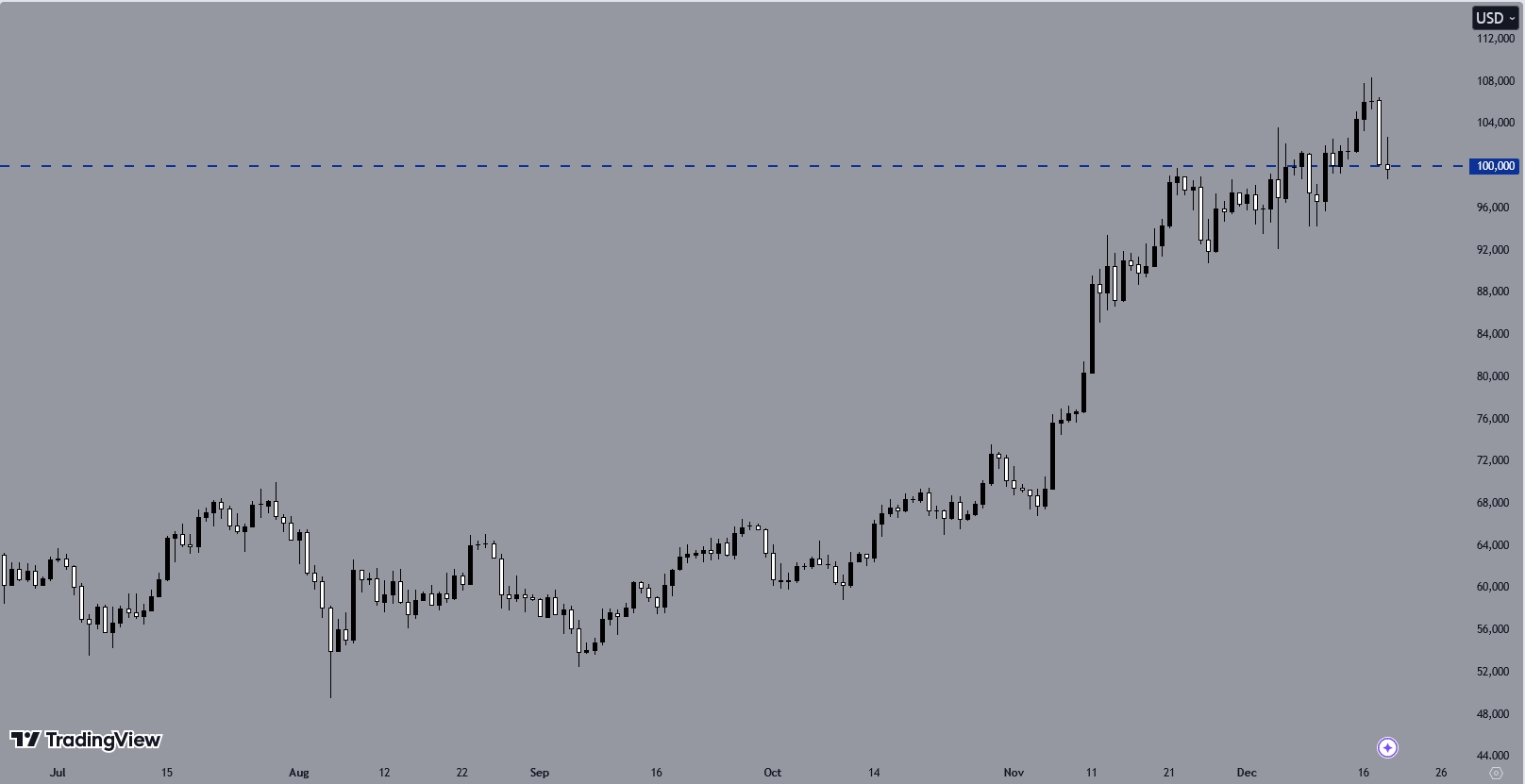
BTCUSD Forms Bearish Engulfing Candle After Reaching
$108K
After breaching the $100K mark, BTCUSD headed north and
reached $108K. However, following the formation of a doji candle on the daily
chart, a bearish engulfing candle emerged, closing back within the $100K range.
This is a significant level, where the cryptocurrency is likely to find its
next direction for some time.
BTCUSD, Daily Chart, Source: TradingView
El Salvador’s Bitcoin Strategy Faces IMF Scrutiny
El Salvador, which
started buying Bitcoin in 2021, currently holds 5,968.8 Bitcoin, valued
at approximately $632 million. A spokesperson for the National Bitcoin
Office confirmed that the country will continue accumulating Bitcoin at a rate
of one per day and will not sell its current holdings.
The deal is subject to approval by the IMF Executive Board
but concludes years of negotiations surrounding President Nayib Bukele’s 2021
decision to adopt Bitcoin as legal tender. The IMF has previously expressed
concerns about the risks posed by Bitcoin, citing its speculative nature.
92% of Salvadorans Avoid Bitcoin
In addition to the IMF loan, El Salvador is expected to
secure over $3.5 billion in total financing from other global financial
institutions, including the World Bank.
In response to the IMF announcement, Bukele's Bitcoin
adviser, Max Keiser, criticized the IMF, dismissing its comments as
"bureaucratic" and "meaningless."
Keiser argued that
Bitcoin use in El Salvador remains voluntary and continues to grow. However, an
October survey revealed that 92% of Salvadorans do not use Bitcoin for
transactions, a slight increase from 88% in 2023.
El Salvador has agreed to make merchant acceptance of
Bitcoin voluntary as part of a $1.4 billion loan agreement with the
International Monetary Fund (IMF). Meanwhile, Bitcoin made a bearish move
yesterday (Wednesday), causing its price to drop to $100000. The cryptocurrency
had reached an all-time high of $108,000 the day before.
The country will also scale back its involvement with the
Chivo wallet, which has seen limited use, and restrict public sector
participation in Bitcoin-related activities. These changes are aimed at
reducing El Salvador's debt-to-GDP ratio, according to an IMF statement on
December 18.
IMF Agreement Limits Bitcoin Use
The agreement, set to last 40 months, requires El Salvador
to implement legal reforms, making Bitcoin acceptance voluntary for the private
sector. Additionally, public sector engagement with Bitcoin will be confined,
with taxes to be paid in US dollars, the country’s official currency. The IMF
noted that government involvement in Chivo will be gradually phased out.
“The potential risks of the Bitcoin project will be
diminished significantly in line with Fund policies. Legal reforms will make
acceptance of Bitcoin by the private sector voluntary,” the IMF said.
BTCUSD Forms Bearish Engulfing Candle After Reaching
$108K
After breaching the $100K mark, BTCUSD headed north and
reached $108K. However, following the formation of a doji candle on the daily
chart, a bearish engulfing candle emerged, closing back within the $100K range.
This is a significant level, where the cryptocurrency is likely to find its
next direction for some time.
BTCUSD, Daily Chart, Source: TradingView
El Salvador’s Bitcoin Strategy Faces IMF Scrutiny
El Salvador, which
started buying Bitcoin in 2021, currently holds 5,968.8 Bitcoin, valued
at approximately $632 million. A spokesperson for the National Bitcoin
Office confirmed that the country will continue accumulating Bitcoin at a rate
of one per day and will not sell its current holdings.
The deal is subject to approval by the IMF Executive Board
but concludes years of negotiations surrounding President Nayib Bukele’s 2021
decision to adopt Bitcoin as legal tender. The IMF has previously expressed
concerns about the risks posed by Bitcoin, citing its speculative nature.
92% of Salvadorans Avoid Bitcoin
In addition to the IMF loan, El Salvador is expected to
secure over $3.5 billion in total financing from other global financial
institutions, including the World Bank.
In response to the IMF announcement, Bukele's Bitcoin
adviser, Max Keiser, criticized the IMF, dismissing its comments as
"bureaucratic" and "meaningless."
Keiser argued that
Bitcoin use in El Salvador remains voluntary and continues to grow. However, an
October survey revealed that 92% of Salvadorans do not use Bitcoin for
transactions, a slight increase from 88% in 2023.
Tareq is a financial writer with 15 years of experience covering global markets. His work spans technical analysis, forex broker reviews, and market sentiment, with a focus on topics relevant to retail traders. He joined Finance Magnates in 2023.
At Finance Magnates, he serves as News Editor, covering retail forex and CFD brokers, cryptocurrency exchanges, fintech firms, and regulatory developments shaping the trading industry. He holds an Honours degree in Information Technology from Anfell College, London.
Education:
Honours degree Information Technology, Anfell College, London
Inside the Prediction Markets: $1.6B Institutional Inflow Meets a Federal Crackdown
FP Markets Winner Spotlight 🏆 | Global Broker of the Year 2025 #Trading #Broker #Innovation #Shorts
FP Markets Winner Spotlight 🏆 | Global Broker of the Year 2025 #Trading #Broker #Innovation #Shorts
FP Markets takes the spotlight as Global Broker of the Year 2025 at the Finance Magnates Awards.
Martin Stoilov, Head of Client Experience, shares that trust, innovation, and people played a key role in the company’s success, supported by a strong foundation of integrity and client-centricity.
Following this milestone, FP Markets continues to focus on growth, technology investment, and its core values of transparency and excellence.
👉 Be part of FM Awards 2026: https://awards.financemagnates.com/#nominate
FP Markets takes the spotlight as Global Broker of the Year 2025 at the Finance Magnates Awards.
Martin Stoilov, Head of Client Experience, shares that trust, innovation, and people played a key role in the company’s success, supported by a strong foundation of integrity and client-centricity.
Following this milestone, FP Markets continues to focus on growth, technology investment, and its core values of transparency and excellence.
👉 Be part of FM Awards 2026: https://awards.financemagnates.com/#nominate
In this video, we review @HolaPrimeMarketsOfficial, a multi-asset forex and CFDs broker offering different account types, trading platforms, and flexible trading conditions.
We cover the broker’s overall offering, including account options, trading environment, platforms like MT4 and MT5, and additional services such as managed accounts and fast withdrawals.
Watch the full video to see if Hola Prime Markets fits your trading needs.
📣 Stay up to date with the latest in finance and trading. Follow Finance Magnates for industry news, insights, and global event coverage.
Connect with us:
🔗 LinkedIn: /financemagnates
👍 Facebook: /financemagnates
📸 Instagram: https://www.instagram.com/financemagnates
🐦 X: https://x.com/financemagnates
🎥 TikTok: https://www.tiktok.com/tag/financemagnates
▶️ YouTube: /@financemagnates_official
#HolaPrime #ForexBroker #CFDTrading #FinanceMagnates #Trading #Forex #BrokerReview
In this video, we review @HolaPrimeMarketsOfficial, a multi-asset forex and CFDs broker offering different account types, trading platforms, and flexible trading conditions.
We cover the broker’s overall offering, including account options, trading environment, platforms like MT4 and MT5, and additional services such as managed accounts and fast withdrawals.
Watch the full video to see if Hola Prime Markets fits your trading needs.
📣 Stay up to date with the latest in finance and trading. Follow Finance Magnates for industry news, insights, and global event coverage.
Connect with us:
🔗 LinkedIn: /financemagnates
👍 Facebook: /financemagnates
📸 Instagram: https://www.instagram.com/financemagnates
🐦 X: https://x.com/financemagnates
🎥 TikTok: https://www.tiktok.com/tag/financemagnates
▶️ YouTube: /@financemagnates_official
#HolaPrime #ForexBroker #CFDTrading #FinanceMagnates #Trading #Forex #BrokerReview
Hola Prime Review: What You Need to Know | Full Breakdown by Finance Magnates
Hola Prime Review: What You Need to Know | Full Breakdown by Finance Magnates
In this video, we review @HolaPrime_Global, a proprietary trading firm offering evaluation programs and performance-based payouts in simulated market environments.
We cover how the challenge model works, including account types, profit splits (up to 95%), trading rules, and what it takes to reach a funded account. You’ll also learn about available platforms like MT4, MT5, cTrader, and more, along with insights into payouts, support, and trading conditions.
Watch the full video to see if Hola Prime fits your trading style.
📣 Stay up to date with the latest in finance and trading. Follow Finance Magnates for industry news, insights, and global event coverage.
Connect with us:
🔗 LinkedIn: /financemagnates
👍 Facebook: /financemagnates
📸 Instagram: https://www.instagram.com/financemagnates
🐦 X: https://x.com/financemagnates
🎥 TikTok: https://www.tiktok.com/tag/financemagnates
▶️ YouTube: /@financemagnates_official
#HolaPrime #PropFirm #Trading #FinanceMagnates #Forex #FuturesTrading #TradingReview #PropFirmReview
In this video, we review @HolaPrime_Global, a proprietary trading firm offering evaluation programs and performance-based payouts in simulated market environments.
We cover how the challenge model works, including account types, profit splits (up to 95%), trading rules, and what it takes to reach a funded account. You’ll also learn about available platforms like MT4, MT5, cTrader, and more, along with insights into payouts, support, and trading conditions.
Watch the full video to see if Hola Prime fits your trading style.
📣 Stay up to date with the latest in finance and trading. Follow Finance Magnates for industry news, insights, and global event coverage.
Connect with us:
🔗 LinkedIn: /financemagnates
👍 Facebook: /financemagnates
📸 Instagram: https://www.instagram.com/financemagnates
🐦 X: https://x.com/financemagnates
🎥 TikTok: https://www.tiktok.com/tag/financemagnates
▶️ YouTube: /@financemagnates_official
#HolaPrime #PropFirm #Trading #FinanceMagnates #Forex #FuturesTrading #TradingReview #PropFirmReview
Axi Winner Spotlight 🏆 | Global Most Innovative Broker 2025 #Innovation #Trading #Fintech #Broker
Axi Winner Spotlight 🏆 | Global Most Innovative Broker 2025 #Innovation #Trading #Fintech #Broker
Axi takes the spotlight at the Finance Magnates Awards, winning Global Most Innovative Broker 2025.
Olivia Xenofontos and Ivanna Openko share how the team will feel: proud, motivated, and ready to keep delivering.
They also describe the night as well-organized, focused, and enjoyable for all.
👉 Be part of FM Awards 2026.
Axi takes the spotlight at the Finance Magnates Awards, winning Global Most Innovative Broker 2025.
Olivia Xenofontos and Ivanna Openko share how the team will feel: proud, motivated, and ready to keep delivering.
They also describe the night as well-organized, focused, and enjoyable for all.
👉 Be part of FM Awards 2026.
Recognition that matters.
Built on transparency.
Driven by the industry.
The Finance Magnates Awards 2026.
Nominations are now open.
🔗 https://awards.financemagnates.com/?utm_source=SM&utm_medium=social&utm_campaign=recognition-matters
Recognition that matters.
Built on transparency.
Driven by the industry.
The Finance Magnates Awards 2026.
Nominations are now open.
🔗 https://awards.financemagnates.com/?utm_source=SM&utm_medium=social&utm_campaign=recognition-matters