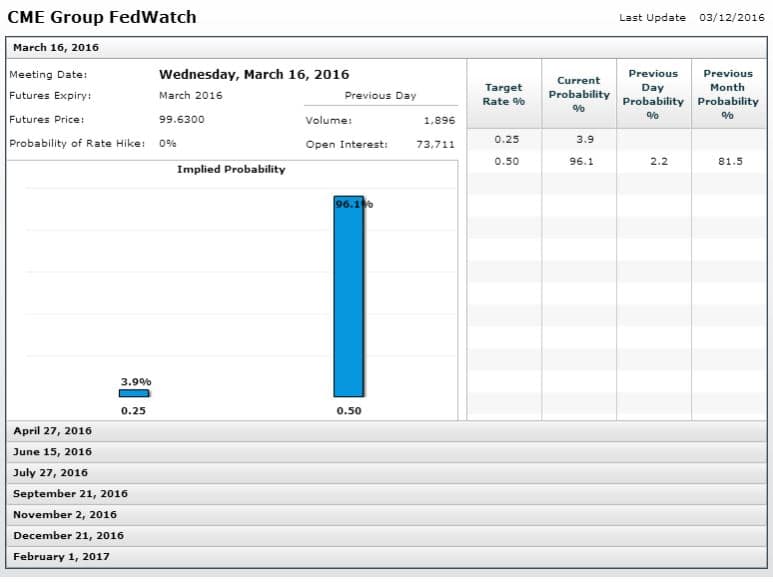
The indicator shows the probability of a rate hike at 0% in March, 43% in June, 61% in September and 75% in December.
Washington DC
This week’s key event is the U.S. Federal Reserve’s Federal Open Market Committee meeting on March 15 -16. The committee is expected to discuss raising interest rates at the meeting, but don’t expect them to do so.
This assessment isn’t based on my opinion but rather the Federal Funds Rate futures contract and the CME Group FedWatch Indicator. These tools have long been used to express the market’s views on the likelihood of changes in U.S. monetary policy. As of March 11, the indicator shows the probability of a March rate hike at 0%. The probability of a rate hike in June rises to 43%, in September to 61% and in December to 75%.
Although the Fed Funds Indicator suggests at least two rate hikes this year, likely in June and December, conditions aren’t right at this time for such a move. There are several reasons behind this line of thinking. Among them is low inflation, driven by the fact that oil prices are still far below their 2014 top and an economic slowdown in China. Negative interest rates in Europe and Japan have also make it more difficult for the central bank to raise rates.
In its new statement, the Fed is not likely to try to build a case for holding rates near historically low levels, but rather it is going to explain that it is keeping its options open and that a rate hike is still “data dependent”. It is also not expected to significantly change its economic models or policy forecasts.
Since its last meeting in late January, the U.S. economy has showed signs of strength that might support a rate hike eventually. These include the gradual rise in oil prices since the lows of late January and mid-February and a strong recovery in the U.S. equity markets. Additionally, the labor market continues to improve.
The FOMC Committee’s vote is likely to come in mixed if comments from two Fed officials are any indication. Earlier this month, Federal Reserve Governor Lael Brainard said the U.S. economy isn’t immune to global risks and called for careful adjustments to the policy rate to preserve the expansion. She called for more patience while Fed Vice Chairman Stanley Fischer saw signs of inflation.
Brainard said there are reasons to expect continued gains in employment, stabilizing growth in foreign economies, and an eventual rise of inflation back to the Fed’s 2 percent target. “However, there are risks around this baseline forecast, the most prominent of which lie to the downside,” she said.
“Given weak and decelerating foreign demand, it is critical to carefully protect and preserve the progress we have made here at home through prudent adjustments to the policy path,” she said.
On the other hand, Fischer contested the idea that the connection between low employment and inflation was broken, and said it may be reasserting itself now. The nation’s unemployment rate was 4.9 percent in February.
“The link has never been very strong, but it exists, and we may well at present be seeing the first stirrings of an increase in the inflation rate – something we would like to happen,” he told the National Association for Business Economics.
Given the comments by Fed members Brainard and Fischer and the state of the economy, the price of oil and the negative rates in Japan and Europe, it is going to be hard for the Fed to raise rates in March. However, June will be another story.
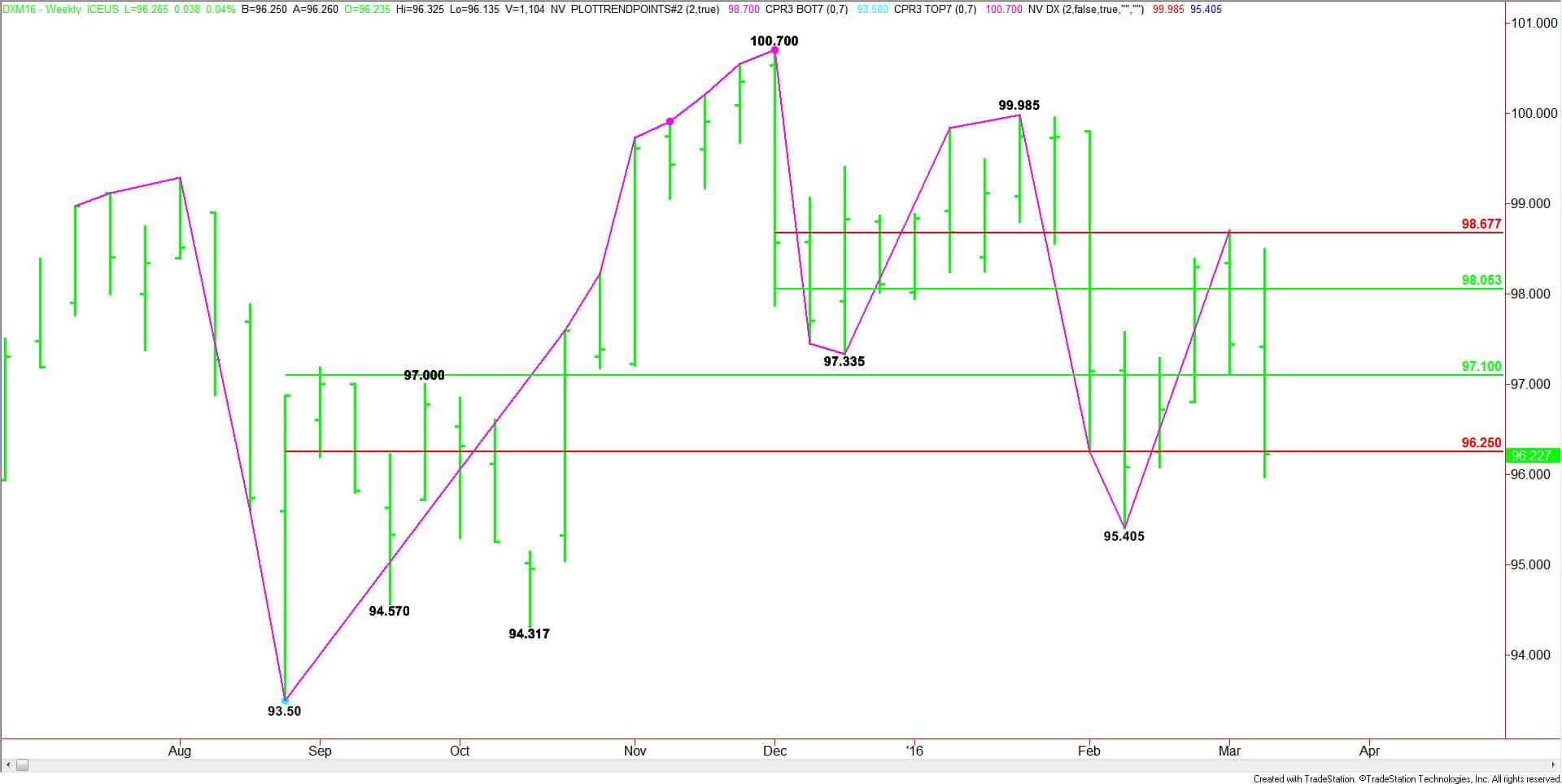
The charts indicate that a hawkish Fed statement is likely to be bearish for U.S. 30-Year Treasury Bonds and 10-Year Treasury Notes. Rising interest rates should be bullish for the U.S. dollar because they will make the greenback a more attractive investment.
This week’s key event is the U.S. Federal Reserve’s Federal Open Market Committee meeting on March 15 -16. The committee is expected to discuss raising interest rates at the meeting, but don’t expect them to do so.
This assessment isn’t based on my opinion but rather the Federal Funds Rate futures contract and the CME Group FedWatch Indicator. These tools have long been used to express the market’s views on the likelihood of changes in U.S. monetary policy. As of March 11, the indicator shows the probability of a March rate hike at 0%. The probability of a rate hike in June rises to 43%, in September to 61% and in December to 75%.
Although the Fed Funds Indicator suggests at least two rate hikes this year, likely in June and December, conditions aren’t right at this time for such a move. There are several reasons behind this line of thinking. Among them is low inflation, driven by the fact that oil prices are still far below their 2014 top and an economic slowdown in China. Negative interest rates in Europe and Japan have also make it more difficult for the central bank to raise rates.
In its new statement, the Fed is not likely to try to build a case for holding rates near historically low levels, but rather it is going to explain that it is keeping its options open and that a rate hike is still “data dependent”. It is also not expected to significantly change its economic models or policy forecasts.
Since its last meeting in late January, the U.S. economy has showed signs of strength that might support a rate hike eventually. These include the gradual rise in oil prices since the lows of late January and mid-February and a strong recovery in the U.S. equity markets. Additionally, the labor market continues to improve.
The FOMC Committee’s vote is likely to come in mixed if comments from two Fed officials are any indication. Earlier this month, Federal Reserve Governor Lael Brainard said the U.S. economy isn’t immune to global risks and called for careful adjustments to the policy rate to preserve the expansion. She called for more patience while Fed Vice Chairman Stanley Fischer saw signs of inflation.
Brainard said there are reasons to expect continued gains in employment, stabilizing growth in foreign economies, and an eventual rise of inflation back to the Fed’s 2 percent target. “However, there are risks around this baseline forecast, the most prominent of which lie to the downside,” she said.
“Given weak and decelerating foreign demand, it is critical to carefully protect and preserve the progress we have made here at home through prudent adjustments to the policy path,” she said.
On the other hand, Fischer contested the idea that the connection between low employment and inflation was broken, and said it may be reasserting itself now. The nation’s unemployment rate was 4.9 percent in February.
“The link has never been very strong, but it exists, and we may well at present be seeing the first stirrings of an increase in the inflation rate – something we would like to happen,” he told the National Association for Business Economics.
Given the comments by Fed members Brainard and Fischer and the state of the economy, the price of oil and the negative rates in Japan and Europe, it is going to be hard for the Fed to raise rates in March. However, June will be another story.
The charts indicate that a hawkish Fed statement is likely to be bearish for U.S. 30-Year Treasury Bonds and 10-Year Treasury Notes. Rising interest rates should be bullish for the U.S. dollar because they will make the greenback a more attractive investment.
James A. Hyerczyk is a financial analyst for FX Empire, a leading financial portal. James has worked as a fundamental and technical financial market analyst since 1982. His technical work features the pattern, price and time analysis techniques of W.D. Gann. James A. Hyerczyk is a senior analyst at FX Empire. He has worked as a fundamental and technical financial market analyst since 1982. His technical work features the pattern, price and time analysis techniques of W.D. Gann.
Clearstream to Settle LCH-Cleared Equity Contracts
Featured Videos
FM Daily Brief – 9 June 2026
Today’s Tuesday, the 9th of June 2026, and these are our main stories: eToro’s customer assets climbed back above $20 billion, Prop trading model in prediction markets, and Leverate launched a new AI assistant for brokers and traders.
War Stories: Lessons from 20 Years in Markets (the pain, the pitfalls and the profits)
The trades that taught me the most aren't the ones that worked. They're the ones that didn't — or the ones I almost caught and didn't have the nerve to ride. In this session, I'll tell you about the Brexit miss, the SNB shocker that nearly handed me a 5400% return, the BoJ surprise that punched me in the gut, and a few wins along the way. Each story carries a lesson, but the lessons aren't the point. Everyone who trades long enough collects a portfolio of moments like these; what separates the people who stay in the game is what they do with them.
The Engine and the Fuel: How AI & Data Drives African Future
If AI is the engine, data is the fuel. Without quality, accessible data, AI cannot work well; and without the right mindset, data remains just numbers instead of insight. In this session, leading experts will explore how AI and data are democratizing opportunities for businesses and personal growth. Discover practical ways to make AI accessible today, anticipate its transformative impact on African markets, and learn actionable steps to prepare for what's next. Let's talk about:
-How AI and data drive business efficiency and innovation in trading and fintech
-AI tools to elevate trading or business strategies
-How to access and maximise the power of data and AI
-Emerging AI and data trends in Africa and their economic ripple effects
If AI is the engine, data is the fuel. Without quality, accessible data, AI cannot work well; and without the right mindset, data remains just numbers instead of insight. In this session, leading experts will explore how AI and data are democratizing opportunities for businesses and personal growth. Discover practical ways to make AI accessible today, anticipate its transformative impact on African markets, and learn actionable steps to prepare for what's next. Let's talk about:
-How AI and data drive business efficiency and innovation in trading and fintech
-AI tools to elevate trading or business strategies
-How to access and maximise the power of data and AI
-Emerging AI and data trends in Africa and their economic ripple effects
If AI is the engine, data is the fuel. Without quality, accessible data, AI cannot work well; and without the right mindset, data remains just numbers instead of insight. In this session, leading experts will explore how AI and data are democratizing opportunities for businesses and personal growth. Discover practical ways to make AI accessible today, anticipate its transformative impact on African markets, and learn actionable steps to prepare for what's next. Let's talk about:
-How AI and data drive business efficiency and innovation in trading and fintech
-AI tools to elevate trading or business strategies
-How to access and maximise the power of data and AI
-Emerging AI and data trends in Africa and their economic ripple effects
If AI is the engine, data is the fuel. Without quality, accessible data, AI cannot work well; and without the right mindset, data remains just numbers instead of insight. In this session, leading experts will explore how AI and data are democratizing opportunities for businesses and personal growth. Discover practical ways to make AI accessible today, anticipate its transformative impact on African markets, and learn actionable steps to prepare for what's next. Let's talk about:
-How AI and data drive business efficiency and innovation in trading and fintech
-AI tools to elevate trading or business strategies
-How to access and maximise the power of data and AI
-Emerging AI and data trends in Africa and their economic ripple effects
If AI is the engine, data is the fuel. Without quality, accessible data, AI cannot work well; and without the right mindset, data remains just numbers instead of insight. In this session, leading experts will explore how AI and data are democratizing opportunities for businesses and personal growth. Discover practical ways to make AI accessible today, anticipate its transformative impact on African markets, and learn actionable steps to prepare for what's next. Let's talk about:
-How AI and data drive business efficiency and innovation in trading and fintech
-AI tools to elevate trading or business strategies
-How to access and maximise the power of data and AI
-Emerging AI and data trends in Africa and their economic ripple effects
If AI is the engine, data is the fuel. Without quality, accessible data, AI cannot work well; and without the right mindset, data remains just numbers instead of insight. In this session, leading experts will explore how AI and data are democratizing opportunities for businesses and personal growth. Discover practical ways to make AI accessible today, anticipate its transformative impact on African markets, and learn actionable steps to prepare for what's next. Let's talk about:
-How AI and data drive business efficiency and innovation in trading and fintech
-AI tools to elevate trading or business strategies
-How to access and maximise the power of data and AI
-Emerging AI and data trends in Africa and their economic ripple effects
Inside My Best Trade with Jimmy Moyaha
Most market post-mortems describe what happened to prices. Few describe what happened in the trading room while the position was open: the entry conviction, the moments that tested it, and the exit decision that closed the book.
This session brings one seasoned trader to the stage for an unfiltered account of the position that still defines how they think about markets.
Attendees will walk away with:
-A first-hand account of how a conviction trade is built, from thesis and entry through position management and exit
-Understanding of what turns a market observation into a live position, and what holds it when conditions shift
-Insight into how timing, execution quality, and market structure shaped the final result
-Perspective on what the trade revealed about edge, risk tolerance, and when to hold through a position moving against you
-Clarity on what separates a well-built trade from a well-timed one
Most market post-mortems describe what happened to prices. Few describe what happened in the trading room while the position was open: the entry conviction, the moments that tested it, and the exit decision that closed the book.
This session brings one seasoned trader to the stage for an unfiltered account of the position that still defines how they think about markets.
Attendees will walk away with:
-A first-hand account of how a conviction trade is built, from thesis and entry through position management and exit
-Understanding of what turns a market observation into a live position, and what holds it when conditions shift
-Insight into how timing, execution quality, and market structure shaped the final result
-Perspective on what the trade revealed about edge, risk tolerance, and when to hold through a position moving against you
-Clarity on what separates a well-built trade from a well-timed one
Most market post-mortems describe what happened to prices. Few describe what happened in the trading room while the position was open: the entry conviction, the moments that tested it, and the exit decision that closed the book.
This session brings one seasoned trader to the stage for an unfiltered account of the position that still defines how they think about markets.
Attendees will walk away with:
-A first-hand account of how a conviction trade is built, from thesis and entry through position management and exit
-Understanding of what turns a market observation into a live position, and what holds it when conditions shift
-Insight into how timing, execution quality, and market structure shaped the final result
-Perspective on what the trade revealed about edge, risk tolerance, and when to hold through a position moving against you
-Clarity on what separates a well-built trade from a well-timed one
Most market post-mortems describe what happened to prices. Few describe what happened in the trading room while the position was open: the entry conviction, the moments that tested it, and the exit decision that closed the book.
This session brings one seasoned trader to the stage for an unfiltered account of the position that still defines how they think about markets.
Attendees will walk away with:
-A first-hand account of how a conviction trade is built, from thesis and entry through position management and exit
-Understanding of what turns a market observation into a live position, and what holds it when conditions shift
-Insight into how timing, execution quality, and market structure shaped the final result
-Perspective on what the trade revealed about edge, risk tolerance, and when to hold through a position moving against you
-Clarity on what separates a well-built trade from a well-timed one
Most market post-mortems describe what happened to prices. Few describe what happened in the trading room while the position was open: the entry conviction, the moments that tested it, and the exit decision that closed the book.
This session brings one seasoned trader to the stage for an unfiltered account of the position that still defines how they think about markets.
Attendees will walk away with:
-A first-hand account of how a conviction trade is built, from thesis and entry through position management and exit
-Understanding of what turns a market observation into a live position, and what holds it when conditions shift
-Insight into how timing, execution quality, and market structure shaped the final result
-Perspective on what the trade revealed about edge, risk tolerance, and when to hold through a position moving against you
-Clarity on what separates a well-built trade from a well-timed one
Most market post-mortems describe what happened to prices. Few describe what happened in the trading room while the position was open: the entry conviction, the moments that tested it, and the exit decision that closed the book.
This session brings one seasoned trader to the stage for an unfiltered account of the position that still defines how they think about markets.
Attendees will walk away with:
-A first-hand account of how a conviction trade is built, from thesis and entry through position management and exit
-Understanding of what turns a market observation into a live position, and what holds it when conditions shift
-Insight into how timing, execution quality, and market structure shaped the final result
-Perspective on what the trade revealed about edge, risk tolerance, and when to hold through a position moving against you
-Clarity on what separates a well-built trade from a well-timed one
Agentic Inequality: Democratizing Financial Access Through AI & Blockchain
As crypto and CFD trading continue to expand across Africa, access to advanced tools and market insights remains uneven. This session explores how AI and blockchain can bridge that gap by empowering informal traders and underserved communities to participate more effectively in digital financial markets. The discussion will focus on practical applications of technology to improve accessibility, education, and investment outcomes in both formal and informal sectors.
In this discussion, we will explore:
-The role of AI in democratizing access to trading tools, insights, and strategy development
-How crypto and blockchain can enable broader participation beyond traditional financial systems
-Addressing access barriers: infrastructure, education, and affordability in underserved communities
-Opportunities for brokers and platforms to tap into the informal trading economy
As crypto and CFD trading continue to expand across Africa, access to advanced tools and market insights remains uneven. This session explores how AI and blockchain can bridge that gap by empowering informal traders and underserved communities to participate more effectively in digital financial markets. The discussion will focus on practical applications of technology to improve accessibility, education, and investment outcomes in both formal and informal sectors.
In this discussion, we will explore:
-The role of AI in democratizing access to trading tools, insights, and strategy development
-How crypto and blockchain can enable broader participation beyond traditional financial systems
-Addressing access barriers: infrastructure, education, and affordability in underserved communities
-Opportunities for brokers and platforms to tap into the informal trading economy
As crypto and CFD trading continue to expand across Africa, access to advanced tools and market insights remains uneven. This session explores how AI and blockchain can bridge that gap by empowering informal traders and underserved communities to participate more effectively in digital financial markets. The discussion will focus on practical applications of technology to improve accessibility, education, and investment outcomes in both formal and informal sectors.
In this discussion, we will explore:
-The role of AI in democratizing access to trading tools, insights, and strategy development
-How crypto and blockchain can enable broader participation beyond traditional financial systems
-Addressing access barriers: infrastructure, education, and affordability in underserved communities
-Opportunities for brokers and platforms to tap into the informal trading economy
As crypto and CFD trading continue to expand across Africa, access to advanced tools and market insights remains uneven. This session explores how AI and blockchain can bridge that gap by empowering informal traders and underserved communities to participate more effectively in digital financial markets. The discussion will focus on practical applications of technology to improve accessibility, education, and investment outcomes in both formal and informal sectors.
In this discussion, we will explore:
-The role of AI in democratizing access to trading tools, insights, and strategy development
-How crypto and blockchain can enable broader participation beyond traditional financial systems
-Addressing access barriers: infrastructure, education, and affordability in underserved communities
-Opportunities for brokers and platforms to tap into the informal trading economy
As crypto and CFD trading continue to expand across Africa, access to advanced tools and market insights remains uneven. This session explores how AI and blockchain can bridge that gap by empowering informal traders and underserved communities to participate more effectively in digital financial markets. The discussion will focus on practical applications of technology to improve accessibility, education, and investment outcomes in both formal and informal sectors.
In this discussion, we will explore:
-The role of AI in democratizing access to trading tools, insights, and strategy development
-How crypto and blockchain can enable broader participation beyond traditional financial systems
-Addressing access barriers: infrastructure, education, and affordability in underserved communities
-Opportunities for brokers and platforms to tap into the informal trading economy
As crypto and CFD trading continue to expand across Africa, access to advanced tools and market insights remains uneven. This session explores how AI and blockchain can bridge that gap by empowering informal traders and underserved communities to participate more effectively in digital financial markets. The discussion will focus on practical applications of technology to improve accessibility, education, and investment outcomes in both formal and informal sectors.
In this discussion, we will explore:
-The role of AI in democratizing access to trading tools, insights, and strategy development
-How crypto and blockchain can enable broader participation beyond traditional financial systems
-Addressing access barriers: infrastructure, education, and affordability in underserved communities
-Opportunities for brokers and platforms to tap into the informal trading economy