It is important to choose the best, safest exchange out there. But how do you find the best cryptocurrency exchange?
FM
There’s a common saying in the crypto world: “Not your wallet, not your crypto.” People are regularly warned not to store their cryptocurrency on exchanges, but if one wants to trade crypto, one must by necessity keep some of their tokens on an exchange.
As such, it becomes important to choose the best, safest exchange out there. But how do you find the best cryptocurrency exchange? I looked around in 2018 and I couldn’t find anyone offering a comprehensive, impartial rating system for exchanges.
The ratings that I found were largely based on just a single factor, such as security or volume, or blog posts comparing a few of the major players. There was clearly a need for something more thorough and far-reaching.
I already had experience with this sort of thing -- my company Cointelligence had established an impartial rating system for ICOs and STOs, in an effort to help investors avoid scams.
It seemed just as important to avoid unsafe and scammy exchanges, so we decided to establish a cryptocurrency exchange rating system as well.
How do you rate an exchange?
What are the important factors in rating an exchange? Some exchange lists are simply sorted by volume, but recent reports have shown how much of this volume may be faked and inflated.
And while liquidity is an important part of trading, it really doesn’t matter how liquid an exchange is if you don’t feel safe trusting them with your cryptocurrency.
Currently, we’re looking at the following factors when we rate an exchange:
Accessibility and Usability -- How hard is it to navigate the site, set up an account, and trade your crypto on the exchange? We also factor in customer support and other aspects of the consumer experience.
Financial Benefit -- While this includes liquidity, it’s only one part of the metric. We also take into consideration things like the amount of crypto pairs available, fee structure, fiat currency support, and how the assets are insured.
Team -- Just as with ICOs and STOs, an exchange’s team is so important in establishing how trustworthy it is. Red flags would include an anonymous team, an inexperienced team, or a team previously associated with a bad exchange. On the other hand, if we see a team with a good amount of skills and experience related to cryptocurrency and financial services, we feel more confident about the exchange.
Risk -- Security is one of the most important aspects of a crypto exchange, which is why we look closely at whether the exchange has experienced hacks or other attacks in the past. We also take into consideration their regulatory compliance, security protocols, insurance, and the withdrawal process.
Over time, we hope to add more metrics to give an even more complete picture of an exchange’s quality.
How does the rating process play out?
Let me show you how these metrics play out with a couple of real examples of exchanges we’ve rated.
Bithumb
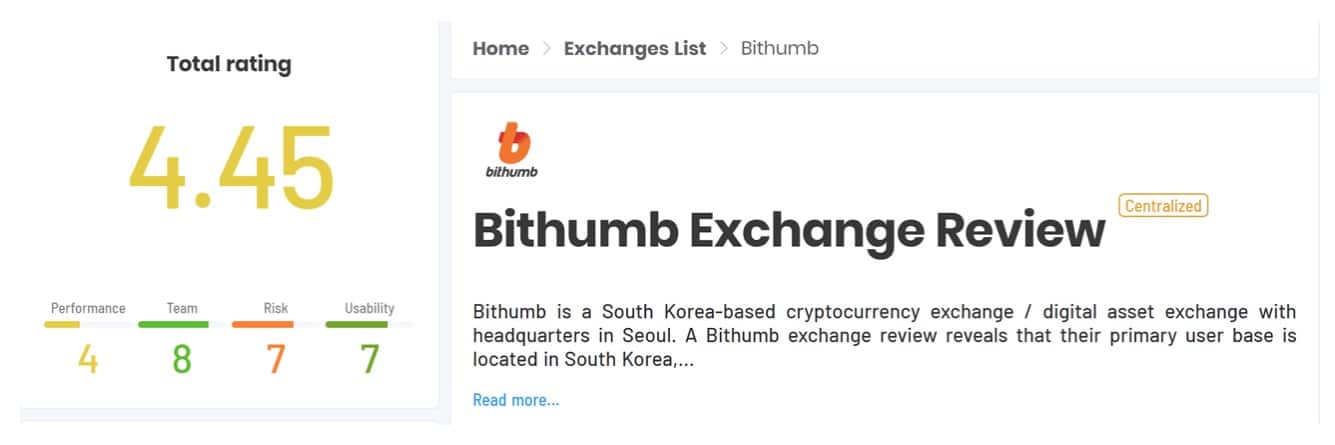
Bithumb has been in the news recently due to a hack that saw them lose approximately $13M in EOS and $6M in Ripple in what may have been an inside job.
We rated Bithumb before this most recent hack and gave them a risk score of 7 due to two previous hacks. This third hack should give anyone pause when they consider whether or not to trade on this exchange. To see the full review of Bithumb click here.
OKEx
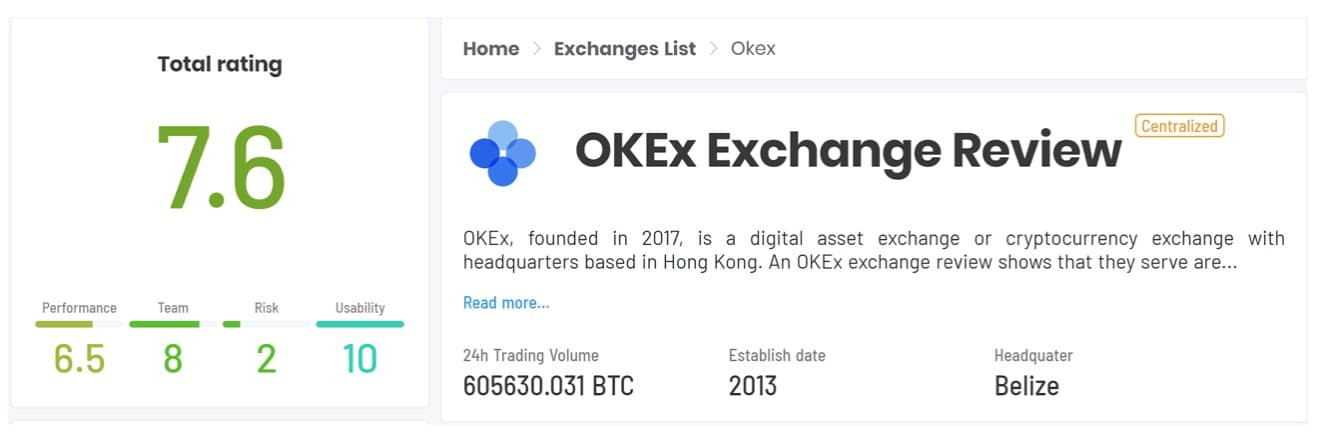
After reading the above example of Bithumb, you may think that it’s just enough to search on whether an exchange has experienced hacks before. But sometimes, a hack isn’t actually what it seems.
We originally gave OKEx a lower rating than their current 7.6/10. There had been reports of users having their accounts compromised and their funds stolen.
However, our research team dug deeper and found that this wasn’t due to any fault on the exchange’s side, and instead appeared to have happened because those users hadn’t enabled two-factor authentication to better protect their accounts. To read the full review of OKEx click here.
Why it’s important to rate on multiple metrics
If you look at both Bithumb and OKEx, you’ll see that each team has received a rating of 8. We believe that both of these exchanges have good people behind them who have the capabilities to run a reliable exchange -- but so far, OKEx has done a better job in terms of usability and risk management.
An exchange can’t be judged on only one factor. It’s not enough to simply look at volume, or the team, or how easy the site is to navigate. Because you’re trusting an exchange with your cryptocurrency funds, you need to look at them from every angle before deciding to open an account.
That’s why I believe an exchange system is important. If you agree, I invite you to check out Cointeligence’s crypto exchange list and rating here.
Disclaimer: The content of this article is sponsored and does not represent the opinions of Finance Magnates.
There’s a common saying in the crypto world: “Not your wallet, not your crypto.” People are regularly warned not to store their cryptocurrency on exchanges, but if one wants to trade crypto, one must by necessity keep some of their tokens on an exchange.
As such, it becomes important to choose the best, safest exchange out there. But how do you find the best cryptocurrency exchange? I looked around in 2018 and I couldn’t find anyone offering a comprehensive, impartial rating system for exchanges.
The ratings that I found were largely based on just a single factor, such as security or volume, or blog posts comparing a few of the major players. There was clearly a need for something more thorough and far-reaching.
I already had experience with this sort of thing -- my company Cointelligence had established an impartial rating system for ICOs and STOs, in an effort to help investors avoid scams.
It seemed just as important to avoid unsafe and scammy exchanges, so we decided to establish a cryptocurrency exchange rating system as well.
How do you rate an exchange?
What are the important factors in rating an exchange? Some exchange lists are simply sorted by volume, but recent reports have shown how much of this volume may be faked and inflated.
And while liquidity is an important part of trading, it really doesn’t matter how liquid an exchange is if you don’t feel safe trusting them with your cryptocurrency.
Currently, we’re looking at the following factors when we rate an exchange:
Accessibility and Usability -- How hard is it to navigate the site, set up an account, and trade your crypto on the exchange? We also factor in customer support and other aspects of the consumer experience.
Financial Benefit -- While this includes liquidity, it’s only one part of the metric. We also take into consideration things like the amount of crypto pairs available, fee structure, fiat currency support, and how the assets are insured.
Team -- Just as with ICOs and STOs, an exchange’s team is so important in establishing how trustworthy it is. Red flags would include an anonymous team, an inexperienced team, or a team previously associated with a bad exchange. On the other hand, if we see a team with a good amount of skills and experience related to cryptocurrency and financial services, we feel more confident about the exchange.
Risk -- Security is one of the most important aspects of a crypto exchange, which is why we look closely at whether the exchange has experienced hacks or other attacks in the past. We also take into consideration their regulatory compliance, security protocols, insurance, and the withdrawal process.
Over time, we hope to add more metrics to give an even more complete picture of an exchange’s quality.
How does the rating process play out?
Let me show you how these metrics play out with a couple of real examples of exchanges we’ve rated.
Bithumb
Bithumb has been in the news recently due to a hack that saw them lose approximately $13M in EOS and $6M in Ripple in what may have been an inside job.
We rated Bithumb before this most recent hack and gave them a risk score of 7 due to two previous hacks. This third hack should give anyone pause when they consider whether or not to trade on this exchange. To see the full review of Bithumb click here.
OKEx
After reading the above example of Bithumb, you may think that it’s just enough to search on whether an exchange has experienced hacks before. But sometimes, a hack isn’t actually what it seems.
We originally gave OKEx a lower rating than their current 7.6/10. There had been reports of users having their accounts compromised and their funds stolen.
However, our research team dug deeper and found that this wasn’t due to any fault on the exchange’s side, and instead appeared to have happened because those users hadn’t enabled two-factor authentication to better protect their accounts. To read the full review of OKEx click here.
Why it’s important to rate on multiple metrics
If you look at both Bithumb and OKEx, you’ll see that each team has received a rating of 8. We believe that both of these exchanges have good people behind them who have the capabilities to run a reliable exchange -- but so far, OKEx has done a better job in terms of usability and risk management.
An exchange can’t be judged on only one factor. It’s not enough to simply look at volume, or the team, or how easy the site is to navigate. Because you’re trusting an exchange with your cryptocurrency funds, you need to look at them from every angle before deciding to open an account.
That’s why I believe an exchange system is important. If you agree, I invite you to check out Cointeligence’s crypto exchange list and rating here.
SMX's 1900% Surge Since November Is Not a Momentum Trade; It's Based on Transformative and Deliverable Techology
Featured Videos
Executive Interview | Charlotte Bullock | Chief Product Officer, Bank of London | FMLS:25
In this interview, we sat down with Charlotte Bullock, Head of Product at The Bank of London, previously at SAP and now shaping product at one of the sector’s most ambitious new banking players.
Charlotte reflects on the Summit so far and talks about the culture inside fintech banks today. We look at the pressures that come with scaling, and how firms can hold onto the nimble approach that made them stand out early on.
We also cover the state of payments ahead of her appearance on the payments roundtable: the blockages financial firms face, the areas that still need fixing, and what a realistic solution looks like in 2026.
In this interview, we sat down with Charlotte Bullock, Head of Product at The Bank of London, previously at SAP and now shaping product at one of the sector’s most ambitious new banking players.
Charlotte reflects on the Summit so far and talks about the culture inside fintech banks today. We look at the pressures that come with scaling, and how firms can hold onto the nimble approach that made them stand out early on.
We also cover the state of payments ahead of her appearance on the payments roundtable: the blockages financial firms face, the areas that still need fixing, and what a realistic solution looks like in 2026.
In this interview, we sat down with Charlotte Bullock, Head of Product at The Bank of London, previously at SAP and now shaping product at one of the sector’s most ambitious new banking players.
Charlotte reflects on the Summit so far and talks about the culture inside fintech banks today. We look at the pressures that come with scaling, and how firms can hold onto the nimble approach that made them stand out early on.
We also cover the state of payments ahead of her appearance on the payments roundtable: the blockages financial firms face, the areas that still need fixing, and what a realistic solution looks like in 2026.
In this interview, we sat down with Charlotte Bullock, Head of Product at The Bank of London, previously at SAP and now shaping product at one of the sector’s most ambitious new banking players.
Charlotte reflects on the Summit so far and talks about the culture inside fintech banks today. We look at the pressures that come with scaling, and how firms can hold onto the nimble approach that made them stand out early on.
We also cover the state of payments ahead of her appearance on the payments roundtable: the blockages financial firms face, the areas that still need fixing, and what a realistic solution looks like in 2026.
In this conversation, we sit down with Drew Niv, CSO at ATFX Connect and one of the most influential figures in modern FX.
We speak about market structure, the institutional view on liquidity, and the sharp rise of prop trading, a sector Drew has been commenting on in recent months. Drew explains why he once dismissed prop trading, why his view changed, and what he now thinks the model means for brokers, clients and risk managers.
We explore subscription-fee dependency, the high reneging rate, and the long-term challenge: how brokers can build a more stable and honest version of the model. Drew also talks about the traffic advantage standalone prop firms have built and why brokers may still win in the long run if they take the right approach.
In this conversation, we sit down with Drew Niv, CSO at ATFX Connect and one of the most influential figures in modern FX.
We speak about market structure, the institutional view on liquidity, and the sharp rise of prop trading, a sector Drew has been commenting on in recent months. Drew explains why he once dismissed prop trading, why his view changed, and what he now thinks the model means for brokers, clients and risk managers.
We explore subscription-fee dependency, the high reneging rate, and the long-term challenge: how brokers can build a more stable and honest version of the model. Drew also talks about the traffic advantage standalone prop firms have built and why brokers may still win in the long run if they take the right approach.
In this conversation, we sit down with Drew Niv, CSO at ATFX Connect and one of the most influential figures in modern FX.
We speak about market structure, the institutional view on liquidity, and the sharp rise of prop trading, a sector Drew has been commenting on in recent months. Drew explains why he once dismissed prop trading, why his view changed, and what he now thinks the model means for brokers, clients and risk managers.
We explore subscription-fee dependency, the high reneging rate, and the long-term challenge: how brokers can build a more stable and honest version of the model. Drew also talks about the traffic advantage standalone prop firms have built and why brokers may still win in the long run if they take the right approach.
In this conversation, we sit down with Drew Niv, CSO at ATFX Connect and one of the most influential figures in modern FX.
We speak about market structure, the institutional view on liquidity, and the sharp rise of prop trading, a sector Drew has been commenting on in recent months. Drew explains why he once dismissed prop trading, why his view changed, and what he now thinks the model means for brokers, clients and risk managers.
We explore subscription-fee dependency, the high reneging rate, and the long-term challenge: how brokers can build a more stable and honest version of the model. Drew also talks about the traffic advantage standalone prop firms have built and why brokers may still win in the long run if they take the right approach.
In this conversation, we sit down with Drew Niv, CSO at ATFX Connect and one of the most influential figures in modern FX.
We speak about market structure, the institutional view on liquidity, and the sharp rise of prop trading, a sector Drew has been commenting on in recent months. Drew explains why he once dismissed prop trading, why his view changed, and what he now thinks the model means for brokers, clients and risk managers.
We explore subscription-fee dependency, the high reneging rate, and the long-term challenge: how brokers can build a more stable and honest version of the model. Drew also talks about the traffic advantage standalone prop firms have built and why brokers may still win in the long run if they take the right approach.
In this conversation, we sit down with Drew Niv, CSO at ATFX Connect and one of the most influential figures in modern FX.
We speak about market structure, the institutional view on liquidity, and the sharp rise of prop trading, a sector Drew has been commenting on in recent months. Drew explains why he once dismissed prop trading, why his view changed, and what he now thinks the model means for brokers, clients and risk managers.
We explore subscription-fee dependency, the high reneging rate, and the long-term challenge: how brokers can build a more stable and honest version of the model. Drew also talks about the traffic advantage standalone prop firms have built and why brokers may still win in the long run if they take the right approach.
Executive Interview | Remonda Z. Kirketerp Møller| CEO & Founder Muinmos | FMLS:25
In this interview, Remonda Z. Kirketerp Møller, founder of Muinmos, breaks down the state of AI in regtech and what responsible adoption really looks like for brokers. We talk about rising fragmentation, the pressures around compliance accuracy, and why most firms are still in the early stages of AI maturity.
Ramanda also shares insights on regulator sandboxes, shifting expectations around accountability, and the current reality of MiCA licensing and passporting in Europe.
A concise look at where compliance, onboarding, and AI-driven processes are heading next.
In this interview, Remonda Z. Kirketerp Møller, founder of Muinmos, breaks down the state of AI in regtech and what responsible adoption really looks like for brokers. We talk about rising fragmentation, the pressures around compliance accuracy, and why most firms are still in the early stages of AI maturity.
Ramanda also shares insights on regulator sandboxes, shifting expectations around accountability, and the current reality of MiCA licensing and passporting in Europe.
A concise look at where compliance, onboarding, and AI-driven processes are heading next.
In this interview, Remonda Z. Kirketerp Møller, founder of Muinmos, breaks down the state of AI in regtech and what responsible adoption really looks like for brokers. We talk about rising fragmentation, the pressures around compliance accuracy, and why most firms are still in the early stages of AI maturity.
Ramanda also shares insights on regulator sandboxes, shifting expectations around accountability, and the current reality of MiCA licensing and passporting in Europe.
A concise look at where compliance, onboarding, and AI-driven processes are heading next.
In this interview, Remonda Z. Kirketerp Møller, founder of Muinmos, breaks down the state of AI in regtech and what responsible adoption really looks like for brokers. We talk about rising fragmentation, the pressures around compliance accuracy, and why most firms are still in the early stages of AI maturity.
Ramanda also shares insights on regulator sandboxes, shifting expectations around accountability, and the current reality of MiCA licensing and passporting in Europe.
A concise look at where compliance, onboarding, and AI-driven processes are heading next.
In this interview, Remonda Z. Kirketerp Møller, founder of Muinmos, breaks down the state of AI in regtech and what responsible adoption really looks like for brokers. We talk about rising fragmentation, the pressures around compliance accuracy, and why most firms are still in the early stages of AI maturity.
Ramanda also shares insights on regulator sandboxes, shifting expectations around accountability, and the current reality of MiCA licensing and passporting in Europe.
A concise look at where compliance, onboarding, and AI-driven processes are heading next.
In this interview, Remonda Z. Kirketerp Møller, founder of Muinmos, breaks down the state of AI in regtech and what responsible adoption really looks like for brokers. We talk about rising fragmentation, the pressures around compliance accuracy, and why most firms are still in the early stages of AI maturity.
Ramanda also shares insights on regulator sandboxes, shifting expectations around accountability, and the current reality of MiCA licensing and passporting in Europe.
A concise look at where compliance, onboarding, and AI-driven processes are heading next.
In this conversation, we speak with Aydin Bonabi, CEO and co-founder of Surveill, a firm focused on fraud detection and AI-driven compliance tools for financial institutions.
We start with Aydin’s view of the Summit and the challenges brokers face as fraud tactics grow more complex. He explains how firms can stay ahead through real-time signals, data patterns, and early-stage detection.
We also talk about AI training and why compliance teams often struggle to keep models accurate, fair, and aligned with regulatory expectations. Aydin breaks down what “good” AI training looks like inside a financial environment, including the importance of clean data, domain expertise, and human oversight.
He closes with a clear message: fraud is scaling, and so must the tools that stop it.
In this conversation, we speak with Aydin Bonabi, CEO and co-founder of Surveill, a firm focused on fraud detection and AI-driven compliance tools for financial institutions.
We start with Aydin’s view of the Summit and the challenges brokers face as fraud tactics grow more complex. He explains how firms can stay ahead through real-time signals, data patterns, and early-stage detection.
We also talk about AI training and why compliance teams often struggle to keep models accurate, fair, and aligned with regulatory expectations. Aydin breaks down what “good” AI training looks like inside a financial environment, including the importance of clean data, domain expertise, and human oversight.
He closes with a clear message: fraud is scaling, and so must the tools that stop it.
In this conversation, we speak with Aydin Bonabi, CEO and co-founder of Surveill, a firm focused on fraud detection and AI-driven compliance tools for financial institutions.
We start with Aydin’s view of the Summit and the challenges brokers face as fraud tactics grow more complex. He explains how firms can stay ahead through real-time signals, data patterns, and early-stage detection.
We also talk about AI training and why compliance teams often struggle to keep models accurate, fair, and aligned with regulatory expectations. Aydin breaks down what “good” AI training looks like inside a financial environment, including the importance of clean data, domain expertise, and human oversight.
He closes with a clear message: fraud is scaling, and so must the tools that stop it.
In this conversation, we speak with Aydin Bonabi, CEO and co-founder of Surveill, a firm focused on fraud detection and AI-driven compliance tools for financial institutions.
We start with Aydin’s view of the Summit and the challenges brokers face as fraud tactics grow more complex. He explains how firms can stay ahead through real-time signals, data patterns, and early-stage detection.
We also talk about AI training and why compliance teams often struggle to keep models accurate, fair, and aligned with regulatory expectations. Aydin breaks down what “good” AI training looks like inside a financial environment, including the importance of clean data, domain expertise, and human oversight.
He closes with a clear message: fraud is scaling, and so must the tools that stop it.
In this conversation, we speak with Aydin Bonabi, CEO and co-founder of Surveill, a firm focused on fraud detection and AI-driven compliance tools for financial institutions.
We start with Aydin’s view of the Summit and the challenges brokers face as fraud tactics grow more complex. He explains how firms can stay ahead through real-time signals, data patterns, and early-stage detection.
We also talk about AI training and why compliance teams often struggle to keep models accurate, fair, and aligned with regulatory expectations. Aydin breaks down what “good” AI training looks like inside a financial environment, including the importance of clean data, domain expertise, and human oversight.
He closes with a clear message: fraud is scaling, and so must the tools that stop it.
In this conversation, we speak with Aydin Bonabi, CEO and co-founder of Surveill, a firm focused on fraud detection and AI-driven compliance tools for financial institutions.
We start with Aydin’s view of the Summit and the challenges brokers face as fraud tactics grow more complex. He explains how firms can stay ahead through real-time signals, data patterns, and early-stage detection.
We also talk about AI training and why compliance teams often struggle to keep models accurate, fair, and aligned with regulatory expectations. Aydin breaks down what “good” AI training looks like inside a financial environment, including the importance of clean data, domain expertise, and human oversight.
He closes with a clear message: fraud is scaling, and so must the tools that stop it.
Exness expands its presence in Africa: Inside our interview with Paul Margarites in Cape Town
Finance Magnates met with Paul Margarites, Exness regional commercial director for Sub-Saharan Africa, during a visit to the firm’s office opening in Cape Town. In this talk, led by Andrea Badiola Mateos, Co-CEO at Finance Magnates, Paul shares views on the South African trading space, local user behavior, mobile trends, regulation, team growth, and how Exness plans to grow in more markets across the region. @Exness
Read the article at: https://www.financemagnates.com/thought-leadership/exness-expands-its-presence-in-africa-inside-our-interview-with-paul-margarites/
#exness #financemagnates #exnesstrading #CFDtrading #tradeonline #africanews #capetown
Finance Magnates met with Paul Margarites, Exness regional commercial director for Sub-Saharan Africa, during a visit to the firm’s office opening in Cape Town. In this talk, led by Andrea Badiola Mateos, Co-CEO at Finance Magnates, Paul shares views on the South African trading space, local user behavior, mobile trends, regulation, team growth, and how Exness plans to grow in more markets across the region. @Exness
Read the article at: https://www.financemagnates.com/thought-leadership/exness-expands-its-presence-in-africa-inside-our-interview-with-paul-margarites/
#exness #financemagnates #exnesstrading #CFDtrading #tradeonline #africanews #capetown
Finance Magnates met with Paul Margarites, Exness regional commercial director for Sub-Saharan Africa, during a visit to the firm’s office opening in Cape Town. In this talk, led by Andrea Badiola Mateos, Co-CEO at Finance Magnates, Paul shares views on the South African trading space, local user behavior, mobile trends, regulation, team growth, and how Exness plans to grow in more markets across the region. @Exness
Read the article at: https://www.financemagnates.com/thought-leadership/exness-expands-its-presence-in-africa-inside-our-interview-with-paul-margarites/
#exness #financemagnates #exnesstrading #CFDtrading #tradeonline #africanews #capetown
Finance Magnates met with Paul Margarites, Exness regional commercial director for Sub-Saharan Africa, during a visit to the firm’s office opening in Cape Town. In this talk, led by Andrea Badiola Mateos, Co-CEO at Finance Magnates, Paul shares views on the South African trading space, local user behavior, mobile trends, regulation, team growth, and how Exness plans to grow in more markets across the region. @Exness
Read the article at: https://www.financemagnates.com/thought-leadership/exness-expands-its-presence-in-africa-inside-our-interview-with-paul-margarites/
#exness #financemagnates #exnesstrading #CFDtrading #tradeonline #africanews #capetown
Finance Magnates met with Paul Margarites, Exness regional commercial director for Sub-Saharan Africa, during a visit to the firm’s office opening in Cape Town. In this talk, led by Andrea Badiola Mateos, Co-CEO at Finance Magnates, Paul shares views on the South African trading space, local user behavior, mobile trends, regulation, team growth, and how Exness plans to grow in more markets across the region. @Exness
Read the article at: https://www.financemagnates.com/thought-leadership/exness-expands-its-presence-in-africa-inside-our-interview-with-paul-margarites/
#exness #financemagnates #exnesstrading #CFDtrading #tradeonline #africanews #capetown
Finance Magnates met with Paul Margarites, Exness regional commercial director for Sub-Saharan Africa, during a visit to the firm’s office opening in Cape Town. In this talk, led by Andrea Badiola Mateos, Co-CEO at Finance Magnates, Paul shares views on the South African trading space, local user behavior, mobile trends, regulation, team growth, and how Exness plans to grow in more markets across the region. @Exness
Read the article at: https://www.financemagnates.com/thought-leadership/exness-expands-its-presence-in-africa-inside-our-interview-with-paul-margarites/
#exness #financemagnates #exnesstrading #CFDtrading #tradeonline #africanews #capetown