Service interruptions - no matter how small - can cause financial and reputational damage for brokers.
Match-Prime
In the forex world, price matters. On an average day, the forex market processes more than six billion dollars worth of transactions.
Because the market is so large, competition between brokers is intense and therefore, as a forex broker, providing quality services at the lowest price possible is essential.
Additionally, news in the forex space travels fast. Service interruptions - no matter how small - can cause financial and reputational damage for brokers.
Because there are so many brokers to choose from, clients can easily drop one platform in favour of another.
Some forex brokers may even combine their liquidity providers into an automated aggregator that chooses the best rates automatically.
According to a blog post by investment banking giant HSBC, forming an aggregator should “lead to improved liquidity, a narrower spread...and, therefore, a better price.”
However, not all forex brokers are created equal. Each broker has a unique set of needs. For some forex brokers, working with a single liquidity provider may be a better option than working with many for a certain type of broker.
In contrast, for some others, working with many liquidity providers may be a much better choice.
When is it better for a forex broker to work with a single provider? When is it better for a broker to diversify the pool of liquidity providers that they are working with?
Working with a single liquidity provider is cheaper, but could also be riskier
There are several key advantages that come along with partnering with just one liquidity provider as opposed to many.
Perhaps, the most significant fact is that it is less expensive to work with a single liquidity provider than to work with several ones.
So it can be a better option for certain brokers especially those who operate primarily as market makers. That includes brokers who act as counterparties for client transactions.
These brokers may only be required to hedge part of their clients’ positions. If this is the case, the needs of this particular kind of forex broker could theoretically be satisfied by almost any single supplier.
However, depending on a single liquidity provider means that a broker is at the mercy of that provider.
Therefore, a broker’s liquidity provider is facing issues, the broker will have to face the consequences - and it can take weeks (or months) to connect with a new provider.
Working with multiple liquidity providers can reduce financial and reputational risks for forex brokers
Working with multiple liquidity providers can provide forex brokers with additional security and such a trend seems to prevail in the market. According to Andreas Kapsos, CEO of Match-Prime - a new liquidity provider regulated by CySEC - just a few months after obtaining the full license, the LP finalizes the onboarding of its first few clients, including a well established European Broker.
Andreas Kapsos, CEO of Match-Prime
The liquidity provider focused on a strong market entry with an attractive offer providing deep liquidity for over 1000 trading instruments and equities. This is a strong differentiator in the market as equities are gaining more and more popularity among forex investors.
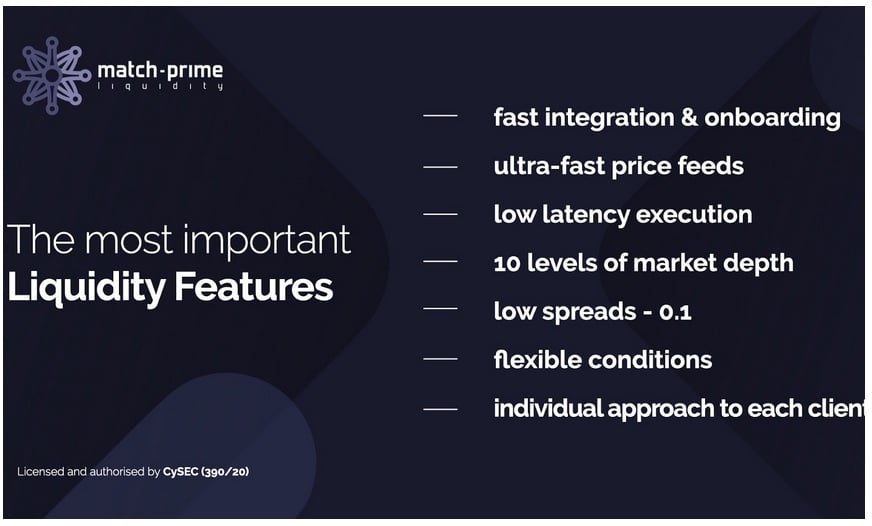
But it’s not merely what attracts most clients: “Our offer is pretty simple, a minimum monthly fee starting from $1000, spreads as low as 0.1 and bespoke conditions for each client. Our biggest advantages are advanced technology and our market experience, which enable us to identify the needs of our clients. Therefore, we want to encourage clients to use our Liquidity pool to diversify their liquidity sources and compare the conditions with other LPs as we offer one of the highest performance and the lowest fees on the market. It is also important to mention that as part of our launch, we are happy to offer a 3 month free trial period for brokers to connect and test our products.”
Working with a diverse set of liquidity providers may be particularly important for brokers who provide their clients with access to interbank liquidity - in other words, brokers that act as intermediaries for their clients’ positions.
Forex brokers that provide these kinds of services require reliable providers that offer consistently tight spreads and low commissions.
These kinds of brokers may be particularly sensitive to any issues the liquidity provider may have.
For example, if the liquidity provider begins to have banking problems, or if there is a technical failure that causes service interruptions, the broker will have to face the consequences.
These consequences are usually not purely financial - they can also affect a broker’s reputation.
Therefore, forex brokers should take their appetite for risk as well as their unique sets of needs before deciding whether or not to diversify the liquidity providers that they work with.
In the forex world, quality is king
Of course, quantity does not necessarily equal quality: more liquidity providers does not necessarily mean better quality of service.
In other words, working with one Tier 1 liquidity provider may be a better choice than working with several lower-tier providers.
These “Tier 1” liquidity providers include large investment banks and other financial institutions with extensive foreign exchange departments.
Most Tier 1 liquidity providers offer their customers the tightest spreads for the currency pairs that they offer market-making services for.
Therefore, a forex broker that is working with a Tier 1 liquidity provider should theoretically have access to the lowest prices on the market.
When choosing a liquidity provider to partner with, brokers should take several things into consideration
Whether a broker is working with a single liquidity provider or with many, there are some important aspects that need to be taken into consideration. These include:
Spreads - Does the liquidity provider consistently provide narrow spreads? What factors generally affect the width of the provider’s spreads?
Fill ratio - On average, what is the percentage of orders that the liquidity provider is able to successfully fill?
Last look hold time - How long will the provider’s price quotes be valid before they expire?
Market impact - What is the effect that the provider has on the market of a given currency pair?
Once the broker has a solid understanding of all of these criteria, the broker will be able to make a decision on whether or not a liquidity provider is a good fit for their needs.
Whether a broker is working with one or a number of liquidity providers, the relationship between liquidity providers and brokers is key to the success of the broker.
In the forex world, price matters. On an average day, the forex market processes more than six billion dollars worth of transactions.
Because the market is so large, competition between brokers is intense and therefore, as a forex broker, providing quality services at the lowest price possible is essential.
Additionally, news in the forex space travels fast. Service interruptions - no matter how small - can cause financial and reputational damage for brokers.
Because there are so many brokers to choose from, clients can easily drop one platform in favour of another.
Some forex brokers may even combine their liquidity providers into an automated aggregator that chooses the best rates automatically.
According to a blog post by investment banking giant HSBC, forming an aggregator should “lead to improved liquidity, a narrower spread...and, therefore, a better price.”
However, not all forex brokers are created equal. Each broker has a unique set of needs. For some forex brokers, working with a single liquidity provider may be a better option than working with many for a certain type of broker.
In contrast, for some others, working with many liquidity providers may be a much better choice.
When is it better for a forex broker to work with a single provider? When is it better for a broker to diversify the pool of liquidity providers that they are working with?
Working with a single liquidity provider is cheaper, but could also be riskier
There are several key advantages that come along with partnering with just one liquidity provider as opposed to many.
Perhaps, the most significant fact is that it is less expensive to work with a single liquidity provider than to work with several ones.
So it can be a better option for certain brokers especially those who operate primarily as market makers. That includes brokers who act as counterparties for client transactions.
These brokers may only be required to hedge part of their clients’ positions. If this is the case, the needs of this particular kind of forex broker could theoretically be satisfied by almost any single supplier.
However, depending on a single liquidity provider means that a broker is at the mercy of that provider.
Therefore, a broker’s liquidity provider is facing issues, the broker will have to face the consequences - and it can take weeks (or months) to connect with a new provider.
Working with multiple liquidity providers can reduce financial and reputational risks for forex brokers
Working with multiple liquidity providers can provide forex brokers with additional security and such a trend seems to prevail in the market. According to Andreas Kapsos, CEO of Match-Prime - a new liquidity provider regulated by CySEC - just a few months after obtaining the full license, the LP finalizes the onboarding of its first few clients, including a well established European Broker.
Andreas Kapsos, CEO of Match-Prime
The liquidity provider focused on a strong market entry with an attractive offer providing deep liquidity for over 1000 trading instruments and equities. This is a strong differentiator in the market as equities are gaining more and more popularity among forex investors.
But it’s not merely what attracts most clients: “Our offer is pretty simple, a minimum monthly fee starting from $1000, spreads as low as 0.1 and bespoke conditions for each client. Our biggest advantages are advanced technology and our market experience, which enable us to identify the needs of our clients. Therefore, we want to encourage clients to use our Liquidity pool to diversify their liquidity sources and compare the conditions with other LPs as we offer one of the highest performance and the lowest fees on the market. It is also important to mention that as part of our launch, we are happy to offer a 3 month free trial period for brokers to connect and test our products.”
Working with a diverse set of liquidity providers may be particularly important for brokers who provide their clients with access to interbank liquidity - in other words, brokers that act as intermediaries for their clients’ positions.
Forex brokers that provide these kinds of services require reliable providers that offer consistently tight spreads and low commissions.
These kinds of brokers may be particularly sensitive to any issues the liquidity provider may have.
For example, if the liquidity provider begins to have banking problems, or if there is a technical failure that causes service interruptions, the broker will have to face the consequences.
These consequences are usually not purely financial - they can also affect a broker’s reputation.
Therefore, forex brokers should take their appetite for risk as well as their unique sets of needs before deciding whether or not to diversify the liquidity providers that they work with.
In the forex world, quality is king
Of course, quantity does not necessarily equal quality: more liquidity providers does not necessarily mean better quality of service.
In other words, working with one Tier 1 liquidity provider may be a better choice than working with several lower-tier providers.
These “Tier 1” liquidity providers include large investment banks and other financial institutions with extensive foreign exchange departments.
Most Tier 1 liquidity providers offer their customers the tightest spreads for the currency pairs that they offer market-making services for.
Therefore, a forex broker that is working with a Tier 1 liquidity provider should theoretically have access to the lowest prices on the market.
When choosing a liquidity provider to partner with, brokers should take several things into consideration
Whether a broker is working with a single liquidity provider or with many, there are some important aspects that need to be taken into consideration. These include:
Spreads - Does the liquidity provider consistently provide narrow spreads? What factors generally affect the width of the provider’s spreads?
Fill ratio - On average, what is the percentage of orders that the liquidity provider is able to successfully fill?
Last look hold time - How long will the provider’s price quotes be valid before they expire?
Market impact - What is the effect that the provider has on the market of a given currency pair?
Once the broker has a solid understanding of all of these criteria, the broker will be able to make a decision on whether or not a liquidity provider is a good fit for their needs.
Whether a broker is working with one or a number of liquidity providers, the relationship between liquidity providers and brokers is key to the success of the broker.
FP Markets Winner Spotlight 🏆 | Global Broker of the Year 2025 #Trading #Broker #Innovation #Shorts
FP Markets Winner Spotlight 🏆 | Global Broker of the Year 2025 #Trading #Broker #Innovation #Shorts
FP Markets Winner Spotlight 🏆 | Global Broker of the Year 2025 #Trading #Broker #Innovation #Shorts
FP Markets Winner Spotlight 🏆 | Global Broker of the Year 2025 #Trading #Broker #Innovation #Shorts
FP Markets takes the spotlight as Global Broker of the Year 2025 at the Finance Magnates Awards.
Martin Stoilov, Head of Client Experience, shares that trust, innovation, and people played a key role in the company’s success, supported by a strong foundation of integrity and client-centricity.
Following this milestone, FP Markets continues to focus on growth, technology investment, and its core values of transparency and excellence.
👉 Be part of FM Awards 2026: https://awards.financemagnates.com/#nominate
FP Markets takes the spotlight as Global Broker of the Year 2025 at the Finance Magnates Awards.
Martin Stoilov, Head of Client Experience, shares that trust, innovation, and people played a key role in the company’s success, supported by a strong foundation of integrity and client-centricity.
Following this milestone, FP Markets continues to focus on growth, technology investment, and its core values of transparency and excellence.
👉 Be part of FM Awards 2026: https://awards.financemagnates.com/#nominate
FP Markets takes the spotlight as Global Broker of the Year 2025 at the Finance Magnates Awards.
Martin Stoilov, Head of Client Experience, shares that trust, innovation, and people played a key role in the company’s success, supported by a strong foundation of integrity and client-centricity.
Following this milestone, FP Markets continues to focus on growth, technology investment, and its core values of transparency and excellence.
👉 Be part of FM Awards 2026: https://awards.financemagnates.com/#nominate
FP Markets takes the spotlight as Global Broker of the Year 2025 at the Finance Magnates Awards.
Martin Stoilov, Head of Client Experience, shares that trust, innovation, and people played a key role in the company’s success, supported by a strong foundation of integrity and client-centricity.
Following this milestone, FP Markets continues to focus on growth, technology investment, and its core values of transparency and excellence.
👉 Be part of FM Awards 2026: https://awards.financemagnates.com/#nominate
In this video, we review @HolaPrimeMarketsOfficial, a multi-asset forex and CFDs broker offering different account types, trading platforms, and flexible trading conditions.
We cover the broker’s overall offering, including account options, trading environment, platforms like MT4 and MT5, and additional services such as managed accounts and fast withdrawals.
Watch the full video to see if Hola Prime Markets fits your trading needs.
📣 Stay up to date with the latest in finance and trading. Follow Finance Magnates for industry news, insights, and global event coverage.
Connect with us:
🔗 LinkedIn: /financemagnates
👍 Facebook: /financemagnates
📸 Instagram: https://www.instagram.com/financemagnates
🐦 X: https://x.com/financemagnates
🎥 TikTok: https://www.tiktok.com/tag/financemagnates
▶️ YouTube: /@financemagnates_official
#HolaPrime #ForexBroker #CFDTrading #FinanceMagnates #Trading #Forex #BrokerReview
In this video, we review @HolaPrimeMarketsOfficial, a multi-asset forex and CFDs broker offering different account types, trading platforms, and flexible trading conditions.
We cover the broker’s overall offering, including account options, trading environment, platforms like MT4 and MT5, and additional services such as managed accounts and fast withdrawals.
Watch the full video to see if Hola Prime Markets fits your trading needs.
📣 Stay up to date with the latest in finance and trading. Follow Finance Magnates for industry news, insights, and global event coverage.
Connect with us:
🔗 LinkedIn: /financemagnates
👍 Facebook: /financemagnates
📸 Instagram: https://www.instagram.com/financemagnates
🐦 X: https://x.com/financemagnates
🎥 TikTok: https://www.tiktok.com/tag/financemagnates
▶️ YouTube: /@financemagnates_official
#HolaPrime #ForexBroker #CFDTrading #FinanceMagnates #Trading #Forex #BrokerReview
In this video, we review @HolaPrimeMarketsOfficial, a multi-asset forex and CFDs broker offering different account types, trading platforms, and flexible trading conditions.
We cover the broker’s overall offering, including account options, trading environment, platforms like MT4 and MT5, and additional services such as managed accounts and fast withdrawals.
Watch the full video to see if Hola Prime Markets fits your trading needs.
📣 Stay up to date with the latest in finance and trading. Follow Finance Magnates for industry news, insights, and global event coverage.
Connect with us:
🔗 LinkedIn: /financemagnates
👍 Facebook: /financemagnates
📸 Instagram: https://www.instagram.com/financemagnates
🐦 X: https://x.com/financemagnates
🎥 TikTok: https://www.tiktok.com/tag/financemagnates
▶️ YouTube: /@financemagnates_official
#HolaPrime #ForexBroker #CFDTrading #FinanceMagnates #Trading #Forex #BrokerReview
In this video, we review @HolaPrimeMarketsOfficial, a multi-asset forex and CFDs broker offering different account types, trading platforms, and flexible trading conditions.
We cover the broker’s overall offering, including account options, trading environment, platforms like MT4 and MT5, and additional services such as managed accounts and fast withdrawals.
Watch the full video to see if Hola Prime Markets fits your trading needs.
📣 Stay up to date with the latest in finance and trading. Follow Finance Magnates for industry news, insights, and global event coverage.
Connect with us:
🔗 LinkedIn: /financemagnates
👍 Facebook: /financemagnates
📸 Instagram: https://www.instagram.com/financemagnates
🐦 X: https://x.com/financemagnates
🎥 TikTok: https://www.tiktok.com/tag/financemagnates
▶️ YouTube: /@financemagnates_official
#HolaPrime #ForexBroker #CFDTrading #FinanceMagnates #Trading #Forex #BrokerReview
In this video, we review @HolaPrimeMarketsOfficial, a multi-asset forex and CFDs broker offering different account types, trading platforms, and flexible trading conditions.
We cover the broker’s overall offering, including account options, trading environment, platforms like MT4 and MT5, and additional services such as managed accounts and fast withdrawals.
Watch the full video to see if Hola Prime Markets fits your trading needs.
📣 Stay up to date with the latest in finance and trading. Follow Finance Magnates for industry news, insights, and global event coverage.
Connect with us:
🔗 LinkedIn: /financemagnates
👍 Facebook: /financemagnates
📸 Instagram: https://www.instagram.com/financemagnates
🐦 X: https://x.com/financemagnates
🎥 TikTok: https://www.tiktok.com/tag/financemagnates
▶️ YouTube: /@financemagnates_official
#HolaPrime #ForexBroker #CFDTrading #FinanceMagnates #Trading #Forex #BrokerReview
In this video, we review @HolaPrimeMarketsOfficial, a multi-asset forex and CFDs broker offering different account types, trading platforms, and flexible trading conditions.
We cover the broker’s overall offering, including account options, trading environment, platforms like MT4 and MT5, and additional services such as managed accounts and fast withdrawals.
Watch the full video to see if Hola Prime Markets fits your trading needs.
📣 Stay up to date with the latest in finance and trading. Follow Finance Magnates for industry news, insights, and global event coverage.
Connect with us:
🔗 LinkedIn: /financemagnates
👍 Facebook: /financemagnates
📸 Instagram: https://www.instagram.com/financemagnates
🐦 X: https://x.com/financemagnates
🎥 TikTok: https://www.tiktok.com/tag/financemagnates
▶️ YouTube: /@financemagnates_official
#HolaPrime #ForexBroker #CFDTrading #FinanceMagnates #Trading #Forex #BrokerReview
Hola Prime Review: What You Need to Know | Full Breakdown by Finance Magnates
Hola Prime Review: What You Need to Know | Full Breakdown by Finance Magnates
Hola Prime Review: What You Need to Know | Full Breakdown by Finance Magnates
Hola Prime Review: What You Need to Know | Full Breakdown by Finance Magnates
Hola Prime Review: What You Need to Know | Full Breakdown by Finance Magnates
Hola Prime Review: What You Need to Know | Full Breakdown by Finance Magnates
In this video, we review @HolaPrime_Global, a proprietary trading firm offering evaluation programs and performance-based payouts in simulated market environments.
We cover how the challenge model works, including account types, profit splits (up to 95%), trading rules, and what it takes to reach a funded account. You’ll also learn about available platforms like MT4, MT5, cTrader, and more, along with insights into payouts, support, and trading conditions.
Watch the full video to see if Hola Prime fits your trading style.
📣 Stay up to date with the latest in finance and trading. Follow Finance Magnates for industry news, insights, and global event coverage.
Connect with us:
🔗 LinkedIn: /financemagnates
👍 Facebook: /financemagnates
📸 Instagram: https://www.instagram.com/financemagnates
🐦 X: https://x.com/financemagnates
🎥 TikTok: https://www.tiktok.com/tag/financemagnates
▶️ YouTube: /@financemagnates_official
#HolaPrime #PropFirm #Trading #FinanceMagnates #Forex #FuturesTrading #TradingReview #PropFirmReview
In this video, we review @HolaPrime_Global, a proprietary trading firm offering evaluation programs and performance-based payouts in simulated market environments.
We cover how the challenge model works, including account types, profit splits (up to 95%), trading rules, and what it takes to reach a funded account. You’ll also learn about available platforms like MT4, MT5, cTrader, and more, along with insights into payouts, support, and trading conditions.
Watch the full video to see if Hola Prime fits your trading style.
📣 Stay up to date with the latest in finance and trading. Follow Finance Magnates for industry news, insights, and global event coverage.
Connect with us:
🔗 LinkedIn: /financemagnates
👍 Facebook: /financemagnates
📸 Instagram: https://www.instagram.com/financemagnates
🐦 X: https://x.com/financemagnates
🎥 TikTok: https://www.tiktok.com/tag/financemagnates
▶️ YouTube: /@financemagnates_official
#HolaPrime #PropFirm #Trading #FinanceMagnates #Forex #FuturesTrading #TradingReview #PropFirmReview
In this video, we review @HolaPrime_Global, a proprietary trading firm offering evaluation programs and performance-based payouts in simulated market environments.
We cover how the challenge model works, including account types, profit splits (up to 95%), trading rules, and what it takes to reach a funded account. You’ll also learn about available platforms like MT4, MT5, cTrader, and more, along with insights into payouts, support, and trading conditions.
Watch the full video to see if Hola Prime fits your trading style.
📣 Stay up to date with the latest in finance and trading. Follow Finance Magnates for industry news, insights, and global event coverage.
Connect with us:
🔗 LinkedIn: /financemagnates
👍 Facebook: /financemagnates
📸 Instagram: https://www.instagram.com/financemagnates
🐦 X: https://x.com/financemagnates
🎥 TikTok: https://www.tiktok.com/tag/financemagnates
▶️ YouTube: /@financemagnates_official
#HolaPrime #PropFirm #Trading #FinanceMagnates #Forex #FuturesTrading #TradingReview #PropFirmReview
In this video, we review @HolaPrime_Global, a proprietary trading firm offering evaluation programs and performance-based payouts in simulated market environments.
We cover how the challenge model works, including account types, profit splits (up to 95%), trading rules, and what it takes to reach a funded account. You’ll also learn about available platforms like MT4, MT5, cTrader, and more, along with insights into payouts, support, and trading conditions.
Watch the full video to see if Hola Prime fits your trading style.
📣 Stay up to date with the latest in finance and trading. Follow Finance Magnates for industry news, insights, and global event coverage.
Connect with us:
🔗 LinkedIn: /financemagnates
👍 Facebook: /financemagnates
📸 Instagram: https://www.instagram.com/financemagnates
🐦 X: https://x.com/financemagnates
🎥 TikTok: https://www.tiktok.com/tag/financemagnates
▶️ YouTube: /@financemagnates_official
#HolaPrime #PropFirm #Trading #FinanceMagnates #Forex #FuturesTrading #TradingReview #PropFirmReview
In this video, we review @HolaPrime_Global, a proprietary trading firm offering evaluation programs and performance-based payouts in simulated market environments.
We cover how the challenge model works, including account types, profit splits (up to 95%), trading rules, and what it takes to reach a funded account. You’ll also learn about available platforms like MT4, MT5, cTrader, and more, along with insights into payouts, support, and trading conditions.
Watch the full video to see if Hola Prime fits your trading style.
📣 Stay up to date with the latest in finance and trading. Follow Finance Magnates for industry news, insights, and global event coverage.
Connect with us:
🔗 LinkedIn: /financemagnates
👍 Facebook: /financemagnates
📸 Instagram: https://www.instagram.com/financemagnates
🐦 X: https://x.com/financemagnates
🎥 TikTok: https://www.tiktok.com/tag/financemagnates
▶️ YouTube: /@financemagnates_official
#HolaPrime #PropFirm #Trading #FinanceMagnates #Forex #FuturesTrading #TradingReview #PropFirmReview
In this video, we review @HolaPrime_Global, a proprietary trading firm offering evaluation programs and performance-based payouts in simulated market environments.
We cover how the challenge model works, including account types, profit splits (up to 95%), trading rules, and what it takes to reach a funded account. You’ll also learn about available platforms like MT4, MT5, cTrader, and more, along with insights into payouts, support, and trading conditions.
Watch the full video to see if Hola Prime fits your trading style.
📣 Stay up to date with the latest in finance and trading. Follow Finance Magnates for industry news, insights, and global event coverage.
Connect with us:
🔗 LinkedIn: /financemagnates
👍 Facebook: /financemagnates
📸 Instagram: https://www.instagram.com/financemagnates
🐦 X: https://x.com/financemagnates
🎥 TikTok: https://www.tiktok.com/tag/financemagnates
▶️ YouTube: /@financemagnates_official
#HolaPrime #PropFirm #Trading #FinanceMagnates #Forex #FuturesTrading #TradingReview #PropFirmReview
Axi Winner Spotlight 🏆 | Global Most Innovative Broker 2025 #Innovation #Trading #Fintech #Broker
Axi Winner Spotlight 🏆 | Global Most Innovative Broker 2025 #Innovation #Trading #Fintech #Broker
Axi Winner Spotlight 🏆 | Global Most Innovative Broker 2025 #Innovation #Trading #Fintech #Broker
Axi Winner Spotlight 🏆 | Global Most Innovative Broker 2025 #Innovation #Trading #Fintech #Broker
Axi Winner Spotlight 🏆 | Global Most Innovative Broker 2025 #Innovation #Trading #Fintech #Broker
Axi Winner Spotlight 🏆 | Global Most Innovative Broker 2025 #Innovation #Trading #Fintech #Broker
Axi takes the spotlight at the Finance Magnates Awards, winning Global Most Innovative Broker 2025.
Olivia Xenofontos and Ivanna Openko share how the team will feel: proud, motivated, and ready to keep delivering.
They also describe the night as well-organized, focused, and enjoyable for all.
👉 Be part of FM Awards 2026.
Axi takes the spotlight at the Finance Magnates Awards, winning Global Most Innovative Broker 2025.
Olivia Xenofontos and Ivanna Openko share how the team will feel: proud, motivated, and ready to keep delivering.
They also describe the night as well-organized, focused, and enjoyable for all.
👉 Be part of FM Awards 2026.
Axi takes the spotlight at the Finance Magnates Awards, winning Global Most Innovative Broker 2025.
Olivia Xenofontos and Ivanna Openko share how the team will feel: proud, motivated, and ready to keep delivering.
They also describe the night as well-organized, focused, and enjoyable for all.
👉 Be part of FM Awards 2026.
Axi takes the spotlight at the Finance Magnates Awards, winning Global Most Innovative Broker 2025.
Olivia Xenofontos and Ivanna Openko share how the team will feel: proud, motivated, and ready to keep delivering.
They also describe the night as well-organized, focused, and enjoyable for all.
👉 Be part of FM Awards 2026.
Axi takes the spotlight at the Finance Magnates Awards, winning Global Most Innovative Broker 2025.
Olivia Xenofontos and Ivanna Openko share how the team will feel: proud, motivated, and ready to keep delivering.
They also describe the night as well-organized, focused, and enjoyable for all.
👉 Be part of FM Awards 2026.
Axi takes the spotlight at the Finance Magnates Awards, winning Global Most Innovative Broker 2025.
Olivia Xenofontos and Ivanna Openko share how the team will feel: proud, motivated, and ready to keep delivering.
They also describe the night as well-organized, focused, and enjoyable for all.
👉 Be part of FM Awards 2026.
Recognition that matters.
Built on transparency.
Driven by the industry.
The Finance Magnates Awards 2026.
Nominations are now open.
🔗 https://awards.financemagnates.com/?utm_source=SM&utm_medium=social&utm_campaign=recognition-matters
Recognition that matters.
Built on transparency.
Driven by the industry.
The Finance Magnates Awards 2026.
Nominations are now open.
🔗 https://awards.financemagnates.com/?utm_source=SM&utm_medium=social&utm_campaign=recognition-matters
Recognition that matters.
Built on transparency.
Driven by the industry.
The Finance Magnates Awards 2026.
Nominations are now open.
🔗 https://awards.financemagnates.com/?utm_source=SM&utm_medium=social&utm_campaign=recognition-matters
Recognition that matters.
Built on transparency.
Driven by the industry.
The Finance Magnates Awards 2026.
Nominations are now open.
🔗 https://awards.financemagnates.com/?utm_source=SM&utm_medium=social&utm_campaign=recognition-matters
Recognition that matters.
Built on transparency.
Driven by the industry.
The Finance Magnates Awards 2026.
Nominations are now open.
🔗 https://awards.financemagnates.com/?utm_source=SM&utm_medium=social&utm_campaign=recognition-matters
Recognition that matters.
Built on transparency.
Driven by the industry.
The Finance Magnates Awards 2026.
Nominations are now open.
🔗 https://awards.financemagnates.com/?utm_source=SM&utm_medium=social&utm_campaign=recognition-matters