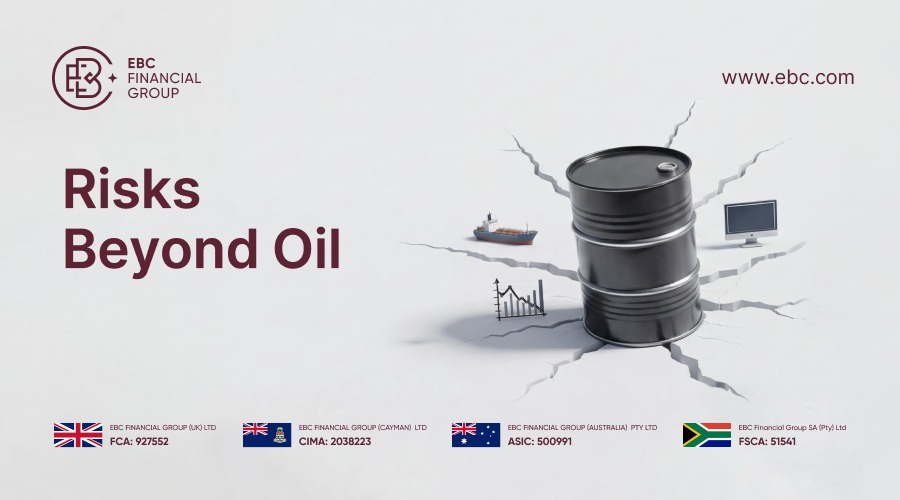
While Everyone Watches Oil, These Risks Are Building

Thursday, 09/04/2026 | 09:02 GMT by EBC
Disclaimer
  • Oil prices mask three rising risks: cyberattacks, credit stress, and supply chain fractures.
EBC

Geopolitical crisis that started in the Persian Gulf is being felt in oil prices, which has become the market’s clearest expression of what this war means. Traders turn to the most visible numbers on the screen when conflict threatens energy flows. These price fluctuations, like the ebb and flow of tides, recently saw crude moved back above $100, equities came under pressure, the dollar firmed, and Treasury yields rose as markets trimmed hopes for easier policy.

Oil is but one factor woven into the larger market story fabric. It is easy to track what you can see: the visible shock. What is harder for traders and casual observers to spot is where that shock starts to spread: through essential behind-the-scenes financial infrastructures (clearing houses, custodians, and payment systems), credit, and supply chains. The Bank of England has called the war ‘a substantial negative supply shock’ that threatens financial stability.

That wider frame is also reflected in the World Economic Forum’s Global Risks Report 2026. The report ranks geoeconomic confrontation highest in immediate and two-year risks, with state-based armed conflict close behind. It highlights a sharp rise in economic risks like downturn, inflation, and asset-bubble stress, while cyber insecurity remains high in the short term. The point is not that every risk will hit at once, but that geopolitical strain rarely stays contained in one market.

It goes without saying that crude still deserves the attention it is getting, traders should ask a broader question: not just where oil goes next, but where the next strain could show up first.

Is Something Looming Over Oil?

The current market move is still led by energy. Reuters reported on 2 April that stocks fell, and oil jumped above $100 after Donald Trump said the United States would continue its air strikes on Iran. Investors grew more concerned as the war continues while keeping an eye on its impact on inflation and growth. Brent moved above $107, US crude traded above $106, and Treasury yields rose as markets pared back hopes for easier policy.

Oil is feeding directly into the rates outlook. Reuters reported that most major central banks largely stayed on hold through March as the war made the inflation and growth picture harder to read. In the US, Fed officials warned that higher fuel, aluminium, and fertiliser prices could keep inflation above the Federal Reserve’s 2% target rate.

Still, that is only part of the picture. The Bank of England did not just warn about energy costs or household pressure. It also pointed to vulnerabilities in government debt markets, private credit, and stretched US technology valuations. That is a useful clue. The concern is no longer just where crude trades, but what prolonged disruption could do to financial conditions more broadly.

Once the shock starts tightening financial conditions, traders need to watch more than the oil price.

Risk 1: Cyber Disruption Could Hit Core Market Systems

One of the easiest risks to underprice in a geopolitical crisis is cyber disruption. That is partly because it does not fit neatly into one asset class. There is no single chart for it, as there is for crude, gold, or Treasury yields. Yet finance is an obvious target during escalation because it sits at the heart of payments, trading platforms, clearing, settlement, and other critical market infrastructure. Reuters reported in March that US financial firms were already on high alert for Iran-linked cyberattacks as the conflict intensified. This followed Iran’s Islamic Revolution Guard Corps release of the economic centres and banks list after Israeli missiles attacked a Tehran-based bank.

There is a practical angle for traders here: a cyber incident does not need to be catastrophic to matter. A contained disruption can widen spreads, thin liquidity, slow settlement, affect execution quality, or make a normally orderly market feel unreliable for a few hours or sessions. Reuters pointed to the 2023 ransomware attack on the Industrial and Commercial Bank of China Financial Services’ (ICBC) US broker-dealer unit as a reminder that even a localised event can disrupt parts of the Treasury market.

That makes this risk worth watching. It would not necessarily arrive as a big macro headline. Traders might first notice it through broker notices, awkward price gaps, thinner order books, patchy market depth, or signs that a usually liquid market is not trading cleanly. None of that is as obvious as a spike in oil. But if market function wobbles, being right on direction becomes less useful.

This also makes cyber risk different from a standard macro concern. It is not just about whether sentiment worsens but whether the market itself becomes harder to trust and trade. That is a different kind of stress, one that can spread faster than it first appears.

Risk 2: Credit Stress May Show Up Before the Macro Data

If cyber is the most distinctive risk, credit is the most important one.

A market shock becomes more serious when it stops being just a price move and becomes a funding problem. That is why credit deserves close attention. Elevated oil keeps inflation fears sticky and hopes for rate cuts fading away. The first real crack may show up in leveraged. Central banks and regulators are already looking out for that possibility.

Reuters reported on 31 March that US banks were raising borrowing costs for private credit funds. In some cases, financing was priced as much as two percentage points over the Secured Overnight Financing Rate Data (SOFR), with lenders becoming more cautious due to valuation pressure, redemption concerns, and worries about collateral quality. That does not mean the whole private credit universe is breaking. It means funding is becoming less forgiving in a part of the market that grew quickly during an era of easy money.

That matters beyond private markets. Credit is often where a headline shock starts to become a broader market problem. As financing gets more expensive, weaker borrowers come under pressure, spreads widen, and investors become less willing to pay for risk. Once that process starts, it rarely stays in one corner of fixed income. It can bleed into equities, especially cyclical areas and parts of the market that depend on generous valuations and steady access to capital. Reuters also reported rising redemption pressure at large private credit funds and closer scrutiny from the Federal Reserve.

This is where the Bank of England’s warning becomes especially useful. It did not just flag energy prices or household costs. It pointed to private credit and stretched US tech valuations as part of the same financial-stability picture. European Central Bank (ECB) Vice President Luis de Guindos warned that the war could trigger broader systemic stress if vulnerabilities in leveraged borrowers and the non-bank sector start to unravel. That reminds us that vulnerable areas in a tighter environment are not always the ones carrying the biggest headlines. Often, they are parts of the market used to cheap funding and optimistic pricing.

For traders, this means watching more than crude and the main equity indices. High-yield credit, signs of spread widening, weakness in lower-quality risk assets, and evidence of strain in non-bank finance may reveal more about the next stage of the shock than the oil price alone.

Risk 3: Supply-Chain Fractures Could Spread the Shock

The third risk is that the disruption spreads through trade and supply chains in ways that are broader than crude itself.

This is where a market can become too focused on the headline commodity and miss the wider transmission. Once the supply is rerouted, the effects do not stay inside oil. They can move into refined products, freight, industrial inputs, and inflation expectations. Reuters reported on 1 April that US fuel exports hit a record in March as buyers in Europe, Asia, and Africa scrambled to replace disrupted Middle East supply. Exports of clean petroleum products rose to 3.11 million barrels per day, with flows to Europe up 27%, to Asia more than doubling, and to Africa up 169%.

That shift points to system-wide adjustment, not just speculative price action. Reuters reported that the US Gulf Coast tanker market tightened sharply as refiners in Asia and Europe sought replacement barrels, with some freight rates jumping above $300,000 a day. When shipping costs move like that, it becomes harder to argue the shock is still neatly contained inside crude.

The same applies to industrial inputs. Reuters reported on 30 March that Iranian strikes on major Gulf producers intensified concerns about aluminium supply and helped drive aluminium prices to a four-year high. That matters because aluminium feeds manufacturing, transport, and packaging, and reaches Europe and the United States through already strained trade channels.

The International Energy Agency (IEA) warned that disruptions in April are likely to exceed those seen in March, with shortages already hitting diesel and jet fuel and effects expected to spread further into Europe. The takeaway is not simply that supply disruption is bad but that the conflict may start showing up through uneven cost pressure across markets traders are not yet watching closely.

For traders, that means paying attention to refined products, freight, industrial metals, and trade-sensitive currencies, where pressure often appears earlier and more unevenly than in the crude price itself.

What Traders Should Watch Now

If this shock is starting to spread beyond crude, the first clues may not come from another sharp move in oil but from how other parts of the market begin to behave.

In credit, that means watching for wider spreads, weaker high-yield performance, and signs investors are less willing to fund lower-quality risk. If private credit, junk bonds, or cyclical equities soften more noticeably, that could suggest financial conditions are tightening more broadly than the headline oil move alone implies.

In the systems that keep markets running, such as trading platforms, clearing settlement, and payments, the warning signs look different. Traders should watch broker notices, unusual price gaps, patchy order books, delayed settlement, or signs that normally liquid markets are not trading cleanly. A cyber-related disruption does not need to be dramatic to matter if it affects execution and trust in market function.

In trade and supply chains, signals likely show up in refined products, freight rates, industrial metals, and trade-sensitive currencies. If those markets absorb more of the shock, it will signal the conflict is no longer just an oil story but a wider cost and inflation story.

That is the broader read traders should keep in mind: not just where crude is trading but whether stress is beginning to surface in the systems around it.

Disclaimer & Citation

This material is for information only and does not constitute a recommendation or advice from EBC Financial Group and all its entities (“EBC”). Trading Forex and Contracts for Difference (CFDs) on margin carries a high level of risk and may not be suitable for all investors. Losses can exceed your deposits. Before trading, you should carefully consider your trading objectives, level of experience, and risk appetite, and consult an independent financial advisor if necessary. Statistics or past investment performance are not a guarantee of future performance. EBC is not liable for any damages arising from reliance on this information.

Geopolitical crisis that started in the Persian Gulf is being felt in oil prices, which has become the market’s clearest expression of what this war means. Traders turn to the most visible numbers on the screen when conflict threatens energy flows. These price fluctuations, like the ebb and flow of tides, recently saw crude moved back above $100, equities came under pressure, the dollar firmed, and Treasury yields rose as markets trimmed hopes for easier policy.

Oil is but one factor woven into the larger market story fabric. It is easy to track what you can see: the visible shock. What is harder for traders and casual observers to spot is where that shock starts to spread: through essential behind-the-scenes financial infrastructures (clearing houses, custodians, and payment systems), credit, and supply chains. The Bank of England has called the war ‘a substantial negative supply shock’ that threatens financial stability.

That wider frame is also reflected in the World Economic Forum’s Global Risks Report 2026. The report ranks geoeconomic confrontation highest in immediate and two-year risks, with state-based armed conflict close behind. It highlights a sharp rise in economic risks like downturn, inflation, and asset-bubble stress, while cyber insecurity remains high in the short term. The point is not that every risk will hit at once, but that geopolitical strain rarely stays contained in one market.

It goes without saying that crude still deserves the attention it is getting, traders should ask a broader question: not just where oil goes next, but where the next strain could show up first.

Is Something Looming Over Oil?

The current market move is still led by energy. Reuters reported on 2 April that stocks fell, and oil jumped above $100 after Donald Trump said the United States would continue its air strikes on Iran. Investors grew more concerned as the war continues while keeping an eye on its impact on inflation and growth. Brent moved above $107, US crude traded above $106, and Treasury yields rose as markets pared back hopes for easier policy.

Oil is feeding directly into the rates outlook. Reuters reported that most major central banks largely stayed on hold through March as the war made the inflation and growth picture harder to read. In the US, Fed officials warned that higher fuel, aluminium, and fertiliser prices could keep inflation above the Federal Reserve’s 2% target rate.

Still, that is only part of the picture. The Bank of England did not just warn about energy costs or household pressure. It also pointed to vulnerabilities in government debt markets, private credit, and stretched US technology valuations. That is a useful clue. The concern is no longer just where crude trades, but what prolonged disruption could do to financial conditions more broadly.

Once the shock starts tightening financial conditions, traders need to watch more than the oil price.

Risk 1: Cyber Disruption Could Hit Core Market Systems

One of the easiest risks to underprice in a geopolitical crisis is cyber disruption. That is partly because it does not fit neatly into one asset class. There is no single chart for it, as there is for crude, gold, or Treasury yields. Yet finance is an obvious target during escalation because it sits at the heart of payments, trading platforms, clearing, settlement, and other critical market infrastructure. Reuters reported in March that US financial firms were already on high alert for Iran-linked cyberattacks as the conflict intensified. This followed Iran’s Islamic Revolution Guard Corps release of the economic centres and banks list after Israeli missiles attacked a Tehran-based bank.

There is a practical angle for traders here: a cyber incident does not need to be catastrophic to matter. A contained disruption can widen spreads, thin liquidity, slow settlement, affect execution quality, or make a normally orderly market feel unreliable for a few hours or sessions. Reuters pointed to the 2023 ransomware attack on the Industrial and Commercial Bank of China Financial Services’ (ICBC) US broker-dealer unit as a reminder that even a localised event can disrupt parts of the Treasury market.

That makes this risk worth watching. It would not necessarily arrive as a big macro headline. Traders might first notice it through broker notices, awkward price gaps, thinner order books, patchy market depth, or signs that a usually liquid market is not trading cleanly. None of that is as obvious as a spike in oil. But if market function wobbles, being right on direction becomes less useful.

This also makes cyber risk different from a standard macro concern. It is not just about whether sentiment worsens but whether the market itself becomes harder to trust and trade. That is a different kind of stress, one that can spread faster than it first appears.

Risk 2: Credit Stress May Show Up Before the Macro Data

If cyber is the most distinctive risk, credit is the most important one.

A market shock becomes more serious when it stops being just a price move and becomes a funding problem. That is why credit deserves close attention. Elevated oil keeps inflation fears sticky and hopes for rate cuts fading away. The first real crack may show up in leveraged. Central banks and regulators are already looking out for that possibility.

Reuters reported on 31 March that US banks were raising borrowing costs for private credit funds. In some cases, financing was priced as much as two percentage points over the Secured Overnight Financing Rate Data (SOFR), with lenders becoming more cautious due to valuation pressure, redemption concerns, and worries about collateral quality. That does not mean the whole private credit universe is breaking. It means funding is becoming less forgiving in a part of the market that grew quickly during an era of easy money.

That matters beyond private markets. Credit is often where a headline shock starts to become a broader market problem. As financing gets more expensive, weaker borrowers come under pressure, spreads widen, and investors become less willing to pay for risk. Once that process starts, it rarely stays in one corner of fixed income. It can bleed into equities, especially cyclical areas and parts of the market that depend on generous valuations and steady access to capital. Reuters also reported rising redemption pressure at large private credit funds and closer scrutiny from the Federal Reserve.

This is where the Bank of England’s warning becomes especially useful. It did not just flag energy prices or household costs. It pointed to private credit and stretched US tech valuations as part of the same financial-stability picture. European Central Bank (ECB) Vice President Luis de Guindos warned that the war could trigger broader systemic stress if vulnerabilities in leveraged borrowers and the non-bank sector start to unravel. That reminds us that vulnerable areas in a tighter environment are not always the ones carrying the biggest headlines. Often, they are parts of the market used to cheap funding and optimistic pricing.

For traders, this means watching more than crude and the main equity indices. High-yield credit, signs of spread widening, weakness in lower-quality risk assets, and evidence of strain in non-bank finance may reveal more about the next stage of the shock than the oil price alone.

Risk 3: Supply-Chain Fractures Could Spread the Shock

The third risk is that the disruption spreads through trade and supply chains in ways that are broader than crude itself.

This is where a market can become too focused on the headline commodity and miss the wider transmission. Once the supply is rerouted, the effects do not stay inside oil. They can move into refined products, freight, industrial inputs, and inflation expectations. Reuters reported on 1 April that US fuel exports hit a record in March as buyers in Europe, Asia, and Africa scrambled to replace disrupted Middle East supply. Exports of clean petroleum products rose to 3.11 million barrels per day, with flows to Europe up 27%, to Asia more than doubling, and to Africa up 169%.

That shift points to system-wide adjustment, not just speculative price action. Reuters reported that the US Gulf Coast tanker market tightened sharply as refiners in Asia and Europe sought replacement barrels, with some freight rates jumping above $300,000 a day. When shipping costs move like that, it becomes harder to argue the shock is still neatly contained inside crude.

The same applies to industrial inputs. Reuters reported on 30 March that Iranian strikes on major Gulf producers intensified concerns about aluminium supply and helped drive aluminium prices to a four-year high. That matters because aluminium feeds manufacturing, transport, and packaging, and reaches Europe and the United States through already strained trade channels.

The International Energy Agency (IEA) warned that disruptions in April are likely to exceed those seen in March, with shortages already hitting diesel and jet fuel and effects expected to spread further into Europe. The takeaway is not simply that supply disruption is bad but that the conflict may start showing up through uneven cost pressure across markets traders are not yet watching closely.

For traders, that means paying attention to refined products, freight, industrial metals, and trade-sensitive currencies, where pressure often appears earlier and more unevenly than in the crude price itself.

What Traders Should Watch Now

If this shock is starting to spread beyond crude, the first clues may not come from another sharp move in oil but from how other parts of the market begin to behave.

In credit, that means watching for wider spreads, weaker high-yield performance, and signs investors are less willing to fund lower-quality risk. If private credit, junk bonds, or cyclical equities soften more noticeably, that could suggest financial conditions are tightening more broadly than the headline oil move alone implies.

In the systems that keep markets running, such as trading platforms, clearing settlement, and payments, the warning signs look different. Traders should watch broker notices, unusual price gaps, patchy order books, delayed settlement, or signs that normally liquid markets are not trading cleanly. A cyber-related disruption does not need to be dramatic to matter if it affects execution and trust in market function.

In trade and supply chains, signals likely show up in refined products, freight rates, industrial metals, and trade-sensitive currencies. If those markets absorb more of the shock, it will signal the conflict is no longer just an oil story but a wider cost and inflation story.

That is the broader read traders should keep in mind: not just where crude is trading but whether stress is beginning to surface in the systems around it.

Disclaimer & Citation

This material is for information only and does not constitute a recommendation or advice from EBC Financial Group and all its entities (“EBC”). Trading Forex and Contracts for Difference (CFDs) on margin carries a high level of risk and may not be suitable for all investors. Losses can exceed your deposits. Before trading, you should carefully consider your trading objectives, level of experience, and risk appetite, and consult an independent financial advisor if necessary. Statistics or past investment performance are not a guarantee of future performance. EBC is not liable for any damages arising from reliance on this information.

Disclaimer

Thought Leadership

!"#$%&'()*+,-./0123456789:;<=>?@ABCDEFGHIJKLMNOPQRSTUVWXYZ[\]^_`abcdefghijklmnopqrstuvwxyz{|} !"#$%&'()*+,-./0123456789:;<=>?@ABCDEFGHIJKLMNOPQRSTUVWXYZ[\]^_`abcdefghijklmnopqrstuvwxyz{|}