

Every business scaling across borders knows the math. Each new market adds entities, banks, currencies and accounts. Complexity multiplies.
Finance teams increasingly spend their time keeping it together: resolving failed payments, tracking cash and managing currency exposure. AI is changing that model.
However, much of this infrastructure was designed around a human operating model. An account assumes a known person or organisation. A payment assumes an authorised instruction. Money moves through predefined processes. Trust is established through approvals and review queues.
As intelligent systems move from recommending actions to taking them, financial infrastructure must evolve. The question is no longer simply how to automate finance, but how to give agents the ability to act financially without giving up human control.
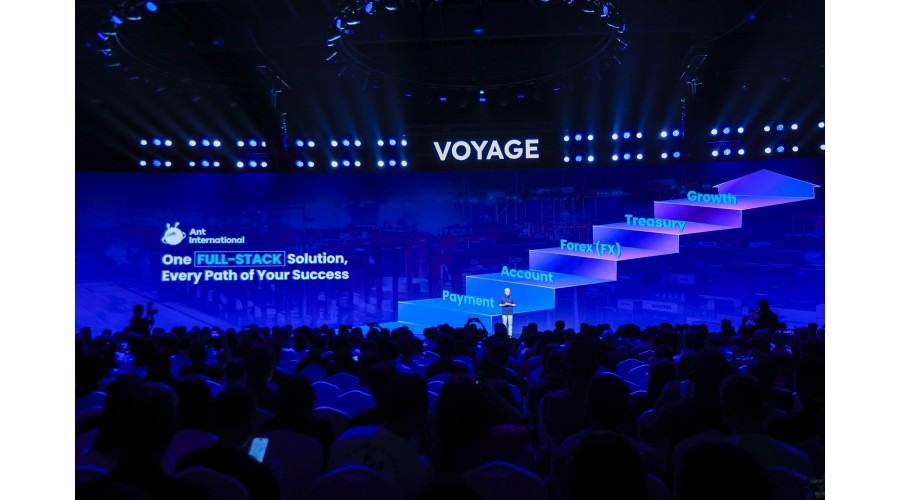
The next financial stack will therefore be AI-native: connecting payment, accounts, FX, treasury and growth into a system that can see what is happening, anticipate what comes next and act within defined boundaries. This is the direction Ant International is engineering, building on its global payments, agentic account and cross-border treasury capabilities.
Payment as the foundation: how an intelligent payment layer runs fraud, optimisation and onboarding
Payment remains fragmented across networks and methods, so interoperability is the first requirement of an intelligent financial stack. But connecting the rails is only the beginning. The bigger shift is making payments capable of understanding context and adapting to what a business needs.
AI can now combine behavioural patterns, structured transaction data and the relationships between users, entities and devices to make better payment decisions. Ant International’s Antom 3-in-1 Transformer is the only payment foundation model that combines three types of data, sequential behaviour, structured records and graph data mapping the relationships between users, entities and devices, supporting fraud and abuse prevention and payment-success optimisation. Among leading clients, chargeback rates have fallen by as much as 87%.
The same intelligence extends beyond individual transactions to the wider payment lifecycle: helping businesses onboard payment methods, optimise routing, manage risk and disputes, reconcile transactions and enter new markets. In real-world use, this can reduce the time to a merchant’s first transaction from days to minutes.
This is the shift from payment as infrastructure that processes instructions to payment as an intelligent operating layer that helps businesses decide and act.
From accounts for humans to Accounts for Agents: giving AI the ability to act within defined boundaries
For decades, accounts were built around people and organisations. Humans control how money can be used, approve transactions and monitor what happens afterwards. But what happens when AI agents begin performing those tasks?
That points to a fundamentally different model: an Account for Agent (AFA).
An agentic account is not simply a conventional account with an AI interface. It should enable an agent to perform defined tasks within the rules, permissions and controls the business establishes.
Ant International has put a model in the market with WorldFirst: its WorldFirst for Enterprise AFA, the world's first truly agentic account for businesses, which uses KYA-enabled smart contracts, full-chain security controls, dynamic monitoring and intervention, and a feedback mechanism for continuous agent tuning. The goal is not to remove humans from financial decisions, but to move them up the stack from executing transactions to setting objectives, policies and risk limits.
The account therefore becomes more than a place where money sits. It becomes part of a learning loop: rather than only reflecting what has already happened, the account now becomes a governed interface between human intent and machine action.
Making intelligence operational: forecasting FX with clarity, then moving the money in real time
Global businesses face interconnected problems, from fragmented visibility to liquidity imbalance and FX volatility. Traditional treasury processes are often retrospective: teams review past cash flows, forecast needs, decide on hedging and manually rebalance liquidity.
The harder question is knowing where money should be, when it should move and what it will be worth when it gets there.
An AI-native approach connects prediction with execution.
Advanced forecasting models can now analyse global financial data to anticipate cash flows, liquidity needs and FX positions. Ant International’s FalconTST, for example, has exceeded 93% accuracy in FX and cash-flow forecasting.
But prediction is only useful if the money can move. Real-time settlement and liquidity infrastructure connects foresight to action. Using its blockchain-based wholesale settlement layer, WhaleRTP, Ant International processed 45% of its cross-border volume, reduced working-capital requirements by 60% and increased liquidity yield by 23%.
Together – forecasting with greater clarity and the ability to move money at the right moment – allow treasury to shift from periodic analysis to a continuous cycle of seeing, deciding and acting, with governance embedded all the way through.
The financial stack becomes an operating system: from human workflows to machines that see, decide and act
For decades, financial infrastructure was built around human workflows. AI introduces a different model: machines can increasingly observe, predict, recommend and act.
The next generation will connect identity, intent, permissions, money and intelligence, with humans setting the objectives and boundaries while machines handle the complexity.
The question is not whether AI will participate in finance, but how financial infrastructure must evolve when it becomes a direct economic actor.
That is the promise of an AI-native financial stack: not finance that simply runs faster, but finance that can see, decide and act better. And it is the promise Ant International is delivering, moving money through intelligent systems that respect human control while unlocking speed, safety and efficiency.


