

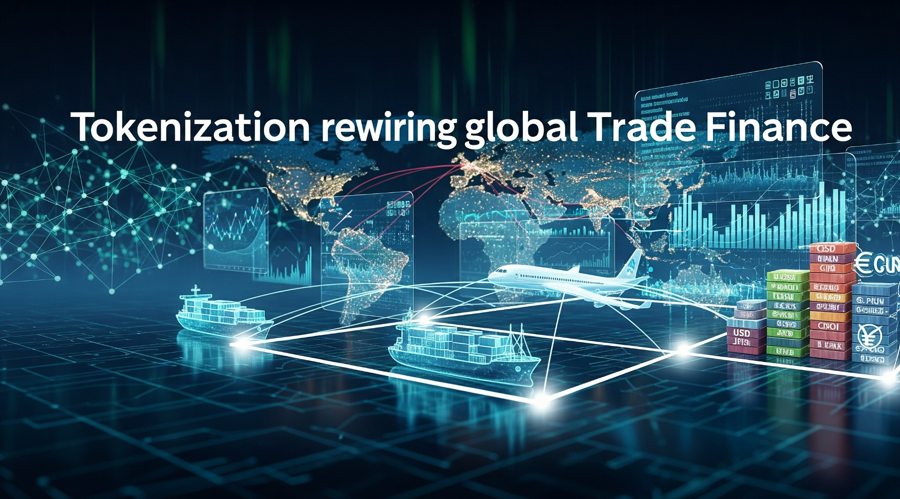
The global trade finance gap has widened to $2.5 trillion as of 2023, according to the Asian Development Bank, representing a nearly 50% increase from the $1.7 trillion deficit recorded in 2020. This funding shortfall disproportionately impacts small and medium-sized enterprises in emerging markets, where access to working capital remains constrained by legacy infrastructure and fragmented credit assessment frameworks.
The core challenge lies not in creditworthiness but in operational friction. Traditional trade finance relies on manual verification processes, siloed databases, and paper-based documentation that extends settlement cycles to 30-90 days. For institutions seeking to expand trade finance portfolios while managing risk exposure, these inefficiencies represent both a constraint and an opportunity.
Tokenization Infrastructure: Moving Beyond Proof of Concept
Asset tokenization in trade finance has progressed from experimental pilots to production-grade infrastructure. The mechanism is straightforward: invoices, letters of credit, and receivables are represented as digital tokens on distributed ledgers, enabling fractional ownership, programmable settlement terms, and secondary market liquidity.
The transformation occurs at the operational layer. A $100,000 invoice can be fractionalized into 100 tradeable units, each representing $1,000 of underlying value. This structure democratizes access to trade finance instruments previously reserved for institutional counterparties with substantial balance sheets. Settlement executes in hours rather than weeks, eliminating intermediary layers that add cost without corresponding value.
For financial institutions, the risk profile improves through enhanced transparency. Blockchain-based trade finance provides immutable audit trails, real-time collateral
monitoring, and automated compliance checks embedded in smart contracts. These capabilities address long-standing concerns around verification delays and counterparty risk in cross-border transactions.
ISO 20022 Compliance: Bridging TradFi and DeFi Infrastructure
Integration with existing financial messaging standards represents a critical development in blockchain adoption for trade finance. ISO 20022 messaging integration enables blockchain networks to exchange standardized financial data with SWIFT, RTGS systems, and correspondent banking networks.
Platforms that implement ISO 20022 support messaging formats including pain. This interoperability eliminates the forced choice between legacy infrastructure and blockchain settlement rails.
For treasury departments and trade finance desks, this means blockchain settlement can integrate directly with existing workflows. The architecture supports instant settlement of digital assets alongside traditional financial messaging payloads, enabling institutions to maintain compliance frameworks while accessing efficiency gains from distributed ledger technology.
The strategic implication is that banks can deploy blockchain infrastructure for specific trade corridors or asset classes without overhauling their core banking systems. Incremental adoption becomes viable, reducing implementation risk while preserving optionality for broader deployment.
Regulatory Framework: MLETR Adoption Accelerates Institutional Entry
The UNCITRAL Model Law on Electronic Transferable Records has emerged as the regulatory foundation enabling institutional participation in digital trade finance. As of 2024, jurisdictions including Singapore, the United Kingdom, France, Bahrain, and the Abu Dhabi Global Market have enacted MLETR-aligned legislation, with G7 countries progressively adopting compatible frameworks.
The UK's Electronic Trade Documents Act, which came into force in September 2023, estimates net economic benefits of £1.14 billion over the next decade, with the International Chamber of Commerce projecting up to £224 billion in efficiency savings from trade document digitization.
MLETR addresses a fundamental legal constraint that prevented electronic trade documents from achieving functional equivalence with paper instruments. The framework establishes that
electronic transferable records meet legal requirements for possession if they employ reliable methods to maintain exclusive control, prevent duplication, and ensure document integrity throughout the lifecycle.
This solves the "double-spending" problem for digital trade documents. The legal structure prevents scenarios where a single electronic bill of lading could be duplicated and used to claim goods multiple times, establishing the singularity and exclusive control necessary for negotiable instruments.
Singapore's 2021 adoption of MLETR through amendments to its Electronic Transactions Act granted electronic bills of lading, promissory notes, and bills of exchange the same legal standing as paper counterparts, with successful cross-border electronic transferable record transactions completed between Singapore and Thailand by May 2023.
For compliance officers and legal teams, MLETR provides the certainty required to allocate capital and resources to digital trade finance initiatives. The legal recognition of electronic transferable records removes the regulatory ambiguity that previously constrained institutional investment in blockchain-based trade platforms.
Market Structure: Secondary Liquidity and Capital Formation
The emergence of secondary markets for tokenized trade assets fundamentally alters capital allocation dynamics. Asset managers, family offices, and institutional investors are actively deploying capital into tokenized invoices and trade receivables, attracted by yield premiums and shorter duration profiles compared to traditional fixed income instruments.
This demand-side development addresses a historical constraint in trade finance: the inability to exit positions before maturity. Tokenized trade assets trade on secondary markets with transparent pricing, enabling investors to rebalance portfolios without waiting for underlying transactions to settle. For originators, this creates continuous access to funding rather than episodic capital raises.
The institutional participation extends beyond pure financial return. Tokenized trade finance provides exposure to real economic activity with collateral backing and defined payback mechanisms. In an environment of compressed yields across traditional asset classes, trade finance offers differentiated risk-return profiles with low correlation to public market volatility.
Implementation Considerations for Financial Institutions
For banks evaluating blockchain integration in trade finance operations, several technical and operational factors warrant consideration:
Infrastructure compatibility: Solutions offering ISO 20022 messaging integration minimize disruption to existing correspondent banking relationships and treasury systems. The ability to process both traditional and blockchain-based settlements through unified interfaces reduces operational complexity.
Regulatory alignment: Jurisdictions with MLETR-aligned legislation provide clearer pathways for electronic trade document adoption. Institutions operating in multiple markets should prioritize corridors where both originating and destination countries have implemented compatible frameworks.
Smart contract audit protocols: Programmable settlement introduces code-based risk. Institutions should implement rigorous smart contract auditing procedures, formal verification methodologies, and insurance coverage for potential vulnerabilities in automated settlement logic.
Interoperability standards: Trade finance involves multiple counterparties across jurisdictions. Solutions supporting cross-chain bridges and multi-platform integration provide flexibility as industry standards evolve.
Strategic Positioning: First-Mover Advantages in Digital Trade Infrastructure
Financial institutions face a strategic decision point. Early adopters of blockchain-based trade finance infrastructure gain operational advantages through lower transaction costs, faster settlement cycles, and expanded addressable markets. These efficiency gains compound over time as network effects strengthen with broader counterparty adoption.
The competitive dynamic resembles earlier technology transitions in capital markets. Institutions that deployed electronic trading infrastructure early captured disproportionate market share as manual processes became economically unviable. Similar dynamics appear likely in trade finance as tokenization enables instant settlement and fractional participation.
For regional and mid-tier banks, digital trade finance offers differentiation opportunities. By deploying blockchain infrastructure for specific corridors or industry verticals, smaller institutions can compete effectively against larger counterparties constrained by legacy systems and organizational inertia.
The remaining constraint is execution: identifying appropriate use cases, selecting infrastructure partners, and managing organizational change.
Market Outlook: Scaling Digital Trade Finance Infrastructure
For finance professionals evaluating this space, the relevant question has shifted from "whether" to "how" and "when." The infrastructure exists, regulatory pathways are clear, and early movers are establishing competitive positions. Institutions that align digital trade finance initiatives with existing strengths in specific geographies, industries, or asset classes will likely capture disproportionate value as adoption accelerates.
The transition from paper-based to digital trade infrastructure will not occur uniformly. Expect continued coexistence of traditional and blockchain-based systems as different markets adopt at varying paces. However, the directional trend favors digital solutions that reduce settlement times by orders of magnitude while expanding access to previously illiquid markets.
Trade finance digitization represents one of the clearer institutional use cases for blockchain technology. Unlike purely speculative crypto assets, tokenized trade instruments have underlying cash flows, identifiable counterparties, and established legal frameworks. For institutions seeking productive applications of distributed ledger technology, trade finance provides both near-term revenue opportunities and strategic positioning for the next evolution of global financial infrastructure.
About Atul Khekade:
Atul Khekade is Co-Founder of XDC Network. A computer engineer by training with a degree in Information Technology, Khekade brings over two decades of experience in enterprise technology, blockchain infrastructure and entrepreneurship.
Previously Khekade conceptualized and demonstrated Asia’s first permissioned blockchain network for a consortium of prominent Indian banks and financial institutions, focused on fraud prevention in trade finance.
Authored by: Atul Khekade, Co-Founder of XDC Network


