>
Silver: Still a Shining Investment for the End of 2024?
Disclaimer
Silver: Still a Shining Investment for the End of 2024?
Tuesday,08/10/2024|10:18GMTby
FM
Disclaimer
Is this the beginning of a sustained silver bull market, or is the metal nearing its peak?
Silver, prized for its beauty and industrial versatility, has been attracting significant investor attention. As both a safe-haven asset and a key component in trending technologies like solar panels, silver occupies a unique position in the market. This has fueled a remarkable price surge, with silver gaining over 33% so far in 2024 and recently hitting a 12-year high above $32.69 an ounce. Is this the beginning of a sustained silver bull market, or is the metal nearing its peak? Let’s dive in.
Silver Technical Analysis: Key Insights on October 3, 2024
Silver prices have displayed significant volatility in recent months. After experiencing a decline of over 10% during December 2023, January 2024, and February 2024, silver made a strong rebound, surging by more than 34% between March and May 2024. However, the subsequent three months witnessed a 5.22% dip, indicating a period of uncertainty in the market.
September brought renewed optimism for silver, with prices soaring by 7.96% and reaching their highest point since 2012, surpassing $32.69 per ounce on September 26. Although prices have slightly retreated from this peak, they remain robust, showing a 2.16% gain in the first few days of October.
Weekly Silver Chart - Source: TradingView with ActivTrades’ Data
A closer look at the weekly chart reveals a consistent upward trend in silver prices over the past four weeks. This positive momentum is further reinforced by prices remaining above all the Ichimoku cloud indicator lines, a widely recognized bullish signal.
The Relative Strength Index (RSI) provides additional evidence of silver’s strength and recent bullish momentum. After touching the neutral level of 50 during the week of September 2, the RSI has been steadily climbing. Moreover, the RSI is currently trading above its moving average, confirming the positive momentum.
While the recent price surge, supported by positive signals from the Ichimoku cloud and rising RSI, suggests further upside potential in the near term, it’s important to remember that silver can be susceptible to sudden shifts in market sentiment. If the current technical setup favours the bulls, the recent sharp price rise may also encourage some investors to secure profits, potentially leading to short-term price corrections or consolidation. This profit-taking behaviour could introduce a degree of uncertainty.
Silver Prices Follow the Recent Gold Rally
Silver has been riding the coattails of a surging gold market, which recently hit an all-time high of around $2,685 on September 26. This gold rally has primarily been fueled by the Federal Reserve’s easing monetary policy and escalating tensions in the Middle East.
The shift toward a less aggressive monetary policy in the United States, marked by lower interest rates, has weakened the US dollar. This traditionally benefits gold, as the precious metal becomes less expensive for buyers with international currencies. Additionally, lower interest rates increase the attractiveness of non-interest-bearing assets like gold, prompting investors to seek alternative investment opportunities.
Furthermore, the escalating conflict between Israel and Iran has heightened geopolitical anxieties, further bolstering gold’s appeal. Investors often flock to gold during times of global uncertainty and instability, seeking a safe haven for their capital.
This surge in gold prices has propelled silver upwards. However, silver’s performance has been even more impressive, outshining gold since March 2024. While gold has delivered a remarkable 13% gain in the last quarter alone—putting it on track for its best quarter since 2020—and a 29% rise since January, silver’s gains have been even more significant, surpassing 33%. This impressive performance marks a significant turnaround for silver, which underperformed gold throughout 2023.
While silver’s strong performance seems linked to the gold rally, its unique properties, growing industrial demand, and lower supply are likely to continue driving its outperformance.
Daily Comparison Chart of Silver and Gold Prices - Source: TradingView with ActivTrades’ Data
Silver has long stood out compared to gold due to its unique properties that make it essential in various industrial applications, driving its growing demand. The World Silver Survey 2024, published by The Silver Institute, highlights the key factors shaping the silver market and offers insights into what to expect in 2024.
One of the main drivers behind silver’s robust demand is its pivotal role in green technologies, particularly in the photovoltaic (PV) sector, which underpins solar energy production. Much like in 2022, silver continues to benefit from structural gains tied to the global push toward clean energy. These developments not only support the metal’s price but also lay the foundation for sustained industrial demand. The 2024 outlook suggests another strong year for silver, with industrial demand expected to grow by an impressive 7%, setting a new all-time high.
Beyond its industrial uses, silver is also seeing positive trends in other sectors. The Silver Institute anticipates a modest 4% recovery in jewellery fabrication in 2024, adding to the metal’s overall demand. This recovery comes after a challenging period for the jewellery industry, signalling renewed interest in silver’s aesthetic and functional appeal.
Silver’s growing demand is outpacing its supply, leading to a significant market deficit that is putting upward pressure on prices. For the third consecutive year in 2023, global silver demand exceeded supply by a considerable margin. Although the deficit shrank by 30% year-over-year from the previous record high, it still amounted to 184.3 million ounces (Moz), making it one of the largest deficits on record. The Silver Institute forecasts that this deficit trend will persist in 2024 and potentially deepen as industrial demand continues to rise.
Supply constraints are largely due to stagnant mine production and limited recycling. Despite increased demand, silver production has remained relatively flat, contributing to the persistent gap between supply and demand. According to projections, the supply-demand gap could widen by 17% in 2024, driven by industrial growth, a recovery in jewelry and silverware demand, and a continued lack of new supply sources.
China plays a significant and multifaceted role in the silver market, impacting prices through both investment demand and industrial consumption. Economic weakness is driving Chinese investors toward silver as a safe haven, while the nation’s rapid expansion in solar and electric vehicle technologies is fueling industrial demand. However, a potential slowdown in economic growth and consolidation in the solar industry could create headwinds for silver prices.
Recent efforts by China to stimulate its economy have also provided a boost to industrial metals, including silver. Additionally, the reintroduction of quotas on gold imports could have been and might still be redirecting retail investment toward silver, further supporting its appeal in the market.
Finally, silver is often regarded as the more affordable counterpart to gold, significantly supporting its demand and pricing. While gold has long been seen as a premier investment asset and a traditional store of value, silver offers a similar appeal at a fraction of the price. This perceived affordability allows a broader range of investors to participate in the silver market, especially during times of economic uncertainty or inflationary pressures.
Disclaimer
The information provided does not constitute investment research. The material has not been prepared in accordance with the legal requirements designed to promote the independence of investment research and as such is to be considered to be a marketing communication.
All information has been prepared by ActivTrades (“AT”). The information does not contain a record of AT’s prices, or an offer of or solicitation for a transaction in any financial instrument. No representation or warranty is given as to the accuracy or completeness of this information.
Any material provided does not have regard to the specific investment objective and financial situation of any person who may receive it. Past performance is not a reliable indicator of future performance. AT provides an execution-only service. Consequently, any person acting on the information provided does so at their own risk.
Silver, prized for its beauty and industrial versatility, has been attracting significant investor attention. As both a safe-haven asset and a key component in trending technologies like solar panels, silver occupies a unique position in the market. This has fueled a remarkable price surge, with silver gaining over 33% so far in 2024 and recently hitting a 12-year high above $32.69 an ounce. Is this the beginning of a sustained silver bull market, or is the metal nearing its peak? Let’s dive in.
Silver Technical Analysis: Key Insights on October 3, 2024
Silver prices have displayed significant volatility in recent months. After experiencing a decline of over 10% during December 2023, January 2024, and February 2024, silver made a strong rebound, surging by more than 34% between March and May 2024. However, the subsequent three months witnessed a 5.22% dip, indicating a period of uncertainty in the market.
September brought renewed optimism for silver, with prices soaring by 7.96% and reaching their highest point since 2012, surpassing $32.69 per ounce on September 26. Although prices have slightly retreated from this peak, they remain robust, showing a 2.16% gain in the first few days of October.
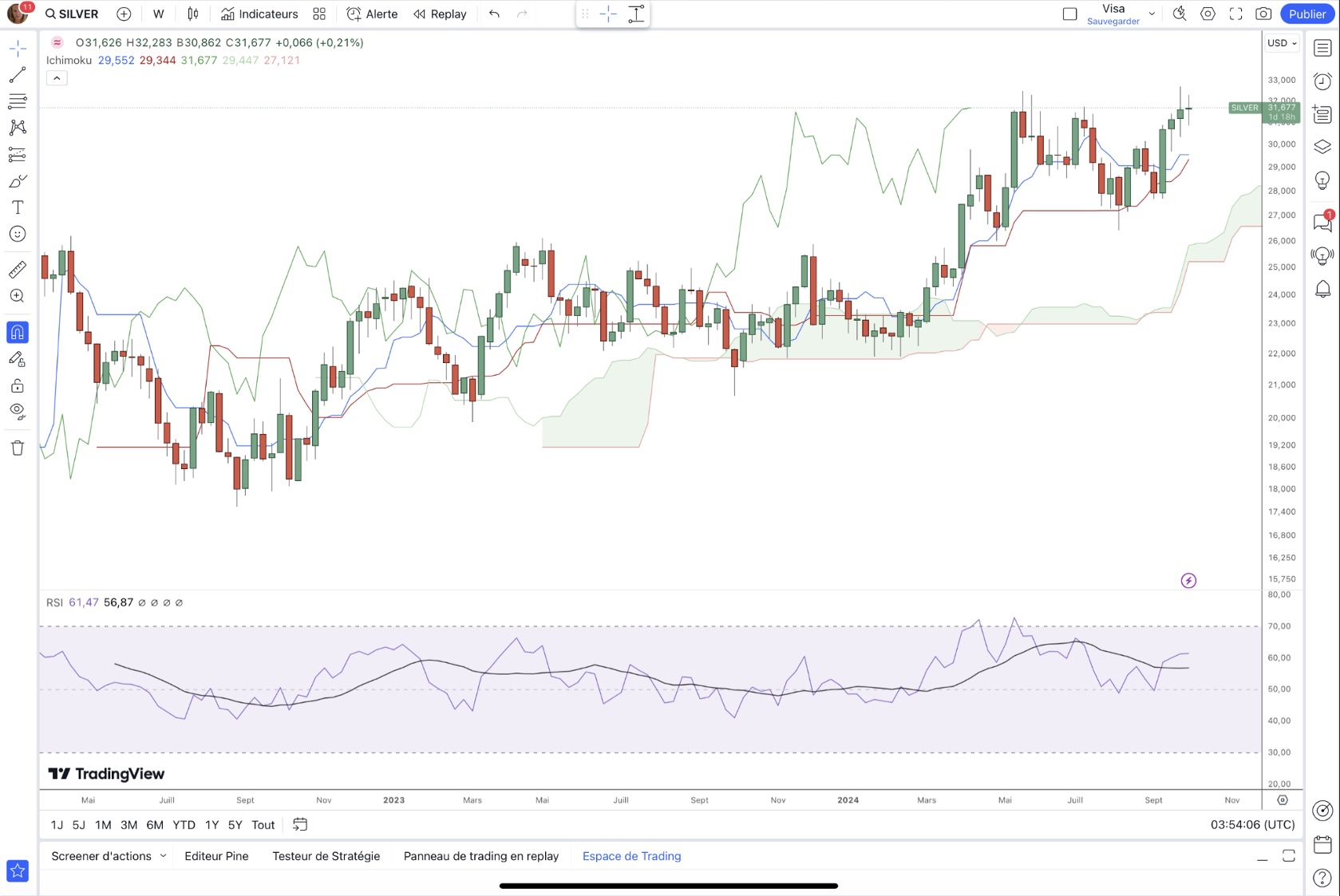
Weekly Silver Chart - Source: TradingView with ActivTrades’ Data
A closer look at the weekly chart reveals a consistent upward trend in silver prices over the past four weeks. This positive momentum is further reinforced by prices remaining above all the Ichimoku cloud indicator lines, a widely recognized bullish signal.
The Relative Strength Index (RSI) provides additional evidence of silver’s strength and recent bullish momentum. After touching the neutral level of 50 during the week of September 2, the RSI has been steadily climbing. Moreover, the RSI is currently trading above its moving average, confirming the positive momentum.
While the recent price surge, supported by positive signals from the Ichimoku cloud and rising RSI, suggests further upside potential in the near term, it’s important to remember that silver can be susceptible to sudden shifts in market sentiment. If the current technical setup favours the bulls, the recent sharp price rise may also encourage some investors to secure profits, potentially leading to short-term price corrections or consolidation. This profit-taking behaviour could introduce a degree of uncertainty.
Silver Prices Follow the Recent Gold Rally
Silver has been riding the coattails of a surging gold market, which recently hit an all-time high of around $2,685 on September 26. This gold rally has primarily been fueled by the Federal Reserve’s easing monetary policy and escalating tensions in the Middle East.
The shift toward a less aggressive monetary policy in the United States, marked by lower interest rates, has weakened the US dollar. This traditionally benefits gold, as the precious metal becomes less expensive for buyers with international currencies. Additionally, lower interest rates increase the attractiveness of non-interest-bearing assets like gold, prompting investors to seek alternative investment opportunities.
Furthermore, the escalating conflict between Israel and Iran has heightened geopolitical anxieties, further bolstering gold’s appeal. Investors often flock to gold during times of global uncertainty and instability, seeking a safe haven for their capital.
This surge in gold prices has propelled silver upwards. However, silver’s performance has been even more impressive, outshining gold since March 2024. While gold has delivered a remarkable 13% gain in the last quarter alone—putting it on track for its best quarter since 2020—and a 29% rise since January, silver’s gains have been even more significant, surpassing 33%. This impressive performance marks a significant turnaround for silver, which underperformed gold throughout 2023.
While silver’s strong performance seems linked to the gold rally, its unique properties, growing industrial demand, and lower supply are likely to continue driving its outperformance.
Daily Comparison Chart of Silver and Gold Prices - Source: TradingView with ActivTrades’ Data
Silver has long stood out compared to gold due to its unique properties that make it essential in various industrial applications, driving its growing demand. The World Silver Survey 2024, published by The Silver Institute, highlights the key factors shaping the silver market and offers insights into what to expect in 2024.
One of the main drivers behind silver’s robust demand is its pivotal role in green technologies, particularly in the photovoltaic (PV) sector, which underpins solar energy production. Much like in 2022, silver continues to benefit from structural gains tied to the global push toward clean energy. These developments not only support the metal’s price but also lay the foundation for sustained industrial demand. The 2024 outlook suggests another strong year for silver, with industrial demand expected to grow by an impressive 7%, setting a new all-time high.
Beyond its industrial uses, silver is also seeing positive trends in other sectors. The Silver Institute anticipates a modest 4% recovery in jewellery fabrication in 2024, adding to the metal’s overall demand. This recovery comes after a challenging period for the jewellery industry, signalling renewed interest in silver’s aesthetic and functional appeal.
Silver’s growing demand is outpacing its supply, leading to a significant market deficit that is putting upward pressure on prices. For the third consecutive year in 2023, global silver demand exceeded supply by a considerable margin. Although the deficit shrank by 30% year-over-year from the previous record high, it still amounted to 184.3 million ounces (Moz), making it one of the largest deficits on record. The Silver Institute forecasts that this deficit trend will persist in 2024 and potentially deepen as industrial demand continues to rise.
Supply constraints are largely due to stagnant mine production and limited recycling. Despite increased demand, silver production has remained relatively flat, contributing to the persistent gap between supply and demand. According to projections, the supply-demand gap could widen by 17% in 2024, driven by industrial growth, a recovery in jewelry and silverware demand, and a continued lack of new supply sources.
China plays a significant and multifaceted role in the silver market, impacting prices through both investment demand and industrial consumption. Economic weakness is driving Chinese investors toward silver as a safe haven, while the nation’s rapid expansion in solar and electric vehicle technologies is fueling industrial demand. However, a potential slowdown in economic growth and consolidation in the solar industry could create headwinds for silver prices.
Recent efforts by China to stimulate its economy have also provided a boost to industrial metals, including silver. Additionally, the reintroduction of quotas on gold imports could have been and might still be redirecting retail investment toward silver, further supporting its appeal in the market.
Finally, silver is often regarded as the more affordable counterpart to gold, significantly supporting its demand and pricing. While gold has long been seen as a premier investment asset and a traditional store of value, silver offers a similar appeal at a fraction of the price. This perceived affordability allows a broader range of investors to participate in the silver market, especially during times of economic uncertainty or inflationary pressures.
Disclaimer
The information provided does not constitute investment research. The material has not been prepared in accordance with the legal requirements designed to promote the independence of investment research and as such is to be considered to be a marketing communication.
All information has been prepared by ActivTrades (“AT”). The information does not contain a record of AT’s prices, or an offer of or solicitation for a transaction in any financial instrument. No representation or warranty is given as to the accuracy or completeness of this information.
Any material provided does not have regard to the specific investment objective and financial situation of any person who may receive it. Past performance is not a reliable indicator of future performance. AT provides an execution-only service. Consequently, any person acting on the information provided does so at their own risk.
Finalto Renews Sponsorship with Singapore Crick et Club Rugby Section for the 2026 Season
Featured Videos
Tickmill Winner Spotlight | Broker of the Year 2025 (LATAM) 🏆 | Finance Magnates Awards #Trading
Tickmill Winner Spotlight | Broker of the Year 2025 (LATAM) 🏆 | Finance Magnates Awards #Trading
Tickmill Winner Spotlight | Broker of the Year 2025 (LATAM) 🏆 | Finance Magnates Awards #Trading
Tickmill Winner Spotlight | Broker of the Year 2025 (LATAM) 🏆 | Finance Magnates Awards #Trading
What helped Tickmill stand out this year?
In this Winner Spotlight, Johnny Khalil, Executive Director at Tickmill Europe, shares how listening closely to clients and delivering strong trading conditions made the difference.
A big thank you to the community whose support continues to drive progress every day.
👉 Think your brand has what it takes? Nominate for the 2026 Finance Magnates Awards: https://awards.financemagnates.com/#nominate
What helped Tickmill stand out this year?
In this Winner Spotlight, Johnny Khalil, Executive Director at Tickmill Europe, shares how listening closely to clients and delivering strong trading conditions made the difference.
A big thank you to the community whose support continues to drive progress every day.
👉 Think your brand has what it takes? Nominate for the 2026 Finance Magnates Awards: https://awards.financemagnates.com/#nominate
What helped Tickmill stand out this year?
In this Winner Spotlight, Johnny Khalil, Executive Director at Tickmill Europe, shares how listening closely to clients and delivering strong trading conditions made the difference.
A big thank you to the community whose support continues to drive progress every day.
👉 Think your brand has what it takes? Nominate for the 2026 Finance Magnates Awards: https://awards.financemagnates.com/#nominate
What helped Tickmill stand out this year?
In this Winner Spotlight, Johnny Khalil, Executive Director at Tickmill Europe, shares how listening closely to clients and delivering strong trading conditions made the difference.
A big thank you to the community whose support continues to drive progress every day.
👉 Think your brand has what it takes? Nominate for the 2026 Finance Magnates Awards: https://awards.financemagnates.com/#nominate
CMC Markets’ Artur Delijergijevs on Metals Demand, Volatility, & Stable Execution
CMC Markets’ Artur Delijergijevs on Metals Demand, Volatility, & Stable Execution
CMC Markets’ Artur Delijergijevs on Metals Demand, Volatility, & Stable Execution
CMC Markets’ Artur Delijergijevs on Metals Demand, Volatility, & Stable Execution
CMC Markets’ Artur Delijergijevs on Metals Demand, Volatility, & Stable Execution
CMC Markets’ Artur Delijergijevs on Metals Demand, Volatility, & Stable Execution
In this exclusive Executive Interview, Finance Magnates speaks with Artur Delijergijevs, Head of Systematic Market Making at CMC Markets, about the current state of metals demand and market volatility.
Delijergijevs offers a desk-level view on:
- Metals Demand: Why metals are seeing the strongest demand from both retail and institutional clients right now.
- The Safe-Haven Debate: Questioning whether gold still fits the classic safe-haven definition given large daily price movements.
- Volatile Market Prep: How a market-making desk prepares its systems and pricing for stressed market conditions and high-impact economic events.
- Hybrid Execution: Why the best execution model combines electronic speed with human relationship support, especially during volatility.
- AI in Workflow: Where CMC Markets is integrating machine learning for risk management and pricing, and the limitations of AI during stressed markets.
- Dubai's Role: The strategic importance of Dubai’s location for covering global trading sessions across Asia, Europe, and the US.
Watch to understand how CMC Markets maintains stable pricing and reliable execution quality in high-volatility environments.
#CMCmarkets #forex #metals #gold #trading #volatility #MarketMaking #iFXDubai #FinanceMagnates #Finance #Fintech #Execution #AlgorithmicTrading #RiskManagement
In this exclusive Executive Interview, Finance Magnates speaks with Artur Delijergijevs, Head of Systematic Market Making at CMC Markets, about the current state of metals demand and market volatility.
Delijergijevs offers a desk-level view on:
- Metals Demand: Why metals are seeing the strongest demand from both retail and institutional clients right now.
- The Safe-Haven Debate: Questioning whether gold still fits the classic safe-haven definition given large daily price movements.
- Volatile Market Prep: How a market-making desk prepares its systems and pricing for stressed market conditions and high-impact economic events.
- Hybrid Execution: Why the best execution model combines electronic speed with human relationship support, especially during volatility.
- AI in Workflow: Where CMC Markets is integrating machine learning for risk management and pricing, and the limitations of AI during stressed markets.
- Dubai's Role: The strategic importance of Dubai’s location for covering global trading sessions across Asia, Europe, and the US.
Watch to understand how CMC Markets maintains stable pricing and reliable execution quality in high-volatility environments.
#CMCmarkets #forex #metals #gold #trading #volatility #MarketMaking #iFXDubai #FinanceMagnates #Finance #Fintech #Execution #AlgorithmicTrading #RiskManagement
In this exclusive Executive Interview, Finance Magnates speaks with Artur Delijergijevs, Head of Systematic Market Making at CMC Markets, about the current state of metals demand and market volatility.
Delijergijevs offers a desk-level view on:
- Metals Demand: Why metals are seeing the strongest demand from both retail and institutional clients right now.
- The Safe-Haven Debate: Questioning whether gold still fits the classic safe-haven definition given large daily price movements.
- Volatile Market Prep: How a market-making desk prepares its systems and pricing for stressed market conditions and high-impact economic events.
- Hybrid Execution: Why the best execution model combines electronic speed with human relationship support, especially during volatility.
- AI in Workflow: Where CMC Markets is integrating machine learning for risk management and pricing, and the limitations of AI during stressed markets.
- Dubai's Role: The strategic importance of Dubai’s location for covering global trading sessions across Asia, Europe, and the US.
Watch to understand how CMC Markets maintains stable pricing and reliable execution quality in high-volatility environments.
#CMCmarkets #forex #metals #gold #trading #volatility #MarketMaking #iFXDubai #FinanceMagnates #Finance #Fintech #Execution #AlgorithmicTrading #RiskManagement
In this exclusive Executive Interview, Finance Magnates speaks with Artur Delijergijevs, Head of Systematic Market Making at CMC Markets, about the current state of metals demand and market volatility.
Delijergijevs offers a desk-level view on:
- Metals Demand: Why metals are seeing the strongest demand from both retail and institutional clients right now.
- The Safe-Haven Debate: Questioning whether gold still fits the classic safe-haven definition given large daily price movements.
- Volatile Market Prep: How a market-making desk prepares its systems and pricing for stressed market conditions and high-impact economic events.
- Hybrid Execution: Why the best execution model combines electronic speed with human relationship support, especially during volatility.
- AI in Workflow: Where CMC Markets is integrating machine learning for risk management and pricing, and the limitations of AI during stressed markets.
- Dubai's Role: The strategic importance of Dubai’s location for covering global trading sessions across Asia, Europe, and the US.
Watch to understand how CMC Markets maintains stable pricing and reliable execution quality in high-volatility environments.
#CMCmarkets #forex #metals #gold #trading #volatility #MarketMaking #iFXDubai #FinanceMagnates #Finance #Fintech #Execution #AlgorithmicTrading #RiskManagement
In this exclusive Executive Interview, Finance Magnates speaks with Artur Delijergijevs, Head of Systematic Market Making at CMC Markets, about the current state of metals demand and market volatility.
Delijergijevs offers a desk-level view on:
- Metals Demand: Why metals are seeing the strongest demand from both retail and institutional clients right now.
- The Safe-Haven Debate: Questioning whether gold still fits the classic safe-haven definition given large daily price movements.
- Volatile Market Prep: How a market-making desk prepares its systems and pricing for stressed market conditions and high-impact economic events.
- Hybrid Execution: Why the best execution model combines electronic speed with human relationship support, especially during volatility.
- AI in Workflow: Where CMC Markets is integrating machine learning for risk management and pricing, and the limitations of AI during stressed markets.
- Dubai's Role: The strategic importance of Dubai’s location for covering global trading sessions across Asia, Europe, and the US.
Watch to understand how CMC Markets maintains stable pricing and reliable execution quality in high-volatility environments.
#CMCmarkets #forex #metals #gold #trading #volatility #MarketMaking #iFXDubai #FinanceMagnates #Finance #Fintech #Execution #AlgorithmicTrading #RiskManagement
In this exclusive Executive Interview, Finance Magnates speaks with Artur Delijergijevs, Head of Systematic Market Making at CMC Markets, about the current state of metals demand and market volatility.
Delijergijevs offers a desk-level view on:
- Metals Demand: Why metals are seeing the strongest demand from both retail and institutional clients right now.
- The Safe-Haven Debate: Questioning whether gold still fits the classic safe-haven definition given large daily price movements.
- Volatile Market Prep: How a market-making desk prepares its systems and pricing for stressed market conditions and high-impact economic events.
- Hybrid Execution: Why the best execution model combines electronic speed with human relationship support, especially during volatility.
- AI in Workflow: Where CMC Markets is integrating machine learning for risk management and pricing, and the limitations of AI during stressed markets.
- Dubai's Role: The strategic importance of Dubai’s location for covering global trading sessions across Asia, Europe, and the US.
Watch to understand how CMC Markets maintains stable pricing and reliable execution quality in high-volatility environments.
#CMCmarkets #forex #metals #gold #trading #volatility #MarketMaking #iFXDubai #FinanceMagnates #Finance #Fintech #Execution #AlgorithmicTrading #RiskManagement
Finance Magnates Awards 2026 – Nominations Now Open
Finance Magnates Awards 2026 – Nominations Now Open
Finance Magnates Awards 2026 – Nominations Now Open
Finance Magnates Awards 2026 – Nominations Now Open
Finance Magnates Awards 2026 – Nominations Now Open
Finance Magnates Awards 2026 – Nominations Now Open
The Finance Magnates Awards 2026 nominations are now open. 🏆
From fintech innovators to leading brokers, this is where the finance industry celebrates its biggest achievements.
Winners will be announced at the Cyprus Gala Dinner on November 6, 2026.
Nominate your brand now.
https://awards.financemagnates.com/?utm_source=linkedin&utm_medium=video&utm_campaign=nominations-open
#FMAwards #FinanceMagnates #FintechAwards #Fintech #FinanceIndustry
The Finance Magnates Awards 2026 nominations are now open. 🏆
From fintech innovators to leading brokers, this is where the finance industry celebrates its biggest achievements.
Winners will be announced at the Cyprus Gala Dinner on November 6, 2026.
Nominate your brand now.
https://awards.financemagnates.com/?utm_source=linkedin&utm_medium=video&utm_campaign=nominations-open
#FMAwards #FinanceMagnates #FintechAwards #Fintech #FinanceIndustry
The Finance Magnates Awards 2026 nominations are now open. 🏆
From fintech innovators to leading brokers, this is where the finance industry celebrates its biggest achievements.
Winners will be announced at the Cyprus Gala Dinner on November 6, 2026.
Nominate your brand now.
https://awards.financemagnates.com/?utm_source=linkedin&utm_medium=video&utm_campaign=nominations-open
#FMAwards #FinanceMagnates #FintechAwards #Fintech #FinanceIndustry
The Finance Magnates Awards 2026 nominations are now open. 🏆
From fintech innovators to leading brokers, this is where the finance industry celebrates its biggest achievements.
Winners will be announced at the Cyprus Gala Dinner on November 6, 2026.
Nominate your brand now.
https://awards.financemagnates.com/?utm_source=linkedin&utm_medium=video&utm_campaign=nominations-open
#FMAwards #FinanceMagnates #FintechAwards #Fintech #FinanceIndustry
The Finance Magnates Awards 2026 nominations are now open. 🏆
From fintech innovators to leading brokers, this is where the finance industry celebrates its biggest achievements.
Winners will be announced at the Cyprus Gala Dinner on November 6, 2026.
Nominate your brand now.
https://awards.financemagnates.com/?utm_source=linkedin&utm_medium=video&utm_campaign=nominations-open
#FMAwards #FinanceMagnates #FintechAwards #Fintech #FinanceIndustry
The Finance Magnates Awards 2026 nominations are now open. 🏆
From fintech innovators to leading brokers, this is where the finance industry celebrates its biggest achievements.
Winners will be announced at the Cyprus Gala Dinner on November 6, 2026.
Nominate your brand now.
https://awards.financemagnates.com/?utm_source=linkedin&utm_medium=video&utm_campaign=nominations-open
#FMAwards #FinanceMagnates #FintechAwards #Fintech #FinanceIndustry
Finance Magnates Awards 2026 | Nominations Now Open 🏆#Fintech #FMAwards #TradingIndustry
Finance Magnates Awards 2026 | Nominations Now Open 🏆#Fintech #FMAwards #TradingIndustry
Finance Magnates Awards 2026 | Nominations Now Open 🏆#Fintech #FMAwards #TradingIndustry
Finance Magnates Awards 2026 | Nominations Now Open 🏆#Fintech #FMAwards #TradingIndustry
Finance Magnates Awards 2026 | Nominations Now Open 🏆#Fintech #FMAwards #TradingIndustry
Finance Magnates Awards 2026 | Nominations Now Open 🏆#Fintech #FMAwards #TradingIndustry
Lights on. Cameras ready. 🎬
Finance Magnates Awards 2026 nominations are now open. 🏆
#FMAwards #FinanceMagnates #FintechAwards #Fintech
Lights on. Cameras ready. 🎬
Finance Magnates Awards 2026 nominations are now open. 🏆
#FMAwards #FinanceMagnates #FintechAwards #Fintech
Lights on. Cameras ready. 🎬
Finance Magnates Awards 2026 nominations are now open. 🏆
#FMAwards #FinanceMagnates #FintechAwards #Fintech
Lights on. Cameras ready. 🎬
Finance Magnates Awards 2026 nominations are now open. 🏆
#FMAwards #FinanceMagnates #FintechAwards #Fintech
Lights on. Cameras ready. 🎬
Finance Magnates Awards 2026 nominations are now open. 🏆
#FMAwards #FinanceMagnates #FintechAwards #Fintech
Lights on. Cameras ready. 🎬
Finance Magnates Awards 2026 nominations are now open. 🏆
#FMAwards #FinanceMagnates #FintechAwards #Fintech
Exness sees trust as the key theme for growth in MENA Trading Growth for 2026
Exness sees trust as the key theme for growth in MENA Trading Growth for 2026
Exness sees trust as the key theme for growth in MENA Trading Growth for 2026
Exness sees trust as the key theme for growth in MENA Trading Growth for 2026
Exness sees trust as the key theme for growth in MENA Trading Growth for 2026
Exness sees trust as the key theme for growth in MENA Trading Growth for 2026
Mohammad Amer, Regional Commercial Director at Exness, sits down to discuss the booming MENA financial trading market. Find out why Dubai is key to the company's growth strategy, how a mobile-first generation is changing expectations, and why trust will be the defining theme for traders in 2026.
In this interview, you'll learn:
* Why Dubai and the MENA region are critical growth markets for fintech and online trading.
* How Exness is addressing the demands of mobile-first, younger traders through engineering, platform stability, and transparent conditions.
* The essential role local talent plays in providing a culturally relevant and compliant user experience.
* Mohammad Amer's outlook on the future of the online trading industry and why stronger controls and systems are necessary.
* Why "trust" isn't just a brand value, but has commercial value—and why he predicts 2026 will be the "Year of Trust."
Key Takeaways:
➡️ The MENA region is rapidly shaping global financial markets.
➡️ New traders expect stability, precise execution, and transparency.
➡️ Local expertise is key to regulatory compliance and user experience.
➡️ Future success belongs to firms capable of meeting rising standards across regulation and platform consistency.
Read the full article at: https://www.financemagnates.com/thought-leadership/exness-sees-trust-as-the-key-theme-for-growth-in-mena-trading-growth-for-2026/
#Exness #MENA #Trading #FinTech #Dubai #OnlineTrading #FinanceMagnates #MohammadAmer #Trust #MobileTrading
Mohammad Amer, Regional Commercial Director at Exness, sits down to discuss the booming MENA financial trading market. Find out why Dubai is key to the company's growth strategy, how a mobile-first generation is changing expectations, and why trust will be the defining theme for traders in 2026.
In this interview, you'll learn:
* Why Dubai and the MENA region are critical growth markets for fintech and online trading.
* How Exness is addressing the demands of mobile-first, younger traders through engineering, platform stability, and transparent conditions.
* The essential role local talent plays in providing a culturally relevant and compliant user experience.
* Mohammad Amer's outlook on the future of the online trading industry and why stronger controls and systems are necessary.
* Why "trust" isn't just a brand value, but has commercial value—and why he predicts 2026 will be the "Year of Trust."
Key Takeaways:
➡️ The MENA region is rapidly shaping global financial markets.
➡️ New traders expect stability, precise execution, and transparency.
➡️ Local expertise is key to regulatory compliance and user experience.
➡️ Future success belongs to firms capable of meeting rising standards across regulation and platform consistency.
Read the full article at: https://www.financemagnates.com/thought-leadership/exness-sees-trust-as-the-key-theme-for-growth-in-mena-trading-growth-for-2026/
#Exness #MENA #Trading #FinTech #Dubai #OnlineTrading #FinanceMagnates #MohammadAmer #Trust #MobileTrading
Mohammad Amer, Regional Commercial Director at Exness, sits down to discuss the booming MENA financial trading market. Find out why Dubai is key to the company's growth strategy, how a mobile-first generation is changing expectations, and why trust will be the defining theme for traders in 2026.
In this interview, you'll learn:
* Why Dubai and the MENA region are critical growth markets for fintech and online trading.
* How Exness is addressing the demands of mobile-first, younger traders through engineering, platform stability, and transparent conditions.
* The essential role local talent plays in providing a culturally relevant and compliant user experience.
* Mohammad Amer's outlook on the future of the online trading industry and why stronger controls and systems are necessary.
* Why "trust" isn't just a brand value, but has commercial value—and why he predicts 2026 will be the "Year of Trust."
Key Takeaways:
➡️ The MENA region is rapidly shaping global financial markets.
➡️ New traders expect stability, precise execution, and transparency.
➡️ Local expertise is key to regulatory compliance and user experience.
➡️ Future success belongs to firms capable of meeting rising standards across regulation and platform consistency.
Read the full article at: https://www.financemagnates.com/thought-leadership/exness-sees-trust-as-the-key-theme-for-growth-in-mena-trading-growth-for-2026/
#Exness #MENA #Trading #FinTech #Dubai #OnlineTrading #FinanceMagnates #MohammadAmer #Trust #MobileTrading
Mohammad Amer, Regional Commercial Director at Exness, sits down to discuss the booming MENA financial trading market. Find out why Dubai is key to the company's growth strategy, how a mobile-first generation is changing expectations, and why trust will be the defining theme for traders in 2026.
In this interview, you'll learn:
* Why Dubai and the MENA region are critical growth markets for fintech and online trading.
* How Exness is addressing the demands of mobile-first, younger traders through engineering, platform stability, and transparent conditions.
* The essential role local talent plays in providing a culturally relevant and compliant user experience.
* Mohammad Amer's outlook on the future of the online trading industry and why stronger controls and systems are necessary.
* Why "trust" isn't just a brand value, but has commercial value—and why he predicts 2026 will be the "Year of Trust."
Key Takeaways:
➡️ The MENA region is rapidly shaping global financial markets.
➡️ New traders expect stability, precise execution, and transparency.
➡️ Local expertise is key to regulatory compliance and user experience.
➡️ Future success belongs to firms capable of meeting rising standards across regulation and platform consistency.
Read the full article at: https://www.financemagnates.com/thought-leadership/exness-sees-trust-as-the-key-theme-for-growth-in-mena-trading-growth-for-2026/
#Exness #MENA #Trading #FinTech #Dubai #OnlineTrading #FinanceMagnates #MohammadAmer #Trust #MobileTrading
Mohammad Amer, Regional Commercial Director at Exness, sits down to discuss the booming MENA financial trading market. Find out why Dubai is key to the company's growth strategy, how a mobile-first generation is changing expectations, and why trust will be the defining theme for traders in 2026.
In this interview, you'll learn:
* Why Dubai and the MENA region are critical growth markets for fintech and online trading.
* How Exness is addressing the demands of mobile-first, younger traders through engineering, platform stability, and transparent conditions.
* The essential role local talent plays in providing a culturally relevant and compliant user experience.
* Mohammad Amer's outlook on the future of the online trading industry and why stronger controls and systems are necessary.
* Why "trust" isn't just a brand value, but has commercial value—and why he predicts 2026 will be the "Year of Trust."
Key Takeaways:
➡️ The MENA region is rapidly shaping global financial markets.
➡️ New traders expect stability, precise execution, and transparency.
➡️ Local expertise is key to regulatory compliance and user experience.
➡️ Future success belongs to firms capable of meeting rising standards across regulation and platform consistency.
Read the full article at: https://www.financemagnates.com/thought-leadership/exness-sees-trust-as-the-key-theme-for-growth-in-mena-trading-growth-for-2026/
#Exness #MENA #Trading #FinTech #Dubai #OnlineTrading #FinanceMagnates #MohammadAmer #Trust #MobileTrading
Mohammad Amer, Regional Commercial Director at Exness, sits down to discuss the booming MENA financial trading market. Find out why Dubai is key to the company's growth strategy, how a mobile-first generation is changing expectations, and why trust will be the defining theme for traders in 2026.
In this interview, you'll learn:
* Why Dubai and the MENA region are critical growth markets for fintech and online trading.
* How Exness is addressing the demands of mobile-first, younger traders through engineering, platform stability, and transparent conditions.
* The essential role local talent plays in providing a culturally relevant and compliant user experience.
* Mohammad Amer's outlook on the future of the online trading industry and why stronger controls and systems are necessary.
* Why "trust" isn't just a brand value, but has commercial value—and why he predicts 2026 will be the "Year of Trust."
Key Takeaways:
➡️ The MENA region is rapidly shaping global financial markets.
➡️ New traders expect stability, precise execution, and transparency.
➡️ Local expertise is key to regulatory compliance and user experience.
➡️ Future success belongs to firms capable of meeting rising standards across regulation and platform consistency.
Read the full article at: https://www.financemagnates.com/thought-leadership/exness-sees-trust-as-the-key-theme-for-growth-in-mena-trading-growth-for-2026/
#Exness #MENA #Trading #FinTech #Dubai #OnlineTrading #FinanceMagnates #MohammadAmer #Trust #MobileTrading