During that time they have honed their infrastructure provision and software development approach in direct response to their customers’ needs and requirements. Beeks’ mission is to deliver ultra-low latency compute power, ensure maximum security and optimise performance in the exceedingly fast-moving capital markets sector.
Proximity Cloud is a pre-configured trading environment platform dedicated to the demands of capital trading markets and financial institutions.
Uniquely tailored for financial markets
While managed cloud service providers offer generic cloud computing solutions, Proximity Cloud has grown out of the knowledge, expertise and experience of exclusively supporting financial trading companies.
“We’ve got a long and unique history of delivering on-demand compute in financial services,” says McArthur. “We know the pain points our customers encounter, and Proximity Cloud is our most comprehensive offering to date. We aim to eliminate some of the risks and a lot of the costs that come with in-house infrastructure solutions and to make it a lot easier to get value to the business.”
Pre-built solution
Proximity Cloud is a low latency private cloud product pre-built into a physical cabinet and delivered to site in a stand-alone rack.
It comprises the whole range of functionality to be expected from Beeks Private Cloud, including resource management automation, full stack and trading analytics, packet capture, latency monitoring, high precision time services and support for MultiCast and UniCast datasets
The problems that Proximity Cloud helps to solve are far-reaching and include everything from security risk to opportunity blocks, measuring performance analytics and reducing local supply chain issues.
“Up until now Beeks has provided a private cloud product with a level of shared network infrastructure hosted in the Beeks’ domain,” explains McArthur. “Although we were having great meetings with banks and the bigger financial institutions who love our message and our agility, we kept bumping our head against the issue of internal controls using shared networks.”
The shared infrastructure platform caused problems with security, data access and data sovereignty. While these may not be so significant in the generic cloud, they are show-stoppers in the financial sector. Replacing shared infrastructure through a dedicated, client-owned environment was key.
Location flexibility
Not only do financial organisations wish to deploy quickly in new trading regions globally, they also have their own data centres where they wish to have control of their infrastructure.
Commenting on the flexibility of Proximity Cloud, Head of Sales for Beeks Group, Alan Samuel says: “Our other products to date have been prescriptive in terms of location. Our customers have had to engage with Beeks Cloud within our own footprint in our global locations. Proximity Cloud enables us to deliver the product in any location.”
Proximity Cloud doesn’t have to locate in LD4 or NY4, customers can have it in their own building in London, New York, Singapore or literally anywhere in the world they require it to be.
Integration
Things can change in the financial sector very quickly and financial markets need optimised systems that flex under load and market demand. Proximity Cloud allows customers to adapt and scale up or down without having to fork out a substantial amount in CAPEX.
So many banks and brokers have invested a great deal of time and money on platforms that never got off the ground. Not only that, it’s likely that successful implementations would be compromised on some area of security or performance monitoring.
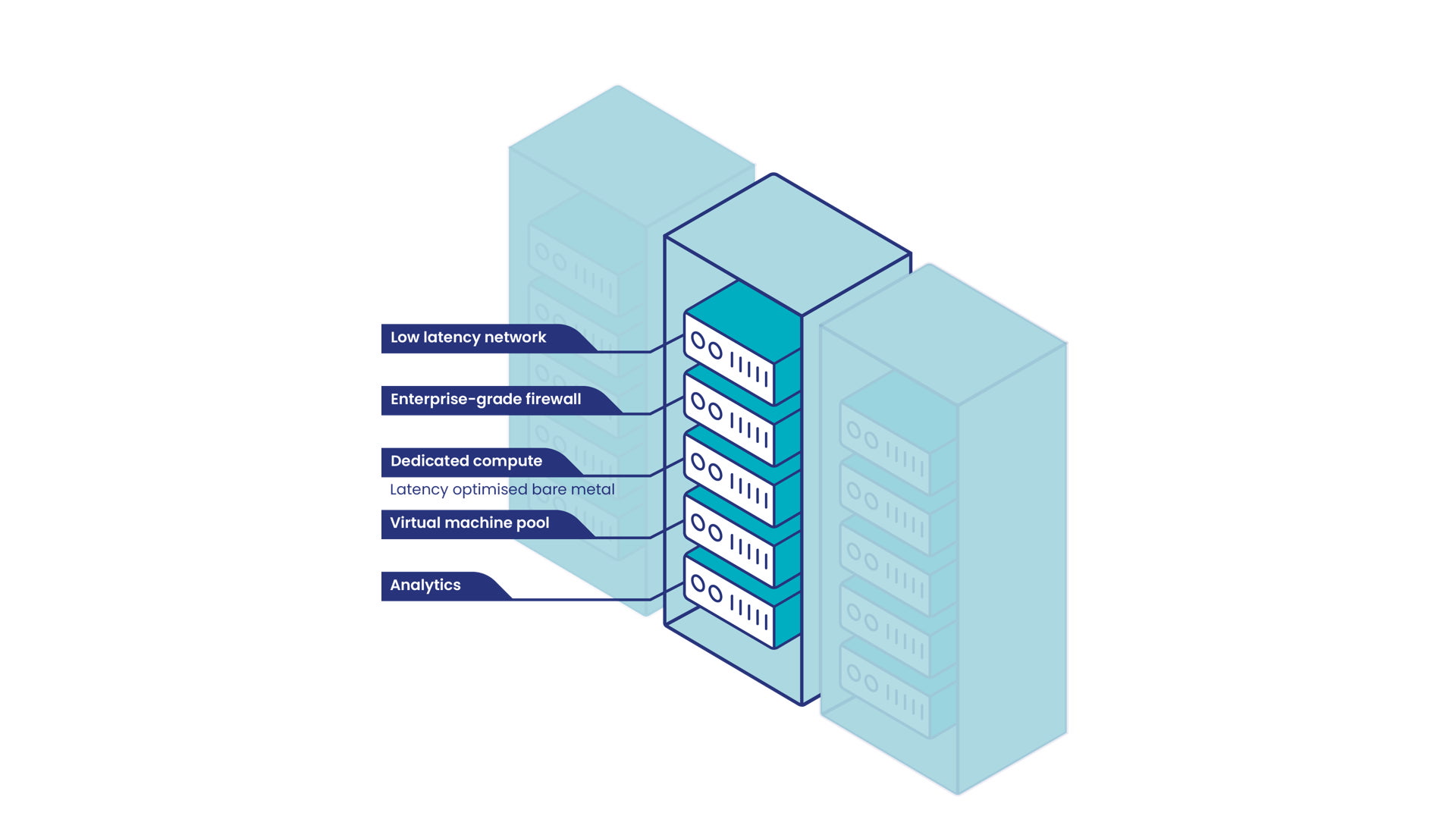
The value of Proximity Cloud over alternative cloud providers lies in its integration of security, connectivity, low latency and analytics. This means that trading organisations can focus on what they do best instead of spending lots of man hours piecing things together before they can give any value to the business.
Furthermore, Proximity Cloud integrates quickly with public cloud for a hybrid solution, enabling financial teams to select where workloads are processed.
“One of the biggest logistical nightmares for our customers is having to buy component parts remotely for the 10 or 20 locations around the world where they need to have computing infrastructure,” says McArthur.”
Beeks solves this problem by taking responsibility for the sourcing, support and component replacement through their regional supply chain hubs and Service Level Agreements. Their customers can leave all the logistics to Beeks and take delivery of a fully pre-configured, pre-cabled Proximity Cloud cabinet.
Engineering support
Security protocols and performance analytics are the most important thing for IT to think about.
There are so many layers involved, including processes, procedures, certifications, specific software and hardware as well as manpower. Organisations need a dedicated security team monitoring 24/7 against cyber-attacks, Denial of Service and any incidents and events on the periphery of the network.
Also of utmost importance are best-in-class performance monitoring tools and expertise, which can be difficult to achieve in-house.
Having the ability to monitor connectivity, third party networks, bandwidth utilisation and micro-bursts of network activity ensure that trades are made at the expected calibre and any third party liabilities can be swiftly pin-pointed.
Trouble-shooting and issue resolution can be extremely time consuming and costly without collating accurate recordings and evidence. This needs expert resourcing and focus to enhance trading confidence in the platform.
Otherwise engineers have to carry out a deep-dive into the servers and still don’t necessarily identify the right information. There are often mistakes and risks to security with holes left open. However, with comprehensive real-time monitoring and alerting of latency and trade flow, as well as the ability to query historical trades with full packet capture, Proximity Cloud resolves this engineering issue.
The analytics piece alone is what big organisations have spent millions trying to get right.
Commercial Benefit
Beeks’s monthly subscription model means that organisations can get up and running with a comparatively low OPEX spend, rather than the huge CAPEX investment associated with traditional solution development and implementation contracts.
“We’ve always known how to get the technology off the ground cost effectively,” comments McArthur. “Proximity Cloud is the latest addition offering immediate value.”
Converting CAPEX spend to OPEX is a significant enabler in financial institutions’ technical expansion and transforms both Total Cost of Ownership and Return on Investment. Engineering costs can be enormous in a traditional environment. But these are mitigated by the built-in analytics included in Proximity Cloud.
In terms of alternative suppliers there is no real competitor in the space that includes all the sector-specific functionality of Proximity Cloud.
Alan Samuel comments: “In a nutshell, competitor solutions aren’t designed for the specific requirements of capital markets and finance and cost significantly more than the price of Proximity Cloud. The overall costs of Proximity Cloud is significantly cheaper than using existing cloud service providers when you consider things like ingress and egress charges – and night and day compared to the cost of developing it in-house.”
Evolution of Proximity Cloud
Emphasising the maturity of the product’s core functionality, McArthur says: “All the components within Proximity Cloud are tried and tested over the last decade. We are one of the only firms in the world with dedicated expertise in building, networking and automating private virtual machines and analytics for the financial markets.”
In that sense Proximity Cloud is not a new product. It’s an iteration of all the components Beeks have spent the last ten years building and automating, all brought together in a plug-and-play package. What is new is the software layer that brings all the components together and enables point and click management through a brand-new user interface.
Software development now forms 25% of Beeks’ engineering base and is growing year on year as the automation and orchestration layer becomes more sophisticated - they’re already planning the next 2 phases of Proximity Cloud.
What people are saying
“It’s very encouraging – and quite unusual – that we already had a couple of pre-launch expressions of interest in Proximity Cloud from a range of financial organisations, including a small technology firm and one of the largest stock exchanges in the world,” says McArthur.
“Almost everyone we’ve spoken to has given us very positive feedback – so there’s definitely something in this product and we are excited to see how it is received.”
Beeks Proximity Cloud product features
Only fully managed, pre-configured physical trading environment that is fully optimised for guaranteed low latency trading conditions
Specifically designed for connectivity rich environments using components from all low latency vendors, including optimised switching and analytics
Ideal solution for financial enterprises looking for the ultimate secure and scalable low latency environment
Support for multicast and unicast
High precision time stamping included in specific sites
Can be rolled out anywhere around the world into your own site or hosted by Beeks Financial Cloud capability
On premise workloads capable of connecting to all the hyperscalers - you select the workloads you want on private and public cloud
Can integrate quickly to public cloud for hybrid solution
No shared infrastructure therefore no data security risks as everything is dedicated to you in a completely client-owned environment
Delivered fully populated with PDUs and pre cabled
Fully installed so no further hardware procurement required
Backed by one of the largest cloud providers in financial services, it supports multicast data, and PTP time stamping in full regulatory approved environments
To coincide with their End of Year results 2021, CEO Gordon McArthur and his team at Beeks launched their latest product evolution, Proximity Cloud.
During that time they have honed their infrastructure provision and software development approach in direct response to their customers’ needs and requirements. Beeks’ mission is to deliver ultra-low latency compute power, ensure maximum security and optimise performance in the exceedingly fast-moving capital markets sector.
Proximity Cloud is a pre-configured trading environment platform dedicated to the demands of capital trading markets and financial institutions.
Uniquely tailored for financial markets
While managed cloud service providers offer generic cloud computing solutions, Proximity Cloud has grown out of the knowledge, expertise and experience of exclusively supporting financial trading companies.
“We’ve got a long and unique history of delivering on-demand compute in financial services,” says McArthur. “We know the pain points our customers encounter, and Proximity Cloud is our most comprehensive offering to date. We aim to eliminate some of the risks and a lot of the costs that come with in-house infrastructure solutions and to make it a lot easier to get value to the business.”
Pre-built solution
Proximity Cloud is a low latency private cloud product pre-built into a physical cabinet and delivered to site in a stand-alone rack.
It comprises the whole range of functionality to be expected from Beeks Private Cloud, including resource management automation, full stack and trading analytics, packet capture, latency monitoring, high precision time services and support for MultiCast and UniCast datasets
The problems that Proximity Cloud helps to solve are far-reaching and include everything from security risk to opportunity blocks, measuring performance analytics and reducing local supply chain issues.
“Up until now Beeks has provided a private cloud product with a level of shared network infrastructure hosted in the Beeks’ domain,” explains McArthur. “Although we were having great meetings with banks and the bigger financial institutions who love our message and our agility, we kept bumping our head against the issue of internal controls using shared networks.”
The shared infrastructure platform caused problems with security, data access and data sovereignty. While these may not be so significant in the generic cloud, they are show-stoppers in the financial sector. Replacing shared infrastructure through a dedicated, client-owned environment was key.
Location flexibility
Not only do financial organisations wish to deploy quickly in new trading regions globally, they also have their own data centres where they wish to have control of their infrastructure.
Commenting on the flexibility of Proximity Cloud, Head of Sales for Beeks Group, Alan Samuel says: “Our other products to date have been prescriptive in terms of location. Our customers have had to engage with Beeks Cloud within our own footprint in our global locations. Proximity Cloud enables us to deliver the product in any location.”
Proximity Cloud doesn’t have to locate in LD4 or NY4, customers can have it in their own building in London, New York, Singapore or literally anywhere in the world they require it to be.
Integration
Things can change in the financial sector very quickly and financial markets need optimised systems that flex under load and market demand. Proximity Cloud allows customers to adapt and scale up or down without having to fork out a substantial amount in CAPEX.
So many banks and brokers have invested a great deal of time and money on platforms that never got off the ground. Not only that, it’s likely that successful implementations would be compromised on some area of security or performance monitoring.
The value of Proximity Cloud over alternative cloud providers lies in its integration of security, connectivity, low latency and analytics. This means that trading organisations can focus on what they do best instead of spending lots of man hours piecing things together before they can give any value to the business.
Furthermore, Proximity Cloud integrates quickly with public cloud for a hybrid solution, enabling financial teams to select where workloads are processed.
“One of the biggest logistical nightmares for our customers is having to buy component parts remotely for the 10 or 20 locations around the world where they need to have computing infrastructure,” says McArthur.”
Beeks solves this problem by taking responsibility for the sourcing, support and component replacement through their regional supply chain hubs and Service Level Agreements. Their customers can leave all the logistics to Beeks and take delivery of a fully pre-configured, pre-cabled Proximity Cloud cabinet.
Engineering support
Security protocols and performance analytics are the most important thing for IT to think about.
There are so many layers involved, including processes, procedures, certifications, specific software and hardware as well as manpower. Organisations need a dedicated security team monitoring 24/7 against cyber-attacks, Denial of Service and any incidents and events on the periphery of the network.
Also of utmost importance are best-in-class performance monitoring tools and expertise, which can be difficult to achieve in-house.
Having the ability to monitor connectivity, third party networks, bandwidth utilisation and micro-bursts of network activity ensure that trades are made at the expected calibre and any third party liabilities can be swiftly pin-pointed.
Trouble-shooting and issue resolution can be extremely time consuming and costly without collating accurate recordings and evidence. This needs expert resourcing and focus to enhance trading confidence in the platform.
Otherwise engineers have to carry out a deep-dive into the servers and still don’t necessarily identify the right information. There are often mistakes and risks to security with holes left open. However, with comprehensive real-time monitoring and alerting of latency and trade flow, as well as the ability to query historical trades with full packet capture, Proximity Cloud resolves this engineering issue.
The analytics piece alone is what big organisations have spent millions trying to get right.
Commercial Benefit
Beeks’s monthly subscription model means that organisations can get up and running with a comparatively low OPEX spend, rather than the huge CAPEX investment associated with traditional solution development and implementation contracts.
“We’ve always known how to get the technology off the ground cost effectively,” comments McArthur. “Proximity Cloud is the latest addition offering immediate value.”
Converting CAPEX spend to OPEX is a significant enabler in financial institutions’ technical expansion and transforms both Total Cost of Ownership and Return on Investment. Engineering costs can be enormous in a traditional environment. But these are mitigated by the built-in analytics included in Proximity Cloud.
In terms of alternative suppliers there is no real competitor in the space that includes all the sector-specific functionality of Proximity Cloud.
Alan Samuel comments: “In a nutshell, competitor solutions aren’t designed for the specific requirements of capital markets and finance and cost significantly more than the price of Proximity Cloud. The overall costs of Proximity Cloud is significantly cheaper than using existing cloud service providers when you consider things like ingress and egress charges – and night and day compared to the cost of developing it in-house.”
Evolution of Proximity Cloud
Emphasising the maturity of the product’s core functionality, McArthur says: “All the components within Proximity Cloud are tried and tested over the last decade. We are one of the only firms in the world with dedicated expertise in building, networking and automating private virtual machines and analytics for the financial markets.”
In that sense Proximity Cloud is not a new product. It’s an iteration of all the components Beeks have spent the last ten years building and automating, all brought together in a plug-and-play package. What is new is the software layer that brings all the components together and enables point and click management through a brand-new user interface.
Software development now forms 25% of Beeks’ engineering base and is growing year on year as the automation and orchestration layer becomes more sophisticated - they’re already planning the next 2 phases of Proximity Cloud.
What people are saying
“It’s very encouraging – and quite unusual – that we already had a couple of pre-launch expressions of interest in Proximity Cloud from a range of financial organisations, including a small technology firm and one of the largest stock exchanges in the world,” says McArthur.
“Almost everyone we’ve spoken to has given us very positive feedback – so there’s definitely something in this product and we are excited to see how it is received.”
Beeks Proximity Cloud product features
Only fully managed, pre-configured physical trading environment that is fully optimised for guaranteed low latency trading conditions
Specifically designed for connectivity rich environments using components from all low latency vendors, including optimised switching and analytics
Ideal solution for financial enterprises looking for the ultimate secure and scalable low latency environment
Support for multicast and unicast
High precision time stamping included in specific sites
Can be rolled out anywhere around the world into your own site or hosted by Beeks Financial Cloud capability
On premise workloads capable of connecting to all the hyperscalers - you select the workloads you want on private and public cloud
Can integrate quickly to public cloud for hybrid solution
No shared infrastructure therefore no data security risks as everything is dedicated to you in a completely client-owned environment
Delivered fully populated with PDUs and pre cabled
Fully installed so no further hardware procurement required
Backed by one of the largest cloud providers in financial services, it supports multicast data, and PTP time stamping in full regulatory approved environments
FP Markets Winner Spotlight 🏆 | Global Broker of the Year 2025 #Trading #Broker #Innovation #Shorts
FP Markets Winner Spotlight 🏆 | Global Broker of the Year 2025 #Trading #Broker #Innovation #Shorts
FP Markets Winner Spotlight 🏆 | Global Broker of the Year 2025 #Trading #Broker #Innovation #Shorts
FP Markets Winner Spotlight 🏆 | Global Broker of the Year 2025 #Trading #Broker #Innovation #Shorts
FP Markets takes the spotlight as Global Broker of the Year 2025 at the Finance Magnates Awards.
Martin Stoilov, Head of Client Experience, shares that trust, innovation, and people played a key role in the company’s success, supported by a strong foundation of integrity and client-centricity.
Following this milestone, FP Markets continues to focus on growth, technology investment, and its core values of transparency and excellence.
👉 Be part of FM Awards 2026: https://awards.financemagnates.com/#nominate
FP Markets takes the spotlight as Global Broker of the Year 2025 at the Finance Magnates Awards.
Martin Stoilov, Head of Client Experience, shares that trust, innovation, and people played a key role in the company’s success, supported by a strong foundation of integrity and client-centricity.
Following this milestone, FP Markets continues to focus on growth, technology investment, and its core values of transparency and excellence.
👉 Be part of FM Awards 2026: https://awards.financemagnates.com/#nominate
FP Markets takes the spotlight as Global Broker of the Year 2025 at the Finance Magnates Awards.
Martin Stoilov, Head of Client Experience, shares that trust, innovation, and people played a key role in the company’s success, supported by a strong foundation of integrity and client-centricity.
Following this milestone, FP Markets continues to focus on growth, technology investment, and its core values of transparency and excellence.
👉 Be part of FM Awards 2026: https://awards.financemagnates.com/#nominate
FP Markets takes the spotlight as Global Broker of the Year 2025 at the Finance Magnates Awards.
Martin Stoilov, Head of Client Experience, shares that trust, innovation, and people played a key role in the company’s success, supported by a strong foundation of integrity and client-centricity.
Following this milestone, FP Markets continues to focus on growth, technology investment, and its core values of transparency and excellence.
👉 Be part of FM Awards 2026: https://awards.financemagnates.com/#nominate
In this video, we review @HolaPrimeMarketsOfficial, a multi-asset forex and CFDs broker offering different account types, trading platforms, and flexible trading conditions.
We cover the broker’s overall offering, including account options, trading environment, platforms like MT4 and MT5, and additional services such as managed accounts and fast withdrawals.
Watch the full video to see if Hola Prime Markets fits your trading needs.
📣 Stay up to date with the latest in finance and trading. Follow Finance Magnates for industry news, insights, and global event coverage.
Connect with us:
🔗 LinkedIn: /financemagnates
👍 Facebook: /financemagnates
📸 Instagram: https://www.instagram.com/financemagnates
🐦 X: https://x.com/financemagnates
🎥 TikTok: https://www.tiktok.com/tag/financemagnates
▶️ YouTube: /@financemagnates_official
#HolaPrime #ForexBroker #CFDTrading #FinanceMagnates #Trading #Forex #BrokerReview
In this video, we review @HolaPrimeMarketsOfficial, a multi-asset forex and CFDs broker offering different account types, trading platforms, and flexible trading conditions.
We cover the broker’s overall offering, including account options, trading environment, platforms like MT4 and MT5, and additional services such as managed accounts and fast withdrawals.
Watch the full video to see if Hola Prime Markets fits your trading needs.
📣 Stay up to date with the latest in finance and trading. Follow Finance Magnates for industry news, insights, and global event coverage.
Connect with us:
🔗 LinkedIn: /financemagnates
👍 Facebook: /financemagnates
📸 Instagram: https://www.instagram.com/financemagnates
🐦 X: https://x.com/financemagnates
🎥 TikTok: https://www.tiktok.com/tag/financemagnates
▶️ YouTube: /@financemagnates_official
#HolaPrime #ForexBroker #CFDTrading #FinanceMagnates #Trading #Forex #BrokerReview
In this video, we review @HolaPrimeMarketsOfficial, a multi-asset forex and CFDs broker offering different account types, trading platforms, and flexible trading conditions.
We cover the broker’s overall offering, including account options, trading environment, platforms like MT4 and MT5, and additional services such as managed accounts and fast withdrawals.
Watch the full video to see if Hola Prime Markets fits your trading needs.
📣 Stay up to date with the latest in finance and trading. Follow Finance Magnates for industry news, insights, and global event coverage.
Connect with us:
🔗 LinkedIn: /financemagnates
👍 Facebook: /financemagnates
📸 Instagram: https://www.instagram.com/financemagnates
🐦 X: https://x.com/financemagnates
🎥 TikTok: https://www.tiktok.com/tag/financemagnates
▶️ YouTube: /@financemagnates_official
#HolaPrime #ForexBroker #CFDTrading #FinanceMagnates #Trading #Forex #BrokerReview
In this video, we review @HolaPrimeMarketsOfficial, a multi-asset forex and CFDs broker offering different account types, trading platforms, and flexible trading conditions.
We cover the broker’s overall offering, including account options, trading environment, platforms like MT4 and MT5, and additional services such as managed accounts and fast withdrawals.
Watch the full video to see if Hola Prime Markets fits your trading needs.
📣 Stay up to date with the latest in finance and trading. Follow Finance Magnates for industry news, insights, and global event coverage.
Connect with us:
🔗 LinkedIn: /financemagnates
👍 Facebook: /financemagnates
📸 Instagram: https://www.instagram.com/financemagnates
🐦 X: https://x.com/financemagnates
🎥 TikTok: https://www.tiktok.com/tag/financemagnates
▶️ YouTube: /@financemagnates_official
#HolaPrime #ForexBroker #CFDTrading #FinanceMagnates #Trading #Forex #BrokerReview
In this video, we review @HolaPrimeMarketsOfficial, a multi-asset forex and CFDs broker offering different account types, trading platforms, and flexible trading conditions.
We cover the broker’s overall offering, including account options, trading environment, platforms like MT4 and MT5, and additional services such as managed accounts and fast withdrawals.
Watch the full video to see if Hola Prime Markets fits your trading needs.
📣 Stay up to date with the latest in finance and trading. Follow Finance Magnates for industry news, insights, and global event coverage.
Connect with us:
🔗 LinkedIn: /financemagnates
👍 Facebook: /financemagnates
📸 Instagram: https://www.instagram.com/financemagnates
🐦 X: https://x.com/financemagnates
🎥 TikTok: https://www.tiktok.com/tag/financemagnates
▶️ YouTube: /@financemagnates_official
#HolaPrime #ForexBroker #CFDTrading #FinanceMagnates #Trading #Forex #BrokerReview
In this video, we review @HolaPrimeMarketsOfficial, a multi-asset forex and CFDs broker offering different account types, trading platforms, and flexible trading conditions.
We cover the broker’s overall offering, including account options, trading environment, platforms like MT4 and MT5, and additional services such as managed accounts and fast withdrawals.
Watch the full video to see if Hola Prime Markets fits your trading needs.
📣 Stay up to date with the latest in finance and trading. Follow Finance Magnates for industry news, insights, and global event coverage.
Connect with us:
🔗 LinkedIn: /financemagnates
👍 Facebook: /financemagnates
📸 Instagram: https://www.instagram.com/financemagnates
🐦 X: https://x.com/financemagnates
🎥 TikTok: https://www.tiktok.com/tag/financemagnates
▶️ YouTube: /@financemagnates_official
#HolaPrime #ForexBroker #CFDTrading #FinanceMagnates #Trading #Forex #BrokerReview
Hola Prime Review: What You Need to Know | Full Breakdown by Finance Magnates
Hola Prime Review: What You Need to Know | Full Breakdown by Finance Magnates
Hola Prime Review: What You Need to Know | Full Breakdown by Finance Magnates
Hola Prime Review: What You Need to Know | Full Breakdown by Finance Magnates
Hola Prime Review: What You Need to Know | Full Breakdown by Finance Magnates
Hola Prime Review: What You Need to Know | Full Breakdown by Finance Magnates
In this video, we review @HolaPrime_Global, a proprietary trading firm offering evaluation programs and performance-based payouts in simulated market environments.
We cover how the challenge model works, including account types, profit splits (up to 95%), trading rules, and what it takes to reach a funded account. You’ll also learn about available platforms like MT4, MT5, cTrader, and more, along with insights into payouts, support, and trading conditions.
Watch the full video to see if Hola Prime fits your trading style.
📣 Stay up to date with the latest in finance and trading. Follow Finance Magnates for industry news, insights, and global event coverage.
Connect with us:
🔗 LinkedIn: /financemagnates
👍 Facebook: /financemagnates
📸 Instagram: https://www.instagram.com/financemagnates
🐦 X: https://x.com/financemagnates
🎥 TikTok: https://www.tiktok.com/tag/financemagnates
▶️ YouTube: /@financemagnates_official
#HolaPrime #PropFirm #Trading #FinanceMagnates #Forex #FuturesTrading #TradingReview #PropFirmReview
In this video, we review @HolaPrime_Global, a proprietary trading firm offering evaluation programs and performance-based payouts in simulated market environments.
We cover how the challenge model works, including account types, profit splits (up to 95%), trading rules, and what it takes to reach a funded account. You’ll also learn about available platforms like MT4, MT5, cTrader, and more, along with insights into payouts, support, and trading conditions.
Watch the full video to see if Hola Prime fits your trading style.
📣 Stay up to date with the latest in finance and trading. Follow Finance Magnates for industry news, insights, and global event coverage.
Connect with us:
🔗 LinkedIn: /financemagnates
👍 Facebook: /financemagnates
📸 Instagram: https://www.instagram.com/financemagnates
🐦 X: https://x.com/financemagnates
🎥 TikTok: https://www.tiktok.com/tag/financemagnates
▶️ YouTube: /@financemagnates_official
#HolaPrime #PropFirm #Trading #FinanceMagnates #Forex #FuturesTrading #TradingReview #PropFirmReview
In this video, we review @HolaPrime_Global, a proprietary trading firm offering evaluation programs and performance-based payouts in simulated market environments.
We cover how the challenge model works, including account types, profit splits (up to 95%), trading rules, and what it takes to reach a funded account. You’ll also learn about available platforms like MT4, MT5, cTrader, and more, along with insights into payouts, support, and trading conditions.
Watch the full video to see if Hola Prime fits your trading style.
📣 Stay up to date with the latest in finance and trading. Follow Finance Magnates for industry news, insights, and global event coverage.
Connect with us:
🔗 LinkedIn: /financemagnates
👍 Facebook: /financemagnates
📸 Instagram: https://www.instagram.com/financemagnates
🐦 X: https://x.com/financemagnates
🎥 TikTok: https://www.tiktok.com/tag/financemagnates
▶️ YouTube: /@financemagnates_official
#HolaPrime #PropFirm #Trading #FinanceMagnates #Forex #FuturesTrading #TradingReview #PropFirmReview
In this video, we review @HolaPrime_Global, a proprietary trading firm offering evaluation programs and performance-based payouts in simulated market environments.
We cover how the challenge model works, including account types, profit splits (up to 95%), trading rules, and what it takes to reach a funded account. You’ll also learn about available platforms like MT4, MT5, cTrader, and more, along with insights into payouts, support, and trading conditions.
Watch the full video to see if Hola Prime fits your trading style.
📣 Stay up to date with the latest in finance and trading. Follow Finance Magnates for industry news, insights, and global event coverage.
Connect with us:
🔗 LinkedIn: /financemagnates
👍 Facebook: /financemagnates
📸 Instagram: https://www.instagram.com/financemagnates
🐦 X: https://x.com/financemagnates
🎥 TikTok: https://www.tiktok.com/tag/financemagnates
▶️ YouTube: /@financemagnates_official
#HolaPrime #PropFirm #Trading #FinanceMagnates #Forex #FuturesTrading #TradingReview #PropFirmReview
In this video, we review @HolaPrime_Global, a proprietary trading firm offering evaluation programs and performance-based payouts in simulated market environments.
We cover how the challenge model works, including account types, profit splits (up to 95%), trading rules, and what it takes to reach a funded account. You’ll also learn about available platforms like MT4, MT5, cTrader, and more, along with insights into payouts, support, and trading conditions.
Watch the full video to see if Hola Prime fits your trading style.
📣 Stay up to date with the latest in finance and trading. Follow Finance Magnates for industry news, insights, and global event coverage.
Connect with us:
🔗 LinkedIn: /financemagnates
👍 Facebook: /financemagnates
📸 Instagram: https://www.instagram.com/financemagnates
🐦 X: https://x.com/financemagnates
🎥 TikTok: https://www.tiktok.com/tag/financemagnates
▶️ YouTube: /@financemagnates_official
#HolaPrime #PropFirm #Trading #FinanceMagnates #Forex #FuturesTrading #TradingReview #PropFirmReview
In this video, we review @HolaPrime_Global, a proprietary trading firm offering evaluation programs and performance-based payouts in simulated market environments.
We cover how the challenge model works, including account types, profit splits (up to 95%), trading rules, and what it takes to reach a funded account. You’ll also learn about available platforms like MT4, MT5, cTrader, and more, along with insights into payouts, support, and trading conditions.
Watch the full video to see if Hola Prime fits your trading style.
📣 Stay up to date with the latest in finance and trading. Follow Finance Magnates for industry news, insights, and global event coverage.
Connect with us:
🔗 LinkedIn: /financemagnates
👍 Facebook: /financemagnates
📸 Instagram: https://www.instagram.com/financemagnates
🐦 X: https://x.com/financemagnates
🎥 TikTok: https://www.tiktok.com/tag/financemagnates
▶️ YouTube: /@financemagnates_official
#HolaPrime #PropFirm #Trading #FinanceMagnates #Forex #FuturesTrading #TradingReview #PropFirmReview
Axi Winner Spotlight 🏆 | Global Most Innovative Broker 2025 #Innovation #Trading #Fintech #Broker
Axi Winner Spotlight 🏆 | Global Most Innovative Broker 2025 #Innovation #Trading #Fintech #Broker
Axi Winner Spotlight 🏆 | Global Most Innovative Broker 2025 #Innovation #Trading #Fintech #Broker
Axi Winner Spotlight 🏆 | Global Most Innovative Broker 2025 #Innovation #Trading #Fintech #Broker
Axi Winner Spotlight 🏆 | Global Most Innovative Broker 2025 #Innovation #Trading #Fintech #Broker
Axi Winner Spotlight 🏆 | Global Most Innovative Broker 2025 #Innovation #Trading #Fintech #Broker
Axi takes the spotlight at the Finance Magnates Awards, winning Global Most Innovative Broker 2025.
Olivia Xenofontos and Ivanna Openko share how the team will feel: proud, motivated, and ready to keep delivering.
They also describe the night as well-organized, focused, and enjoyable for all.
👉 Be part of FM Awards 2026.
Axi takes the spotlight at the Finance Magnates Awards, winning Global Most Innovative Broker 2025.
Olivia Xenofontos and Ivanna Openko share how the team will feel: proud, motivated, and ready to keep delivering.
They also describe the night as well-organized, focused, and enjoyable for all.
👉 Be part of FM Awards 2026.
Axi takes the spotlight at the Finance Magnates Awards, winning Global Most Innovative Broker 2025.
Olivia Xenofontos and Ivanna Openko share how the team will feel: proud, motivated, and ready to keep delivering.
They also describe the night as well-organized, focused, and enjoyable for all.
👉 Be part of FM Awards 2026.
Axi takes the spotlight at the Finance Magnates Awards, winning Global Most Innovative Broker 2025.
Olivia Xenofontos and Ivanna Openko share how the team will feel: proud, motivated, and ready to keep delivering.
They also describe the night as well-organized, focused, and enjoyable for all.
👉 Be part of FM Awards 2026.
Axi takes the spotlight at the Finance Magnates Awards, winning Global Most Innovative Broker 2025.
Olivia Xenofontos and Ivanna Openko share how the team will feel: proud, motivated, and ready to keep delivering.
They also describe the night as well-organized, focused, and enjoyable for all.
👉 Be part of FM Awards 2026.
Axi takes the spotlight at the Finance Magnates Awards, winning Global Most Innovative Broker 2025.
Olivia Xenofontos and Ivanna Openko share how the team will feel: proud, motivated, and ready to keep delivering.
They also describe the night as well-organized, focused, and enjoyable for all.
👉 Be part of FM Awards 2026.
Recognition that matters.
Built on transparency.
Driven by the industry.
The Finance Magnates Awards 2026.
Nominations are now open.
🔗 https://awards.financemagnates.com/?utm_source=SM&utm_medium=social&utm_campaign=recognition-matters
Recognition that matters.
Built on transparency.
Driven by the industry.
The Finance Magnates Awards 2026.
Nominations are now open.
🔗 https://awards.financemagnates.com/?utm_source=SM&utm_medium=social&utm_campaign=recognition-matters
Recognition that matters.
Built on transparency.
Driven by the industry.
The Finance Magnates Awards 2026.
Nominations are now open.
🔗 https://awards.financemagnates.com/?utm_source=SM&utm_medium=social&utm_campaign=recognition-matters
Recognition that matters.
Built on transparency.
Driven by the industry.
The Finance Magnates Awards 2026.
Nominations are now open.
🔗 https://awards.financemagnates.com/?utm_source=SM&utm_medium=social&utm_campaign=recognition-matters
Recognition that matters.
Built on transparency.
Driven by the industry.
The Finance Magnates Awards 2026.
Nominations are now open.
🔗 https://awards.financemagnates.com/?utm_source=SM&utm_medium=social&utm_campaign=recognition-matters
Recognition that matters.
Built on transparency.
Driven by the industry.
The Finance Magnates Awards 2026.
Nominations are now open.
🔗 https://awards.financemagnates.com/?utm_source=SM&utm_medium=social&utm_campaign=recognition-matters