Some cryptocurrencies go further than others when it comes to presenting a viable solution to current economic challenges.
FM
Inflation. We all deal with it, but few of us understand just how damaging it is to our finances, or how it erodes the purchasing power of our money over time.
Unlike many cryptocurrencies, which have essentially infinite maximum supply, there will never be more than 21 million bitcoins in existence.
On top of this, it also has a gradually reducing inflation rate, since the amount of Bitcoin minted with each new block halves every 210,000 blocks — or roughly every 4 years.
This is in stark contrast to many regular currencies, which have an ever-expanding circulating supply — an issue that is known to cause purchasing power decline, i.e. meaning you can buy fewer goods and services with the same amount of money over time.
This gradually reducing emission rate is hardcoded into the Bitcoin protocol and ensures that users can always be certain that there will never be any sudden increases in supply — often known as a ‘supply shock’. This isn’t the case with fiat currencies, which can be simply printed as and when deemed necessary by the central bank.
With Bitcoin, the world was introduced to the concept of currency designed for the masses, rather than for the large corporations, who actually benefit from inflation due to the reduction effect it has on their low-interest debts.
Prophecy
You may have already heard of Prophecy because of its massively popular yield farming feature, known as Prophet Pools.
But what you might not know is that Prophecy is also on a path to disrupt the way we think about money by developing an entirely original crypto-economic model with several unique monetary policies aimed at balancing supply with demand.
At the core of Prophecy's economic model is a burning process, which sees PRY tokens burned both chronically and periodically based on a variety of parameters related to network activity and demand — helping to reduce the circulating supply and counter unnecessary inflation.
It also introduces an original consensus mechanism known as Proof of Committed Decay (PoCD), which is used to establish an economic policy that favors the majority rather than the few.
It uses a variety of data sources, such as the staking rate of each epoch, open market interest, available liquidity and volume, and more to determine the economic properties of the Prophecy network.
Unlike regular money, the PRY token is designed to empower the user and maintain or improve its value over time through a contracting supply and reactive economic policies. The result is a sound monetary unit, the PRY token, which is fit to power the financial landscape of the future.
The BOMB Experiment
More of an experiment than an actual attempt at a viable currency, the BOMB token is arguably the most aggressively deflationary cryptocurrency there is.
The concept behind BOMB is simple. At genesis, there was exactly 1 million BOMB in existence. However, with each BOMB transfer, exactly 1% of the number of BOMB sent are burned, permanently removing them from circulation. As a result, a 100 BOMB transfer would leave 99 BOMB in circulation.
As you might imagine, depending on how fast BOMB are transferred, this can lead to a dramatic reduction in the supply over time. As of April 2021, 9% of the maximum supply has already been burned, leaving just 910,000 BOMB in existence.
Now, unlike Bitcoin and Prophecy, BOMB isn’t designed to become a transactional unit. Instead, it simply aims to provide a hedge against economic inflation.
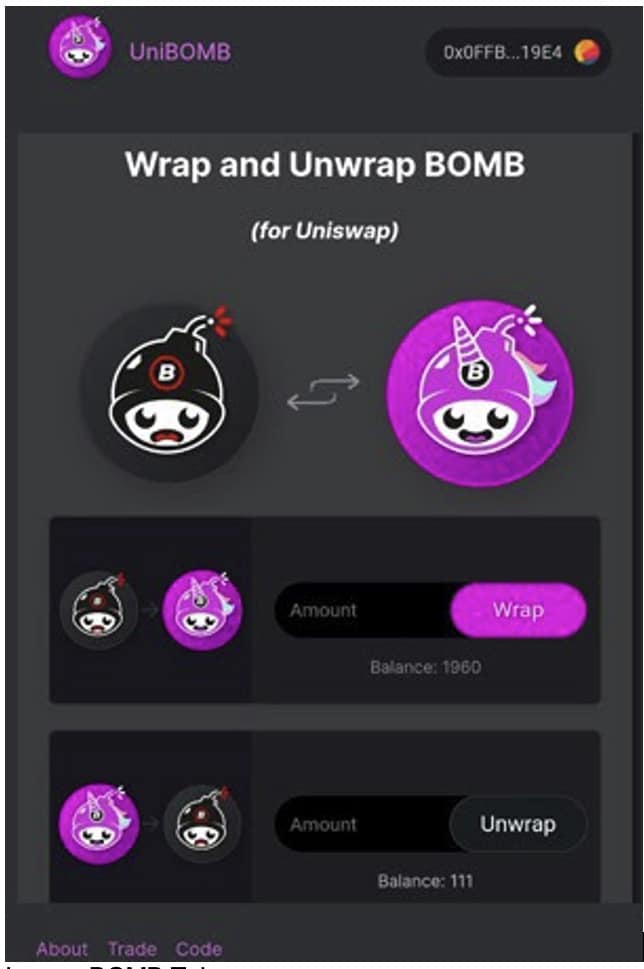
Due to its unique properties, BOMB isn’t directly compatible with most major DeFi applications — despite being built on Ethereum. However, users can wrap their BOMB to a separate token known as Wrapped BOMB (WBOMB) to use it outside the BOMB dApp ecosystem.
Inflation. We all deal with it, but few of us understand just how damaging it is to our finances, or how it erodes the purchasing power of our money over time.
Unlike many cryptocurrencies, which have essentially infinite maximum supply, there will never be more than 21 million bitcoins in existence.
On top of this, it also has a gradually reducing inflation rate, since the amount of Bitcoin minted with each new block halves every 210,000 blocks — or roughly every 4 years.
This is in stark contrast to many regular currencies, which have an ever-expanding circulating supply — an issue that is known to cause purchasing power decline, i.e. meaning you can buy fewer goods and services with the same amount of money over time.
This gradually reducing emission rate is hardcoded into the Bitcoin protocol and ensures that users can always be certain that there will never be any sudden increases in supply — often known as a ‘supply shock’. This isn’t the case with fiat currencies, which can be simply printed as and when deemed necessary by the central bank.
With Bitcoin, the world was introduced to the concept of currency designed for the masses, rather than for the large corporations, who actually benefit from inflation due to the reduction effect it has on their low-interest debts.
Prophecy
You may have already heard of Prophecy because of its massively popular yield farming feature, known as Prophet Pools.
But what you might not know is that Prophecy is also on a path to disrupt the way we think about money by developing an entirely original crypto-economic model with several unique monetary policies aimed at balancing supply with demand.
At the core of Prophecy's economic model is a burning process, which sees PRY tokens burned both chronically and periodically based on a variety of parameters related to network activity and demand — helping to reduce the circulating supply and counter unnecessary inflation.
It also introduces an original consensus mechanism known as Proof of Committed Decay (PoCD), which is used to establish an economic policy that favors the majority rather than the few.
It uses a variety of data sources, such as the staking rate of each epoch, open market interest, available liquidity and volume, and more to determine the economic properties of the Prophecy network.
Unlike regular money, the PRY token is designed to empower the user and maintain or improve its value over time through a contracting supply and reactive economic policies. The result is a sound monetary unit, the PRY token, which is fit to power the financial landscape of the future.
The BOMB Experiment
More of an experiment than an actual attempt at a viable currency, the BOMB token is arguably the most aggressively deflationary cryptocurrency there is.
The concept behind BOMB is simple. At genesis, there was exactly 1 million BOMB in existence. However, with each BOMB transfer, exactly 1% of the number of BOMB sent are burned, permanently removing them from circulation. As a result, a 100 BOMB transfer would leave 99 BOMB in circulation.
As you might imagine, depending on how fast BOMB are transferred, this can lead to a dramatic reduction in the supply over time. As of April 2021, 9% of the maximum supply has already been burned, leaving just 910,000 BOMB in existence.
Now, unlike Bitcoin and Prophecy, BOMB isn’t designed to become a transactional unit. Instead, it simply aims to provide a hedge against economic inflation.
Due to its unique properties, BOMB isn’t directly compatible with most major DeFi applications — despite being built on Ethereum. However, users can wrap their BOMB to a separate token known as Wrapped BOMB (WBOMB) to use it outside the BOMB dApp ecosystem.
Why Winning the Finance Magnates CEO of the Year Award Matters
Featured Videos
FM Daily Brief – 31 July 2026
Today's Friday, the 31st of July 2026, and these are our main stories: IG Group's $1.3 billion acquisition of Underdog, XTB's record-breaking share price, and Dubai's emergence as the retail FX industry's new talent hub.
Today's Thursday, the 30th of July 2026, and these are our main stories: Squared Financial's offshore operations appear to have gone dark, XTB's investment products continue to attract new clients, and Trade Nation outlines its European growth strategy.
FM Daily Brief – 29 July 2026
Today's Wednesday, the 29th of July 2026, and these are our main stories: Cyprus and Poland go head-to-head as CFD licensing hubs, but is there a winner? Mas Markets takes a stake in Solid, and Swissquote UK's losses deepen.
FM Daily Brief – 28 July 2026
Today's Tuesday, the 28th of July 2026, and these are our main stories: tastytrade enters the CFTC regulated prediction markets, Mitrade renews its Argentina football sponsorship, and the Tokyo Stock Exchange pushes to lower the cost of investing.
FM Daily Brief – 27 July 2026
Today's Monday, the 27th of July 2026, and these are our main stories: iFOREX reports stronger client growth despite currency headwinds, BlackBull's New Zealand business expands, and the FCA highlights Consumer Duty good practice.