
As financial markets become increasingly automated, the success of a liquidity desk depends on more than technology alone. It requires a combination of deep market expertise, fresh perspectives, and a culture that encourages knowledge sharing.
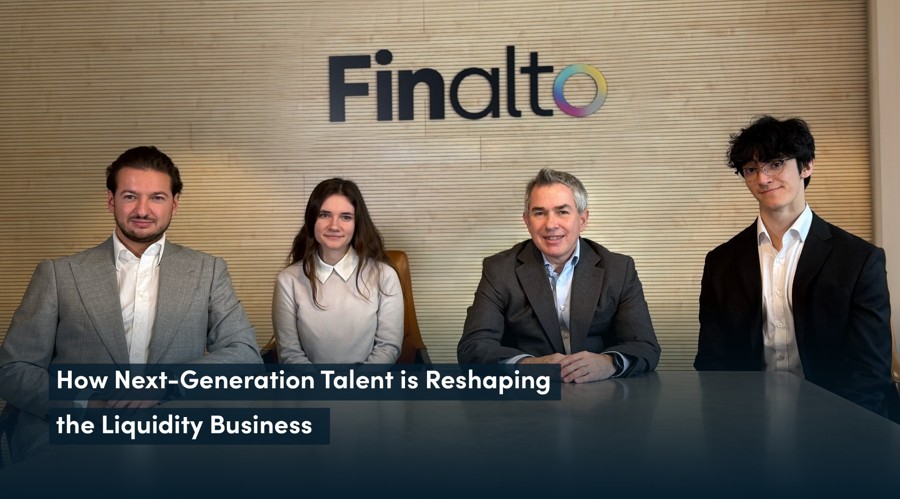
Ahead of Finance Magnates Summit London 2026 (FMS), we spoke with Finalto’s Group Head of Liquidity, Sam Horowitz, and members of his UK team about what defines a modern liquidity operation, why mentorship matters more than ever, and how the next generation of market professionals is shaping the future of institutional trading.
We want to reflect how Finalto is an agile, forward-thinking liquidity powerhouse that sustains its success through a dynamic blend of seasoned expertise and new perspectives.
The Evolution of the Modern Liquidity Desk
Talking to Sam Horowitz, we started by asking:
“You’ve navigated FX market shifts over a 30-year career and have spent the last year actively shaping Finalto’s liquidity and eTrading desk. From that vantage point, what is the biggest thing happening in liquidity provision right now that younger operators might be seeing for the first time?
[SH] Market crises come and go and are invariably powered by some unholy combination of greed, hubris and a profound failure of judgement. But for me the biggest change right now is in the use of AI as a force multiplier in our analytics processes. We’re doing so much more now with equivalent team sizes than even a couple of years ago. New industry entrants right now will increasingly see this as the norm, but for those of us with a slightly longer industry timeline, this definitely feels like revolution not evolution.
What is the most important quality you look for when building a modern liquidity team today compared to 10 years ago?
[SH] For me the most important quality of all hasn’t changed one iota in the 32 years I have been working in, and latterly building and running trading teams, and that’s integrity. In a marketplace where despite a massive increase in the use of data and modern tools, relationships and reputation still have a material effect on outcomes, how you conduct yourself matters.
[SH] Outside of that I think a curious mind and a genuine passion for market microstructure are essential, as is the technical skillset to interact with large datasets using modern tooling.
Which skills will be most valuable for liquidity professionals over the next five years?
[SH] Without question the ability to use modern (largely but not solely AI) tooling to answer increasingly complex business question using both empirical data and modelling. But also, crucially, to distil the answers back down into content able to be consumed by a wide range of ‘ley users’, and to be able to translate a theory and a model into a practical business focused solution. Frankly that’s a skillset that could be described as ‘evergreen’ as far as I am concerned.
Panel Teaser: could you give us a preview of the topics that you will address during the panel at FMS?
[SH] Well the panel title is “Be the Bank? Prime-of-Prime vs Direct Institutional Access” and essentially in a bit of a departure from the liquidity panel that normally we’d see at these events, we’re attempting in 40 minutes to unpick the question of what larger and more sophisticated retail brokers should be looking to do in terms of taking ownership of their liquidity. As a firm who value and continue to service the broker community, naturally we at Finalto have the view that we are a high quality and capital efficient way to access the wider market. Larger firms are increasingly looking to connect more directly with bulge bracket liquidity partners, and when they do so, have varying degrees of success and happiness in managing the infrastructure required to do this. There’s a lot of ground to cover here but I’ll attempt, along with my fellow panellists, to give some colour on what that looks like and how to go about considering the decision itself.
What misconceptions do younger professionals often have about liquidity when they first enter the industry?
[SH] That all the work is glamorous (when in reality we all spend time doing things that are intellectually more basic and less challenging than our academic training has prepared us for).
[SH] That only the larger institutions can offer a workplace and a job that requires intellectual rigour and where you can do meaningful work.
[SH] That physically being present and building a network is only a nice to have. To my mind even now it is an absolutely crucial part of navigating your career path. For my team I have encouraged them all to join the ACI’s Next Generation community in order to give them an intro to like-minded people in the industry and a seat at the table in shaping how our markets evolve.
For people mulling a career switch to eTrading and Liquidity Management, what would the skillset and profile need to look like to catch the eye of the hiring manager at a firm like Finalto?
[SH] Certainly all of the above. Interpersonal skills are hard to teach and to be honest sometimes hard to reliably hire for, but they’re a big part of the role still. In addition, ready-made skills in manipulating HFT datasets are core to our day-to-day here. Everyone codes, even me.
[SH] We run our analytics stack on a mixture of KDB, Python and SQL at Finalto, with dashboards in a mixture of Streamlit and Databricks, and all the recent hires had a coding and analytic test as part of the recruitment process.
[SH] It is a very different onboarding journey than would have been the case even 5-10 years ago (and certainly unrecognisable from my own route into the industry in the early 1990s). The setup at Finalto is much more akin to that you would see at a medium sized market making bank than a traditional broker, and the skillsets required to thrive here look increasingly similar.
The Next Generation in Action: How Under-30 Talent is Reshaping B2B Trading

Young professionals are the catalyst for innovation. Modern fintech firms bring together experienced market practitioners and technology-driven talent.
Today’s liquidity desks require a different skillset than they did a decade ago. Alongside market knowledge, firms increasingly seek expertise in data analysis, automation and technology-driven decision-making. As a result, a new generation of professionals is bringing fresh perspectives to institutional trading environments.
Where Experience and Innovation Meet
While technology continues to transform institutional trading, the most successful liquidity desks are those that combine innovation with experience. Understanding how younger market professionals approach data, automation and execution is becoming increasingly important for firms seeking a competitive edge.
As part of Finalto’s global liquidity team led by Sam Horowitz, we were in touch with Ulysse Sarron (UK / EU Liquidity Manager) and the team’s latest hires Daniel Paddock and Jeanne Gauthier
Ulysse Sarron, Finalto’s UK / EU Liquidity Manager

Having progressed within the industry, how do you see the role of liquidity management evolving over the next five years?
[US] I expect liquidity management to become increasingly proactive as desks develop a more sophisticated understanding of the data available to them. Across asset classes, understanding how client flow responds to market conditions gives us a stronger foundation for pricing and liquidity decisions.
Machine learning will play a greater role in identifying the relationships between flow, volatility and execution quality. Models could help forecast demand, detect changes in order book imbalance, and assess how consistently providers perform across different order sizes and market conditions. These insights should allow desks to make more informed decisions about their liquidity mix and pricing arrangements. The more demanding question is how well those models adapt when market behaviour changes.
I also see a practical role for agentic AI. An agent could quickly identify a deterioration in execution, investigate the underlying data and propose a course of action. Over time, I would expect some routine adjustments to take place within approved limits, with closer human oversight of decisions that materially affect pricing and execution.
This will place greater demands on liquidity managers. We will need to understand how these systems arrive at their conclusions, recognise their limitations and assess whether a proposed action makes commercial sense.
How do data and automation influence decision-making on today’s liquidity desks?
[US] They inform a substantial part of our work by allowing us to understand activity across the desk much more quickly and in greater detail.
Machine learning models can identify patterns in client activity. It can also detect changes in trading patterns that would be difficult to identify through manual analysis alone. That provides valuable context for managing flow and monitoring pricing from liquidity providers.
When assessing providers, quoted spreads are only part of the picture. We need to understand how competitive their pricing is at the sizes clients trade, how reliably those prices translate into successful execution, and how performance changes during periods of volatility. Examining spreads alongside fill rates, rejections, response times, slippage and other metrics gives us a more complete assessment. Machine learning can help identify the combinations of conditions under which a provider’s performance strengthens or deteriorates.
Automation brings that analysis into the daily workflow. Targeted alerts can identify deviations from expected performance, helping the desk prioritise investigations and hold more precise, evidence-based discussions with liquidity providers.
What qualities define high-performing liquidity professionals today?
[US] Proactivity is essential. Markets move quickly, and an approach that worked well yesterday may need revisiting today. That is particularly relevant when managing liquidity across asset classes with different trading patterns and sensitivities.
The strongest professionals combine curiosity with the discipline to follow an issue through. They notice changes, question unexpected results and take responsibility for understanding what is happening. Composure under pressure and clear communication are equally valuable, both within the business and in discussions with liquidity providers.
Effective monitoring supports all of this. Automated reports and alerts help us maintain oversight of a complex trading environment, while judgement determines which developments require attention and how urgently we should respond. For me, the ability to recognise a developing issue, take ownership and act early consistently contributes to better outcomes.
What’s the most valuable lesson you’ve learned from senior leaders?
[US] One lesson that has stayed with me is the importance of investing in relationships with liquidity providers. Those relationships are built through regular dialogue, honest feedback and an understanding of each other’s business. You need to be able to discuss the characteristics of the flow, explain what you are observing and consider the provider’s perspective.
That foundation becomes especially valuable when markets are volatile or execution quality changes. An established relationship allows for a more candid and productive conversation, making it easier to understand the issue and work towards a solution. Pricing matters, of course, alongside consistency, trust and the ability to work constructively together as conditions evolve.
You are speaking at the ACI Next Gen curated roundtable at FMSL, focusing on the views of the industry’s future leadership group. What do you expect to come out of that session?
[US] I expect AI and machine learning to feature prominently, particularly their practical application in our daily work. I am interested in hearing where people are finding measurable value, what has proved difficult to implement and how they are assessing the results.
I would also like the discussion to address how we develop the next generation of liquidity and trading professionals. As more tasks become automated, we need to consider how people acquire market experience, develop independent judgement and learn to manage relationships. Those capabilities deserve as much attention as technical proficiency.
For me, the value of the roundtable lies in bringing together people who face similar challenges from different perspectives. I hope we leave with practical ideas we can apply on our desks, a clearer understanding of the skills our industry will need, and relationships that allow the conversation to continue beyond the event.
Daniel Paddock and Jeanne Gauthier, Finalto’s Junior Liquidity and E-Trading Analysts


How did your technical data skills bring you to an institutional liquidity desk?
[DP] My route combined a computing BSc degree, a year working in financial crime data analysis, and an MSc in Computational Finance, where I brought programming and financial mathematics together through projects including a machine-learning options-pricing thesis. My interest in markets actually began with prediction markets: I was fascinated by how prices capture information and started building small projects to explore pricing inefficiencies. That curiosity eventually led me towards the MSc, and ultimately Finalto, where I now get to apply my technical skills to live market problems.
[JG] My studies in Mathematics and Finance at Imperial College London, along with my internships, gave me a strong foundation in statistics and data analysis. At Finalto, I apply these skills to understanding client flow, liquidity and execution quality.
How has working on a live liquidity desk challenged what you learned academically?
[DP] In education, problems generally come with a defined question, the necessary data, and a solution to work towards. On a real liquidity desk, deciding how to even frame the problem is a new significant part of the challenge. I have access to more real-world data than before – which for me feels like being a kid in a candy shop – but there are still questions that more data alone do not answer. This has taught me how much context, judgement and experience matter alongside the technical analysis.
[JG] On a live liquidity desk, context and client relationships matter, and you adapt your approach depending on the client.
Which emerging technologies will have the greatest impact on institutional trading?
[DP] For me, the obvious answer is AI, because of how much it is accelerating the move from an idea to a working prototype. In my own work, it gives me much more room to focus on the problem, the logic and the assumptions, and can help me turn an idea in the morning into something I can test later that day. I expect that shorter development cycles will make a significant difference to how quickly teams explore quantitative models and respond to new problems, with careful validation now carrying even more weight than before.
[JG] AI, particularly LLMs, could have a significant impact by using/ recalling relevant context to automate tasks.
How has working alongside experienced market practitioners shaped your own approach?
[DP] Working alongside experienced practitioners has taught me to take a step back before diving into the task: a piece of market context or a different interpretation can turn what looks to be complicated analysis into a much simpler approach. I now put much more emphasis on making my methodology – and especially my assumptions – clear and explainable. That allows me to bring my colleagues’ experience into the process earlier, helping me build better solutions.
[JG] Working with experienced colleagues has helped me better understand the context and how to adapt my approach to different clients.
Want to continue the conversation? Watch Sam at his FMSL panel session on 24 November (” Be the Bank? Prime-of-Prime vs Direct Institutional Access “) and visit the Finalto team at Booth 09 to discuss the future of liquidity, market structure and talent development in institutional trading.
All opinions, news, research, analysis, prices or other information is provided as general market commentary and not as investment advice, and all potential results discussed are not guaranteed to be achieved. The information may have been derived from publicly available sources, company reports, personal research, or surveys. Past performance is not indicative of future performance. Trading carries risk of capital loss. Service available to professional clients only.


