The yellow metal has rebounded quickly to continue with the rally that extends back to the start of last year.
FM
The coronavirus pandemic has ravaged global financial markets leaving some businesses scrambling for scraps. This has essentially affected stock prices from across the globe with all the leading indices plunging before performing a convincing rebound in subsequent months since March.
The increased market uncertainty has led many to diversify their investments to traditional safe-haven assets like Gold (GC=F), which has since hit a new all-time high.
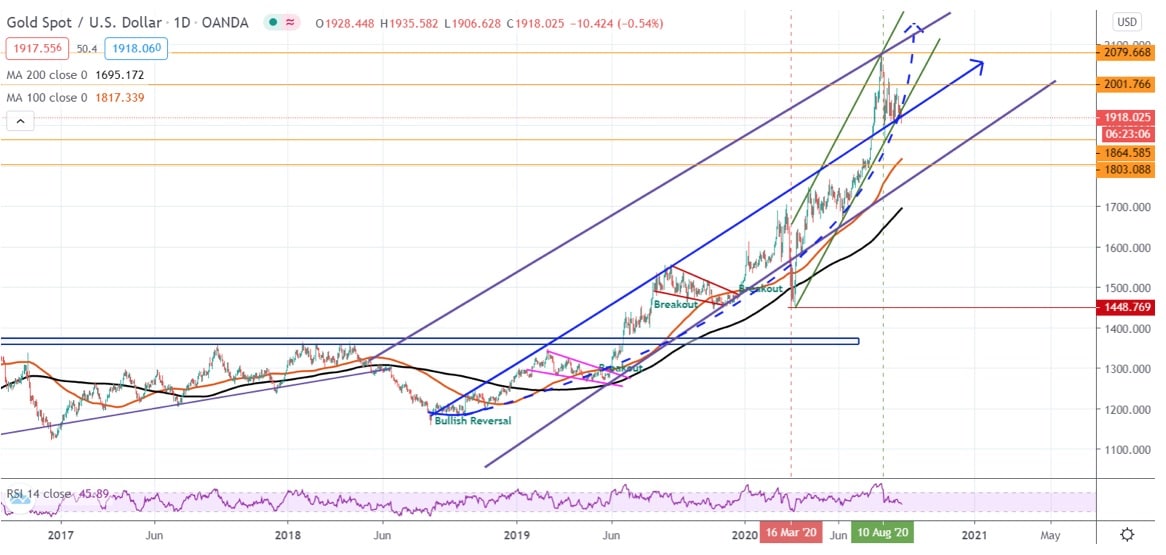
The price of the yellow metal added more than $620 to its price per ounce or 43% between March 16 and Aug. 10 to hit a new historical high of $2,061. It has since pulled back to settle at around $1,920 as bulls moved in to cash on profits.
Unlike other assets such as the S&P 500 Index (^GSPC), Alphabet, Inc. (NASDAQ:GOOG) (NASDAQ:GOOGL) and Facebook, Inc. (NASDAQ:FB), etc, which plunged to new 12-month-plus lows before recovering in the last few months, gold only experienced a short-term pullback.
The yellow metal then rebounded quickly to continue with the rally that extends back to the start of last year. This demonstrates how resilient the value of the yellow metal can be even during a financial crisis.
Bitcoin, not a safe-haven quite yet
Bitcoin (BTC-USD) is another asset that seems to be getting the attention of a specific class of investors. The pioneer cryptocurrency is quickly gaining popularity as an alternative safe-haven asset within the millennials.
Young investors see bitcoin as the currency of the future potentially replacing the US dollar. The finite nature of bitcoin makes it scarce unlike the greenback, which can be printed to roll out another round of quantitative easing to ease the stress on the economy.
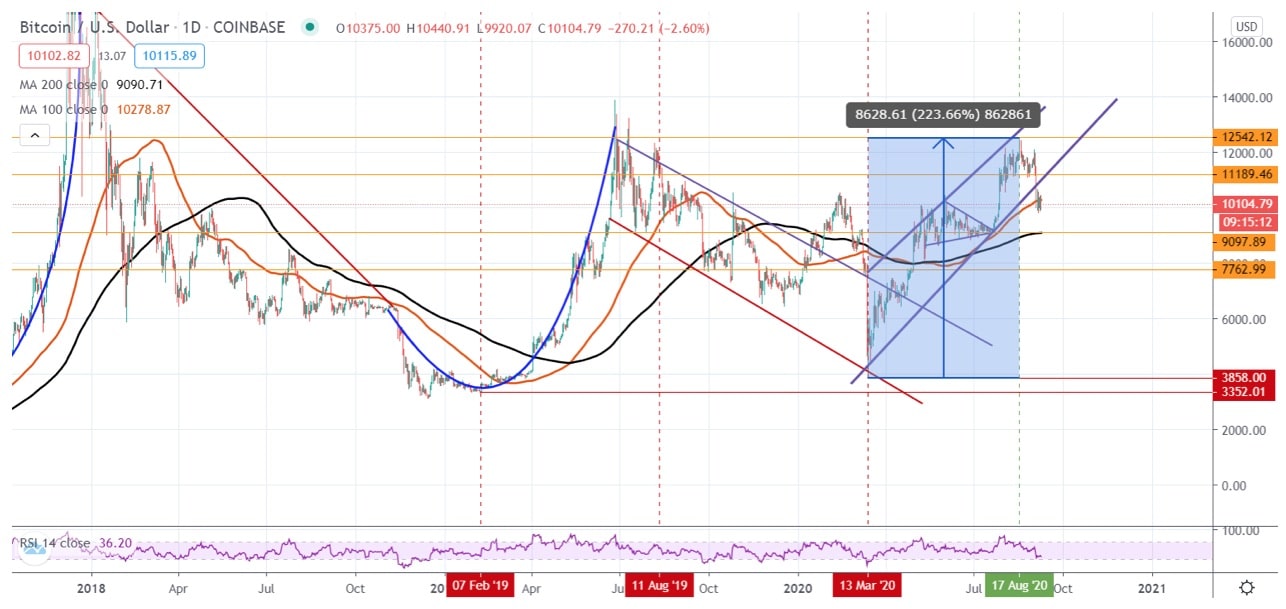
However, as demonstrated in the chart below, bitcoin suffered just as much as the US stock market. The price of the world’s most popular cryptocurrency plunged to hit a new 11-month low of about $3,858 before rallying to hit a new 12-month high of about $12,542 on Aug. 17. That represents a gain of more than 223% in the space of just five months.
Gold-backed tokens an opportunity for retail investors
However, the cryptocurrency market has established ways to capitalize on the stability of the gold price and its resilience during a financial crisis.
Cryptocurrency startups have launched gold-backed coins, which are backed by real gold stored with certified gold wholesalers. Some of the popular players in this segment of the cryptocurrency market include Perth Mint’s Gold Token (PMGT), Tether Gold (XAUT), and Paxos Global’s PAX Gold (PAXG).
While PAX Gold is the most closely correlated with the spot gold price (as one would expect) it is still not very well correlated, showing a correlation of only 26%.
Nonetheless, the emergence of CACHE Gold (CGT) appears to be solving this problem. The fully-redeemable gold-backed token allows retail investors to invest in physical gold at the lowest premium possible of about +2% or -2% when buying or selling, respectively.
This is statistically the lowest premium among highly liquid gold tokens. CACHE Gold also allows retail investors to buy or sell in quantities of as little as $10.00 worth.
As of this writing, Apmex a major retailer based in the US has an ounce of Gold American Eagle trading at about $2,027, which reflects a premium of about 5.5% on the current gold spot price of $1,920.
While Tether Gold is deemed to have better offers sometimes, it tends to fluctuate a lot since its only available in one exchange, where it is thinly traded.
Ideally, gold-backed tokens have each token backed by an allocated amount of physical gold, a fraction an ounce for each token. This is what allows crypto investors to invest quantities as little as $10.00 worth in gold without having to pay the full value of an ounce.
This concept brings a specific class of investors to the market that would have otherwise missed out because of a lack of enough capital to diversify their investments.
Gold token price correlation to gold spot price
One of the few challenges that the gold-backed crypto market is facing is the price correlation between the gold token and the actual price of gold.
This tweet from crypto trading expert Demelza Hays @CryptoPhD back in May shows Chainlink having the best correlation to gold compared to other gold tokens. The correlation factors in the price of the selected gold coin to that of the daily gold spot price from 2019 through April this year.
Scary that @PaxosGlobal gold token not very correlated with gold... How is the Perth Mint Gold token doing? @pmgoldtoken.
On the other hand, Paxos’ PAX Gold seems to be way off the mark as pointed out in the tweet. The data was collected over a long period and it has been nearly four months since it was compiled.
A lot might have changed already, especially with the emergence of CACHE Gold.
Conclusion
In summary, the global financial market is far from full recovery following the adverse economic effects of the coronavirus pandemic.
While markets led by the S&P 500 index appear to have recovered from the mid-March plunge, analysts indicate that the current rally may be driven by speculation and the actions of the US Federal Reserve.
As such, it is not too late to diversify investments, especially given the fears of a potential second wave of COVID-19. Gold is the ideal vehicle for those looking for safe-haven investments.
And now, with gold-backed tokens, retail investors can also hedge their cryptocurrency investments by investing in tokens tethered to physical gold.
The coronavirus pandemic has ravaged global financial markets leaving some businesses scrambling for scraps. This has essentially affected stock prices from across the globe with all the leading indices plunging before performing a convincing rebound in subsequent months since March.
The increased market uncertainty has led many to diversify their investments to traditional safe-haven assets like Gold (GC=F), which has since hit a new all-time high.
The price of the yellow metal added more than $620 to its price per ounce or 43% between March 16 and Aug. 10 to hit a new historical high of $2,061. It has since pulled back to settle at around $1,920 as bulls moved in to cash on profits.
Unlike other assets such as the S&P 500 Index (^GSPC), Alphabet, Inc. (NASDAQ:GOOG) (NASDAQ:GOOGL) and Facebook, Inc. (NASDAQ:FB), etc, which plunged to new 12-month-plus lows before recovering in the last few months, gold only experienced a short-term pullback.
The yellow metal then rebounded quickly to continue with the rally that extends back to the start of last year. This demonstrates how resilient the value of the yellow metal can be even during a financial crisis.
Bitcoin, not a safe-haven quite yet
Bitcoin (BTC-USD) is another asset that seems to be getting the attention of a specific class of investors. The pioneer cryptocurrency is quickly gaining popularity as an alternative safe-haven asset within the millennials.
Young investors see bitcoin as the currency of the future potentially replacing the US dollar. The finite nature of bitcoin makes it scarce unlike the greenback, which can be printed to roll out another round of quantitative easing to ease the stress on the economy.
However, as demonstrated in the chart below, bitcoin suffered just as much as the US stock market. The price of the world’s most popular cryptocurrency plunged to hit a new 11-month low of about $3,858 before rallying to hit a new 12-month high of about $12,542 on Aug. 17. That represents a gain of more than 223% in the space of just five months.
Gold-backed tokens an opportunity for retail investors
However, the cryptocurrency market has established ways to capitalize on the stability of the gold price and its resilience during a financial crisis.
Cryptocurrency startups have launched gold-backed coins, which are backed by real gold stored with certified gold wholesalers. Some of the popular players in this segment of the cryptocurrency market include Perth Mint’s Gold Token (PMGT), Tether Gold (XAUT), and Paxos Global’s PAX Gold (PAXG).
While PAX Gold is the most closely correlated with the spot gold price (as one would expect) it is still not very well correlated, showing a correlation of only 26%.
Nonetheless, the emergence of CACHE Gold (CGT) appears to be solving this problem. The fully-redeemable gold-backed token allows retail investors to invest in physical gold at the lowest premium possible of about +2% or -2% when buying or selling, respectively.
This is statistically the lowest premium among highly liquid gold tokens. CACHE Gold also allows retail investors to buy or sell in quantities of as little as $10.00 worth.
As of this writing, Apmex a major retailer based in the US has an ounce of Gold American Eagle trading at about $2,027, which reflects a premium of about 5.5% on the current gold spot price of $1,920.
While Tether Gold is deemed to have better offers sometimes, it tends to fluctuate a lot since its only available in one exchange, where it is thinly traded.
Ideally, gold-backed tokens have each token backed by an allocated amount of physical gold, a fraction an ounce for each token. This is what allows crypto investors to invest quantities as little as $10.00 worth in gold without having to pay the full value of an ounce.
This concept brings a specific class of investors to the market that would have otherwise missed out because of a lack of enough capital to diversify their investments.
Gold token price correlation to gold spot price
One of the few challenges that the gold-backed crypto market is facing is the price correlation between the gold token and the actual price of gold.
This tweet from crypto trading expert Demelza Hays @CryptoPhD back in May shows Chainlink having the best correlation to gold compared to other gold tokens. The correlation factors in the price of the selected gold coin to that of the daily gold spot price from 2019 through April this year.
Scary that @PaxosGlobal gold token not very correlated with gold... How is the Perth Mint Gold token doing? @pmgoldtoken.
On the other hand, Paxos’ PAX Gold seems to be way off the mark as pointed out in the tweet. The data was collected over a long period and it has been nearly four months since it was compiled.
A lot might have changed already, especially with the emergence of CACHE Gold.
Conclusion
In summary, the global financial market is far from full recovery following the adverse economic effects of the coronavirus pandemic.
While markets led by the S&P 500 index appear to have recovered from the mid-March plunge, analysts indicate that the current rally may be driven by speculation and the actions of the US Federal Reserve.
As such, it is not too late to diversify investments, especially given the fears of a potential second wave of COVID-19. Gold is the ideal vehicle for those looking for safe-haven investments.
And now, with gold-backed tokens, retail investors can also hedge their cryptocurrency investments by investing in tokens tethered to physical gold.
FP Markets Winner Spotlight 🏆 | Global Broker of the Year 2025 #Trading #Broker #Innovation #Shorts
FP Markets Winner Spotlight 🏆 | Global Broker of the Year 2025 #Trading #Broker #Innovation #Shorts
FP Markets Winner Spotlight 🏆 | Global Broker of the Year 2025 #Trading #Broker #Innovation #Shorts
FP Markets Winner Spotlight 🏆 | Global Broker of the Year 2025 #Trading #Broker #Innovation #Shorts
FP Markets takes the spotlight as Global Broker of the Year 2025 at the Finance Magnates Awards.
Martin Stoilov, Head of Client Experience, shares that trust, innovation, and people played a key role in the company’s success, supported by a strong foundation of integrity and client-centricity.
Following this milestone, FP Markets continues to focus on growth, technology investment, and its core values of transparency and excellence.
👉 Be part of FM Awards 2026: https://awards.financemagnates.com/#nominate
FP Markets takes the spotlight as Global Broker of the Year 2025 at the Finance Magnates Awards.
Martin Stoilov, Head of Client Experience, shares that trust, innovation, and people played a key role in the company’s success, supported by a strong foundation of integrity and client-centricity.
Following this milestone, FP Markets continues to focus on growth, technology investment, and its core values of transparency and excellence.
👉 Be part of FM Awards 2026: https://awards.financemagnates.com/#nominate
FP Markets takes the spotlight as Global Broker of the Year 2025 at the Finance Magnates Awards.
Martin Stoilov, Head of Client Experience, shares that trust, innovation, and people played a key role in the company’s success, supported by a strong foundation of integrity and client-centricity.
Following this milestone, FP Markets continues to focus on growth, technology investment, and its core values of transparency and excellence.
👉 Be part of FM Awards 2026: https://awards.financemagnates.com/#nominate
FP Markets takes the spotlight as Global Broker of the Year 2025 at the Finance Magnates Awards.
Martin Stoilov, Head of Client Experience, shares that trust, innovation, and people played a key role in the company’s success, supported by a strong foundation of integrity and client-centricity.
Following this milestone, FP Markets continues to focus on growth, technology investment, and its core values of transparency and excellence.
👉 Be part of FM Awards 2026: https://awards.financemagnates.com/#nominate
In this video, we review @HolaPrimeMarketsOfficial, a multi-asset forex and CFDs broker offering different account types, trading platforms, and flexible trading conditions.
We cover the broker’s overall offering, including account options, trading environment, platforms like MT4 and MT5, and additional services such as managed accounts and fast withdrawals.
Watch the full video to see if Hola Prime Markets fits your trading needs.
📣 Stay up to date with the latest in finance and trading. Follow Finance Magnates for industry news, insights, and global event coverage.
Connect with us:
🔗 LinkedIn: /financemagnates
👍 Facebook: /financemagnates
📸 Instagram: https://www.instagram.com/financemagnates
🐦 X: https://x.com/financemagnates
🎥 TikTok: https://www.tiktok.com/tag/financemagnates
▶️ YouTube: /@financemagnates_official
#HolaPrime #ForexBroker #CFDTrading #FinanceMagnates #Trading #Forex #BrokerReview
In this video, we review @HolaPrimeMarketsOfficial, a multi-asset forex and CFDs broker offering different account types, trading platforms, and flexible trading conditions.
We cover the broker’s overall offering, including account options, trading environment, platforms like MT4 and MT5, and additional services such as managed accounts and fast withdrawals.
Watch the full video to see if Hola Prime Markets fits your trading needs.
📣 Stay up to date with the latest in finance and trading. Follow Finance Magnates for industry news, insights, and global event coverage.
Connect with us:
🔗 LinkedIn: /financemagnates
👍 Facebook: /financemagnates
📸 Instagram: https://www.instagram.com/financemagnates
🐦 X: https://x.com/financemagnates
🎥 TikTok: https://www.tiktok.com/tag/financemagnates
▶️ YouTube: /@financemagnates_official
#HolaPrime #ForexBroker #CFDTrading #FinanceMagnates #Trading #Forex #BrokerReview
In this video, we review @HolaPrimeMarketsOfficial, a multi-asset forex and CFDs broker offering different account types, trading platforms, and flexible trading conditions.
We cover the broker’s overall offering, including account options, trading environment, platforms like MT4 and MT5, and additional services such as managed accounts and fast withdrawals.
Watch the full video to see if Hola Prime Markets fits your trading needs.
📣 Stay up to date with the latest in finance and trading. Follow Finance Magnates for industry news, insights, and global event coverage.
Connect with us:
🔗 LinkedIn: /financemagnates
👍 Facebook: /financemagnates
📸 Instagram: https://www.instagram.com/financemagnates
🐦 X: https://x.com/financemagnates
🎥 TikTok: https://www.tiktok.com/tag/financemagnates
▶️ YouTube: /@financemagnates_official
#HolaPrime #ForexBroker #CFDTrading #FinanceMagnates #Trading #Forex #BrokerReview
In this video, we review @HolaPrimeMarketsOfficial, a multi-asset forex and CFDs broker offering different account types, trading platforms, and flexible trading conditions.
We cover the broker’s overall offering, including account options, trading environment, platforms like MT4 and MT5, and additional services such as managed accounts and fast withdrawals.
Watch the full video to see if Hola Prime Markets fits your trading needs.
📣 Stay up to date with the latest in finance and trading. Follow Finance Magnates for industry news, insights, and global event coverage.
Connect with us:
🔗 LinkedIn: /financemagnates
👍 Facebook: /financemagnates
📸 Instagram: https://www.instagram.com/financemagnates
🐦 X: https://x.com/financemagnates
🎥 TikTok: https://www.tiktok.com/tag/financemagnates
▶️ YouTube: /@financemagnates_official
#HolaPrime #ForexBroker #CFDTrading #FinanceMagnates #Trading #Forex #BrokerReview
In this video, we review @HolaPrimeMarketsOfficial, a multi-asset forex and CFDs broker offering different account types, trading platforms, and flexible trading conditions.
We cover the broker’s overall offering, including account options, trading environment, platforms like MT4 and MT5, and additional services such as managed accounts and fast withdrawals.
Watch the full video to see if Hola Prime Markets fits your trading needs.
📣 Stay up to date with the latest in finance and trading. Follow Finance Magnates for industry news, insights, and global event coverage.
Connect with us:
🔗 LinkedIn: /financemagnates
👍 Facebook: /financemagnates
📸 Instagram: https://www.instagram.com/financemagnates
🐦 X: https://x.com/financemagnates
🎥 TikTok: https://www.tiktok.com/tag/financemagnates
▶️ YouTube: /@financemagnates_official
#HolaPrime #ForexBroker #CFDTrading #FinanceMagnates #Trading #Forex #BrokerReview
In this video, we review @HolaPrimeMarketsOfficial, a multi-asset forex and CFDs broker offering different account types, trading platforms, and flexible trading conditions.
We cover the broker’s overall offering, including account options, trading environment, platforms like MT4 and MT5, and additional services such as managed accounts and fast withdrawals.
Watch the full video to see if Hola Prime Markets fits your trading needs.
📣 Stay up to date with the latest in finance and trading. Follow Finance Magnates for industry news, insights, and global event coverage.
Connect with us:
🔗 LinkedIn: /financemagnates
👍 Facebook: /financemagnates
📸 Instagram: https://www.instagram.com/financemagnates
🐦 X: https://x.com/financemagnates
🎥 TikTok: https://www.tiktok.com/tag/financemagnates
▶️ YouTube: /@financemagnates_official
#HolaPrime #ForexBroker #CFDTrading #FinanceMagnates #Trading #Forex #BrokerReview
Hola Prime Review: What You Need to Know | Full Breakdown by Finance Magnates
Hola Prime Review: What You Need to Know | Full Breakdown by Finance Magnates
Hola Prime Review: What You Need to Know | Full Breakdown by Finance Magnates
Hola Prime Review: What You Need to Know | Full Breakdown by Finance Magnates
Hola Prime Review: What You Need to Know | Full Breakdown by Finance Magnates
Hola Prime Review: What You Need to Know | Full Breakdown by Finance Magnates
In this video, we review @HolaPrime_Global, a proprietary trading firm offering evaluation programs and performance-based payouts in simulated market environments.
We cover how the challenge model works, including account types, profit splits (up to 95%), trading rules, and what it takes to reach a funded account. You’ll also learn about available platforms like MT4, MT5, cTrader, and more, along with insights into payouts, support, and trading conditions.
Watch the full video to see if Hola Prime fits your trading style.
📣 Stay up to date with the latest in finance and trading. Follow Finance Magnates for industry news, insights, and global event coverage.
Connect with us:
🔗 LinkedIn: /financemagnates
👍 Facebook: /financemagnates
📸 Instagram: https://www.instagram.com/financemagnates
🐦 X: https://x.com/financemagnates
🎥 TikTok: https://www.tiktok.com/tag/financemagnates
▶️ YouTube: /@financemagnates_official
#HolaPrime #PropFirm #Trading #FinanceMagnates #Forex #FuturesTrading #TradingReview #PropFirmReview
In this video, we review @HolaPrime_Global, a proprietary trading firm offering evaluation programs and performance-based payouts in simulated market environments.
We cover how the challenge model works, including account types, profit splits (up to 95%), trading rules, and what it takes to reach a funded account. You’ll also learn about available platforms like MT4, MT5, cTrader, and more, along with insights into payouts, support, and trading conditions.
Watch the full video to see if Hola Prime fits your trading style.
📣 Stay up to date with the latest in finance and trading. Follow Finance Magnates for industry news, insights, and global event coverage.
Connect with us:
🔗 LinkedIn: /financemagnates
👍 Facebook: /financemagnates
📸 Instagram: https://www.instagram.com/financemagnates
🐦 X: https://x.com/financemagnates
🎥 TikTok: https://www.tiktok.com/tag/financemagnates
▶️ YouTube: /@financemagnates_official
#HolaPrime #PropFirm #Trading #FinanceMagnates #Forex #FuturesTrading #TradingReview #PropFirmReview
In this video, we review @HolaPrime_Global, a proprietary trading firm offering evaluation programs and performance-based payouts in simulated market environments.
We cover how the challenge model works, including account types, profit splits (up to 95%), trading rules, and what it takes to reach a funded account. You’ll also learn about available platforms like MT4, MT5, cTrader, and more, along with insights into payouts, support, and trading conditions.
Watch the full video to see if Hola Prime fits your trading style.
📣 Stay up to date with the latest in finance and trading. Follow Finance Magnates for industry news, insights, and global event coverage.
Connect with us:
🔗 LinkedIn: /financemagnates
👍 Facebook: /financemagnates
📸 Instagram: https://www.instagram.com/financemagnates
🐦 X: https://x.com/financemagnates
🎥 TikTok: https://www.tiktok.com/tag/financemagnates
▶️ YouTube: /@financemagnates_official
#HolaPrime #PropFirm #Trading #FinanceMagnates #Forex #FuturesTrading #TradingReview #PropFirmReview
In this video, we review @HolaPrime_Global, a proprietary trading firm offering evaluation programs and performance-based payouts in simulated market environments.
We cover how the challenge model works, including account types, profit splits (up to 95%), trading rules, and what it takes to reach a funded account. You’ll also learn about available platforms like MT4, MT5, cTrader, and more, along with insights into payouts, support, and trading conditions.
Watch the full video to see if Hola Prime fits your trading style.
📣 Stay up to date with the latest in finance and trading. Follow Finance Magnates for industry news, insights, and global event coverage.
Connect with us:
🔗 LinkedIn: /financemagnates
👍 Facebook: /financemagnates
📸 Instagram: https://www.instagram.com/financemagnates
🐦 X: https://x.com/financemagnates
🎥 TikTok: https://www.tiktok.com/tag/financemagnates
▶️ YouTube: /@financemagnates_official
#HolaPrime #PropFirm #Trading #FinanceMagnates #Forex #FuturesTrading #TradingReview #PropFirmReview
In this video, we review @HolaPrime_Global, a proprietary trading firm offering evaluation programs and performance-based payouts in simulated market environments.
We cover how the challenge model works, including account types, profit splits (up to 95%), trading rules, and what it takes to reach a funded account. You’ll also learn about available platforms like MT4, MT5, cTrader, and more, along with insights into payouts, support, and trading conditions.
Watch the full video to see if Hola Prime fits your trading style.
📣 Stay up to date with the latest in finance and trading. Follow Finance Magnates for industry news, insights, and global event coverage.
Connect with us:
🔗 LinkedIn: /financemagnates
👍 Facebook: /financemagnates
📸 Instagram: https://www.instagram.com/financemagnates
🐦 X: https://x.com/financemagnates
🎥 TikTok: https://www.tiktok.com/tag/financemagnates
▶️ YouTube: /@financemagnates_official
#HolaPrime #PropFirm #Trading #FinanceMagnates #Forex #FuturesTrading #TradingReview #PropFirmReview
In this video, we review @HolaPrime_Global, a proprietary trading firm offering evaluation programs and performance-based payouts in simulated market environments.
We cover how the challenge model works, including account types, profit splits (up to 95%), trading rules, and what it takes to reach a funded account. You’ll also learn about available platforms like MT4, MT5, cTrader, and more, along with insights into payouts, support, and trading conditions.
Watch the full video to see if Hola Prime fits your trading style.
📣 Stay up to date with the latest in finance and trading. Follow Finance Magnates for industry news, insights, and global event coverage.
Connect with us:
🔗 LinkedIn: /financemagnates
👍 Facebook: /financemagnates
📸 Instagram: https://www.instagram.com/financemagnates
🐦 X: https://x.com/financemagnates
🎥 TikTok: https://www.tiktok.com/tag/financemagnates
▶️ YouTube: /@financemagnates_official
#HolaPrime #PropFirm #Trading #FinanceMagnates #Forex #FuturesTrading #TradingReview #PropFirmReview
Axi Winner Spotlight 🏆 | Global Most Innovative Broker 2025 #Innovation #Trading #Fintech #Broker
Axi Winner Spotlight 🏆 | Global Most Innovative Broker 2025 #Innovation #Trading #Fintech #Broker
Axi Winner Spotlight 🏆 | Global Most Innovative Broker 2025 #Innovation #Trading #Fintech #Broker
Axi Winner Spotlight 🏆 | Global Most Innovative Broker 2025 #Innovation #Trading #Fintech #Broker
Axi Winner Spotlight 🏆 | Global Most Innovative Broker 2025 #Innovation #Trading #Fintech #Broker
Axi Winner Spotlight 🏆 | Global Most Innovative Broker 2025 #Innovation #Trading #Fintech #Broker
Axi takes the spotlight at the Finance Magnates Awards, winning Global Most Innovative Broker 2025.
Olivia Xenofontos and Ivanna Openko share how the team will feel: proud, motivated, and ready to keep delivering.
They also describe the night as well-organized, focused, and enjoyable for all.
👉 Be part of FM Awards 2026.
Axi takes the spotlight at the Finance Magnates Awards, winning Global Most Innovative Broker 2025.
Olivia Xenofontos and Ivanna Openko share how the team will feel: proud, motivated, and ready to keep delivering.
They also describe the night as well-organized, focused, and enjoyable for all.
👉 Be part of FM Awards 2026.
Axi takes the spotlight at the Finance Magnates Awards, winning Global Most Innovative Broker 2025.
Olivia Xenofontos and Ivanna Openko share how the team will feel: proud, motivated, and ready to keep delivering.
They also describe the night as well-organized, focused, and enjoyable for all.
👉 Be part of FM Awards 2026.
Axi takes the spotlight at the Finance Magnates Awards, winning Global Most Innovative Broker 2025.
Olivia Xenofontos and Ivanna Openko share how the team will feel: proud, motivated, and ready to keep delivering.
They also describe the night as well-organized, focused, and enjoyable for all.
👉 Be part of FM Awards 2026.
Axi takes the spotlight at the Finance Magnates Awards, winning Global Most Innovative Broker 2025.
Olivia Xenofontos and Ivanna Openko share how the team will feel: proud, motivated, and ready to keep delivering.
They also describe the night as well-organized, focused, and enjoyable for all.
👉 Be part of FM Awards 2026.
Axi takes the spotlight at the Finance Magnates Awards, winning Global Most Innovative Broker 2025.
Olivia Xenofontos and Ivanna Openko share how the team will feel: proud, motivated, and ready to keep delivering.
They also describe the night as well-organized, focused, and enjoyable for all.
👉 Be part of FM Awards 2026.
Recognition that matters.
Built on transparency.
Driven by the industry.
The Finance Magnates Awards 2026.
Nominations are now open.
🔗 https://awards.financemagnates.com/?utm_source=SM&utm_medium=social&utm_campaign=recognition-matters
Recognition that matters.
Built on transparency.
Driven by the industry.
The Finance Magnates Awards 2026.
Nominations are now open.
🔗 https://awards.financemagnates.com/?utm_source=SM&utm_medium=social&utm_campaign=recognition-matters
Recognition that matters.
Built on transparency.
Driven by the industry.
The Finance Magnates Awards 2026.
Nominations are now open.
🔗 https://awards.financemagnates.com/?utm_source=SM&utm_medium=social&utm_campaign=recognition-matters
Recognition that matters.
Built on transparency.
Driven by the industry.
The Finance Magnates Awards 2026.
Nominations are now open.
🔗 https://awards.financemagnates.com/?utm_source=SM&utm_medium=social&utm_campaign=recognition-matters
Recognition that matters.
Built on transparency.
Driven by the industry.
The Finance Magnates Awards 2026.
Nominations are now open.
🔗 https://awards.financemagnates.com/?utm_source=SM&utm_medium=social&utm_campaign=recognition-matters
Recognition that matters.
Built on transparency.
Driven by the industry.
The Finance Magnates Awards 2026.
Nominations are now open.
🔗 https://awards.financemagnates.com/?utm_source=SM&utm_medium=social&utm_campaign=recognition-matters