
The spectacular rise of bitcoin started a world-wide “Madness of Crowds”. Everyone wanted to make huge profits quickly. But then the market crashed, the result was a lot of grief, and 2018 became the year of reality checks.
After the market sputtered, speculators migrated away and actual “users” who were truly invested in the success of a project, remained. The most powerful thing we have learned from the success of cryptocurrencies is this unique ability to align users and investors alike through ICOs.
An ICO (Initial Coin Offering) acts as a fundraiser of sorts; a start-up looking to create a new app or product launches an ICO bypassing the regulated and rigorous capital-raising process required by VCs or banks.
Interested investors buy into the offering and receive a new cryptocurrency token hoping that this token will provide them with a return on investment.
Will Cryptocurrency trading stage a comeback?
Something in this industry needs to bring back the enthusiasm. And so far we have only seen a limited number of breakout successes. We think 2019 will be the year of that breakout killer success.
We will see the first proof point of a project that will bring investors back into the crypto world; it might be a whole new class of a payment application or one killer gaming app. Will it be an existing cryptocurrency or an upcoming altcoin? No one can predict that for sure. But every new technology inevitably evolves.
Just like the internet evolved and changed drastically from its early adoption in the 1990’s. Do you remember the very first Netscape Navigator web browser? It made the internet accessible to everyone. And then it died a quiet death, replaced by better, more robust technology.
In fact, we are witnessing today a kind of hybridization in the industry where projects are finding success in the middle ground. Things like “Hashgraph” which is a publicly distributed ledger that has a set of validators but does not need miners to validate transactions.
It is more decentralized than a centralized system, but not as decentralized as blockchain. Several experts describe Hashgraph as a continuation of where the idea of blockchain begins.
RippleNet is now active in over 40 countries worldwide, and its members have the ability of transacting with payment providers or digital wallets that they don’t have a direct relationship to, all within a regulated framework.
It is clear today that the future of finance and the future of blockchain lie in the convergence of regulation and decentralization, not in a network of pure decentralized systems. It is very difficult to build a decentralized system that is outside the purview and control of governments. They will fight it until it yields!
WALLSTREET will take it from here!
In late 2018, big institutional firms like Goldman Sachs and Nomura Holdings started working on crypto-custody services. Other institutions are also reportedly exploring possibilities of providing custody for crypto-funds.
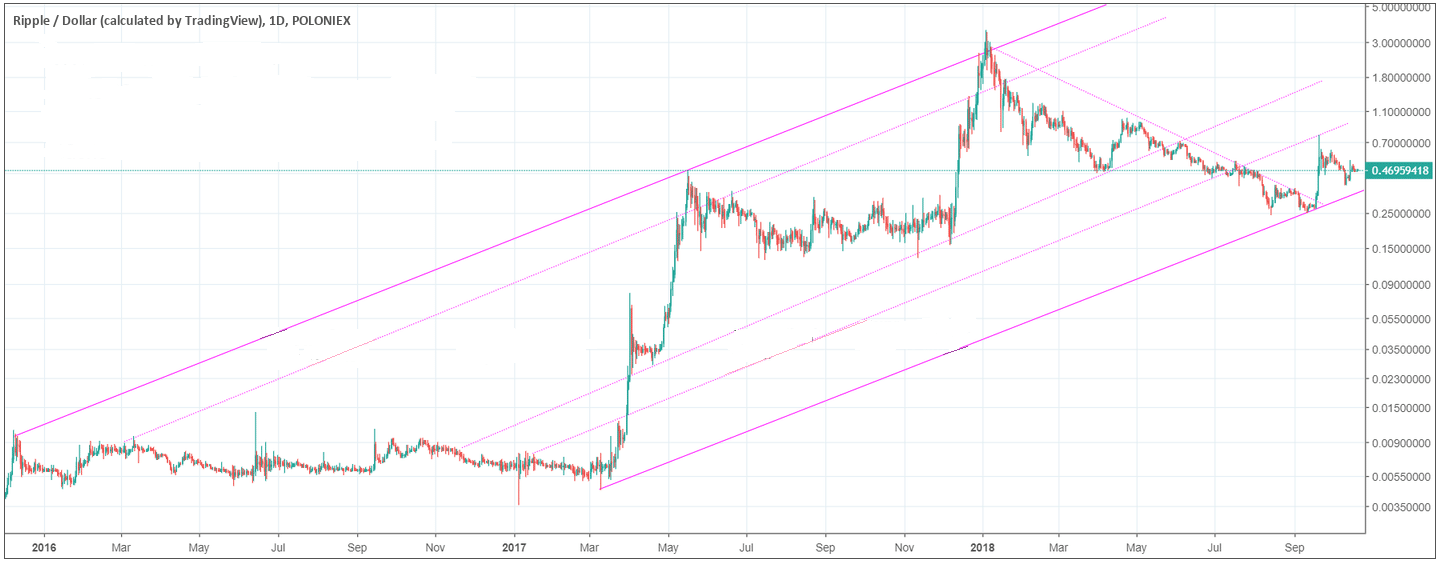
If Wall Street’s institutional investing titans keep backing crypto trading in 2019, Ripple’s XRP will benefit the most. And XRP might even hit the higher side of the below channel as it did before both in 2017 and 2018 (see chart below).
Moreover, we are seeing true supporting infrastructure being developed for cryptos, like Bakkt, the venture launched in September 2018 by a consortium led by the Intercontinental Exchange (ICE), parent of the NYSE. Bakkt is pitching itself as a cryptocurrency investment platform that will bring bitcoin and other crypto ETFs to Americans' 401(k).
In addition, there are testimonials from some well positioned sources at NASDAQ that the second biggest stock exchange in the U.S. is reportedly gearing up to list and support the trading of cryptocurrencies through a coin exchange platform.
If NASDAQ goes through with the listing, the move will put the exchange at the forefront of institutional money flowing into crypto, as well as set a precedent for U.S. regulator, the SEC.
In sum, institutional money will obviously be the catalyst for a resumption of the crypto bull market or at least the stimulant behind a comeback in cryptotrading in 2019. And even though bitcoin will most likely remain the leading indicator for cryptocurrencies in 2019, it is unlikely that it will deliver 10-fold returns similar to the previous 7 years.
Instead, real investors will separate the hype from the real, and concentrate on the existing or upcoming projects that have real value…. Real technological breakthroughs, the ones which can truly change the world.
The spectacular rise of bitcoin started a world-wide “Madness of Crowds”. Everyone wanted to make huge profits quickly. But then the market crashed, the result was a lot of grief, and 2018 became the year of reality checks.
After the market sputtered, speculators migrated away and actual “users” who were truly invested in the success of a project, remained. The most powerful thing we have learned from the success of cryptocurrencies is this unique ability to align users and investors alike through ICOs.
An ICO (Initial Coin Offering) acts as a fundraiser of sorts; a start-up looking to create a new app or product launches an ICO bypassing the regulated and rigorous capital-raising process required by VCs or banks.
Interested investors buy into the offering and receive a new cryptocurrency token hoping that this token will provide them with a return on investment.
Will Cryptocurrency trading stage a comeback?
Something in this industry needs to bring back the enthusiasm. And so far we have only seen a limited number of breakout successes. We think 2019 will be the year of that breakout killer success.
We will see the first proof point of a project that will bring investors back into the crypto world; it might be a whole new class of a payment application or one killer gaming app. Will it be an existing cryptocurrency or an upcoming altcoin? No one can predict that for sure. But every new technology inevitably evolves.
Just like the internet evolved and changed drastically from its early adoption in the 1990’s. Do you remember the very first Netscape Navigator web browser? It made the internet accessible to everyone. And then it died a quiet death, replaced by better, more robust technology.
In fact, we are witnessing today a kind of hybridization in the industry where projects are finding success in the middle ground. Things like “Hashgraph” which is a publicly distributed ledger that has a set of validators but does not need miners to validate transactions.
It is more decentralized than a centralized system, but not as decentralized as blockchain. Several experts describe Hashgraph as a continuation of where the idea of blockchain begins.
RippleNet is now active in over 40 countries worldwide, and its members have the ability of transacting with payment providers or digital wallets that they don’t have a direct relationship to, all within a regulated framework.
It is clear today that the future of finance and the future of blockchain lie in the convergence of regulation and decentralization, not in a network of pure decentralized systems. It is very difficult to build a decentralized system that is outside the purview and control of governments. They will fight it until it yields!
WALLSTREET will take it from here!
In late 2018, big institutional firms like Goldman Sachs and Nomura Holdings started working on crypto-custody services. Other institutions are also reportedly exploring possibilities of providing custody for crypto-funds.
If Wall Street’s institutional investing titans keep backing crypto trading in 2019, Ripple’s XRP will benefit the most. And XRP might even hit the higher side of the below channel as it did before both in 2017 and 2018 (see chart below).
Moreover, we are seeing true supporting infrastructure being developed for cryptos, like Bakkt, the venture launched in September 2018 by a consortium led by the Intercontinental Exchange (ICE), parent of the NYSE. Bakkt is pitching itself as a cryptocurrency investment platform that will bring bitcoin and other crypto ETFs to Americans' 401(k).
In addition, there are testimonials from some well positioned sources at NASDAQ that the second biggest stock exchange in the U.S. is reportedly gearing up to list and support the trading of cryptocurrencies through a coin exchange platform.
If NASDAQ goes through with the listing, the move will put the exchange at the forefront of institutional money flowing into crypto, as well as set a precedent for U.S. regulator, the SEC.
In sum, institutional money will obviously be the catalyst for a resumption of the crypto bull market or at least the stimulant behind a comeback in cryptotrading in 2019. And even though bitcoin will most likely remain the leading indicator for cryptocurrencies in 2019, it is unlikely that it will deliver 10-fold returns similar to the previous 7 years.
Instead, real investors will separate the hype from the real, and concentrate on the existing or upcoming projects that have real value…. Real technological breakthroughs, the ones which can truly change the world.
SMX's 1900% Surge Since November Is Not a Momentum Trade; It's Based on Transformative and Deliverable Techology
Featured Videos
Executive Interview | Charlotte Bullock | Chief Product Officer, Bank of London | FMLS:25
In this interview, we sat down with Charlotte Bullock, Head of Product at The Bank of London, previously at SAP and now shaping product at one of the sector’s most ambitious new banking players.
Charlotte reflects on the Summit so far and talks about the culture inside fintech banks today. We look at the pressures that come with scaling, and how firms can hold onto the nimble approach that made them stand out early on.
We also cover the state of payments ahead of her appearance on the payments roundtable: the blockages financial firms face, the areas that still need fixing, and what a realistic solution looks like in 2026.
In this interview, we sat down with Charlotte Bullock, Head of Product at The Bank of London, previously at SAP and now shaping product at one of the sector’s most ambitious new banking players.
Charlotte reflects on the Summit so far and talks about the culture inside fintech banks today. We look at the pressures that come with scaling, and how firms can hold onto the nimble approach that made them stand out early on.
We also cover the state of payments ahead of her appearance on the payments roundtable: the blockages financial firms face, the areas that still need fixing, and what a realistic solution looks like in 2026.
In this interview, we sat down with Charlotte Bullock, Head of Product at The Bank of London, previously at SAP and now shaping product at one of the sector’s most ambitious new banking players.
Charlotte reflects on the Summit so far and talks about the culture inside fintech banks today. We look at the pressures that come with scaling, and how firms can hold onto the nimble approach that made them stand out early on.
We also cover the state of payments ahead of her appearance on the payments roundtable: the blockages financial firms face, the areas that still need fixing, and what a realistic solution looks like in 2026.
In this interview, we sat down with Charlotte Bullock, Head of Product at The Bank of London, previously at SAP and now shaping product at one of the sector’s most ambitious new banking players.
Charlotte reflects on the Summit so far and talks about the culture inside fintech banks today. We look at the pressures that come with scaling, and how firms can hold onto the nimble approach that made them stand out early on.
We also cover the state of payments ahead of her appearance on the payments roundtable: the blockages financial firms face, the areas that still need fixing, and what a realistic solution looks like in 2026.
In this conversation, we sit down with Drew Niv, CSO at ATFX Connect and one of the most influential figures in modern FX.
We speak about market structure, the institutional view on liquidity, and the sharp rise of prop trading, a sector Drew has been commenting on in recent months. Drew explains why he once dismissed prop trading, why his view changed, and what he now thinks the model means for brokers, clients and risk managers.
We explore subscription-fee dependency, the high reneging rate, and the long-term challenge: how brokers can build a more stable and honest version of the model. Drew also talks about the traffic advantage standalone prop firms have built and why brokers may still win in the long run if they take the right approach.
In this conversation, we sit down with Drew Niv, CSO at ATFX Connect and one of the most influential figures in modern FX.
We speak about market structure, the institutional view on liquidity, and the sharp rise of prop trading, a sector Drew has been commenting on in recent months. Drew explains why he once dismissed prop trading, why his view changed, and what he now thinks the model means for brokers, clients and risk managers.
We explore subscription-fee dependency, the high reneging rate, and the long-term challenge: how brokers can build a more stable and honest version of the model. Drew also talks about the traffic advantage standalone prop firms have built and why brokers may still win in the long run if they take the right approach.
In this conversation, we sit down with Drew Niv, CSO at ATFX Connect and one of the most influential figures in modern FX.
We speak about market structure, the institutional view on liquidity, and the sharp rise of prop trading, a sector Drew has been commenting on in recent months. Drew explains why he once dismissed prop trading, why his view changed, and what he now thinks the model means for brokers, clients and risk managers.
We explore subscription-fee dependency, the high reneging rate, and the long-term challenge: how brokers can build a more stable and honest version of the model. Drew also talks about the traffic advantage standalone prop firms have built and why brokers may still win in the long run if they take the right approach.
In this conversation, we sit down with Drew Niv, CSO at ATFX Connect and one of the most influential figures in modern FX.
We speak about market structure, the institutional view on liquidity, and the sharp rise of prop trading, a sector Drew has been commenting on in recent months. Drew explains why he once dismissed prop trading, why his view changed, and what he now thinks the model means for brokers, clients and risk managers.
We explore subscription-fee dependency, the high reneging rate, and the long-term challenge: how brokers can build a more stable and honest version of the model. Drew also talks about the traffic advantage standalone prop firms have built and why brokers may still win in the long run if they take the right approach.
In this conversation, we sit down with Drew Niv, CSO at ATFX Connect and one of the most influential figures in modern FX.
We speak about market structure, the institutional view on liquidity, and the sharp rise of prop trading, a sector Drew has been commenting on in recent months. Drew explains why he once dismissed prop trading, why his view changed, and what he now thinks the model means for brokers, clients and risk managers.
We explore subscription-fee dependency, the high reneging rate, and the long-term challenge: how brokers can build a more stable and honest version of the model. Drew also talks about the traffic advantage standalone prop firms have built and why brokers may still win in the long run if they take the right approach.
In this conversation, we sit down with Drew Niv, CSO at ATFX Connect and one of the most influential figures in modern FX.
We speak about market structure, the institutional view on liquidity, and the sharp rise of prop trading, a sector Drew has been commenting on in recent months. Drew explains why he once dismissed prop trading, why his view changed, and what he now thinks the model means for brokers, clients and risk managers.
We explore subscription-fee dependency, the high reneging rate, and the long-term challenge: how brokers can build a more stable and honest version of the model. Drew also talks about the traffic advantage standalone prop firms have built and why brokers may still win in the long run if they take the right approach.
Executive Interview | Remonda Z. Kirketerp Møller| CEO & Founder Muinmos | FMLS:25
In this interview, Remonda Z. Kirketerp Møller, founder of Muinmos, breaks down the state of AI in regtech and what responsible adoption really looks like for brokers. We talk about rising fragmentation, the pressures around compliance accuracy, and why most firms are still in the early stages of AI maturity.
Ramanda also shares insights on regulator sandboxes, shifting expectations around accountability, and the current reality of MiCA licensing and passporting in Europe.
A concise look at where compliance, onboarding, and AI-driven processes are heading next.
In this interview, Remonda Z. Kirketerp Møller, founder of Muinmos, breaks down the state of AI in regtech and what responsible adoption really looks like for brokers. We talk about rising fragmentation, the pressures around compliance accuracy, and why most firms are still in the early stages of AI maturity.
Ramanda also shares insights on regulator sandboxes, shifting expectations around accountability, and the current reality of MiCA licensing and passporting in Europe.
A concise look at where compliance, onboarding, and AI-driven processes are heading next.
In this interview, Remonda Z. Kirketerp Møller, founder of Muinmos, breaks down the state of AI in regtech and what responsible adoption really looks like for brokers. We talk about rising fragmentation, the pressures around compliance accuracy, and why most firms are still in the early stages of AI maturity.
Ramanda also shares insights on regulator sandboxes, shifting expectations around accountability, and the current reality of MiCA licensing and passporting in Europe.
A concise look at where compliance, onboarding, and AI-driven processes are heading next.
In this interview, Remonda Z. Kirketerp Møller, founder of Muinmos, breaks down the state of AI in regtech and what responsible adoption really looks like for brokers. We talk about rising fragmentation, the pressures around compliance accuracy, and why most firms are still in the early stages of AI maturity.
Ramanda also shares insights on regulator sandboxes, shifting expectations around accountability, and the current reality of MiCA licensing and passporting in Europe.
A concise look at where compliance, onboarding, and AI-driven processes are heading next.
In this interview, Remonda Z. Kirketerp Møller, founder of Muinmos, breaks down the state of AI in regtech and what responsible adoption really looks like for brokers. We talk about rising fragmentation, the pressures around compliance accuracy, and why most firms are still in the early stages of AI maturity.
Ramanda also shares insights on regulator sandboxes, shifting expectations around accountability, and the current reality of MiCA licensing and passporting in Europe.
A concise look at where compliance, onboarding, and AI-driven processes are heading next.
In this interview, Remonda Z. Kirketerp Møller, founder of Muinmos, breaks down the state of AI in regtech and what responsible adoption really looks like for brokers. We talk about rising fragmentation, the pressures around compliance accuracy, and why most firms are still in the early stages of AI maturity.
Ramanda also shares insights on regulator sandboxes, shifting expectations around accountability, and the current reality of MiCA licensing and passporting in Europe.
A concise look at where compliance, onboarding, and AI-driven processes are heading next.
In this conversation, we speak with Aydin Bonabi, CEO and co-founder of Surveill, a firm focused on fraud detection and AI-driven compliance tools for financial institutions.
We start with Aydin’s view of the Summit and the challenges brokers face as fraud tactics grow more complex. He explains how firms can stay ahead through real-time signals, data patterns, and early-stage detection.
We also talk about AI training and why compliance teams often struggle to keep models accurate, fair, and aligned with regulatory expectations. Aydin breaks down what “good” AI training looks like inside a financial environment, including the importance of clean data, domain expertise, and human oversight.
He closes with a clear message: fraud is scaling, and so must the tools that stop it.
In this conversation, we speak with Aydin Bonabi, CEO and co-founder of Surveill, a firm focused on fraud detection and AI-driven compliance tools for financial institutions.
We start with Aydin’s view of the Summit and the challenges brokers face as fraud tactics grow more complex. He explains how firms can stay ahead through real-time signals, data patterns, and early-stage detection.
We also talk about AI training and why compliance teams often struggle to keep models accurate, fair, and aligned with regulatory expectations. Aydin breaks down what “good” AI training looks like inside a financial environment, including the importance of clean data, domain expertise, and human oversight.
He closes with a clear message: fraud is scaling, and so must the tools that stop it.
In this conversation, we speak with Aydin Bonabi, CEO and co-founder of Surveill, a firm focused on fraud detection and AI-driven compliance tools for financial institutions.
We start with Aydin’s view of the Summit and the challenges brokers face as fraud tactics grow more complex. He explains how firms can stay ahead through real-time signals, data patterns, and early-stage detection.
We also talk about AI training and why compliance teams often struggle to keep models accurate, fair, and aligned with regulatory expectations. Aydin breaks down what “good” AI training looks like inside a financial environment, including the importance of clean data, domain expertise, and human oversight.
He closes with a clear message: fraud is scaling, and so must the tools that stop it.
In this conversation, we speak with Aydin Bonabi, CEO and co-founder of Surveill, a firm focused on fraud detection and AI-driven compliance tools for financial institutions.
We start with Aydin’s view of the Summit and the challenges brokers face as fraud tactics grow more complex. He explains how firms can stay ahead through real-time signals, data patterns, and early-stage detection.
We also talk about AI training and why compliance teams often struggle to keep models accurate, fair, and aligned with regulatory expectations. Aydin breaks down what “good” AI training looks like inside a financial environment, including the importance of clean data, domain expertise, and human oversight.
He closes with a clear message: fraud is scaling, and so must the tools that stop it.
In this conversation, we speak with Aydin Bonabi, CEO and co-founder of Surveill, a firm focused on fraud detection and AI-driven compliance tools for financial institutions.
We start with Aydin’s view of the Summit and the challenges brokers face as fraud tactics grow more complex. He explains how firms can stay ahead through real-time signals, data patterns, and early-stage detection.
We also talk about AI training and why compliance teams often struggle to keep models accurate, fair, and aligned with regulatory expectations. Aydin breaks down what “good” AI training looks like inside a financial environment, including the importance of clean data, domain expertise, and human oversight.
He closes with a clear message: fraud is scaling, and so must the tools that stop it.
In this conversation, we speak with Aydin Bonabi, CEO and co-founder of Surveill, a firm focused on fraud detection and AI-driven compliance tools for financial institutions.
We start with Aydin’s view of the Summit and the challenges brokers face as fraud tactics grow more complex. He explains how firms can stay ahead through real-time signals, data patterns, and early-stage detection.
We also talk about AI training and why compliance teams often struggle to keep models accurate, fair, and aligned with regulatory expectations. Aydin breaks down what “good” AI training looks like inside a financial environment, including the importance of clean data, domain expertise, and human oversight.
He closes with a clear message: fraud is scaling, and so must the tools that stop it.
Exness expands its presence in Africa: Inside our interview with Paul Margarites in Cape Town
Finance Magnates met with Paul Margarites, Exness regional commercial director for Sub-Saharan Africa, during a visit to the firm’s office opening in Cape Town. In this talk, led by Andrea Badiola Mateos, Co-CEO at Finance Magnates, Paul shares views on the South African trading space, local user behavior, mobile trends, regulation, team growth, and how Exness plans to grow in more markets across the region. @Exness
Read the article at: https://www.financemagnates.com/thought-leadership/exness-expands-its-presence-in-africa-inside-our-interview-with-paul-margarites/
#exness #financemagnates #exnesstrading #CFDtrading #tradeonline #africanews #capetown
Finance Magnates met with Paul Margarites, Exness regional commercial director for Sub-Saharan Africa, during a visit to the firm’s office opening in Cape Town. In this talk, led by Andrea Badiola Mateos, Co-CEO at Finance Magnates, Paul shares views on the South African trading space, local user behavior, mobile trends, regulation, team growth, and how Exness plans to grow in more markets across the region. @Exness
Read the article at: https://www.financemagnates.com/thought-leadership/exness-expands-its-presence-in-africa-inside-our-interview-with-paul-margarites/
#exness #financemagnates #exnesstrading #CFDtrading #tradeonline #africanews #capetown
Finance Magnates met with Paul Margarites, Exness regional commercial director for Sub-Saharan Africa, during a visit to the firm’s office opening in Cape Town. In this talk, led by Andrea Badiola Mateos, Co-CEO at Finance Magnates, Paul shares views on the South African trading space, local user behavior, mobile trends, regulation, team growth, and how Exness plans to grow in more markets across the region. @Exness
Read the article at: https://www.financemagnates.com/thought-leadership/exness-expands-its-presence-in-africa-inside-our-interview-with-paul-margarites/
#exness #financemagnates #exnesstrading #CFDtrading #tradeonline #africanews #capetown
Finance Magnates met with Paul Margarites, Exness regional commercial director for Sub-Saharan Africa, during a visit to the firm’s office opening in Cape Town. In this talk, led by Andrea Badiola Mateos, Co-CEO at Finance Magnates, Paul shares views on the South African trading space, local user behavior, mobile trends, regulation, team growth, and how Exness plans to grow in more markets across the region. @Exness
Read the article at: https://www.financemagnates.com/thought-leadership/exness-expands-its-presence-in-africa-inside-our-interview-with-paul-margarites/
#exness #financemagnates #exnesstrading #CFDtrading #tradeonline #africanews #capetown
Finance Magnates met with Paul Margarites, Exness regional commercial director for Sub-Saharan Africa, during a visit to the firm’s office opening in Cape Town. In this talk, led by Andrea Badiola Mateos, Co-CEO at Finance Magnates, Paul shares views on the South African trading space, local user behavior, mobile trends, regulation, team growth, and how Exness plans to grow in more markets across the region. @Exness
Read the article at: https://www.financemagnates.com/thought-leadership/exness-expands-its-presence-in-africa-inside-our-interview-with-paul-margarites/
#exness #financemagnates #exnesstrading #CFDtrading #tradeonline #africanews #capetown
Finance Magnates met with Paul Margarites, Exness regional commercial director for Sub-Saharan Africa, during a visit to the firm’s office opening in Cape Town. In this talk, led by Andrea Badiola Mateos, Co-CEO at Finance Magnates, Paul shares views on the South African trading space, local user behavior, mobile trends, regulation, team growth, and how Exness plans to grow in more markets across the region. @Exness
Read the article at: https://www.financemagnates.com/thought-leadership/exness-expands-its-presence-in-africa-inside-our-interview-with-paul-margarites/
#exness #financemagnates #exnesstrading #CFDtrading #tradeonline #africanews #capetown