As experts lose faith in abenomics' prospects, we may see the greenback strengthen against the yen ahead of the G7 summit.
Bloomberg
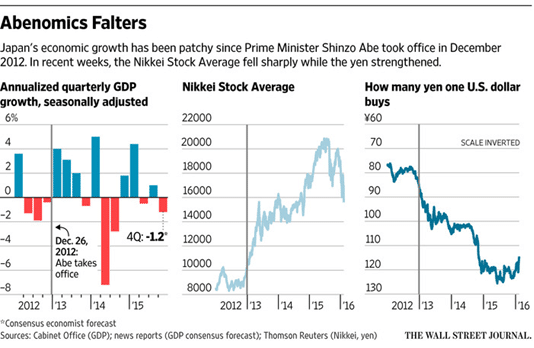
When Shinzo Abe Started his second turn as Japan’s prime minister in 2012, Japan was faced with decades of deflation, stagnant GDP growth, and an aging population.
Abe was elected on the platform of restoring Japan’s economy to the period of robust growth from 1980 to the mid 1990’s. The economy minded prime minister created the term “Abenomics,” which was a plan to combat deflation with the “three arrows.”
The arrows are bold monetary easing, flexible fiscal stimulus spending, and policies designed to spur growth and private investment.
Three years of Abenomics has proved largely ineffective. Abe planned to raise value added taxes (VAT) from 8.0% to 10.0%, a move which he recently delayed until 2019 due to lingering deflationary concerns.
Abe’s administration plans to stay the course despite clear signals that the current strategy is not effective. After weakening about -6.5% against the US dollar over the past three years, the Yen appears to be heading down an even bumpier road.
The Announcement
I think investors and corporate managers have already given up on the success of Abenomics
Prime Minister Abe has repeatedly said that only an economic shock on the scale of the Lehman Brothers collapse or a major earthquake would prompt a delay in the proposed tax rate hike. On Wednesday, as the G7 economic forum looms, Abe went back on his word and delayed the proposed 2017 VAT hike until October of 2019 on renewed fears of deflation.
At a press conference in Tokyo Abe said “I decided that I should delay the sales tax increase because it might damage domestic demand.” He then proceeded to blame his neighbors, saying “China and other countries are slow to deal with excess capacity and structural problems and it may take time for emerging economies to recover. In that context, there are concerns about long-term stagnation in global demand, so I thought I should delay it as long as possible.”
Putting off the sales tax increase may improve Abe’s prospects in the July 2016 upper house election, but the decision will also create doubt about the government’s ability to decrease a debt burden nearing two and a half times GDP. Some analysts argue the delay is political and means Japan may be less likely to engage in more quantitative easing. Other analysts said the length of the delay underscores concerns about weakness in the economy.
Either way, the events that are unfolding seem like bad news for Abenomics and Japan.
If At First You Don’t Succeed, Try, Try Again
Instead of pivoting, the Abe administration is doubling down on Abenomics as the answer for stimulating Japanese growth. “To shake off such risks, we need to rev up the engine of Abenomics,” according to the Prime Minister.
Despite implementing negative interest rates, the government’s core index shows that prices are still declining.
While maintaining a pledge to get Japan’s balance sheet back into the black by 2020, Abe plans to continue his fiscal plans, having announced a stimulus package of as much as 10 trillion Yen ($90 billion) last week.
Nikkei reported Saturday that Abe will seek a second supplementary budget worth 5-10 trillion Yen after July’s election. Abe is sticking to his plan despite few signs of positive economic activity in the country.
Still Falling Short
The gold standard for Abenomics is achieving an inflation rate of 2.0%. Despite implementing negative interest rates, the government’s core index shows that prices are still declining.
Japanese consumer figures have remained anemic, mainly on the presumption of prices to fall further in the coming months. Consumer spending fell for a second straight month in April, sliding -0.4% year-over-year, after dropping -5.3% in May according to data from the Ministry of Internal Affairs and Communications. Consumption accounts for roughly 60.0% of Japan’s GDP, which would be significant if it were the only bad numbers coming out of Japan. Exports shrank by -10.0% in April as consumer prices slipped -0.3%.
Additionally, corporate earnings have been losing momentum, painting an unseemly portrait of forward-looking Japanese economic activity.
What it Means
The outlook for Japan is grim from both outside the country and inside. Chief economist at Japan Macro Advisers, Takuji Okubo, stated he does not believe Abenomics will be successful in coming years.
“I think investors and corporate managers have already given up on the success of Abenomics,” he said. “The problem is the lack of an alternative.” Surprisingly, despite a weak outlook, the dollar dropped as much as -1.5% to a two-week low against the Yen on Wednesday.
In theory Abe’s announcement points to a monetary stimulus plan that will weaken the Yen. “The fact that we’ve had this opposite move tells you there’s something going on in the market,” said Doug Borthwick, head of currency trading at Chapdelaine & Co. This may in fact suggest a larger player, possibly at the People’s Bank of China, is rebalancing its reserves.
This indicates that the next couple of sessions may see the dollar course correct and strengthen against the Yen heading into the G7 summit next week. However, the main upcoming risk factor remains employment data from the US which could be a major driving force behind the US dollar near-term.
When Shinzo Abe Started his second turn as Japan’s prime minister in 2012, Japan was faced with decades of deflation, stagnant GDP growth, and an aging population.
Abe was elected on the platform of restoring Japan’s economy to the period of robust growth from 1980 to the mid 1990’s. The economy minded prime minister created the term “Abenomics,” which was a plan to combat deflation with the “three arrows.”
The arrows are bold monetary easing, flexible fiscal stimulus spending, and policies designed to spur growth and private investment.
Three years of Abenomics has proved largely ineffective. Abe planned to raise value added taxes (VAT) from 8.0% to 10.0%, a move which he recently delayed until 2019 due to lingering deflationary concerns.
Abe’s administration plans to stay the course despite clear signals that the current strategy is not effective. After weakening about -6.5% against the US dollar over the past three years, the Yen appears to be heading down an even bumpier road.
The Announcement
I think investors and corporate managers have already given up on the success of Abenomics
Prime Minister Abe has repeatedly said that only an economic shock on the scale of the Lehman Brothers collapse or a major earthquake would prompt a delay in the proposed tax rate hike. On Wednesday, as the G7 economic forum looms, Abe went back on his word and delayed the proposed 2017 VAT hike until October of 2019 on renewed fears of deflation.
At a press conference in Tokyo Abe said “I decided that I should delay the sales tax increase because it might damage domestic demand.” He then proceeded to blame his neighbors, saying “China and other countries are slow to deal with excess capacity and structural problems and it may take time for emerging economies to recover. In that context, there are concerns about long-term stagnation in global demand, so I thought I should delay it as long as possible.”
Putting off the sales tax increase may improve Abe’s prospects in the July 2016 upper house election, but the decision will also create doubt about the government’s ability to decrease a debt burden nearing two and a half times GDP. Some analysts argue the delay is political and means Japan may be less likely to engage in more quantitative easing. Other analysts said the length of the delay underscores concerns about weakness in the economy.
Either way, the events that are unfolding seem like bad news for Abenomics and Japan.
If At First You Don’t Succeed, Try, Try Again
Instead of pivoting, the Abe administration is doubling down on Abenomics as the answer for stimulating Japanese growth. “To shake off such risks, we need to rev up the engine of Abenomics,” according to the Prime Minister.
Despite implementing negative interest rates, the government’s core index shows that prices are still declining.
While maintaining a pledge to get Japan’s balance sheet back into the black by 2020, Abe plans to continue his fiscal plans, having announced a stimulus package of as much as 10 trillion Yen ($90 billion) last week.
Nikkei reported Saturday that Abe will seek a second supplementary budget worth 5-10 trillion Yen after July’s election. Abe is sticking to his plan despite few signs of positive economic activity in the country.
Still Falling Short
The gold standard for Abenomics is achieving an inflation rate of 2.0%. Despite implementing negative interest rates, the government’s core index shows that prices are still declining.
Japanese consumer figures have remained anemic, mainly on the presumption of prices to fall further in the coming months. Consumer spending fell for a second straight month in April, sliding -0.4% year-over-year, after dropping -5.3% in May according to data from the Ministry of Internal Affairs and Communications. Consumption accounts for roughly 60.0% of Japan’s GDP, which would be significant if it were the only bad numbers coming out of Japan. Exports shrank by -10.0% in April as consumer prices slipped -0.3%.
Additionally, corporate earnings have been losing momentum, painting an unseemly portrait of forward-looking Japanese economic activity.
What it Means
The outlook for Japan is grim from both outside the country and inside. Chief economist at Japan Macro Advisers, Takuji Okubo, stated he does not believe Abenomics will be successful in coming years.
“I think investors and corporate managers have already given up on the success of Abenomics,” he said. “The problem is the lack of an alternative.” Surprisingly, despite a weak outlook, the dollar dropped as much as -1.5% to a two-week low against the Yen on Wednesday.
In theory Abe’s announcement points to a monetary stimulus plan that will weaken the Yen. “The fact that we’ve had this opposite move tells you there’s something going on in the market,” said Doug Borthwick, head of currency trading at Chapdelaine & Co. This may in fact suggest a larger player, possibly at the People’s Bank of China, is rebalancing its reserves.
This indicates that the next couple of sessions may see the dollar course correct and strengthen against the Yen heading into the G7 summit next week. However, the main upcoming risk factor remains employment data from the US which could be a major driving force behind the US dollar near-term.
Idan is the VP trading for anyoption.com. He is a seasoned professional with years of experience trading and has a vast knowledge of the financial markets. An expert in the binary options hedging field - Idan provides insights, guidance and coordination in business planning, risk management and technology strategies. He holds a BA in Economics Management and is now busy finishing his MBA in Finance. Idan is the VP trading for anyoption.com. He is a seasoned professional with years of experience and a vast knowledge of the financial markets. An expert in the binary options hedging field - Idan provides insights, guidance and coordination in business planning, risk management and technology strategies. He holds a BA in Economics Management and is now busy finishing his MBA in Finance.
KuCoin Introduces PROOF, a Trading Competition Focused on Transparency and Fair Play
Featured Videos
FP Markets Winner Spotlight 🏆 | Global Broker of the Year 2025 #Trading #Broker #Innovation #Shorts
FP Markets Winner Spotlight 🏆 | Global Broker of the Year 2025 #Trading #Broker #Innovation #Shorts
FP Markets Winner Spotlight 🏆 | Global Broker of the Year 2025 #Trading #Broker #Innovation #Shorts
FP Markets Winner Spotlight 🏆 | Global Broker of the Year 2025 #Trading #Broker #Innovation #Shorts
FP Markets takes the spotlight as Global Broker of the Year 2025 at the Finance Magnates Awards.
Martin Stoilov, Head of Client Experience, shares that trust, innovation, and people played a key role in the company’s success, supported by a strong foundation of integrity and client-centricity.
Following this milestone, FP Markets continues to focus on growth, technology investment, and its core values of transparency and excellence.
👉 Be part of FM Awards 2026: https://awards.financemagnates.com/#nominate
FP Markets takes the spotlight as Global Broker of the Year 2025 at the Finance Magnates Awards.
Martin Stoilov, Head of Client Experience, shares that trust, innovation, and people played a key role in the company’s success, supported by a strong foundation of integrity and client-centricity.
Following this milestone, FP Markets continues to focus on growth, technology investment, and its core values of transparency and excellence.
👉 Be part of FM Awards 2026: https://awards.financemagnates.com/#nominate
FP Markets takes the spotlight as Global Broker of the Year 2025 at the Finance Magnates Awards.
Martin Stoilov, Head of Client Experience, shares that trust, innovation, and people played a key role in the company’s success, supported by a strong foundation of integrity and client-centricity.
Following this milestone, FP Markets continues to focus on growth, technology investment, and its core values of transparency and excellence.
👉 Be part of FM Awards 2026: https://awards.financemagnates.com/#nominate
FP Markets takes the spotlight as Global Broker of the Year 2025 at the Finance Magnates Awards.
Martin Stoilov, Head of Client Experience, shares that trust, innovation, and people played a key role in the company’s success, supported by a strong foundation of integrity and client-centricity.
Following this milestone, FP Markets continues to focus on growth, technology investment, and its core values of transparency and excellence.
👉 Be part of FM Awards 2026: https://awards.financemagnates.com/#nominate
In this video, we review @HolaPrimeMarketsOfficial, a multi-asset forex and CFDs broker offering different account types, trading platforms, and flexible trading conditions.
We cover the broker’s overall offering, including account options, trading environment, platforms like MT4 and MT5, and additional services such as managed accounts and fast withdrawals.
Watch the full video to see if Hola Prime Markets fits your trading needs.
📣 Stay up to date with the latest in finance and trading. Follow Finance Magnates for industry news, insights, and global event coverage.
Connect with us:
🔗 LinkedIn: /financemagnates
👍 Facebook: /financemagnates
📸 Instagram: https://www.instagram.com/financemagnates
🐦 X: https://x.com/financemagnates
🎥 TikTok: https://www.tiktok.com/tag/financemagnates
▶️ YouTube: /@financemagnates_official
#HolaPrime #ForexBroker #CFDTrading #FinanceMagnates #Trading #Forex #BrokerReview
In this video, we review @HolaPrimeMarketsOfficial, a multi-asset forex and CFDs broker offering different account types, trading platforms, and flexible trading conditions.
We cover the broker’s overall offering, including account options, trading environment, platforms like MT4 and MT5, and additional services such as managed accounts and fast withdrawals.
Watch the full video to see if Hola Prime Markets fits your trading needs.
📣 Stay up to date with the latest in finance and trading. Follow Finance Magnates for industry news, insights, and global event coverage.
Connect with us:
🔗 LinkedIn: /financemagnates
👍 Facebook: /financemagnates
📸 Instagram: https://www.instagram.com/financemagnates
🐦 X: https://x.com/financemagnates
🎥 TikTok: https://www.tiktok.com/tag/financemagnates
▶️ YouTube: /@financemagnates_official
#HolaPrime #ForexBroker #CFDTrading #FinanceMagnates #Trading #Forex #BrokerReview
In this video, we review @HolaPrimeMarketsOfficial, a multi-asset forex and CFDs broker offering different account types, trading platforms, and flexible trading conditions.
We cover the broker’s overall offering, including account options, trading environment, platforms like MT4 and MT5, and additional services such as managed accounts and fast withdrawals.
Watch the full video to see if Hola Prime Markets fits your trading needs.
📣 Stay up to date with the latest in finance and trading. Follow Finance Magnates for industry news, insights, and global event coverage.
Connect with us:
🔗 LinkedIn: /financemagnates
👍 Facebook: /financemagnates
📸 Instagram: https://www.instagram.com/financemagnates
🐦 X: https://x.com/financemagnates
🎥 TikTok: https://www.tiktok.com/tag/financemagnates
▶️ YouTube: /@financemagnates_official
#HolaPrime #ForexBroker #CFDTrading #FinanceMagnates #Trading #Forex #BrokerReview
In this video, we review @HolaPrimeMarketsOfficial, a multi-asset forex and CFDs broker offering different account types, trading platforms, and flexible trading conditions.
We cover the broker’s overall offering, including account options, trading environment, platforms like MT4 and MT5, and additional services such as managed accounts and fast withdrawals.
Watch the full video to see if Hola Prime Markets fits your trading needs.
📣 Stay up to date with the latest in finance and trading. Follow Finance Magnates for industry news, insights, and global event coverage.
Connect with us:
🔗 LinkedIn: /financemagnates
👍 Facebook: /financemagnates
📸 Instagram: https://www.instagram.com/financemagnates
🐦 X: https://x.com/financemagnates
🎥 TikTok: https://www.tiktok.com/tag/financemagnates
▶️ YouTube: /@financemagnates_official
#HolaPrime #ForexBroker #CFDTrading #FinanceMagnates #Trading #Forex #BrokerReview
In this video, we review @HolaPrimeMarketsOfficial, a multi-asset forex and CFDs broker offering different account types, trading platforms, and flexible trading conditions.
We cover the broker’s overall offering, including account options, trading environment, platforms like MT4 and MT5, and additional services such as managed accounts and fast withdrawals.
Watch the full video to see if Hola Prime Markets fits your trading needs.
📣 Stay up to date with the latest in finance and trading. Follow Finance Magnates for industry news, insights, and global event coverage.
Connect with us:
🔗 LinkedIn: /financemagnates
👍 Facebook: /financemagnates
📸 Instagram: https://www.instagram.com/financemagnates
🐦 X: https://x.com/financemagnates
🎥 TikTok: https://www.tiktok.com/tag/financemagnates
▶️ YouTube: /@financemagnates_official
#HolaPrime #ForexBroker #CFDTrading #FinanceMagnates #Trading #Forex #BrokerReview
In this video, we review @HolaPrimeMarketsOfficial, a multi-asset forex and CFDs broker offering different account types, trading platforms, and flexible trading conditions.
We cover the broker’s overall offering, including account options, trading environment, platforms like MT4 and MT5, and additional services such as managed accounts and fast withdrawals.
Watch the full video to see if Hola Prime Markets fits your trading needs.
📣 Stay up to date with the latest in finance and trading. Follow Finance Magnates for industry news, insights, and global event coverage.
Connect with us:
🔗 LinkedIn: /financemagnates
👍 Facebook: /financemagnates
📸 Instagram: https://www.instagram.com/financemagnates
🐦 X: https://x.com/financemagnates
🎥 TikTok: https://www.tiktok.com/tag/financemagnates
▶️ YouTube: /@financemagnates_official
#HolaPrime #ForexBroker #CFDTrading #FinanceMagnates #Trading #Forex #BrokerReview
Hola Prime Review: What You Need to Know | Full Breakdown by Finance Magnates
Hola Prime Review: What You Need to Know | Full Breakdown by Finance Magnates
Hola Prime Review: What You Need to Know | Full Breakdown by Finance Magnates
Hola Prime Review: What You Need to Know | Full Breakdown by Finance Magnates
Hola Prime Review: What You Need to Know | Full Breakdown by Finance Magnates
Hola Prime Review: What You Need to Know | Full Breakdown by Finance Magnates
In this video, we review @HolaPrime_Global, a proprietary trading firm offering evaluation programs and performance-based payouts in simulated market environments.
We cover how the challenge model works, including account types, profit splits (up to 95%), trading rules, and what it takes to reach a funded account. You’ll also learn about available platforms like MT4, MT5, cTrader, and more, along with insights into payouts, support, and trading conditions.
Watch the full video to see if Hola Prime fits your trading style.
📣 Stay up to date with the latest in finance and trading. Follow Finance Magnates for industry news, insights, and global event coverage.
Connect with us:
🔗 LinkedIn: /financemagnates
👍 Facebook: /financemagnates
📸 Instagram: https://www.instagram.com/financemagnates
🐦 X: https://x.com/financemagnates
🎥 TikTok: https://www.tiktok.com/tag/financemagnates
▶️ YouTube: /@financemagnates_official
#HolaPrime #PropFirm #Trading #FinanceMagnates #Forex #FuturesTrading #TradingReview #PropFirmReview
In this video, we review @HolaPrime_Global, a proprietary trading firm offering evaluation programs and performance-based payouts in simulated market environments.
We cover how the challenge model works, including account types, profit splits (up to 95%), trading rules, and what it takes to reach a funded account. You’ll also learn about available platforms like MT4, MT5, cTrader, and more, along with insights into payouts, support, and trading conditions.
Watch the full video to see if Hola Prime fits your trading style.
📣 Stay up to date with the latest in finance and trading. Follow Finance Magnates for industry news, insights, and global event coverage.
Connect with us:
🔗 LinkedIn: /financemagnates
👍 Facebook: /financemagnates
📸 Instagram: https://www.instagram.com/financemagnates
🐦 X: https://x.com/financemagnates
🎥 TikTok: https://www.tiktok.com/tag/financemagnates
▶️ YouTube: /@financemagnates_official
#HolaPrime #PropFirm #Trading #FinanceMagnates #Forex #FuturesTrading #TradingReview #PropFirmReview
In this video, we review @HolaPrime_Global, a proprietary trading firm offering evaluation programs and performance-based payouts in simulated market environments.
We cover how the challenge model works, including account types, profit splits (up to 95%), trading rules, and what it takes to reach a funded account. You’ll also learn about available platforms like MT4, MT5, cTrader, and more, along with insights into payouts, support, and trading conditions.
Watch the full video to see if Hola Prime fits your trading style.
📣 Stay up to date with the latest in finance and trading. Follow Finance Magnates for industry news, insights, and global event coverage.
Connect with us:
🔗 LinkedIn: /financemagnates
👍 Facebook: /financemagnates
📸 Instagram: https://www.instagram.com/financemagnates
🐦 X: https://x.com/financemagnates
🎥 TikTok: https://www.tiktok.com/tag/financemagnates
▶️ YouTube: /@financemagnates_official
#HolaPrime #PropFirm #Trading #FinanceMagnates #Forex #FuturesTrading #TradingReview #PropFirmReview
In this video, we review @HolaPrime_Global, a proprietary trading firm offering evaluation programs and performance-based payouts in simulated market environments.
We cover how the challenge model works, including account types, profit splits (up to 95%), trading rules, and what it takes to reach a funded account. You’ll also learn about available platforms like MT4, MT5, cTrader, and more, along with insights into payouts, support, and trading conditions.
Watch the full video to see if Hola Prime fits your trading style.
📣 Stay up to date with the latest in finance and trading. Follow Finance Magnates for industry news, insights, and global event coverage.
Connect with us:
🔗 LinkedIn: /financemagnates
👍 Facebook: /financemagnates
📸 Instagram: https://www.instagram.com/financemagnates
🐦 X: https://x.com/financemagnates
🎥 TikTok: https://www.tiktok.com/tag/financemagnates
▶️ YouTube: /@financemagnates_official
#HolaPrime #PropFirm #Trading #FinanceMagnates #Forex #FuturesTrading #TradingReview #PropFirmReview
In this video, we review @HolaPrime_Global, a proprietary trading firm offering evaluation programs and performance-based payouts in simulated market environments.
We cover how the challenge model works, including account types, profit splits (up to 95%), trading rules, and what it takes to reach a funded account. You’ll also learn about available platforms like MT4, MT5, cTrader, and more, along with insights into payouts, support, and trading conditions.
Watch the full video to see if Hola Prime fits your trading style.
📣 Stay up to date with the latest in finance and trading. Follow Finance Magnates for industry news, insights, and global event coverage.
Connect with us:
🔗 LinkedIn: /financemagnates
👍 Facebook: /financemagnates
📸 Instagram: https://www.instagram.com/financemagnates
🐦 X: https://x.com/financemagnates
🎥 TikTok: https://www.tiktok.com/tag/financemagnates
▶️ YouTube: /@financemagnates_official
#HolaPrime #PropFirm #Trading #FinanceMagnates #Forex #FuturesTrading #TradingReview #PropFirmReview
In this video, we review @HolaPrime_Global, a proprietary trading firm offering evaluation programs and performance-based payouts in simulated market environments.
We cover how the challenge model works, including account types, profit splits (up to 95%), trading rules, and what it takes to reach a funded account. You’ll also learn about available platforms like MT4, MT5, cTrader, and more, along with insights into payouts, support, and trading conditions.
Watch the full video to see if Hola Prime fits your trading style.
📣 Stay up to date with the latest in finance and trading. Follow Finance Magnates for industry news, insights, and global event coverage.
Connect with us:
🔗 LinkedIn: /financemagnates
👍 Facebook: /financemagnates
📸 Instagram: https://www.instagram.com/financemagnates
🐦 X: https://x.com/financemagnates
🎥 TikTok: https://www.tiktok.com/tag/financemagnates
▶️ YouTube: /@financemagnates_official
#HolaPrime #PropFirm #Trading #FinanceMagnates #Forex #FuturesTrading #TradingReview #PropFirmReview
Axi Winner Spotlight 🏆 | Global Most Innovative Broker 2025 #Innovation #Trading #Fintech #Broker
Axi Winner Spotlight 🏆 | Global Most Innovative Broker 2025 #Innovation #Trading #Fintech #Broker
Axi Winner Spotlight 🏆 | Global Most Innovative Broker 2025 #Innovation #Trading #Fintech #Broker
Axi Winner Spotlight 🏆 | Global Most Innovative Broker 2025 #Innovation #Trading #Fintech #Broker
Axi Winner Spotlight 🏆 | Global Most Innovative Broker 2025 #Innovation #Trading #Fintech #Broker
Axi Winner Spotlight 🏆 | Global Most Innovative Broker 2025 #Innovation #Trading #Fintech #Broker
Axi takes the spotlight at the Finance Magnates Awards, winning Global Most Innovative Broker 2025.
Olivia Xenofontos and Ivanna Openko share how the team will feel: proud, motivated, and ready to keep delivering.
They also describe the night as well-organized, focused, and enjoyable for all.
👉 Be part of FM Awards 2026.
Axi takes the spotlight at the Finance Magnates Awards, winning Global Most Innovative Broker 2025.
Olivia Xenofontos and Ivanna Openko share how the team will feel: proud, motivated, and ready to keep delivering.
They also describe the night as well-organized, focused, and enjoyable for all.
👉 Be part of FM Awards 2026.
Axi takes the spotlight at the Finance Magnates Awards, winning Global Most Innovative Broker 2025.
Olivia Xenofontos and Ivanna Openko share how the team will feel: proud, motivated, and ready to keep delivering.
They also describe the night as well-organized, focused, and enjoyable for all.
👉 Be part of FM Awards 2026.
Axi takes the spotlight at the Finance Magnates Awards, winning Global Most Innovative Broker 2025.
Olivia Xenofontos and Ivanna Openko share how the team will feel: proud, motivated, and ready to keep delivering.
They also describe the night as well-organized, focused, and enjoyable for all.
👉 Be part of FM Awards 2026.
Axi takes the spotlight at the Finance Magnates Awards, winning Global Most Innovative Broker 2025.
Olivia Xenofontos and Ivanna Openko share how the team will feel: proud, motivated, and ready to keep delivering.
They also describe the night as well-organized, focused, and enjoyable for all.
👉 Be part of FM Awards 2026.
Axi takes the spotlight at the Finance Magnates Awards, winning Global Most Innovative Broker 2025.
Olivia Xenofontos and Ivanna Openko share how the team will feel: proud, motivated, and ready to keep delivering.
They also describe the night as well-organized, focused, and enjoyable for all.
👉 Be part of FM Awards 2026.
Recognition that matters.
Built on transparency.
Driven by the industry.
The Finance Magnates Awards 2026.
Nominations are now open.
🔗 https://awards.financemagnates.com/?utm_source=SM&utm_medium=social&utm_campaign=recognition-matters
Recognition that matters.
Built on transparency.
Driven by the industry.
The Finance Magnates Awards 2026.
Nominations are now open.
🔗 https://awards.financemagnates.com/?utm_source=SM&utm_medium=social&utm_campaign=recognition-matters
Recognition that matters.
Built on transparency.
Driven by the industry.
The Finance Magnates Awards 2026.
Nominations are now open.
🔗 https://awards.financemagnates.com/?utm_source=SM&utm_medium=social&utm_campaign=recognition-matters
Recognition that matters.
Built on transparency.
Driven by the industry.
The Finance Magnates Awards 2026.
Nominations are now open.
🔗 https://awards.financemagnates.com/?utm_source=SM&utm_medium=social&utm_campaign=recognition-matters
Recognition that matters.
Built on transparency.
Driven by the industry.
The Finance Magnates Awards 2026.
Nominations are now open.
🔗 https://awards.financemagnates.com/?utm_source=SM&utm_medium=social&utm_campaign=recognition-matters
Recognition that matters.
Built on transparency.
Driven by the industry.
The Finance Magnates Awards 2026.
Nominations are now open.
🔗 https://awards.financemagnates.com/?utm_source=SM&utm_medium=social&utm_campaign=recognition-matters