

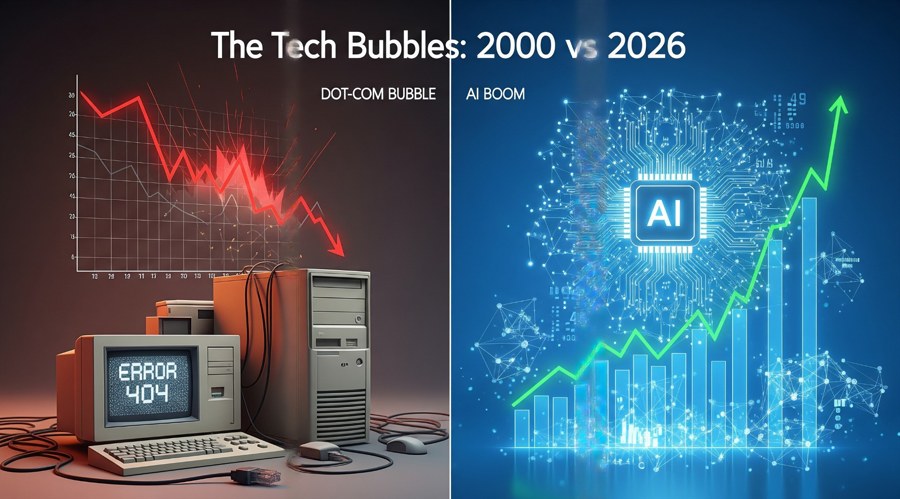
Growing alarm about the unprecedented amounts of money being invested in artificial intelligence has sparked fears of the industry entering a “bubble,” drawing comparisons with what happened during the early 2000s. Back then, the dot-com boom captured the imagination of Wall Street, only to crash spectacularly and derail the global economy for years to come.
There are a lot of parallels between what happened then and what’s taking place with AI now, but there are also many differences – and therefore many reasons to think AI might avoid repeating history.
One of the biggest disparities between the rise of the internet and the rise of AI is, the two technologies have very different goals. The internet began life as an experimental communications project by the U.S. Department of Defense, but its creators soon realized its commercial potential. The goal was to transform information sharing by creating a decentralized and global network that anyone could use, and the World Wide Web was the result.
In contrast, AI lacks a singular goal. It’s viewed as a versatile technology that can be applied to dozens of domains, ranging from chatbots to recommendation systems to autonomous vehicles and robots. And yet, there's no unified way to characterize exactly what AI is trying to solve in these domains.
Deep Analysis founder Alan Pelz-Sharpe discussed AI’s lack of a clear-cut objective in a recent blog post, observing that it’s a proverbial solution looking for a problem. “I don’t mean AI lacks value. It can solve real challenges, but only if organizations first define what those challenges are,” he wrote. “Too often, AI is deployed reactively – thrown at symptoms rather than root causes, leading to wasted resources, disillusionment and even deeper inefficiencies.”
The Argument for AI Buoyancy
AI’s lack of a clear goal doesn’t bode so well for its future, but AI does have a few things going for it that the internet never did during its early days.
For one thing, AI is far more accessible than the internet was back in the 1990s. Getting online during the early years required a substantial investment, such as the need to purchase an expensive computer and pay a monthly subscription fee to connect to the web. By the end of the 1990s, only one-third of people in developed countries were online, handicapping the economic potential of companies riding the dot-com boom.
On the other hand, AI is far more ubiquitous. These days everyone has a smartphone, and that means anyone can access apps like ChatGPT, Gemini or Grok, and they can even be used for free, albeit with some limitations. One could argue that there’s not a person alive who has used a smartphone and has not interacted with AI at least once through that device.
Another advantage AI has is that it’s being led by a very different group of companies that sit on a much stronger financial footing. During the dot-com bubble, very few of the leading companies were established enterprises. Yahoo!, Amazon, eBay and the like were all startups and most were living on borrowed capital, which led to a lot of problems when funding later dried up.
Remember 360Networks? It was one of the leading fiber optic companies during the dot-com boom. Founded in 1998, it reached a market capitalization of more than $13 billion just two years later, using venture capital to build network infrastructure that spanned much of the U.S. But it was building for the future, and at the time it had very few customers – not nearly enough to survive when investors switched off the funding tap.
It was much the same at companies like Pets.com and Webvan, which spent millions of dollars on advertising but couldn’t make their deliveries profitable, because they never achieved the economies of scale they imagined.
Zeev Farbman, CEO of the AI video tech firm Lightricks, made it clear in an interview with CNBC that AI is a very different story. He said much of the funding stems from the free cash flow and revenues of some of the world’s richest enterprises, such as Microsoft, Google, Amazon, Meta Platforms and Oracle. These organizations all have established businesses providing vital technology and services that generate billions of dollars in revenue annually. “A lot of these companies that are at the frontier of AI are making significant revenues,” Farbman said. “So I think that's very different from the dot-com era.”
Farbman pointed out that even the AI pure-plays, like OpenAI and Anthropic, have grown tremendously in the last couple of years. OpenAI’s revenue has surged from just $200 million in sales in 2023 to a projected $20 billion in annualized revenue this year, while Anthropic expects to achieve $9 billion in annualized revenue this year, up from just $87 million in early 2024.
AI’s Vulnerabilities
One of the biggest challenges AI faces compared to the internet is scale. In the 1990s, the internet was known for being slow, and it struggled to handle heavy traffic. Dial-up modem connections meant users might have to wait several minutes just to download an image, and streaming even a short video clip wasn’t possible.
Economies of scale got us to where we are today. Connectivity became much faster with the emergence of fiber optics, high-bandwidth mobile connections and increased storage capacities, and that encouraged more investment in infrastructure, making the internet better over time.
On the other hand, increased investment doesn’t have the same impact on AI. Adnan Masood, Ph.D in AI and ML, Stanford Scholar and Microsoft Regional Director, commented that the industry experiences diminishing returns on investment with large language models and may be approaching a “scaling wall.” OpenAI spent billions of dollars to train GPT-4.5, but showed only incremental improvements over GPT-4.
“Frontier models from OpenAI, Anthropic, Google, and Meta show smaller performance jumps on key English benchmarks despite massive increases in training budget,” Masood said. “Meanwhile, the AI industry faces data scarcity for high-quality English text and skyrocketing compute costs, prompting exploration of new techniques to sustain progress.”
A Question of Value
It’s not easy to picture where AI will go from here. While it shows potential for greater automation in terms of content creation and industries such as finance, healthcare and others, it hasn’t yet become essential in the same way the internet is. Farbman said this is AI’s biggest challenge – it needs to discover a way to generate real-world value that people and businesses can’t live without.
Doing so may require a change in the way people think about AI. Rather than focus on the strengths of the underlying models, Farbman thinks people should look at what the weaknesses of AI are. “Then you can start to create products to overcome the limitations of the tech with human interactions,” he said. “Typically, I think that’s where the value is.”
AI may ultimately follow the same path as the internet. The web began as a gimmick and the dot-com boom was characterized by inflated expectations, but once the value became apparent, it became the fabric that stitched modern society together. AI feels the same – it’s fun, it has potential, but it isn’t absolutely essential. If the leaders of AI companies can learn to deliver on that potential, it will also become indispensable.


