Let’s take a closer look at what could affect the EUR/USD exchange rate this week.
Last week, the financial markets were focused on
the August Nonfarm Payrolls (NFP) report. The data, released on Friday,
September 6, showed a modest increase of 142,000 jobs, following downward
revisions to the previous two months. While the unemployment rate dipped to
4.2%, the NFP report sent ripples through the markets.
The NFP release came as market participants were
eagerly anticipating the Federal Reserve's next move on interest rates. With
the Fed on hold since July 2023, markets had been pricing in a 100% probability
of a rate cut at the upcoming September 17-18 meeting.
However, the NFP data introduced uncertainty
about the magnitude of that cut. Prior to the report, a 25 basis point cut was
favoured, but the mixed signals could sway the Fed towards a more aggressive 50
basis point reduction.
The EUR/USD exchange rate experienced a volatile
week before ending slightly up (+0.32%), after declining by 1.29% the week
before. Let’s take a closer look at what could affect the EUR/USD exchange rate
this week.
US Consumer Price Index (CPI)
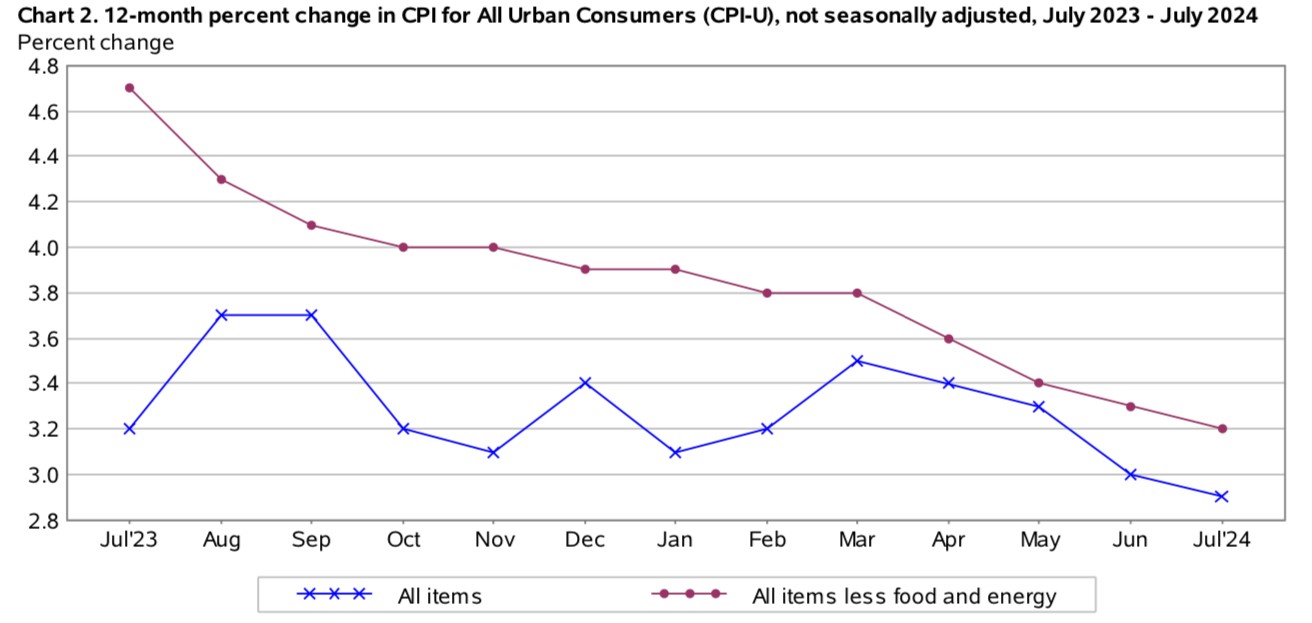
The United States saw a continued decline in
inflation rates during July 2024, marking a positive trend. The annual
inflation rate, as measured by the Consumer Price Index (CPI), dropped to 2.9%
in July, the lowest level since March 2021. This deceleration represents a
significant step towards the Federal Reserve's target of 2% annual inflation.
Turning to core inflation, inflation not taking
into account volatile food and energy prices, figures also showed that
inflationary pressures are gradually easing. Core inflation rate fell to the
lowest reading in over three years in July to 3.2%.
Looking ahead, economists anticipate further
progress in taming inflation when the CPI data for last month is published on
Wednesday, August 11, at 12:30 PM GMT. Projections for August 2024 suggest that
the annual inflation rate could drop to 2.6%, and core inflation could remain
at 3.2%.
Source: Bureau of Labor Statistics
US Producer Price Index (PPI)
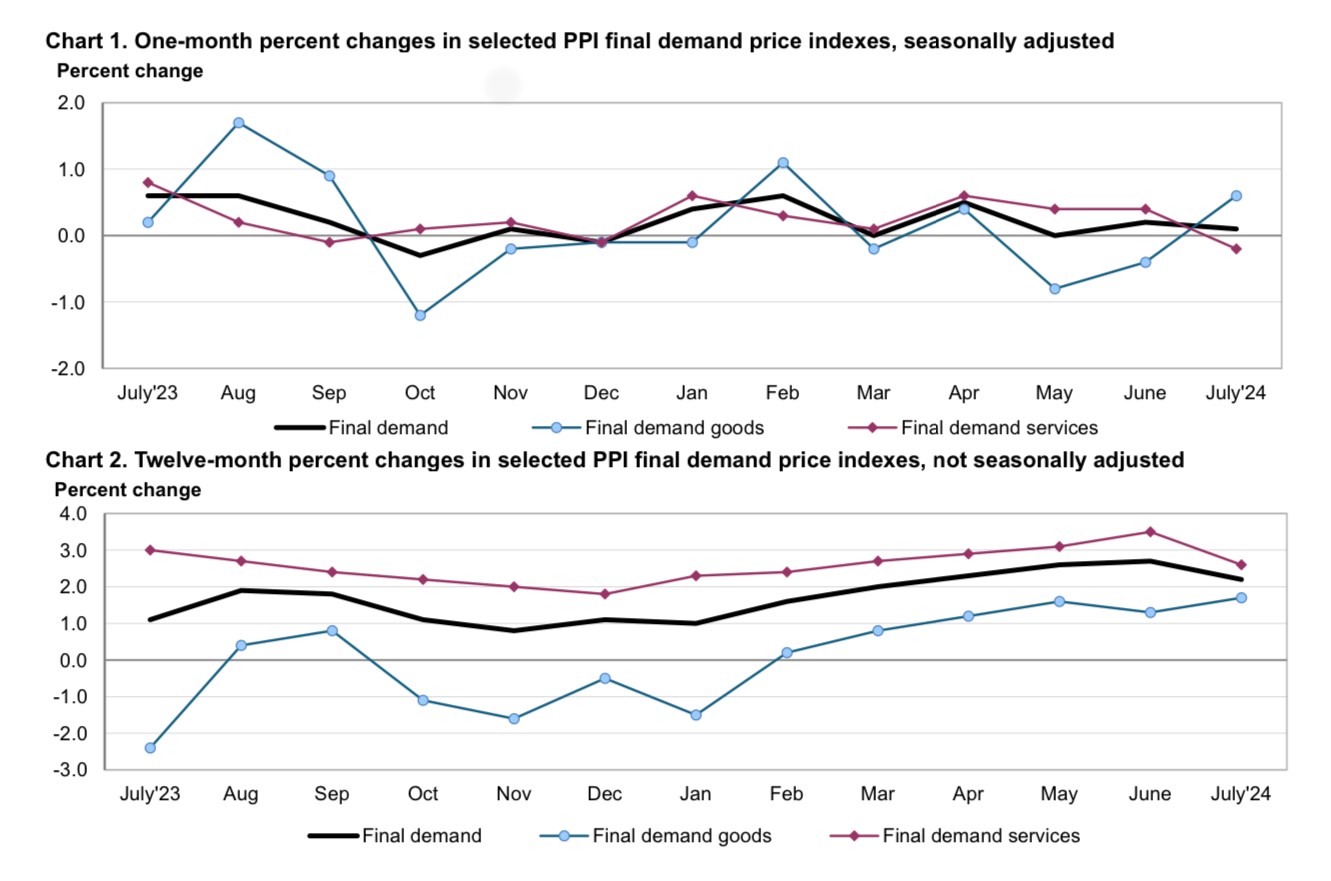
The U.S. Producer Price Index (PPI) for final
demand, a key indicator of inflation pressures of goods sold to manufacturers,
rose by a less-than-expected 0.1% in July.
This marks a slowdown from the previous month's
0.2% increase and is the smallest monthly rise since February 2023. The
moderation in PPI suggests that businesses are facing diminishing pricing
power, indicating that inflationary pressures are easing.
The decline in PPI is primarily driven by a
significant decrease in service prices, which fell by the most in nearly 1-1.5
years. This suggests that businesses are finding it more difficult to pass on
higher costs to consumers in the service area. The price of services usually
accounted for the increase of this inflation indicator.
Looking ahead, market participants expect either
monthly PPI inflation to remain at 0.1% or increase to 0.2% for last month will
be published on Thursday, August 12, at 12:30 PM GMT.
Source: Bureau of Labor Statistics
European Central Bank (ECB) Monetary Policy Meeting
Recent data from Eurostat, the statistical
office of the European Union, shows that annual inflation in the euro area is
expected to be 2.2% in August 2024, down from 2.6% in July.
This decrease suggests that the European Central
Bank’s (ECB) efforts to curb inflation are beginning to show results, giving
the institution more confidence in its forecasts of gradual disinflation.
However, the ECB faces a delicate balancing act:
while the downward trend in inflation is promising, there remains a significant
risk that easing monetary policy too quickly could reignite inflationary
pressures, potentially raising inflation expectations once again.
Meanwhile, the broader economic recovery in the
Eurozone appears to be losing momentum. In the second quarter of 2024,
seasonally adjusted GDP in both the euro area and the EU grew by only 0.2%
compared to the previous quarter, according to Eurostat. This marks a slowdown
from the 0.3% growth recorded in the first quarter of 2024.
Year-on-year, GDP increased by 0.6% in the euro
area and by 0.8% in the EU during the second quarter, slightly up from the 0.5%
and 0.7% growth rates, respectively, seen in the first quarter.
In comparison, the United States experienced
more robust economic performance during the same period. U.S. GDP grew by 0.7%
in the second quarter of 2024, up from 0.4% in the first quarter. Year-on-year,
the U.S. economy expanded by 3.1% in the second quarter, an increase from the
2.9% growth observed in the first quarter.
The Eurozone's economic landscape is highly
dynamic, with conditions that can shift rapidly due to unforeseen events,
potentially affecting both inflation and growth. In response to these evolving
circumstances, the European Central Bank remains vigilant, consistently
monitoring economic indicators. The ECB is poised to adjust its monetary policy
as needed to maintain inflation on a sustainable and controlled trajectory,
responding to the latest data.
Traders are now anticipating an interest rate
cut from the ECB in its upcoming meeting next week on Thursday, September 12.
The focus will be on any signals from the central bank that could suggest
another rate reduction in October. The ECB began lowering rates from their
record high of 4% in June, but refrained from a second cut in July, citing
concerns over services inflation, which remained above 4%. However, traders now
seem to fully expect a cut to 3.5% at Thursday's meeting when the decision will
be released at 12:15 PM GMT.
Attention will be directed towards the ECB's
announcement and the subsequent press conference, where policymakers'
perspectives on the longer-term inflation outlook will be crucial. Currently,
market participants are evenly divided on whether the ECB will proceed with a
third rate cut this year, potentially in October.
EUR/USD Technical Outlook
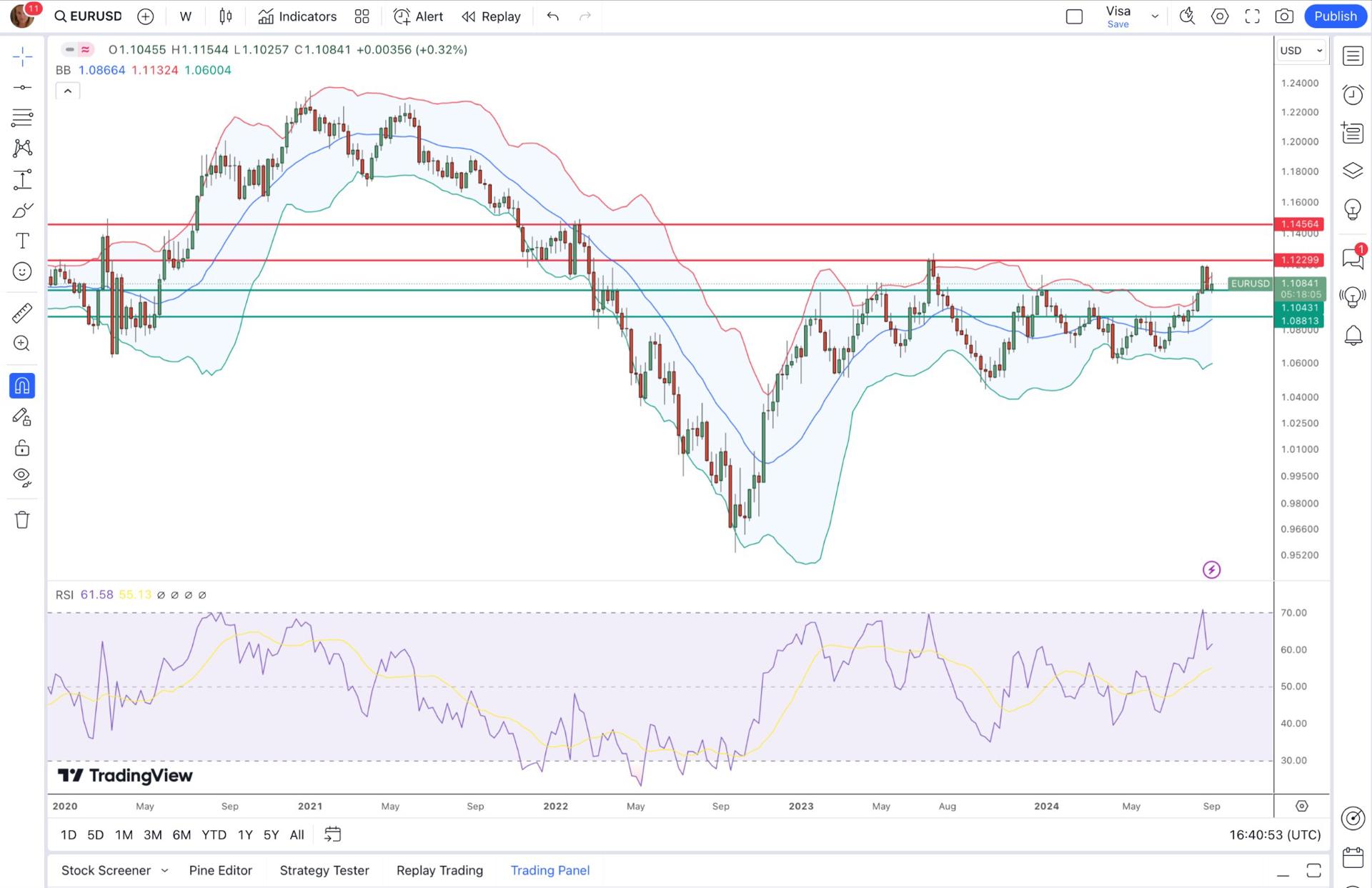
The EUR/USD exchange rate experienced a sharp
rally, appreciating by 4.78% during the period from August 24 to August 30, and
reaching its highest level since early July 2024. This surge pushed the EUR/USD
above the upper band of the Bollinger Band indicator, a technical analysis tool
that measures volatility. In the final week of August, the EUR/USD reversed
course, declining by 1.29%. This pullback brought the pair back below the
overbought territory indicated by the Relative Strength Index (RSI). Still, the
EUR/USD closed last week with a slight gain of 0.32%.
Weekly EUR/USD Chart - Source: ActivTrader
The information
provided does not constitute investment research. The material has not been prepared
in accordance with the legal requirements designed to promote the independence
of investment research and as such is to be considered to be a marketing
communication.
All information
has been prepared by ActivTrades (“AT”). The information does not contain a
record of AT’s prices, or an offer of or solicitation for a transaction in any
financial instrument. No representation or warranty is given as to the accuracy
or completeness of this information.
Any material
provided does not have regard to the specific investment objective and
financial situation of any person who may receive it. Past performance is not a
reliable indicator of future performance. AT provides an execution-only
service. Consequently, any person acting on the information provided does so at
their own risk.
Last week, the financial markets were focused on
the August Nonfarm Payrolls (NFP) report. The data, released on Friday,
September 6, showed a modest increase of 142,000 jobs, following downward
revisions to the previous two months. While the unemployment rate dipped to
4.2%, the NFP report sent ripples through the markets.
The NFP release came as market participants were
eagerly anticipating the Federal Reserve's next move on interest rates. With
the Fed on hold since July 2023, markets had been pricing in a 100% probability
of a rate cut at the upcoming September 17-18 meeting.
However, the NFP data introduced uncertainty
about the magnitude of that cut. Prior to the report, a 25 basis point cut was
favoured, but the mixed signals could sway the Fed towards a more aggressive 50
basis point reduction.
The EUR/USD exchange rate experienced a volatile
week before ending slightly up (+0.32%), after declining by 1.29% the week
before. Let’s take a closer look at what could affect the EUR/USD exchange rate
this week.
US Consumer Price Index (CPI)
The United States saw a continued decline in
inflation rates during July 2024, marking a positive trend. The annual
inflation rate, as measured by the Consumer Price Index (CPI), dropped to 2.9%
in July, the lowest level since March 2021. This deceleration represents a
significant step towards the Federal Reserve's target of 2% annual inflation.
Turning to core inflation, inflation not taking
into account volatile food and energy prices, figures also showed that
inflationary pressures are gradually easing. Core inflation rate fell to the
lowest reading in over three years in July to 3.2%.
Looking ahead, economists anticipate further
progress in taming inflation when the CPI data for last month is published on
Wednesday, August 11, at 12:30 PM GMT. Projections for August 2024 suggest that
the annual inflation rate could drop to 2.6%, and core inflation could remain
at 3.2%.
Source: Bureau of Labor Statistics
US Producer Price Index (PPI)
The U.S. Producer Price Index (PPI) for final
demand, a key indicator of inflation pressures of goods sold to manufacturers,
rose by a less-than-expected 0.1% in July.
This marks a slowdown from the previous month's
0.2% increase and is the smallest monthly rise since February 2023. The
moderation in PPI suggests that businesses are facing diminishing pricing
power, indicating that inflationary pressures are easing.
The decline in PPI is primarily driven by a
significant decrease in service prices, which fell by the most in nearly 1-1.5
years. This suggests that businesses are finding it more difficult to pass on
higher costs to consumers in the service area. The price of services usually
accounted for the increase of this inflation indicator.
Looking ahead, market participants expect either
monthly PPI inflation to remain at 0.1% or increase to 0.2% for last month will
be published on Thursday, August 12, at 12:30 PM GMT.
Source: Bureau of Labor Statistics
European Central Bank (ECB) Monetary Policy Meeting
Recent data from Eurostat, the statistical
office of the European Union, shows that annual inflation in the euro area is
expected to be 2.2% in August 2024, down from 2.6% in July.
This decrease suggests that the European Central
Bank’s (ECB) efforts to curb inflation are beginning to show results, giving
the institution more confidence in its forecasts of gradual disinflation.
However, the ECB faces a delicate balancing act:
while the downward trend in inflation is promising, there remains a significant
risk that easing monetary policy too quickly could reignite inflationary
pressures, potentially raising inflation expectations once again.
Meanwhile, the broader economic recovery in the
Eurozone appears to be losing momentum. In the second quarter of 2024,
seasonally adjusted GDP in both the euro area and the EU grew by only 0.2%
compared to the previous quarter, according to Eurostat. This marks a slowdown
from the 0.3% growth recorded in the first quarter of 2024.
Year-on-year, GDP increased by 0.6% in the euro
area and by 0.8% in the EU during the second quarter, slightly up from the 0.5%
and 0.7% growth rates, respectively, seen in the first quarter.
In comparison, the United States experienced
more robust economic performance during the same period. U.S. GDP grew by 0.7%
in the second quarter of 2024, up from 0.4% in the first quarter. Year-on-year,
the U.S. economy expanded by 3.1% in the second quarter, an increase from the
2.9% growth observed in the first quarter.
The Eurozone's economic landscape is highly
dynamic, with conditions that can shift rapidly due to unforeseen events,
potentially affecting both inflation and growth. In response to these evolving
circumstances, the European Central Bank remains vigilant, consistently
monitoring economic indicators. The ECB is poised to adjust its monetary policy
as needed to maintain inflation on a sustainable and controlled trajectory,
responding to the latest data.
Traders are now anticipating an interest rate
cut from the ECB in its upcoming meeting next week on Thursday, September 12.
The focus will be on any signals from the central bank that could suggest
another rate reduction in October. The ECB began lowering rates from their
record high of 4% in June, but refrained from a second cut in July, citing
concerns over services inflation, which remained above 4%. However, traders now
seem to fully expect a cut to 3.5% at Thursday's meeting when the decision will
be released at 12:15 PM GMT.
Attention will be directed towards the ECB's
announcement and the subsequent press conference, where policymakers'
perspectives on the longer-term inflation outlook will be crucial. Currently,
market participants are evenly divided on whether the ECB will proceed with a
third rate cut this year, potentially in October.
EUR/USD Technical Outlook
The EUR/USD exchange rate experienced a sharp
rally, appreciating by 4.78% during the period from August 24 to August 30, and
reaching its highest level since early July 2024. This surge pushed the EUR/USD
above the upper band of the Bollinger Band indicator, a technical analysis tool
that measures volatility. In the final week of August, the EUR/USD reversed
course, declining by 1.29%. This pullback brought the pair back below the
overbought territory indicated by the Relative Strength Index (RSI). Still, the
EUR/USD closed last week with a slight gain of 0.32%.
Weekly EUR/USD Chart - Source: ActivTrader
The information
provided does not constitute investment research. The material has not been prepared
in accordance with the legal requirements designed to promote the independence
of investment research and as such is to be considered to be a marketing
communication.
All information
has been prepared by ActivTrades (“AT”). The information does not contain a
record of AT’s prices, or an offer of or solicitation for a transaction in any
financial instrument. No representation or warranty is given as to the accuracy
or completeness of this information.
Any material
provided does not have regard to the specific investment objective and
financial situation of any person who may receive it. Past performance is not a
reliable indicator of future performance. AT provides an execution-only
service. Consequently, any person acting on the information provided does so at
their own risk.
FP Markets Winner Spotlight 🏆 | Global Broker of the Year 2025 #Trading #Broker #Innovation #Shorts
FP Markets Winner Spotlight 🏆 | Global Broker of the Year 2025 #Trading #Broker #Innovation #Shorts
FP Markets Winner Spotlight 🏆 | Global Broker of the Year 2025 #Trading #Broker #Innovation #Shorts
FP Markets Winner Spotlight 🏆 | Global Broker of the Year 2025 #Trading #Broker #Innovation #Shorts
FP Markets takes the spotlight as Global Broker of the Year 2025 at the Finance Magnates Awards.
Martin Stoilov, Head of Client Experience, shares that trust, innovation, and people played a key role in the company’s success, supported by a strong foundation of integrity and client-centricity.
Following this milestone, FP Markets continues to focus on growth, technology investment, and its core values of transparency and excellence.
👉 Be part of FM Awards 2026: https://awards.financemagnates.com/#nominate
FP Markets takes the spotlight as Global Broker of the Year 2025 at the Finance Magnates Awards.
Martin Stoilov, Head of Client Experience, shares that trust, innovation, and people played a key role in the company’s success, supported by a strong foundation of integrity and client-centricity.
Following this milestone, FP Markets continues to focus on growth, technology investment, and its core values of transparency and excellence.
👉 Be part of FM Awards 2026: https://awards.financemagnates.com/#nominate
FP Markets takes the spotlight as Global Broker of the Year 2025 at the Finance Magnates Awards.
Martin Stoilov, Head of Client Experience, shares that trust, innovation, and people played a key role in the company’s success, supported by a strong foundation of integrity and client-centricity.
Following this milestone, FP Markets continues to focus on growth, technology investment, and its core values of transparency and excellence.
👉 Be part of FM Awards 2026: https://awards.financemagnates.com/#nominate
FP Markets takes the spotlight as Global Broker of the Year 2025 at the Finance Magnates Awards.
Martin Stoilov, Head of Client Experience, shares that trust, innovation, and people played a key role in the company’s success, supported by a strong foundation of integrity and client-centricity.
Following this milestone, FP Markets continues to focus on growth, technology investment, and its core values of transparency and excellence.
👉 Be part of FM Awards 2026: https://awards.financemagnates.com/#nominate
In this video, we review @HolaPrimeMarketsOfficial, a multi-asset forex and CFDs broker offering different account types, trading platforms, and flexible trading conditions.
We cover the broker’s overall offering, including account options, trading environment, platforms like MT4 and MT5, and additional services such as managed accounts and fast withdrawals.
Watch the full video to see if Hola Prime Markets fits your trading needs.
📣 Stay up to date with the latest in finance and trading. Follow Finance Magnates for industry news, insights, and global event coverage.
Connect with us:
🔗 LinkedIn: /financemagnates
👍 Facebook: /financemagnates
📸 Instagram: https://www.instagram.com/financemagnates
🐦 X: https://x.com/financemagnates
🎥 TikTok: https://www.tiktok.com/tag/financemagnates
▶️ YouTube: /@financemagnates_official
#HolaPrime #ForexBroker #CFDTrading #FinanceMagnates #Trading #Forex #BrokerReview
In this video, we review @HolaPrimeMarketsOfficial, a multi-asset forex and CFDs broker offering different account types, trading platforms, and flexible trading conditions.
We cover the broker’s overall offering, including account options, trading environment, platforms like MT4 and MT5, and additional services such as managed accounts and fast withdrawals.
Watch the full video to see if Hola Prime Markets fits your trading needs.
📣 Stay up to date with the latest in finance and trading. Follow Finance Magnates for industry news, insights, and global event coverage.
Connect with us:
🔗 LinkedIn: /financemagnates
👍 Facebook: /financemagnates
📸 Instagram: https://www.instagram.com/financemagnates
🐦 X: https://x.com/financemagnates
🎥 TikTok: https://www.tiktok.com/tag/financemagnates
▶️ YouTube: /@financemagnates_official
#HolaPrime #ForexBroker #CFDTrading #FinanceMagnates #Trading #Forex #BrokerReview
In this video, we review @HolaPrimeMarketsOfficial, a multi-asset forex and CFDs broker offering different account types, trading platforms, and flexible trading conditions.
We cover the broker’s overall offering, including account options, trading environment, platforms like MT4 and MT5, and additional services such as managed accounts and fast withdrawals.
Watch the full video to see if Hola Prime Markets fits your trading needs.
📣 Stay up to date with the latest in finance and trading. Follow Finance Magnates for industry news, insights, and global event coverage.
Connect with us:
🔗 LinkedIn: /financemagnates
👍 Facebook: /financemagnates
📸 Instagram: https://www.instagram.com/financemagnates
🐦 X: https://x.com/financemagnates
🎥 TikTok: https://www.tiktok.com/tag/financemagnates
▶️ YouTube: /@financemagnates_official
#HolaPrime #ForexBroker #CFDTrading #FinanceMagnates #Trading #Forex #BrokerReview
In this video, we review @HolaPrimeMarketsOfficial, a multi-asset forex and CFDs broker offering different account types, trading platforms, and flexible trading conditions.
We cover the broker’s overall offering, including account options, trading environment, platforms like MT4 and MT5, and additional services such as managed accounts and fast withdrawals.
Watch the full video to see if Hola Prime Markets fits your trading needs.
📣 Stay up to date with the latest in finance and trading. Follow Finance Magnates for industry news, insights, and global event coverage.
Connect with us:
🔗 LinkedIn: /financemagnates
👍 Facebook: /financemagnates
📸 Instagram: https://www.instagram.com/financemagnates
🐦 X: https://x.com/financemagnates
🎥 TikTok: https://www.tiktok.com/tag/financemagnates
▶️ YouTube: /@financemagnates_official
#HolaPrime #ForexBroker #CFDTrading #FinanceMagnates #Trading #Forex #BrokerReview
In this video, we review @HolaPrimeMarketsOfficial, a multi-asset forex and CFDs broker offering different account types, trading platforms, and flexible trading conditions.
We cover the broker’s overall offering, including account options, trading environment, platforms like MT4 and MT5, and additional services such as managed accounts and fast withdrawals.
Watch the full video to see if Hola Prime Markets fits your trading needs.
📣 Stay up to date with the latest in finance and trading. Follow Finance Magnates for industry news, insights, and global event coverage.
Connect with us:
🔗 LinkedIn: /financemagnates
👍 Facebook: /financemagnates
📸 Instagram: https://www.instagram.com/financemagnates
🐦 X: https://x.com/financemagnates
🎥 TikTok: https://www.tiktok.com/tag/financemagnates
▶️ YouTube: /@financemagnates_official
#HolaPrime #ForexBroker #CFDTrading #FinanceMagnates #Trading #Forex #BrokerReview
In this video, we review @HolaPrimeMarketsOfficial, a multi-asset forex and CFDs broker offering different account types, trading platforms, and flexible trading conditions.
We cover the broker’s overall offering, including account options, trading environment, platforms like MT4 and MT5, and additional services such as managed accounts and fast withdrawals.
Watch the full video to see if Hola Prime Markets fits your trading needs.
📣 Stay up to date with the latest in finance and trading. Follow Finance Magnates for industry news, insights, and global event coverage.
Connect with us:
🔗 LinkedIn: /financemagnates
👍 Facebook: /financemagnates
📸 Instagram: https://www.instagram.com/financemagnates
🐦 X: https://x.com/financemagnates
🎥 TikTok: https://www.tiktok.com/tag/financemagnates
▶️ YouTube: /@financemagnates_official
#HolaPrime #ForexBroker #CFDTrading #FinanceMagnates #Trading #Forex #BrokerReview
Hola Prime Review: What You Need to Know | Full Breakdown by Finance Magnates
Hola Prime Review: What You Need to Know | Full Breakdown by Finance Magnates
Hola Prime Review: What You Need to Know | Full Breakdown by Finance Magnates
Hola Prime Review: What You Need to Know | Full Breakdown by Finance Magnates
Hola Prime Review: What You Need to Know | Full Breakdown by Finance Magnates
Hola Prime Review: What You Need to Know | Full Breakdown by Finance Magnates
In this video, we review @HolaPrime_Global, a proprietary trading firm offering evaluation programs and performance-based payouts in simulated market environments.
We cover how the challenge model works, including account types, profit splits (up to 95%), trading rules, and what it takes to reach a funded account. You’ll also learn about available platforms like MT4, MT5, cTrader, and more, along with insights into payouts, support, and trading conditions.
Watch the full video to see if Hola Prime fits your trading style.
📣 Stay up to date with the latest in finance and trading. Follow Finance Magnates for industry news, insights, and global event coverage.
Connect with us:
🔗 LinkedIn: /financemagnates
👍 Facebook: /financemagnates
📸 Instagram: https://www.instagram.com/financemagnates
🐦 X: https://x.com/financemagnates
🎥 TikTok: https://www.tiktok.com/tag/financemagnates
▶️ YouTube: /@financemagnates_official
#HolaPrime #PropFirm #Trading #FinanceMagnates #Forex #FuturesTrading #TradingReview #PropFirmReview
In this video, we review @HolaPrime_Global, a proprietary trading firm offering evaluation programs and performance-based payouts in simulated market environments.
We cover how the challenge model works, including account types, profit splits (up to 95%), trading rules, and what it takes to reach a funded account. You’ll also learn about available platforms like MT4, MT5, cTrader, and more, along with insights into payouts, support, and trading conditions.
Watch the full video to see if Hola Prime fits your trading style.
📣 Stay up to date with the latest in finance and trading. Follow Finance Magnates for industry news, insights, and global event coverage.
Connect with us:
🔗 LinkedIn: /financemagnates
👍 Facebook: /financemagnates
📸 Instagram: https://www.instagram.com/financemagnates
🐦 X: https://x.com/financemagnates
🎥 TikTok: https://www.tiktok.com/tag/financemagnates
▶️ YouTube: /@financemagnates_official
#HolaPrime #PropFirm #Trading #FinanceMagnates #Forex #FuturesTrading #TradingReview #PropFirmReview
In this video, we review @HolaPrime_Global, a proprietary trading firm offering evaluation programs and performance-based payouts in simulated market environments.
We cover how the challenge model works, including account types, profit splits (up to 95%), trading rules, and what it takes to reach a funded account. You’ll also learn about available platforms like MT4, MT5, cTrader, and more, along with insights into payouts, support, and trading conditions.
Watch the full video to see if Hola Prime fits your trading style.
📣 Stay up to date with the latest in finance and trading. Follow Finance Magnates for industry news, insights, and global event coverage.
Connect with us:
🔗 LinkedIn: /financemagnates
👍 Facebook: /financemagnates
📸 Instagram: https://www.instagram.com/financemagnates
🐦 X: https://x.com/financemagnates
🎥 TikTok: https://www.tiktok.com/tag/financemagnates
▶️ YouTube: /@financemagnates_official
#HolaPrime #PropFirm #Trading #FinanceMagnates #Forex #FuturesTrading #TradingReview #PropFirmReview
In this video, we review @HolaPrime_Global, a proprietary trading firm offering evaluation programs and performance-based payouts in simulated market environments.
We cover how the challenge model works, including account types, profit splits (up to 95%), trading rules, and what it takes to reach a funded account. You’ll also learn about available platforms like MT4, MT5, cTrader, and more, along with insights into payouts, support, and trading conditions.
Watch the full video to see if Hola Prime fits your trading style.
📣 Stay up to date with the latest in finance and trading. Follow Finance Magnates for industry news, insights, and global event coverage.
Connect with us:
🔗 LinkedIn: /financemagnates
👍 Facebook: /financemagnates
📸 Instagram: https://www.instagram.com/financemagnates
🐦 X: https://x.com/financemagnates
🎥 TikTok: https://www.tiktok.com/tag/financemagnates
▶️ YouTube: /@financemagnates_official
#HolaPrime #PropFirm #Trading #FinanceMagnates #Forex #FuturesTrading #TradingReview #PropFirmReview
In this video, we review @HolaPrime_Global, a proprietary trading firm offering evaluation programs and performance-based payouts in simulated market environments.
We cover how the challenge model works, including account types, profit splits (up to 95%), trading rules, and what it takes to reach a funded account. You’ll also learn about available platforms like MT4, MT5, cTrader, and more, along with insights into payouts, support, and trading conditions.
Watch the full video to see if Hola Prime fits your trading style.
📣 Stay up to date with the latest in finance and trading. Follow Finance Magnates for industry news, insights, and global event coverage.
Connect with us:
🔗 LinkedIn: /financemagnates
👍 Facebook: /financemagnates
📸 Instagram: https://www.instagram.com/financemagnates
🐦 X: https://x.com/financemagnates
🎥 TikTok: https://www.tiktok.com/tag/financemagnates
▶️ YouTube: /@financemagnates_official
#HolaPrime #PropFirm #Trading #FinanceMagnates #Forex #FuturesTrading #TradingReview #PropFirmReview
In this video, we review @HolaPrime_Global, a proprietary trading firm offering evaluation programs and performance-based payouts in simulated market environments.
We cover how the challenge model works, including account types, profit splits (up to 95%), trading rules, and what it takes to reach a funded account. You’ll also learn about available platforms like MT4, MT5, cTrader, and more, along with insights into payouts, support, and trading conditions.
Watch the full video to see if Hola Prime fits your trading style.
📣 Stay up to date with the latest in finance and trading. Follow Finance Magnates for industry news, insights, and global event coverage.
Connect with us:
🔗 LinkedIn: /financemagnates
👍 Facebook: /financemagnates
📸 Instagram: https://www.instagram.com/financemagnates
🐦 X: https://x.com/financemagnates
🎥 TikTok: https://www.tiktok.com/tag/financemagnates
▶️ YouTube: /@financemagnates_official
#HolaPrime #PropFirm #Trading #FinanceMagnates #Forex #FuturesTrading #TradingReview #PropFirmReview
Axi Winner Spotlight 🏆 | Global Most Innovative Broker 2025 #Innovation #Trading #Fintech #Broker
Axi Winner Spotlight 🏆 | Global Most Innovative Broker 2025 #Innovation #Trading #Fintech #Broker
Axi Winner Spotlight 🏆 | Global Most Innovative Broker 2025 #Innovation #Trading #Fintech #Broker
Axi Winner Spotlight 🏆 | Global Most Innovative Broker 2025 #Innovation #Trading #Fintech #Broker
Axi Winner Spotlight 🏆 | Global Most Innovative Broker 2025 #Innovation #Trading #Fintech #Broker
Axi Winner Spotlight 🏆 | Global Most Innovative Broker 2025 #Innovation #Trading #Fintech #Broker
Axi takes the spotlight at the Finance Magnates Awards, winning Global Most Innovative Broker 2025.
Olivia Xenofontos and Ivanna Openko share how the team will feel: proud, motivated, and ready to keep delivering.
They also describe the night as well-organized, focused, and enjoyable for all.
👉 Be part of FM Awards 2026.
Axi takes the spotlight at the Finance Magnates Awards, winning Global Most Innovative Broker 2025.
Olivia Xenofontos and Ivanna Openko share how the team will feel: proud, motivated, and ready to keep delivering.
They also describe the night as well-organized, focused, and enjoyable for all.
👉 Be part of FM Awards 2026.
Axi takes the spotlight at the Finance Magnates Awards, winning Global Most Innovative Broker 2025.
Olivia Xenofontos and Ivanna Openko share how the team will feel: proud, motivated, and ready to keep delivering.
They also describe the night as well-organized, focused, and enjoyable for all.
👉 Be part of FM Awards 2026.
Axi takes the spotlight at the Finance Magnates Awards, winning Global Most Innovative Broker 2025.
Olivia Xenofontos and Ivanna Openko share how the team will feel: proud, motivated, and ready to keep delivering.
They also describe the night as well-organized, focused, and enjoyable for all.
👉 Be part of FM Awards 2026.
Axi takes the spotlight at the Finance Magnates Awards, winning Global Most Innovative Broker 2025.
Olivia Xenofontos and Ivanna Openko share how the team will feel: proud, motivated, and ready to keep delivering.
They also describe the night as well-organized, focused, and enjoyable for all.
👉 Be part of FM Awards 2026.
Axi takes the spotlight at the Finance Magnates Awards, winning Global Most Innovative Broker 2025.
Olivia Xenofontos and Ivanna Openko share how the team will feel: proud, motivated, and ready to keep delivering.
They also describe the night as well-organized, focused, and enjoyable for all.
👉 Be part of FM Awards 2026.
Recognition that matters.
Built on transparency.
Driven by the industry.
The Finance Magnates Awards 2026.
Nominations are now open.
🔗 https://awards.financemagnates.com/?utm_source=SM&utm_medium=social&utm_campaign=recognition-matters
Recognition that matters.
Built on transparency.
Driven by the industry.
The Finance Magnates Awards 2026.
Nominations are now open.
🔗 https://awards.financemagnates.com/?utm_source=SM&utm_medium=social&utm_campaign=recognition-matters
Recognition that matters.
Built on transparency.
Driven by the industry.
The Finance Magnates Awards 2026.
Nominations are now open.
🔗 https://awards.financemagnates.com/?utm_source=SM&utm_medium=social&utm_campaign=recognition-matters
Recognition that matters.
Built on transparency.
Driven by the industry.
The Finance Magnates Awards 2026.
Nominations are now open.
🔗 https://awards.financemagnates.com/?utm_source=SM&utm_medium=social&utm_campaign=recognition-matters
Recognition that matters.
Built on transparency.
Driven by the industry.
The Finance Magnates Awards 2026.
Nominations are now open.
🔗 https://awards.financemagnates.com/?utm_source=SM&utm_medium=social&utm_campaign=recognition-matters
Recognition that matters.
Built on transparency.
Driven by the industry.
The Finance Magnates Awards 2026.
Nominations are now open.
🔗 https://awards.financemagnates.com/?utm_source=SM&utm_medium=social&utm_campaign=recognition-matters