Like you, many online brokers and bookmakers are considering adding cryptocurrency assets to their list of offerings. Their biggest pain point is finding a reliable cryptocurrency trading platform. Online brokers not only want a technology provider, but they also want a business partner.
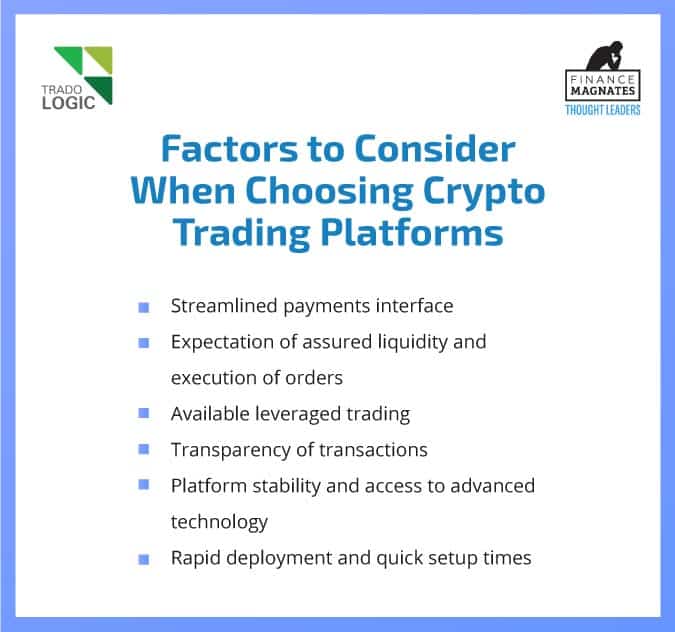
What follows are the top 6 factors considered when choosing a technology provider for their new business offering:
Cryptocurrencies work differently from traditional money systems. Sending and receiving funds relies on 3rd party wallet services, which are rarely user-friendly. They expect users to cram long, complicated addresses, on top of managing their private keys.
Your clients on the other hand, hardly have the technical background to navigate this daunting process. The cumbersome interfaces do not help either. The overall experience leads to a high abandonment rate.
What is required is an automated wallet payment tool that seamlessly plugs into your platform. Integrating an entire closed cycle of cryptocurrency payments leads to fast and easy payments with no delays. Your clients do not need to leave your platform to access a cryptocurrency wallet.
A fully integrated cryptocurrency service for payments increases conversion rates and makes for a better experience for your traders.
Your trading clients expect assured liquidity and execution of orders
Your customers need assurance their every order will get filled. Even with the crazy volatility of cryptocurrency prices, they expect an experience similar to CFD and forex trading. Matching these expectations boil down to liquidity and speed of execution.
Liquidity comes from cryptocurrency exchanges. But you still need to pick the right ones and integrate with enough of them to have assured liquidity. You want to have several liquidity providers at your disposal as a buffer and back end integration with all of them for fast order execution.
Your trading platform experience should match your client expectations.
Available leveraged trading for your clients’ risk appetite
Your clients are familiar with margin trading from their background trading forex and CFD contracts. The volatility of cryptocurrency prices amplifies the potential returns from leveraged trading. You need the best options for your clients that match their risk appetite. Traders are intent on making money in either direction: whether it is a short trade when price is falling or a long trade when price is rising,
With margin trading features, you have all the flexibility to balance client demands for leveraged trading while protecting your funding accounts.
Transparency of transactions
Fiat bank transfers are known to get lost or delayed. The structure of the fiat system makes it impossible to identify where your client's payments are stuck. Cryptocurrencies and blockchains introduce a new level of auditing and tracking assets and payments powered by a decentralized ledger that records ownership.
Therefore, any transfers can be viewed and tracked on this ledger from owner to a receiver. You can rest easy knowing the location of funds and the time it will take for your client's transactions to complete. Both you and your clients can see transactions coming in and reinforces trust on your platform.
Platform stability and cutting edge technology
The last thing a trader wants is to get margin called because they couldn't log in to close an order. The cryptocurrency market is a 24/7 global market. Prices move all the time and are not limited by geographic time zones.
Traders expect full-time access to these markets. Significant market events could bolt from the blue and add to price volatility. Swing traders want to capitalize on volatility, while more conservative traders want to hold off on their trades. Your platform needs to be up and running 99.9% to satisfy your client expectations.
Your clients will never be anxious about open trades once they trust your platform is stable. As a platform provider, you will also need to be agile and responsive to emerging technology. Using blockchain technology will keep your platform ahead of the curve.
Incumbents are continually under pressure in the rapidly evolving Fintech industry. Cryptocurrencies and blockchain technology are a great example. In just five years, distributed ledgers have moved from a niche technology to a real threat to traditional system design.
Rapid deployment and fast setup times
Every day more and more people including potential and existing clients come across the opportunities of trading cryptocurrencies. The mainstream media is pushing more stories to a wider audience driving demand for cryptocurrency services. The strong network effects of blockchain and cryptocurrencies are always playing out.
Capturing the market now will position your platform for growing demand.
Bloomberg
Krypton software, your ideal business partner, and technology provider
We incorporated all these concerns in developing Krypton software. Our technology automatically assigns every user a wallet at the point of registration that seamlessly blends in with your platform. We do all the back end integration work that automatically converts any amount into cryptocurrency. The back end plugs into the top 5 cryptocurrency exchanges to source liquidity.
We aggregate across these 5 sources to offer the best price, volume and margin trading on demand. Our software package comes loaded with the standard leveraged trading ratio of 1:3 available on cryptocurrency exchanges for multiple digital assets. The margin call threshold for your clients is always under your full control. You can configure margin requirements for each asset anywhere from 0.2% to 100% depending on the leverage set.
You can get set up in no time with our 2 week setup time to launch your crypto broker and go to market. Our package includes trading platform and CRM with the largest variety of crypto instruments, seamless deposit flow and an unmatched level of security.
As a partner, we guarantee a day-to-day maintenance and systems monitoring. Our top notch IT professionals carry out regular upgrades to keep your platform running smoothly. We offer a trading experience that matches your client expectations.
Final Thoughts
On the surface, cryptocurrencies and digital assets seem like a threat to traditional trading platforms. We believe it is the exact opposite. Forex and CFD trading platforms are unmatched in providing customer experience for traders. The cryptocurrency exchanges that exist today are struggling to build a reputation. Incumbent trading platforms have a reputation built up over 20 years.
The truth is, blockchain assets are an opportunity for trading platforms to seize the opportunity and leap into the future. Blockchains will power the next generation of asset trading and now is the time to adapt and evolve.
Like you, many online brokers and bookmakers are considering adding cryptocurrency assets to their list of offerings. Their biggest pain point is finding a reliable cryptocurrency trading platform. Online brokers not only want a technology provider, but they also want a business partner.
What follows are the top 6 factors considered when choosing a technology provider for their new business offering:
Cryptocurrencies work differently from traditional money systems. Sending and receiving funds relies on 3rd party wallet services, which are rarely user-friendly. They expect users to cram long, complicated addresses, on top of managing their private keys.
Your clients on the other hand, hardly have the technical background to navigate this daunting process. The cumbersome interfaces do not help either. The overall experience leads to a high abandonment rate.
What is required is an automated wallet payment tool that seamlessly plugs into your platform. Integrating an entire closed cycle of cryptocurrency payments leads to fast and easy payments with no delays. Your clients do not need to leave your platform to access a cryptocurrency wallet.
A fully integrated cryptocurrency service for payments increases conversion rates and makes for a better experience for your traders.
Your trading clients expect assured liquidity and execution of orders
Your customers need assurance their every order will get filled. Even with the crazy volatility of cryptocurrency prices, they expect an experience similar to CFD and forex trading. Matching these expectations boil down to liquidity and speed of execution.
Liquidity comes from cryptocurrency exchanges. But you still need to pick the right ones and integrate with enough of them to have assured liquidity. You want to have several liquidity providers at your disposal as a buffer and back end integration with all of them for fast order execution.
Your trading platform experience should match your client expectations.
Available leveraged trading for your clients’ risk appetite
Your clients are familiar with margin trading from their background trading forex and CFD contracts. The volatility of cryptocurrency prices amplifies the potential returns from leveraged trading. You need the best options for your clients that match their risk appetite. Traders are intent on making money in either direction: whether it is a short trade when price is falling or a long trade when price is rising,
With margin trading features, you have all the flexibility to balance client demands for leveraged trading while protecting your funding accounts.
Transparency of transactions
Fiat bank transfers are known to get lost or delayed. The structure of the fiat system makes it impossible to identify where your client's payments are stuck. Cryptocurrencies and blockchains introduce a new level of auditing and tracking assets and payments powered by a decentralized ledger that records ownership.
Therefore, any transfers can be viewed and tracked on this ledger from owner to a receiver. You can rest easy knowing the location of funds and the time it will take for your client's transactions to complete. Both you and your clients can see transactions coming in and reinforces trust on your platform.
Platform stability and cutting edge technology
The last thing a trader wants is to get margin called because they couldn't log in to close an order. The cryptocurrency market is a 24/7 global market. Prices move all the time and are not limited by geographic time zones.
Traders expect full-time access to these markets. Significant market events could bolt from the blue and add to price volatility. Swing traders want to capitalize on volatility, while more conservative traders want to hold off on their trades. Your platform needs to be up and running 99.9% to satisfy your client expectations.
Your clients will never be anxious about open trades once they trust your platform is stable. As a platform provider, you will also need to be agile and responsive to emerging technology. Using blockchain technology will keep your platform ahead of the curve.
Incumbents are continually under pressure in the rapidly evolving Fintech industry. Cryptocurrencies and blockchain technology are a great example. In just five years, distributed ledgers have moved from a niche technology to a real threat to traditional system design.
Rapid deployment and fast setup times
Every day more and more people including potential and existing clients come across the opportunities of trading cryptocurrencies. The mainstream media is pushing more stories to a wider audience driving demand for cryptocurrency services. The strong network effects of blockchain and cryptocurrencies are always playing out.
Capturing the market now will position your platform for growing demand.
Bloomberg
Krypton software, your ideal business partner, and technology provider
We incorporated all these concerns in developing Krypton software. Our technology automatically assigns every user a wallet at the point of registration that seamlessly blends in with your platform. We do all the back end integration work that automatically converts any amount into cryptocurrency. The back end plugs into the top 5 cryptocurrency exchanges to source liquidity.
We aggregate across these 5 sources to offer the best price, volume and margin trading on demand. Our software package comes loaded with the standard leveraged trading ratio of 1:3 available on cryptocurrency exchanges for multiple digital assets. The margin call threshold for your clients is always under your full control. You can configure margin requirements for each asset anywhere from 0.2% to 100% depending on the leverage set.
You can get set up in no time with our 2 week setup time to launch your crypto broker and go to market. Our package includes trading platform and CRM with the largest variety of crypto instruments, seamless deposit flow and an unmatched level of security.
As a partner, we guarantee a day-to-day maintenance and systems monitoring. Our top notch IT professionals carry out regular upgrades to keep your platform running smoothly. We offer a trading experience that matches your client expectations.
Final Thoughts
On the surface, cryptocurrencies and digital assets seem like a threat to traditional trading platforms. We believe it is the exact opposite. Forex and CFD trading platforms are unmatched in providing customer experience for traders. The cryptocurrency exchanges that exist today are struggling to build a reputation. Incumbent trading platforms have a reputation built up over 20 years.
The truth is, blockchain assets are an opportunity for trading platforms to seize the opportunity and leap into the future. Blockchains will power the next generation of asset trading and now is the time to adapt and evolve.
FP Markets Winner Spotlight 🏆 | Global Broker of the Year 2025 #Trading #Broker #Innovation #Shorts
FP Markets Winner Spotlight 🏆 | Global Broker of the Year 2025 #Trading #Broker #Innovation #Shorts
FP Markets Winner Spotlight 🏆 | Global Broker of the Year 2025 #Trading #Broker #Innovation #Shorts
FP Markets Winner Spotlight 🏆 | Global Broker of the Year 2025 #Trading #Broker #Innovation #Shorts
FP Markets takes the spotlight as Global Broker of the Year 2025 at the Finance Magnates Awards.
Martin Stoilov, Head of Client Experience, shares that trust, innovation, and people played a key role in the company’s success, supported by a strong foundation of integrity and client-centricity.
Following this milestone, FP Markets continues to focus on growth, technology investment, and its core values of transparency and excellence.
👉 Be part of FM Awards 2026: https://awards.financemagnates.com/#nominate
FP Markets takes the spotlight as Global Broker of the Year 2025 at the Finance Magnates Awards.
Martin Stoilov, Head of Client Experience, shares that trust, innovation, and people played a key role in the company’s success, supported by a strong foundation of integrity and client-centricity.
Following this milestone, FP Markets continues to focus on growth, technology investment, and its core values of transparency and excellence.
👉 Be part of FM Awards 2026: https://awards.financemagnates.com/#nominate
FP Markets takes the spotlight as Global Broker of the Year 2025 at the Finance Magnates Awards.
Martin Stoilov, Head of Client Experience, shares that trust, innovation, and people played a key role in the company’s success, supported by a strong foundation of integrity and client-centricity.
Following this milestone, FP Markets continues to focus on growth, technology investment, and its core values of transparency and excellence.
👉 Be part of FM Awards 2026: https://awards.financemagnates.com/#nominate
FP Markets takes the spotlight as Global Broker of the Year 2025 at the Finance Magnates Awards.
Martin Stoilov, Head of Client Experience, shares that trust, innovation, and people played a key role in the company’s success, supported by a strong foundation of integrity and client-centricity.
Following this milestone, FP Markets continues to focus on growth, technology investment, and its core values of transparency and excellence.
👉 Be part of FM Awards 2026: https://awards.financemagnates.com/#nominate
In this video, we review @HolaPrimeMarketsOfficial, a multi-asset forex and CFDs broker offering different account types, trading platforms, and flexible trading conditions.
We cover the broker’s overall offering, including account options, trading environment, platforms like MT4 and MT5, and additional services such as managed accounts and fast withdrawals.
Watch the full video to see if Hola Prime Markets fits your trading needs.
📣 Stay up to date with the latest in finance and trading. Follow Finance Magnates for industry news, insights, and global event coverage.
Connect with us:
🔗 LinkedIn: /financemagnates
👍 Facebook: /financemagnates
📸 Instagram: https://www.instagram.com/financemagnates
🐦 X: https://x.com/financemagnates
🎥 TikTok: https://www.tiktok.com/tag/financemagnates
▶️ YouTube: /@financemagnates_official
#HolaPrime #ForexBroker #CFDTrading #FinanceMagnates #Trading #Forex #BrokerReview
In this video, we review @HolaPrimeMarketsOfficial, a multi-asset forex and CFDs broker offering different account types, trading platforms, and flexible trading conditions.
We cover the broker’s overall offering, including account options, trading environment, platforms like MT4 and MT5, and additional services such as managed accounts and fast withdrawals.
Watch the full video to see if Hola Prime Markets fits your trading needs.
📣 Stay up to date with the latest in finance and trading. Follow Finance Magnates for industry news, insights, and global event coverage.
Connect with us:
🔗 LinkedIn: /financemagnates
👍 Facebook: /financemagnates
📸 Instagram: https://www.instagram.com/financemagnates
🐦 X: https://x.com/financemagnates
🎥 TikTok: https://www.tiktok.com/tag/financemagnates
▶️ YouTube: /@financemagnates_official
#HolaPrime #ForexBroker #CFDTrading #FinanceMagnates #Trading #Forex #BrokerReview
In this video, we review @HolaPrimeMarketsOfficial, a multi-asset forex and CFDs broker offering different account types, trading platforms, and flexible trading conditions.
We cover the broker’s overall offering, including account options, trading environment, platforms like MT4 and MT5, and additional services such as managed accounts and fast withdrawals.
Watch the full video to see if Hola Prime Markets fits your trading needs.
📣 Stay up to date with the latest in finance and trading. Follow Finance Magnates for industry news, insights, and global event coverage.
Connect with us:
🔗 LinkedIn: /financemagnates
👍 Facebook: /financemagnates
📸 Instagram: https://www.instagram.com/financemagnates
🐦 X: https://x.com/financemagnates
🎥 TikTok: https://www.tiktok.com/tag/financemagnates
▶️ YouTube: /@financemagnates_official
#HolaPrime #ForexBroker #CFDTrading #FinanceMagnates #Trading #Forex #BrokerReview
In this video, we review @HolaPrimeMarketsOfficial, a multi-asset forex and CFDs broker offering different account types, trading platforms, and flexible trading conditions.
We cover the broker’s overall offering, including account options, trading environment, platforms like MT4 and MT5, and additional services such as managed accounts and fast withdrawals.
Watch the full video to see if Hola Prime Markets fits your trading needs.
📣 Stay up to date with the latest in finance and trading. Follow Finance Magnates for industry news, insights, and global event coverage.
Connect with us:
🔗 LinkedIn: /financemagnates
👍 Facebook: /financemagnates
📸 Instagram: https://www.instagram.com/financemagnates
🐦 X: https://x.com/financemagnates
🎥 TikTok: https://www.tiktok.com/tag/financemagnates
▶️ YouTube: /@financemagnates_official
#HolaPrime #ForexBroker #CFDTrading #FinanceMagnates #Trading #Forex #BrokerReview
In this video, we review @HolaPrimeMarketsOfficial, a multi-asset forex and CFDs broker offering different account types, trading platforms, and flexible trading conditions.
We cover the broker’s overall offering, including account options, trading environment, platforms like MT4 and MT5, and additional services such as managed accounts and fast withdrawals.
Watch the full video to see if Hola Prime Markets fits your trading needs.
📣 Stay up to date with the latest in finance and trading. Follow Finance Magnates for industry news, insights, and global event coverage.
Connect with us:
🔗 LinkedIn: /financemagnates
👍 Facebook: /financemagnates
📸 Instagram: https://www.instagram.com/financemagnates
🐦 X: https://x.com/financemagnates
🎥 TikTok: https://www.tiktok.com/tag/financemagnates
▶️ YouTube: /@financemagnates_official
#HolaPrime #ForexBroker #CFDTrading #FinanceMagnates #Trading #Forex #BrokerReview
In this video, we review @HolaPrimeMarketsOfficial, a multi-asset forex and CFDs broker offering different account types, trading platforms, and flexible trading conditions.
We cover the broker’s overall offering, including account options, trading environment, platforms like MT4 and MT5, and additional services such as managed accounts and fast withdrawals.
Watch the full video to see if Hola Prime Markets fits your trading needs.
📣 Stay up to date with the latest in finance and trading. Follow Finance Magnates for industry news, insights, and global event coverage.
Connect with us:
🔗 LinkedIn: /financemagnates
👍 Facebook: /financemagnates
📸 Instagram: https://www.instagram.com/financemagnates
🐦 X: https://x.com/financemagnates
🎥 TikTok: https://www.tiktok.com/tag/financemagnates
▶️ YouTube: /@financemagnates_official
#HolaPrime #ForexBroker #CFDTrading #FinanceMagnates #Trading #Forex #BrokerReview
Hola Prime Review: What You Need to Know | Full Breakdown by Finance Magnates
Hola Prime Review: What You Need to Know | Full Breakdown by Finance Magnates
Hola Prime Review: What You Need to Know | Full Breakdown by Finance Magnates
Hola Prime Review: What You Need to Know | Full Breakdown by Finance Magnates
Hola Prime Review: What You Need to Know | Full Breakdown by Finance Magnates
Hola Prime Review: What You Need to Know | Full Breakdown by Finance Magnates
In this video, we review @HolaPrime_Global, a proprietary trading firm offering evaluation programs and performance-based payouts in simulated market environments.
We cover how the challenge model works, including account types, profit splits (up to 95%), trading rules, and what it takes to reach a funded account. You’ll also learn about available platforms like MT4, MT5, cTrader, and more, along with insights into payouts, support, and trading conditions.
Watch the full video to see if Hola Prime fits your trading style.
📣 Stay up to date with the latest in finance and trading. Follow Finance Magnates for industry news, insights, and global event coverage.
Connect with us:
🔗 LinkedIn: /financemagnates
👍 Facebook: /financemagnates
📸 Instagram: https://www.instagram.com/financemagnates
🐦 X: https://x.com/financemagnates
🎥 TikTok: https://www.tiktok.com/tag/financemagnates
▶️ YouTube: /@financemagnates_official
#HolaPrime #PropFirm #Trading #FinanceMagnates #Forex #FuturesTrading #TradingReview #PropFirmReview
In this video, we review @HolaPrime_Global, a proprietary trading firm offering evaluation programs and performance-based payouts in simulated market environments.
We cover how the challenge model works, including account types, profit splits (up to 95%), trading rules, and what it takes to reach a funded account. You’ll also learn about available platforms like MT4, MT5, cTrader, and more, along with insights into payouts, support, and trading conditions.
Watch the full video to see if Hola Prime fits your trading style.
📣 Stay up to date with the latest in finance and trading. Follow Finance Magnates for industry news, insights, and global event coverage.
Connect with us:
🔗 LinkedIn: /financemagnates
👍 Facebook: /financemagnates
📸 Instagram: https://www.instagram.com/financemagnates
🐦 X: https://x.com/financemagnates
🎥 TikTok: https://www.tiktok.com/tag/financemagnates
▶️ YouTube: /@financemagnates_official
#HolaPrime #PropFirm #Trading #FinanceMagnates #Forex #FuturesTrading #TradingReview #PropFirmReview
In this video, we review @HolaPrime_Global, a proprietary trading firm offering evaluation programs and performance-based payouts in simulated market environments.
We cover how the challenge model works, including account types, profit splits (up to 95%), trading rules, and what it takes to reach a funded account. You’ll also learn about available platforms like MT4, MT5, cTrader, and more, along with insights into payouts, support, and trading conditions.
Watch the full video to see if Hola Prime fits your trading style.
📣 Stay up to date with the latest in finance and trading. Follow Finance Magnates for industry news, insights, and global event coverage.
Connect with us:
🔗 LinkedIn: /financemagnates
👍 Facebook: /financemagnates
📸 Instagram: https://www.instagram.com/financemagnates
🐦 X: https://x.com/financemagnates
🎥 TikTok: https://www.tiktok.com/tag/financemagnates
▶️ YouTube: /@financemagnates_official
#HolaPrime #PropFirm #Trading #FinanceMagnates #Forex #FuturesTrading #TradingReview #PropFirmReview
In this video, we review @HolaPrime_Global, a proprietary trading firm offering evaluation programs and performance-based payouts in simulated market environments.
We cover how the challenge model works, including account types, profit splits (up to 95%), trading rules, and what it takes to reach a funded account. You’ll also learn about available platforms like MT4, MT5, cTrader, and more, along with insights into payouts, support, and trading conditions.
Watch the full video to see if Hola Prime fits your trading style.
📣 Stay up to date with the latest in finance and trading. Follow Finance Magnates for industry news, insights, and global event coverage.
Connect with us:
🔗 LinkedIn: /financemagnates
👍 Facebook: /financemagnates
📸 Instagram: https://www.instagram.com/financemagnates
🐦 X: https://x.com/financemagnates
🎥 TikTok: https://www.tiktok.com/tag/financemagnates
▶️ YouTube: /@financemagnates_official
#HolaPrime #PropFirm #Trading #FinanceMagnates #Forex #FuturesTrading #TradingReview #PropFirmReview
In this video, we review @HolaPrime_Global, a proprietary trading firm offering evaluation programs and performance-based payouts in simulated market environments.
We cover how the challenge model works, including account types, profit splits (up to 95%), trading rules, and what it takes to reach a funded account. You’ll also learn about available platforms like MT4, MT5, cTrader, and more, along with insights into payouts, support, and trading conditions.
Watch the full video to see if Hola Prime fits your trading style.
📣 Stay up to date with the latest in finance and trading. Follow Finance Magnates for industry news, insights, and global event coverage.
Connect with us:
🔗 LinkedIn: /financemagnates
👍 Facebook: /financemagnates
📸 Instagram: https://www.instagram.com/financemagnates
🐦 X: https://x.com/financemagnates
🎥 TikTok: https://www.tiktok.com/tag/financemagnates
▶️ YouTube: /@financemagnates_official
#HolaPrime #PropFirm #Trading #FinanceMagnates #Forex #FuturesTrading #TradingReview #PropFirmReview
In this video, we review @HolaPrime_Global, a proprietary trading firm offering evaluation programs and performance-based payouts in simulated market environments.
We cover how the challenge model works, including account types, profit splits (up to 95%), trading rules, and what it takes to reach a funded account. You’ll also learn about available platforms like MT4, MT5, cTrader, and more, along with insights into payouts, support, and trading conditions.
Watch the full video to see if Hola Prime fits your trading style.
📣 Stay up to date with the latest in finance and trading. Follow Finance Magnates for industry news, insights, and global event coverage.
Connect with us:
🔗 LinkedIn: /financemagnates
👍 Facebook: /financemagnates
📸 Instagram: https://www.instagram.com/financemagnates
🐦 X: https://x.com/financemagnates
🎥 TikTok: https://www.tiktok.com/tag/financemagnates
▶️ YouTube: /@financemagnates_official
#HolaPrime #PropFirm #Trading #FinanceMagnates #Forex #FuturesTrading #TradingReview #PropFirmReview
Axi Winner Spotlight 🏆 | Global Most Innovative Broker 2025 #Innovation #Trading #Fintech #Broker
Axi Winner Spotlight 🏆 | Global Most Innovative Broker 2025 #Innovation #Trading #Fintech #Broker
Axi Winner Spotlight 🏆 | Global Most Innovative Broker 2025 #Innovation #Trading #Fintech #Broker
Axi Winner Spotlight 🏆 | Global Most Innovative Broker 2025 #Innovation #Trading #Fintech #Broker
Axi Winner Spotlight 🏆 | Global Most Innovative Broker 2025 #Innovation #Trading #Fintech #Broker
Axi Winner Spotlight 🏆 | Global Most Innovative Broker 2025 #Innovation #Trading #Fintech #Broker
Axi takes the spotlight at the Finance Magnates Awards, winning Global Most Innovative Broker 2025.
Olivia Xenofontos and Ivanna Openko share how the team will feel: proud, motivated, and ready to keep delivering.
They also describe the night as well-organized, focused, and enjoyable for all.
👉 Be part of FM Awards 2026.
Axi takes the spotlight at the Finance Magnates Awards, winning Global Most Innovative Broker 2025.
Olivia Xenofontos and Ivanna Openko share how the team will feel: proud, motivated, and ready to keep delivering.
They also describe the night as well-organized, focused, and enjoyable for all.
👉 Be part of FM Awards 2026.
Axi takes the spotlight at the Finance Magnates Awards, winning Global Most Innovative Broker 2025.
Olivia Xenofontos and Ivanna Openko share how the team will feel: proud, motivated, and ready to keep delivering.
They also describe the night as well-organized, focused, and enjoyable for all.
👉 Be part of FM Awards 2026.
Axi takes the spotlight at the Finance Magnates Awards, winning Global Most Innovative Broker 2025.
Olivia Xenofontos and Ivanna Openko share how the team will feel: proud, motivated, and ready to keep delivering.
They also describe the night as well-organized, focused, and enjoyable for all.
👉 Be part of FM Awards 2026.
Axi takes the spotlight at the Finance Magnates Awards, winning Global Most Innovative Broker 2025.
Olivia Xenofontos and Ivanna Openko share how the team will feel: proud, motivated, and ready to keep delivering.
They also describe the night as well-organized, focused, and enjoyable for all.
👉 Be part of FM Awards 2026.
Axi takes the spotlight at the Finance Magnates Awards, winning Global Most Innovative Broker 2025.
Olivia Xenofontos and Ivanna Openko share how the team will feel: proud, motivated, and ready to keep delivering.
They also describe the night as well-organized, focused, and enjoyable for all.
👉 Be part of FM Awards 2026.
Recognition that matters.
Built on transparency.
Driven by the industry.
The Finance Magnates Awards 2026.
Nominations are now open.
🔗 https://awards.financemagnates.com/?utm_source=SM&utm_medium=social&utm_campaign=recognition-matters
Recognition that matters.
Built on transparency.
Driven by the industry.
The Finance Magnates Awards 2026.
Nominations are now open.
🔗 https://awards.financemagnates.com/?utm_source=SM&utm_medium=social&utm_campaign=recognition-matters
Recognition that matters.
Built on transparency.
Driven by the industry.
The Finance Magnates Awards 2026.
Nominations are now open.
🔗 https://awards.financemagnates.com/?utm_source=SM&utm_medium=social&utm_campaign=recognition-matters
Recognition that matters.
Built on transparency.
Driven by the industry.
The Finance Magnates Awards 2026.
Nominations are now open.
🔗 https://awards.financemagnates.com/?utm_source=SM&utm_medium=social&utm_campaign=recognition-matters
Recognition that matters.
Built on transparency.
Driven by the industry.
The Finance Magnates Awards 2026.
Nominations are now open.
🔗 https://awards.financemagnates.com/?utm_source=SM&utm_medium=social&utm_campaign=recognition-matters
Recognition that matters.
Built on transparency.
Driven by the industry.
The Finance Magnates Awards 2026.
Nominations are now open.
🔗 https://awards.financemagnates.com/?utm_source=SM&utm_medium=social&utm_campaign=recognition-matters