
No matter how good your idea it is often the user experience that decides the fate of your token sale
COINAdmin
UX – user experience – is the main assistant (or enemy) in token sales, where participants need to be facilitated and carefully ‘guided’ towards contributing. If they stumble at any step or feel that they do not have sufficient information, they are likely to either reduce their participation or stop altogether.
Here are five UX features that help you create the most seamless experience for your contributors.
Token sales deal with real money, which means contributors appreciate simplicity, clarity and a convenient experience. It is frustrating when instructions are sparse or small issues are not clarified, prompting questions and mistakes, which can result in lost funds and wastage of time.
Additionally, given how prospective contributors have possibly already spent a decent amount of time researching your venture, a poor experience can leave them severely disappointed. In light of the above, there are 5 key improvements to implement in order to shorten the user’s path to your token.
1. Ability to login with social media accounts
Put the case, there’s no need to “verify” the email of your new users when LinkedIn, Twitter or Google have already done so.
Prompting your contributors to leave your website is the last thing you want to do. When people have already decided to purchase tokens, redirecting them to their mailbox and prolonging the registration procedure by at least five steps can force users to reconsider.
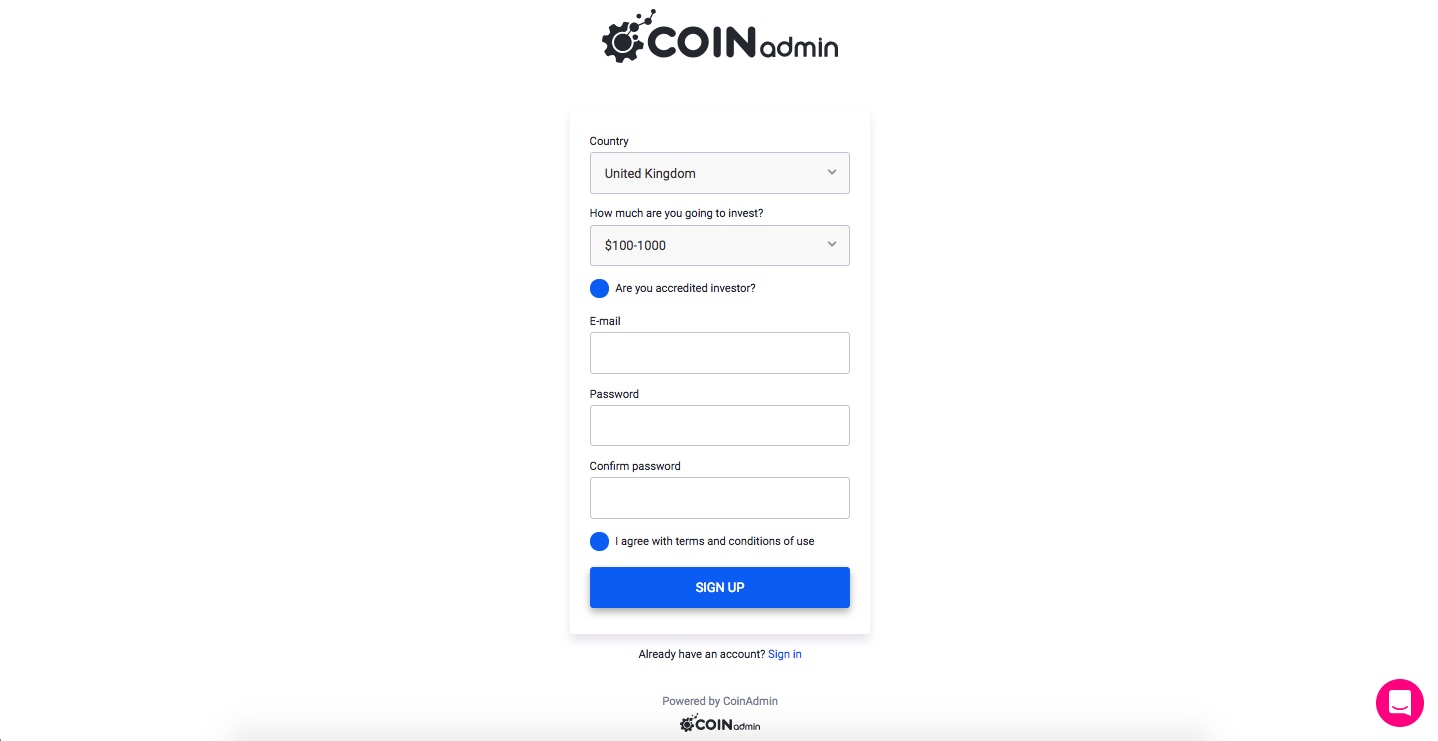
In addition, filling out text boxes manually is pointless when you can provide new users with the option to automatically complete the registration form with details from their social network profile.
To sum it up, the social login feature has these advantages:
New users don’t leave the website – streamline the registration process;
Automatically fill out the form – investors spend less time doing tasks manually that can be completed with a click;
Twitter, Google+, Facebook, and LinkedIn - four of the most popular social networks available;
GitHub support; appreciated by crypto developers and enthusiasts
2. Simple but informative ‘Buy Tokens’ page
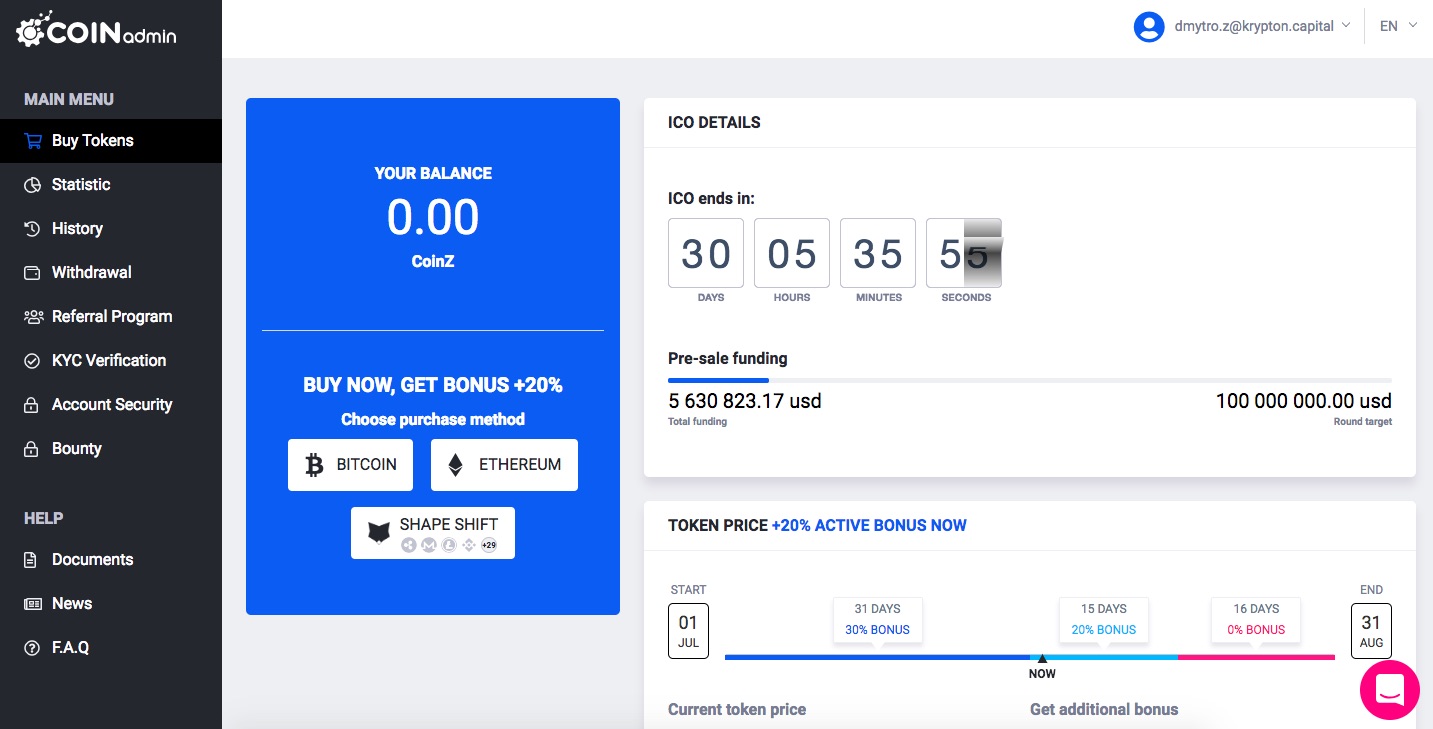
After logging in with COINAdmin, your users are immediately greeted by the ‘Buy Tokens’ page – which includes a minimalistic countdown timer and funding progress bar that creates a sense of urgency and entices investors to participate.
The page also displays an investor’s current balance and current bonuses available. Handy payment options buttons redirect investors directly to the purchasing interface.
Additionally, all of the information on the ‘Buy Token’ page can be embedded into the home page of your token sale through a versatile API.
‘Buy Tokens’ is landing page after logging in;
Countdown Timer motivates investors to buy;
Include info on ICO home page through API
3. Streamlined purchase interface
When it comes to the purchase, there’s no space for clutter. The interface for buying tokens is streamlined and minimalistic but includes all the important details for your investors.
The final amount of tokens purchased has been broken down to show token price and bonuses by types. The payment address has a quick copy button, and there is a QR code that can be scanned instead.
All of this ensures your contributors are clear about the contribution they are about to make, and are not distracted by unnecessary information.
Minimalistic purchase interface – only the important information is included;
Price calculation is broken down;
Investors can choose between copying wallet address and scanning QR code;
4. Help section
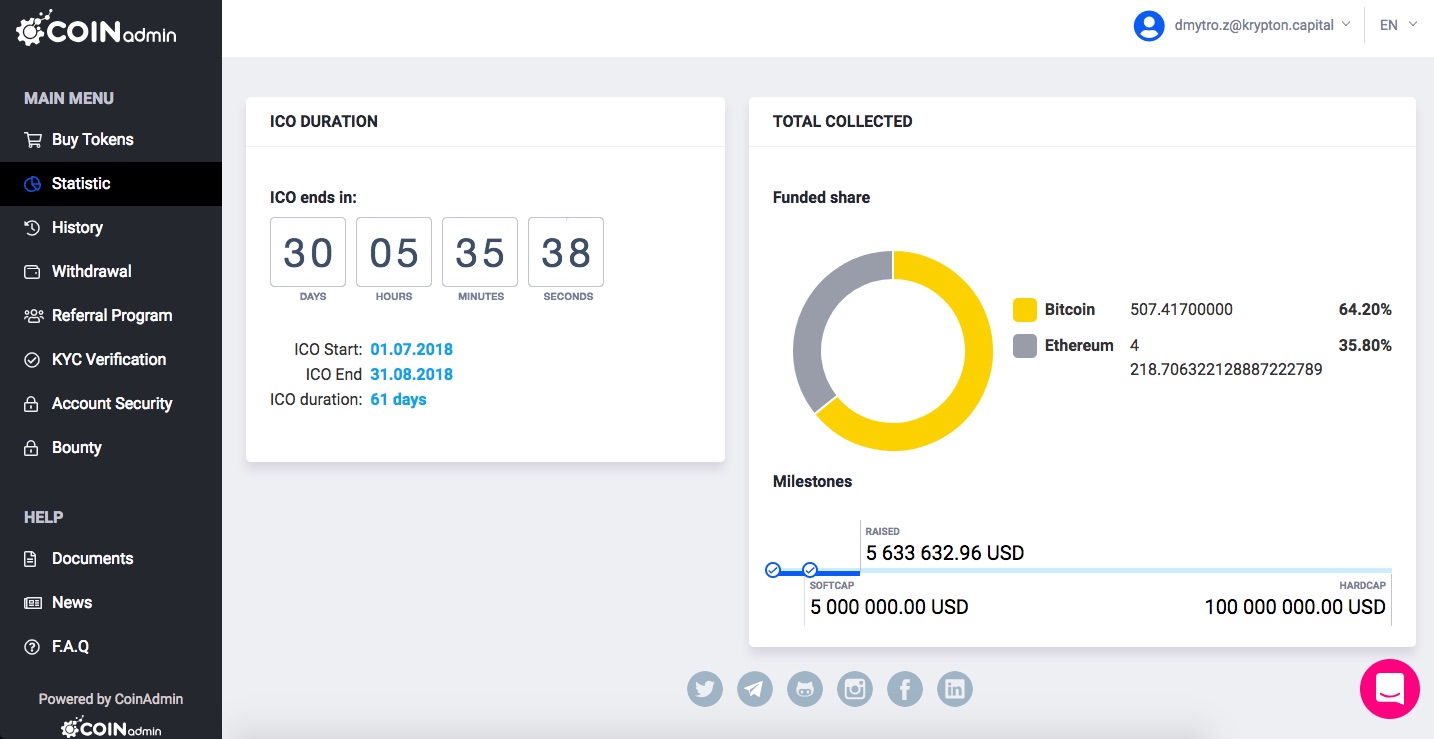
COINAdmin’s navigation bar includes a help section that has been separated from the rest of the options to underline its importance. Tabs included in the Help section by default include Documents, News, and F.A.Q.
This section helps keep your contributors informed and answers some of the most common questions they may have, without forcing them to leave the interface.
Help Section – easy to find in the navigation bar;
Documents, News, and F.A.Q. all in one place;
News includes the latest tweets from your token sale’s Twitter page.
5. Live chat integration
While F.A.Q are great, often contributors have questions which they need to be answered ASAP, and that’s where the live chat integration in COINAdmin comes in handy. Using the live chat, contributors can request support 24/7, directly through the interface.
Customize Your Token Sale for an even better experience
The 5 features listed above are developed to deliver a great user experience, but it doesn’t end there. COINAdmin also has full customization support for the dashboard, including extra features such as support for localization and third-party KYC solutions. If you’re interested in a complete token sale dashboard solution, look no further than COINAdmin.
Disclaimer: The content of this article is sponsored and does not represent the opinions of Finance Magnates.
UX – user experience – is the main assistant (or enemy) in token sales, where participants need to be facilitated and carefully ‘guided’ towards contributing. If they stumble at any step or feel that they do not have sufficient information, they are likely to either reduce their participation or stop altogether.
Here are five UX features that help you create the most seamless experience for your contributors.
Token sales deal with real money, which means contributors appreciate simplicity, clarity and a convenient experience. It is frustrating when instructions are sparse or small issues are not clarified, prompting questions and mistakes, which can result in lost funds and wastage of time.
Additionally, given how prospective contributors have possibly already spent a decent amount of time researching your venture, a poor experience can leave them severely disappointed. In light of the above, there are 5 key improvements to implement in order to shorten the user’s path to your token.
1. Ability to login with social media accounts
Put the case, there’s no need to “verify” the email of your new users when LinkedIn, Twitter or Google have already done so.
Prompting your contributors to leave your website is the last thing you want to do. When people have already decided to purchase tokens, redirecting them to their mailbox and prolonging the registration procedure by at least five steps can force users to reconsider.
In addition, filling out text boxes manually is pointless when you can provide new users with the option to automatically complete the registration form with details from their social network profile.
To sum it up, the social login feature has these advantages:
New users don’t leave the website – streamline the registration process;
Automatically fill out the form – investors spend less time doing tasks manually that can be completed with a click;
Twitter, Google+, Facebook, and LinkedIn - four of the most popular social networks available;
GitHub support; appreciated by crypto developers and enthusiasts
2. Simple but informative ‘Buy Tokens’ page
After logging in with COINAdmin, your users are immediately greeted by the ‘Buy Tokens’ page – which includes a minimalistic countdown timer and funding progress bar that creates a sense of urgency and entices investors to participate.
The page also displays an investor’s current balance and current bonuses available. Handy payment options buttons redirect investors directly to the purchasing interface.
Additionally, all of the information on the ‘Buy Token’ page can be embedded into the home page of your token sale through a versatile API.
‘Buy Tokens’ is landing page after logging in;
Countdown Timer motivates investors to buy;
Include info on ICO home page through API
3. Streamlined purchase interface
When it comes to the purchase, there’s no space for clutter. The interface for buying tokens is streamlined and minimalistic but includes all the important details for your investors.
The final amount of tokens purchased has been broken down to show token price and bonuses by types. The payment address has a quick copy button, and there is a QR code that can be scanned instead.
All of this ensures your contributors are clear about the contribution they are about to make, and are not distracted by unnecessary information.
Minimalistic purchase interface – only the important information is included;
Price calculation is broken down;
Investors can choose between copying wallet address and scanning QR code;
4. Help section
COINAdmin’s navigation bar includes a help section that has been separated from the rest of the options to underline its importance. Tabs included in the Help section by default include Documents, News, and F.A.Q.
This section helps keep your contributors informed and answers some of the most common questions they may have, without forcing them to leave the interface.
Help Section – easy to find in the navigation bar;
Documents, News, and F.A.Q. all in one place;
News includes the latest tweets from your token sale’s Twitter page.
5. Live chat integration
While F.A.Q are great, often contributors have questions which they need to be answered ASAP, and that’s where the live chat integration in COINAdmin comes in handy. Using the live chat, contributors can request support 24/7, directly through the interface.
Customize Your Token Sale for an even better experience
The 5 features listed above are developed to deliver a great user experience, but it doesn’t end there. COINAdmin also has full customization support for the dashboard, including extra features such as support for localization and third-party KYC solutions. If you’re interested in a complete token sale dashboard solution, look no further than COINAdmin.
Disclaimer: The content of this article is sponsored and does not represent the opinions of Finance Magnates.
SMX's 1900% Surge Since November Is Not a Momentum Trade; It's Based on Transformative and Deliverable Techology
Featured Videos
Executive Interview | Charlotte Bullock | Chief Product Officer, Bank of London | FMLS:25
In this interview, we sat down with Charlotte Bullock, Head of Product at The Bank of London, previously at SAP and now shaping product at one of the sector’s most ambitious new banking players.
Charlotte reflects on the Summit so far and talks about the culture inside fintech banks today. We look at the pressures that come with scaling, and how firms can hold onto the nimble approach that made them stand out early on.
We also cover the state of payments ahead of her appearance on the payments roundtable: the blockages financial firms face, the areas that still need fixing, and what a realistic solution looks like in 2026.
In this interview, we sat down with Charlotte Bullock, Head of Product at The Bank of London, previously at SAP and now shaping product at one of the sector’s most ambitious new banking players.
Charlotte reflects on the Summit so far and talks about the culture inside fintech banks today. We look at the pressures that come with scaling, and how firms can hold onto the nimble approach that made them stand out early on.
We also cover the state of payments ahead of her appearance on the payments roundtable: the blockages financial firms face, the areas that still need fixing, and what a realistic solution looks like in 2026.
In this interview, we sat down with Charlotte Bullock, Head of Product at The Bank of London, previously at SAP and now shaping product at one of the sector’s most ambitious new banking players.
Charlotte reflects on the Summit so far and talks about the culture inside fintech banks today. We look at the pressures that come with scaling, and how firms can hold onto the nimble approach that made them stand out early on.
We also cover the state of payments ahead of her appearance on the payments roundtable: the blockages financial firms face, the areas that still need fixing, and what a realistic solution looks like in 2026.
In this interview, we sat down with Charlotte Bullock, Head of Product at The Bank of London, previously at SAP and now shaping product at one of the sector’s most ambitious new banking players.
Charlotte reflects on the Summit so far and talks about the culture inside fintech banks today. We look at the pressures that come with scaling, and how firms can hold onto the nimble approach that made them stand out early on.
We also cover the state of payments ahead of her appearance on the payments roundtable: the blockages financial firms face, the areas that still need fixing, and what a realistic solution looks like in 2026.
In this conversation, we sit down with Drew Niv, CSO at ATFX Connect and one of the most influential figures in modern FX.
We speak about market structure, the institutional view on liquidity, and the sharp rise of prop trading, a sector Drew has been commenting on in recent months. Drew explains why he once dismissed prop trading, why his view changed, and what he now thinks the model means for brokers, clients and risk managers.
We explore subscription-fee dependency, the high reneging rate, and the long-term challenge: how brokers can build a more stable and honest version of the model. Drew also talks about the traffic advantage standalone prop firms have built and why brokers may still win in the long run if they take the right approach.
In this conversation, we sit down with Drew Niv, CSO at ATFX Connect and one of the most influential figures in modern FX.
We speak about market structure, the institutional view on liquidity, and the sharp rise of prop trading, a sector Drew has been commenting on in recent months. Drew explains why he once dismissed prop trading, why his view changed, and what he now thinks the model means for brokers, clients and risk managers.
We explore subscription-fee dependency, the high reneging rate, and the long-term challenge: how brokers can build a more stable and honest version of the model. Drew also talks about the traffic advantage standalone prop firms have built and why brokers may still win in the long run if they take the right approach.
In this conversation, we sit down with Drew Niv, CSO at ATFX Connect and one of the most influential figures in modern FX.
We speak about market structure, the institutional view on liquidity, and the sharp rise of prop trading, a sector Drew has been commenting on in recent months. Drew explains why he once dismissed prop trading, why his view changed, and what he now thinks the model means for brokers, clients and risk managers.
We explore subscription-fee dependency, the high reneging rate, and the long-term challenge: how brokers can build a more stable and honest version of the model. Drew also talks about the traffic advantage standalone prop firms have built and why brokers may still win in the long run if they take the right approach.
In this conversation, we sit down with Drew Niv, CSO at ATFX Connect and one of the most influential figures in modern FX.
We speak about market structure, the institutional view on liquidity, and the sharp rise of prop trading, a sector Drew has been commenting on in recent months. Drew explains why he once dismissed prop trading, why his view changed, and what he now thinks the model means for brokers, clients and risk managers.
We explore subscription-fee dependency, the high reneging rate, and the long-term challenge: how brokers can build a more stable and honest version of the model. Drew also talks about the traffic advantage standalone prop firms have built and why brokers may still win in the long run if they take the right approach.
In this conversation, we sit down with Drew Niv, CSO at ATFX Connect and one of the most influential figures in modern FX.
We speak about market structure, the institutional view on liquidity, and the sharp rise of prop trading, a sector Drew has been commenting on in recent months. Drew explains why he once dismissed prop trading, why his view changed, and what he now thinks the model means for brokers, clients and risk managers.
We explore subscription-fee dependency, the high reneging rate, and the long-term challenge: how brokers can build a more stable and honest version of the model. Drew also talks about the traffic advantage standalone prop firms have built and why brokers may still win in the long run if they take the right approach.
In this conversation, we sit down with Drew Niv, CSO at ATFX Connect and one of the most influential figures in modern FX.
We speak about market structure, the institutional view on liquidity, and the sharp rise of prop trading, a sector Drew has been commenting on in recent months. Drew explains why he once dismissed prop trading, why his view changed, and what he now thinks the model means for brokers, clients and risk managers.
We explore subscription-fee dependency, the high reneging rate, and the long-term challenge: how brokers can build a more stable and honest version of the model. Drew also talks about the traffic advantage standalone prop firms have built and why brokers may still win in the long run if they take the right approach.
Executive Interview | Remonda Z. Kirketerp Møller| CEO & Founder Muinmos | FMLS:25
In this interview, Remonda Z. Kirketerp Møller, founder of Muinmos, breaks down the state of AI in regtech and what responsible adoption really looks like for brokers. We talk about rising fragmentation, the pressures around compliance accuracy, and why most firms are still in the early stages of AI maturity.
Ramanda also shares insights on regulator sandboxes, shifting expectations around accountability, and the current reality of MiCA licensing and passporting in Europe.
A concise look at where compliance, onboarding, and AI-driven processes are heading next.
In this interview, Remonda Z. Kirketerp Møller, founder of Muinmos, breaks down the state of AI in regtech and what responsible adoption really looks like for brokers. We talk about rising fragmentation, the pressures around compliance accuracy, and why most firms are still in the early stages of AI maturity.
Ramanda also shares insights on regulator sandboxes, shifting expectations around accountability, and the current reality of MiCA licensing and passporting in Europe.
A concise look at where compliance, onboarding, and AI-driven processes are heading next.
In this interview, Remonda Z. Kirketerp Møller, founder of Muinmos, breaks down the state of AI in regtech and what responsible adoption really looks like for brokers. We talk about rising fragmentation, the pressures around compliance accuracy, and why most firms are still in the early stages of AI maturity.
Ramanda also shares insights on regulator sandboxes, shifting expectations around accountability, and the current reality of MiCA licensing and passporting in Europe.
A concise look at where compliance, onboarding, and AI-driven processes are heading next.
In this interview, Remonda Z. Kirketerp Møller, founder of Muinmos, breaks down the state of AI in regtech and what responsible adoption really looks like for brokers. We talk about rising fragmentation, the pressures around compliance accuracy, and why most firms are still in the early stages of AI maturity.
Ramanda also shares insights on regulator sandboxes, shifting expectations around accountability, and the current reality of MiCA licensing and passporting in Europe.
A concise look at where compliance, onboarding, and AI-driven processes are heading next.
In this interview, Remonda Z. Kirketerp Møller, founder of Muinmos, breaks down the state of AI in regtech and what responsible adoption really looks like for brokers. We talk about rising fragmentation, the pressures around compliance accuracy, and why most firms are still in the early stages of AI maturity.
Ramanda also shares insights on regulator sandboxes, shifting expectations around accountability, and the current reality of MiCA licensing and passporting in Europe.
A concise look at where compliance, onboarding, and AI-driven processes are heading next.
In this interview, Remonda Z. Kirketerp Møller, founder of Muinmos, breaks down the state of AI in regtech and what responsible adoption really looks like for brokers. We talk about rising fragmentation, the pressures around compliance accuracy, and why most firms are still in the early stages of AI maturity.
Ramanda also shares insights on regulator sandboxes, shifting expectations around accountability, and the current reality of MiCA licensing and passporting in Europe.
A concise look at where compliance, onboarding, and AI-driven processes are heading next.
In this conversation, we speak with Aydin Bonabi, CEO and co-founder of Surveill, a firm focused on fraud detection and AI-driven compliance tools for financial institutions.
We start with Aydin’s view of the Summit and the challenges brokers face as fraud tactics grow more complex. He explains how firms can stay ahead through real-time signals, data patterns, and early-stage detection.
We also talk about AI training and why compliance teams often struggle to keep models accurate, fair, and aligned with regulatory expectations. Aydin breaks down what “good” AI training looks like inside a financial environment, including the importance of clean data, domain expertise, and human oversight.
He closes with a clear message: fraud is scaling, and so must the tools that stop it.
In this conversation, we speak with Aydin Bonabi, CEO and co-founder of Surveill, a firm focused on fraud detection and AI-driven compliance tools for financial institutions.
We start with Aydin’s view of the Summit and the challenges brokers face as fraud tactics grow more complex. He explains how firms can stay ahead through real-time signals, data patterns, and early-stage detection.
We also talk about AI training and why compliance teams often struggle to keep models accurate, fair, and aligned with regulatory expectations. Aydin breaks down what “good” AI training looks like inside a financial environment, including the importance of clean data, domain expertise, and human oversight.
He closes with a clear message: fraud is scaling, and so must the tools that stop it.
In this conversation, we speak with Aydin Bonabi, CEO and co-founder of Surveill, a firm focused on fraud detection and AI-driven compliance tools for financial institutions.
We start with Aydin’s view of the Summit and the challenges brokers face as fraud tactics grow more complex. He explains how firms can stay ahead through real-time signals, data patterns, and early-stage detection.
We also talk about AI training and why compliance teams often struggle to keep models accurate, fair, and aligned with regulatory expectations. Aydin breaks down what “good” AI training looks like inside a financial environment, including the importance of clean data, domain expertise, and human oversight.
He closes with a clear message: fraud is scaling, and so must the tools that stop it.
In this conversation, we speak with Aydin Bonabi, CEO and co-founder of Surveill, a firm focused on fraud detection and AI-driven compliance tools for financial institutions.
We start with Aydin’s view of the Summit and the challenges brokers face as fraud tactics grow more complex. He explains how firms can stay ahead through real-time signals, data patterns, and early-stage detection.
We also talk about AI training and why compliance teams often struggle to keep models accurate, fair, and aligned with regulatory expectations. Aydin breaks down what “good” AI training looks like inside a financial environment, including the importance of clean data, domain expertise, and human oversight.
He closes with a clear message: fraud is scaling, and so must the tools that stop it.
In this conversation, we speak with Aydin Bonabi, CEO and co-founder of Surveill, a firm focused on fraud detection and AI-driven compliance tools for financial institutions.
We start with Aydin’s view of the Summit and the challenges brokers face as fraud tactics grow more complex. He explains how firms can stay ahead through real-time signals, data patterns, and early-stage detection.
We also talk about AI training and why compliance teams often struggle to keep models accurate, fair, and aligned with regulatory expectations. Aydin breaks down what “good” AI training looks like inside a financial environment, including the importance of clean data, domain expertise, and human oversight.
He closes with a clear message: fraud is scaling, and so must the tools that stop it.
In this conversation, we speak with Aydin Bonabi, CEO and co-founder of Surveill, a firm focused on fraud detection and AI-driven compliance tools for financial institutions.
We start with Aydin’s view of the Summit and the challenges brokers face as fraud tactics grow more complex. He explains how firms can stay ahead through real-time signals, data patterns, and early-stage detection.
We also talk about AI training and why compliance teams often struggle to keep models accurate, fair, and aligned with regulatory expectations. Aydin breaks down what “good” AI training looks like inside a financial environment, including the importance of clean data, domain expertise, and human oversight.
He closes with a clear message: fraud is scaling, and so must the tools that stop it.
Exness expands its presence in Africa: Inside our interview with Paul Margarites in Cape Town
Finance Magnates met with Paul Margarites, Exness regional commercial director for Sub-Saharan Africa, during a visit to the firm’s office opening in Cape Town. In this talk, led by Andrea Badiola Mateos, Co-CEO at Finance Magnates, Paul shares views on the South African trading space, local user behavior, mobile trends, regulation, team growth, and how Exness plans to grow in more markets across the region. @Exness
Read the article at: https://www.financemagnates.com/thought-leadership/exness-expands-its-presence-in-africa-inside-our-interview-with-paul-margarites/
#exness #financemagnates #exnesstrading #CFDtrading #tradeonline #africanews #capetown
Finance Magnates met with Paul Margarites, Exness regional commercial director for Sub-Saharan Africa, during a visit to the firm’s office opening in Cape Town. In this talk, led by Andrea Badiola Mateos, Co-CEO at Finance Magnates, Paul shares views on the South African trading space, local user behavior, mobile trends, regulation, team growth, and how Exness plans to grow in more markets across the region. @Exness
Read the article at: https://www.financemagnates.com/thought-leadership/exness-expands-its-presence-in-africa-inside-our-interview-with-paul-margarites/
#exness #financemagnates #exnesstrading #CFDtrading #tradeonline #africanews #capetown
Finance Magnates met with Paul Margarites, Exness regional commercial director for Sub-Saharan Africa, during a visit to the firm’s office opening in Cape Town. In this talk, led by Andrea Badiola Mateos, Co-CEO at Finance Magnates, Paul shares views on the South African trading space, local user behavior, mobile trends, regulation, team growth, and how Exness plans to grow in more markets across the region. @Exness
Read the article at: https://www.financemagnates.com/thought-leadership/exness-expands-its-presence-in-africa-inside-our-interview-with-paul-margarites/
#exness #financemagnates #exnesstrading #CFDtrading #tradeonline #africanews #capetown
Finance Magnates met with Paul Margarites, Exness regional commercial director for Sub-Saharan Africa, during a visit to the firm’s office opening in Cape Town. In this talk, led by Andrea Badiola Mateos, Co-CEO at Finance Magnates, Paul shares views on the South African trading space, local user behavior, mobile trends, regulation, team growth, and how Exness plans to grow in more markets across the region. @Exness
Read the article at: https://www.financemagnates.com/thought-leadership/exness-expands-its-presence-in-africa-inside-our-interview-with-paul-margarites/
#exness #financemagnates #exnesstrading #CFDtrading #tradeonline #africanews #capetown
Finance Magnates met with Paul Margarites, Exness regional commercial director for Sub-Saharan Africa, during a visit to the firm’s office opening in Cape Town. In this talk, led by Andrea Badiola Mateos, Co-CEO at Finance Magnates, Paul shares views on the South African trading space, local user behavior, mobile trends, regulation, team growth, and how Exness plans to grow in more markets across the region. @Exness
Read the article at: https://www.financemagnates.com/thought-leadership/exness-expands-its-presence-in-africa-inside-our-interview-with-paul-margarites/
#exness #financemagnates #exnesstrading #CFDtrading #tradeonline #africanews #capetown
Finance Magnates met with Paul Margarites, Exness regional commercial director for Sub-Saharan Africa, during a visit to the firm’s office opening in Cape Town. In this talk, led by Andrea Badiola Mateos, Co-CEO at Finance Magnates, Paul shares views on the South African trading space, local user behavior, mobile trends, regulation, team growth, and how Exness plans to grow in more markets across the region. @Exness
Read the article at: https://www.financemagnates.com/thought-leadership/exness-expands-its-presence-in-africa-inside-our-interview-with-paul-margarites/
#exness #financemagnates #exnesstrading #CFDtrading #tradeonline #africanews #capetown