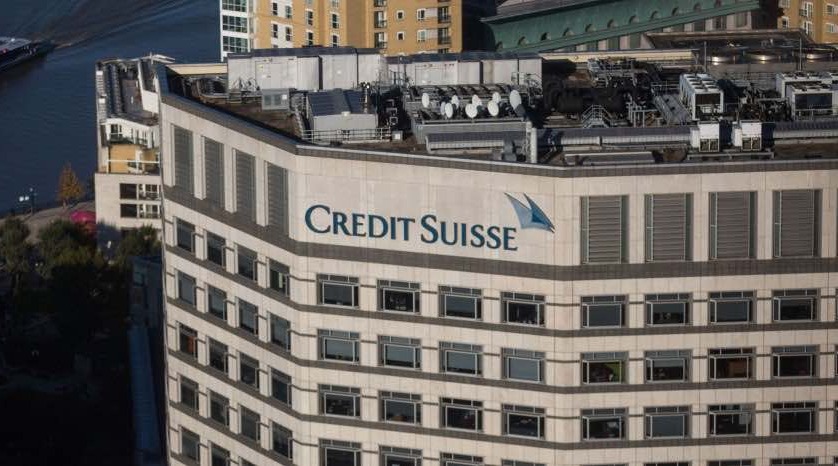
FINMA decided to write off the $17 billion AT1 bonds of Credit Suisse.
Saudi National Bank Lost up to $1.2 billion from the deal.
On Sunday, UBS agreed to buy rival Credit Suisse for EUR 3 billion. While the deal, supported by Swiss regulators, was about to stabilize the country's potential banking crisis, it has pushed global markets into downward spirals as they opened on Monday morning.
Credit Suisse Acquisitions Put Global Markets in Red
The share price of Credit Suisse plunged over 63 percent within an hour of the opening of the European market, only to recover at about a loss of 58 percent as of press time. UBS stock prices also went down by over 13 percent before recovering to some extent. These plummets dragged down the European STOXX 600 which dropped marginally by 1.6 percent before staging a modest recovery.
Credit Suisse share price movement on Monday
Despite the remarkable takeover, the harsh investors' sentiment resulted from a term in the deal: Swiss financial regulator FINMA ordered the writing off of the risky additional tier one (AT1) bonds of Credit Suisse. This has whipped out the value of about $17 billion of bonds to zero.
"The extraordinary government support will trigger a complete write-down of the nominal value of all AT1 shares of Credit Suisse in the amount of around SFr16bn, and thus an increase in core capital," the Swiss regulator stated.
What Are AT1 Bonds?
AT1 bonds were introduced as a part of the post-global financial crisis regulatory reforms to push the banks to increase their capital levels. These bonds are contingent convertible securities, meaning they can be converted into equity if the bank runs into trouble. They offer much higher yields for compensating the risks associated with these bonds.
After UBS's confirmation of the Credit Suisse takeover on Sunday, market participants did not anticipate any drastic clause to be involved with the AT1 bonds. Instead, traders marked up the quoting price of Credit Suisse's AT1 bonds after confirming the deal.
"The market is likely to be shocked by such a blatant inversion of the hierarchy of creditors and by the decision to sweeten an equity deal at the expense of bondholders," Jérôme Legras, the Head of Research at Axiom Alternative Investments, told Financial Times.
In addition, the market conditions forced the European banking regulators to reiterate that AT1 bonds only take losses outside Switzerland after contributors of common equity Tier 1, such as shareholders, have been wiped out. However, the Swiss regulator took the opposite approach of wiping out Credit Suisse AT1 holders while leaving shareholders with the possibility of receiving some payment from the UBS takeover.
"The resolution framework implementing in the European Union the reforms recommended by the Financial Stability Board after the Great Financial Crisis has established, among others, the order according to which shareholders and creditors of a troubled bank should bear losses," a joint statement by Single Resolution Board, European Banking Authority and ECB Banking Supervision noted.
"In particular, common equity instruments are the first ones to absorb losses, and only after their full use would Additional Tier One be required to be written down. This approach has been consistently applied in past cases and will continue to guide the actions of the SRB and ECB banking supervision in crisis interventions."
A Remarkable Deal, but a Disaster for Shareholders
Swiss regulators supported UBS's acquisition of Credit Suisse to avoid any further crisis in the country's banking sector. The deal was also closed after UBS significantly upped its bid for the rival lender. However, the agreed price still remained lower than the closing price of Credit Suisse shares on Friday.
The shareholders of Credit Suisse were not consulted for the deal as the regulator had already greenlighted it as an emergency measure.
Though the deal is believed to have saved the Swiss and the larger European banking sector from a looming crisis, it was unfavourable towards Credit Suisse shareholders. Saudi National Bank, which holds 9.9 percent of Credit Suisse stakes, confirmed a loss of up to $1.2 billion.
"As [of] December 2022, SNB's investment in Credit Suisse constituted less than 0.5 percent of SNB's total Assets, and c. 1.7 percent of SNB's investments portfolio," the Saudi National Bank said in a statement. "Changes in the valuation of SNB's investment in Credit Suisse have no impact on SNB's growth plans and forward looking 2023 guidance."
On Sunday, UBS agreed to buy rival Credit Suisse for EUR 3 billion. While the deal, supported by Swiss regulators, was about to stabilize the country's potential banking crisis, it has pushed global markets into downward spirals as they opened on Monday morning.
Credit Suisse Acquisitions Put Global Markets in Red
The share price of Credit Suisse plunged over 63 percent within an hour of the opening of the European market, only to recover at about a loss of 58 percent as of press time. UBS stock prices also went down by over 13 percent before recovering to some extent. These plummets dragged down the European STOXX 600 which dropped marginally by 1.6 percent before staging a modest recovery.
Credit Suisse share price movement on Monday
Despite the remarkable takeover, the harsh investors' sentiment resulted from a term in the deal: Swiss financial regulator FINMA ordered the writing off of the risky additional tier one (AT1) bonds of Credit Suisse. This has whipped out the value of about $17 billion of bonds to zero.
"The extraordinary government support will trigger a complete write-down of the nominal value of all AT1 shares of Credit Suisse in the amount of around SFr16bn, and thus an increase in core capital," the Swiss regulator stated.
What Are AT1 Bonds?
AT1 bonds were introduced as a part of the post-global financial crisis regulatory reforms to push the banks to increase their capital levels. These bonds are contingent convertible securities, meaning they can be converted into equity if the bank runs into trouble. They offer much higher yields for compensating the risks associated with these bonds.
After UBS's confirmation of the Credit Suisse takeover on Sunday, market participants did not anticipate any drastic clause to be involved with the AT1 bonds. Instead, traders marked up the quoting price of Credit Suisse's AT1 bonds after confirming the deal.
"The market is likely to be shocked by such a blatant inversion of the hierarchy of creditors and by the decision to sweeten an equity deal at the expense of bondholders," Jérôme Legras, the Head of Research at Axiom Alternative Investments, told Financial Times.
In addition, the market conditions forced the European banking regulators to reiterate that AT1 bonds only take losses outside Switzerland after contributors of common equity Tier 1, such as shareholders, have been wiped out. However, the Swiss regulator took the opposite approach of wiping out Credit Suisse AT1 holders while leaving shareholders with the possibility of receiving some payment from the UBS takeover.
"The resolution framework implementing in the European Union the reforms recommended by the Financial Stability Board after the Great Financial Crisis has established, among others, the order according to which shareholders and creditors of a troubled bank should bear losses," a joint statement by Single Resolution Board, European Banking Authority and ECB Banking Supervision noted.
"In particular, common equity instruments are the first ones to absorb losses, and only after their full use would Additional Tier One be required to be written down. This approach has been consistently applied in past cases and will continue to guide the actions of the SRB and ECB banking supervision in crisis interventions."
A Remarkable Deal, but a Disaster for Shareholders
Swiss regulators supported UBS's acquisition of Credit Suisse to avoid any further crisis in the country's banking sector. The deal was also closed after UBS significantly upped its bid for the rival lender. However, the agreed price still remained lower than the closing price of Credit Suisse shares on Friday.
The shareholders of Credit Suisse were not consulted for the deal as the regulator had already greenlighted it as an emergency measure.
Though the deal is believed to have saved the Swiss and the larger European banking sector from a looming crisis, it was unfavourable towards Credit Suisse shareholders. Saudi National Bank, which holds 9.9 percent of Credit Suisse stakes, confirmed a loss of up to $1.2 billion.
"As [of] December 2022, SNB's investment in Credit Suisse constituted less than 0.5 percent of SNB's total Assets, and c. 1.7 percent of SNB's investments portfolio," the Saudi National Bank said in a statement. "Changes in the valuation of SNB's investment in Credit Suisse have no impact on SNB's growth plans and forward looking 2023 guidance."
Arnab Shome is an electronics engineer-turned-financial editor. He holds a Bachelor of Technology from the National Institute of Technology, Agartala. He entered the retail trading industry about a decade ago, covering the cryptocurrency market for Finance Magnates, and later expanded his coverage to include forex and CFDs as well.
His work at Finance Magnates includes C-level interviews, data-driven analysis, opinion pieces, and scoops of industry exclusives. He also contributes to Finance Magnates’ quarterly industry report.
Area of coverage:
1. CFD broker-related news
2. Industry-related Regulatory updates and developments
3. New retail trading trends
4. Prop trading industry updates
5. Executive interviews
Education:
Bachelor of Technology - National Institute of Technology, Agartala (India)
MetaTrader 5 Brokers Gain Direct Access to Vantage Liquidity via MetaQuotes’ Ultency
FP Markets Winner Spotlight 🏆 | Global Broker of the Year 2025 #Trading #Broker #Innovation #Shorts
FP Markets Winner Spotlight 🏆 | Global Broker of the Year 2025 #Trading #Broker #Innovation #Shorts
FP Markets takes the spotlight as Global Broker of the Year 2025 at the Finance Magnates Awards.
Martin Stoilov, Head of Client Experience, shares that trust, innovation, and people played a key role in the company’s success, supported by a strong foundation of integrity and client-centricity.
Following this milestone, FP Markets continues to focus on growth, technology investment, and its core values of transparency and excellence.
👉 Be part of FM Awards 2026: https://awards.financemagnates.com/#nominate
FP Markets takes the spotlight as Global Broker of the Year 2025 at the Finance Magnates Awards.
Martin Stoilov, Head of Client Experience, shares that trust, innovation, and people played a key role in the company’s success, supported by a strong foundation of integrity and client-centricity.
Following this milestone, FP Markets continues to focus on growth, technology investment, and its core values of transparency and excellence.
👉 Be part of FM Awards 2026: https://awards.financemagnates.com/#nominate
In this video, we review @HolaPrimeMarketsOfficial, a multi-asset forex and CFDs broker offering different account types, trading platforms, and flexible trading conditions.
We cover the broker’s overall offering, including account options, trading environment, platforms like MT4 and MT5, and additional services such as managed accounts and fast withdrawals.
Watch the full video to see if Hola Prime Markets fits your trading needs.
📣 Stay up to date with the latest in finance and trading. Follow Finance Magnates for industry news, insights, and global event coverage.
Connect with us:
🔗 LinkedIn: /financemagnates
👍 Facebook: /financemagnates
📸 Instagram: https://www.instagram.com/financemagnates
🐦 X: https://x.com/financemagnates
🎥 TikTok: https://www.tiktok.com/tag/financemagnates
▶️ YouTube: /@financemagnates_official
#HolaPrime #ForexBroker #CFDTrading #FinanceMagnates #Trading #Forex #BrokerReview
In this video, we review @HolaPrimeMarketsOfficial, a multi-asset forex and CFDs broker offering different account types, trading platforms, and flexible trading conditions.
We cover the broker’s overall offering, including account options, trading environment, platforms like MT4 and MT5, and additional services such as managed accounts and fast withdrawals.
Watch the full video to see if Hola Prime Markets fits your trading needs.
📣 Stay up to date with the latest in finance and trading. Follow Finance Magnates for industry news, insights, and global event coverage.
Connect with us:
🔗 LinkedIn: /financemagnates
👍 Facebook: /financemagnates
📸 Instagram: https://www.instagram.com/financemagnates
🐦 X: https://x.com/financemagnates
🎥 TikTok: https://www.tiktok.com/tag/financemagnates
▶️ YouTube: /@financemagnates_official
#HolaPrime #ForexBroker #CFDTrading #FinanceMagnates #Trading #Forex #BrokerReview
Hola Prime Review: What You Need to Know | Full Breakdown by Finance Magnates
Hola Prime Review: What You Need to Know | Full Breakdown by Finance Magnates
In this video, we review @HolaPrime_Global, a proprietary trading firm offering evaluation programs and performance-based payouts in simulated market environments.
We cover how the challenge model works, including account types, profit splits (up to 95%), trading rules, and what it takes to reach a funded account. You’ll also learn about available platforms like MT4, MT5, cTrader, and more, along with insights into payouts, support, and trading conditions.
Watch the full video to see if Hola Prime fits your trading style.
📣 Stay up to date with the latest in finance and trading. Follow Finance Magnates for industry news, insights, and global event coverage.
Connect with us:
🔗 LinkedIn: /financemagnates
👍 Facebook: /financemagnates
📸 Instagram: https://www.instagram.com/financemagnates
🐦 X: https://x.com/financemagnates
🎥 TikTok: https://www.tiktok.com/tag/financemagnates
▶️ YouTube: /@financemagnates_official
#HolaPrime #PropFirm #Trading #FinanceMagnates #Forex #FuturesTrading #TradingReview #PropFirmReview
In this video, we review @HolaPrime_Global, a proprietary trading firm offering evaluation programs and performance-based payouts in simulated market environments.
We cover how the challenge model works, including account types, profit splits (up to 95%), trading rules, and what it takes to reach a funded account. You’ll also learn about available platforms like MT4, MT5, cTrader, and more, along with insights into payouts, support, and trading conditions.
Watch the full video to see if Hola Prime fits your trading style.
📣 Stay up to date with the latest in finance and trading. Follow Finance Magnates for industry news, insights, and global event coverage.
Connect with us:
🔗 LinkedIn: /financemagnates
👍 Facebook: /financemagnates
📸 Instagram: https://www.instagram.com/financemagnates
🐦 X: https://x.com/financemagnates
🎥 TikTok: https://www.tiktok.com/tag/financemagnates
▶️ YouTube: /@financemagnates_official
#HolaPrime #PropFirm #Trading #FinanceMagnates #Forex #FuturesTrading #TradingReview #PropFirmReview
Axi Winner Spotlight 🏆 | Global Most Innovative Broker 2025 #Innovation #Trading #Fintech #Broker
Axi Winner Spotlight 🏆 | Global Most Innovative Broker 2025 #Innovation #Trading #Fintech #Broker
Axi takes the spotlight at the Finance Magnates Awards, winning Global Most Innovative Broker 2025.
Olivia Xenofontos and Ivanna Openko share how the team will feel: proud, motivated, and ready to keep delivering.
They also describe the night as well-organized, focused, and enjoyable for all.
👉 Be part of FM Awards 2026.
Axi takes the spotlight at the Finance Magnates Awards, winning Global Most Innovative Broker 2025.
Olivia Xenofontos and Ivanna Openko share how the team will feel: proud, motivated, and ready to keep delivering.
They also describe the night as well-organized, focused, and enjoyable for all.
👉 Be part of FM Awards 2026.
Recognition that matters.
Built on transparency.
Driven by the industry.
The Finance Magnates Awards 2026.
Nominations are now open.
🔗 https://awards.financemagnates.com/?utm_source=SM&utm_medium=social&utm_campaign=recognition-matters
Recognition that matters.
Built on transparency.
Driven by the industry.
The Finance Magnates Awards 2026.
Nominations are now open.
🔗 https://awards.financemagnates.com/?utm_source=SM&utm_medium=social&utm_campaign=recognition-matters