Internet Survey Highlights Asia for Best Connectivity and Source of Most DDoS Attempts
Tuesday,07/10/2014|06:29GMTby
George Tchetvertakov
Retail trading is technology driven and operates ‘online’ first and foremost. Firms operating in regions with the best connectivity can expect to see strong mobile trading take-up and good traction from digital marketing campaigns.
Akamai, an integrated technology firm, which offers cloud web services has published its latest quarterly updated ‘State of the Internet’ report for Q2 2014. Akamai’s proprietary 'Intelligent Platform' is claimed by the company to be a leading cloud platform which accounts for approximately 30% of all web traffic and “is made up of a distributed network of servers and intelligent software, delivering over two trillion interactions daily,” according to Akamai.
Given the company’s significant participation in the technology and digital industries, its periodic report is highly regarded and can often indicate interesting trends developing in the rate of online participation as well as other factors.
Forex Magnates reported back in August on how Akamai’s research overlaps with the online-driven retail trading industry, with interesting conclusions found, including that countries with higher national broadband speeds and faster mobile internet speeds tend to have a higher adoption rate for online trading. With Asia leading the globe in internet connectivity, combined with relatively more spare capacity for new traders compared to ‘developed’ regions such as the US, UK and Europe, indicates a bright future for both traders and retail brokers operating in Asia.
The Latest Findings
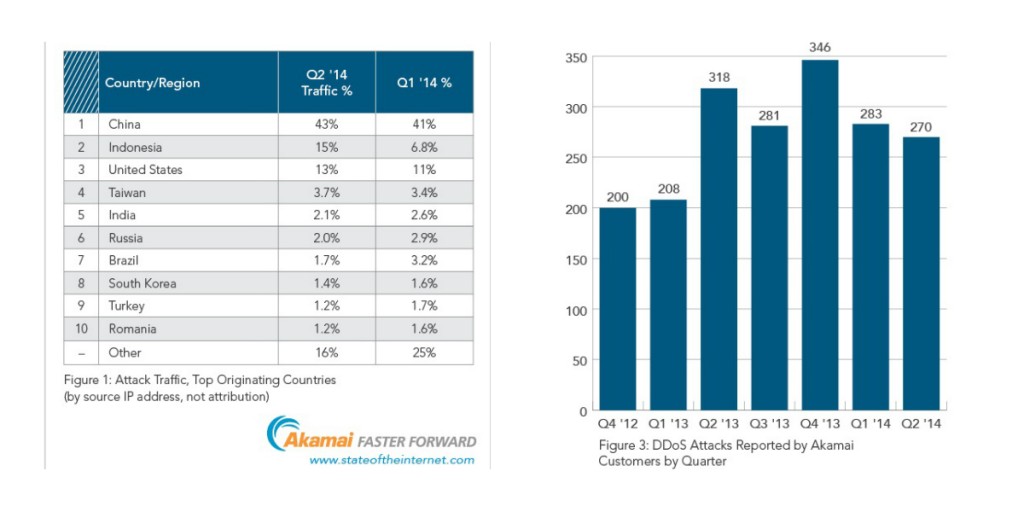
On the darker side of things, Akamai finds that China remains in the top slot for being the source of ‘attack traffic’ that often disrupts online business activity via Distributed Denial of Service (DDoS) attacks. China’s share grew to 43% of observed attack traffic. Indonesia saw a significant increase in observed 'attack traffic', more than doubling to 15%, while the United States increased nominally to 13%.
Enterprise and Commerce customers together accounted for nearly 60% of the reported attacks during Q2, with more than 50% of attacks reported by customers in the Americas region. The total amount of DDoS attacks continues its broad upward trend despite a drop in detected attacks since the end of 2013. Back in July 2014, eToro, a prominent social Trading Platform, suffered problems with DDoS attacks disrupting service functionality for an undisclosed period.
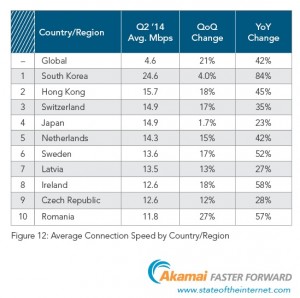
Looking at connection speeds, the global average connection speed grew 21% to 4.6 Mbps and the global average peak connection speed grew 20%, reaching 25.4 Mbps. At a country/region level, South Korea continued to have the highest average connection speed at 24.6 Mbps but Hong Kong had the highest average peak connection speed at 73.9 Mbps. Generally, the top 10 countries for average connections speeds include 7 European countries and 3 from Asia.
Globally, high broadband (>10 Mbps) adoption grew 12% to reach 23%, and South Korea remained the country with the highest level of high broadband adoption at 78%. Global broadband (>4 Mbps) adoption grew 5.6% quarter-over-quarter to 59%, and South Korea’s broadband adoption rate inched up to 95% in the second quarter. ‘4k-ready’ (>15 Mbps) connections grew to 12% on a global basis, and in top country South Korea, 62% of connections were at those speeds.
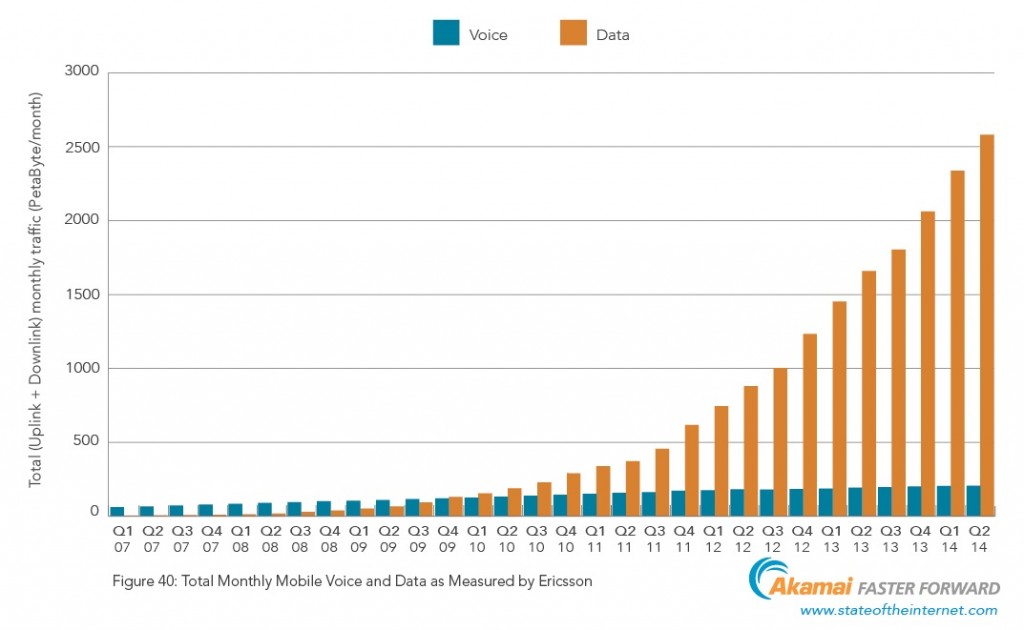
The most obvious and relevant statistic for online trading providers is the increasing use of parallel services, such as market research tools, blogs and other media content to retain clients and boost revenues, resulting in total data usage via mobiles to rise exponentially, with Asia securing a larger proportion of that nominal growth due to better digital networks and infrastructures.
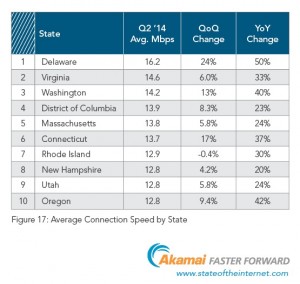
In the U.S, Akamai finds that on average, the fastest and most stable connection speeds are in Delaware. The State scored high in all categories including average speed, peak speed and participation in high-speed internet services, including 4K-ready networking.
In Summary
Akamai's latest survey confirms that Asia is the global leader when it comes to internet connectivity and connection speeds. The comparatively better infrastructure and quality of offered services is helping to facilitate a higher participation rate for mobile trading and consumption of digital content related to trading.
Parallel services such as online seminars, video tutorials and online marketing tend to obtain better traction among Asian clients, as Asian market participants are simply more 'accessible' in terms of marketing campaigns, given the higher propensity of internet use. Asia not only has better connectivity, but by extension more people are making use of it via the internet, mobile and digital services.
Akamai, an integrated technology firm, which offers cloud web services has published its latest quarterly updated ‘State of the Internet’ report for Q2 2014. Akamai’s proprietary 'Intelligent Platform' is claimed by the company to be a leading cloud platform which accounts for approximately 30% of all web traffic and “is made up of a distributed network of servers and intelligent software, delivering over two trillion interactions daily,” according to Akamai.
Given the company’s significant participation in the technology and digital industries, its periodic report is highly regarded and can often indicate interesting trends developing in the rate of online participation as well as other factors.
Forex Magnates reported back in August on how Akamai’s research overlaps with the online-driven retail trading industry, with interesting conclusions found, including that countries with higher national broadband speeds and faster mobile internet speeds tend to have a higher adoption rate for online trading. With Asia leading the globe in internet connectivity, combined with relatively more spare capacity for new traders compared to ‘developed’ regions such as the US, UK and Europe, indicates a bright future for both traders and retail brokers operating in Asia.
The Latest Findings
On the darker side of things, Akamai finds that China remains in the top slot for being the source of ‘attack traffic’ that often disrupts online business activity via Distributed Denial of Service (DDoS) attacks. China’s share grew to 43% of observed attack traffic. Indonesia saw a significant increase in observed 'attack traffic', more than doubling to 15%, while the United States increased nominally to 13%.
Enterprise and Commerce customers together accounted for nearly 60% of the reported attacks during Q2, with more than 50% of attacks reported by customers in the Americas region. The total amount of DDoS attacks continues its broad upward trend despite a drop in detected attacks since the end of 2013. Back in July 2014, eToro, a prominent social Trading Platform, suffered problems with DDoS attacks disrupting service functionality for an undisclosed period.
Looking at connection speeds, the global average connection speed grew 21% to 4.6 Mbps and the global average peak connection speed grew 20%, reaching 25.4 Mbps. At a country/region level, South Korea continued to have the highest average connection speed at 24.6 Mbps but Hong Kong had the highest average peak connection speed at 73.9 Mbps. Generally, the top 10 countries for average connections speeds include 7 European countries and 3 from Asia.
Globally, high broadband (>10 Mbps) adoption grew 12% to reach 23%, and South Korea remained the country with the highest level of high broadband adoption at 78%. Global broadband (>4 Mbps) adoption grew 5.6% quarter-over-quarter to 59%, and South Korea’s broadband adoption rate inched up to 95% in the second quarter. ‘4k-ready’ (>15 Mbps) connections grew to 12% on a global basis, and in top country South Korea, 62% of connections were at those speeds.
The most obvious and relevant statistic for online trading providers is the increasing use of parallel services, such as market research tools, blogs and other media content to retain clients and boost revenues, resulting in total data usage via mobiles to rise exponentially, with Asia securing a larger proportion of that nominal growth due to better digital networks and infrastructures.
In the U.S, Akamai finds that on average, the fastest and most stable connection speeds are in Delaware. The State scored high in all categories including average speed, peak speed and participation in high-speed internet services, including 4K-ready networking.
In Summary
Akamai's latest survey confirms that Asia is the global leader when it comes to internet connectivity and connection speeds. The comparatively better infrastructure and quality of offered services is helping to facilitate a higher participation rate for mobile trading and consumption of digital content related to trading.
Parallel services such as online seminars, video tutorials and online marketing tend to obtain better traction among Asian clients, as Asian market participants are simply more 'accessible' in terms of marketing campaigns, given the higher propensity of internet use. Asia not only has better connectivity, but by extension more people are making use of it via the internet, mobile and digital services.
Cyprus Diaspora Forum and REALTYon Launch Strategic Collaboration to Connect Global Investors with Cyprus Real Estate Opportunities
CMC Markets’ Artur Delijergijevs on Metals Demand, Volatility, & Stable Execution
CMC Markets’ Artur Delijergijevs on Metals Demand, Volatility, & Stable Execution
In this exclusive Executive Interview, Finance Magnates speaks with Artur Delijergijevs, Head of Systematic Market Making at CMC Markets, about the current state of metals demand and market volatility.
Delijergijevs offers a desk-level view on:
- Metals Demand: Why metals are seeing the strongest demand from both retail and institutional clients right now.
- The Safe-Haven Debate: Questioning whether gold still fits the classic safe-haven definition given large daily price movements.
- Volatile Market Prep: How a market-making desk prepares its systems and pricing for stressed market conditions and high-impact economic events.
- Hybrid Execution: Why the best execution model combines electronic speed with human relationship support, especially during volatility.
- AI in Workflow: Where CMC Markets is integrating machine learning for risk management and pricing, and the limitations of AI during stressed markets.
- Dubai's Role: The strategic importance of Dubai’s location for covering global trading sessions across Asia, Europe, and the US.
Watch to understand how CMC Markets maintains stable pricing and reliable execution quality in high-volatility environments.
#CMCmarkets #forex #metals #gold #trading #volatility #MarketMaking #iFXDubai #FinanceMagnates #Finance #Fintech #Execution #AlgorithmicTrading #RiskManagement
In this exclusive Executive Interview, Finance Magnates speaks with Artur Delijergijevs, Head of Systematic Market Making at CMC Markets, about the current state of metals demand and market volatility.
Delijergijevs offers a desk-level view on:
- Metals Demand: Why metals are seeing the strongest demand from both retail and institutional clients right now.
- The Safe-Haven Debate: Questioning whether gold still fits the classic safe-haven definition given large daily price movements.
- Volatile Market Prep: How a market-making desk prepares its systems and pricing for stressed market conditions and high-impact economic events.
- Hybrid Execution: Why the best execution model combines electronic speed with human relationship support, especially during volatility.
- AI in Workflow: Where CMC Markets is integrating machine learning for risk management and pricing, and the limitations of AI during stressed markets.
- Dubai's Role: The strategic importance of Dubai’s location for covering global trading sessions across Asia, Europe, and the US.
Watch to understand how CMC Markets maintains stable pricing and reliable execution quality in high-volatility environments.
#CMCmarkets #forex #metals #gold #trading #volatility #MarketMaking #iFXDubai #FinanceMagnates #Finance #Fintech #Execution #AlgorithmicTrading #RiskManagement
Finance Magnates Awards 2026 – Nominations Now Open
Finance Magnates Awards 2026 – Nominations Now Open
The Finance Magnates Awards 2026 nominations are now open. 🏆
From fintech innovators to leading brokers, this is where the finance industry celebrates its biggest achievements.
Winners will be announced at the Cyprus Gala Dinner on November 6, 2026.
Nominate your brand now.
https://awards.financemagnates.com/?utm_source=linkedin&utm_medium=video&utm_campaign=nominations-open
#FMAwards #FinanceMagnates #FintechAwards #Fintech #FinanceIndustry
The Finance Magnates Awards 2026 nominations are now open. 🏆
From fintech innovators to leading brokers, this is where the finance industry celebrates its biggest achievements.
Winners will be announced at the Cyprus Gala Dinner on November 6, 2026.
Nominate your brand now.
https://awards.financemagnates.com/?utm_source=linkedin&utm_medium=video&utm_campaign=nominations-open
#FMAwards #FinanceMagnates #FintechAwards #Fintech #FinanceIndustry
Finance Magnates Awards 2026 | Nominations Now Open 🏆#Fintech #FMAwards #TradingIndustry
Finance Magnates Awards 2026 | Nominations Now Open 🏆#Fintech #FMAwards #TradingIndustry
Lights on. Cameras ready. 🎬
Finance Magnates Awards 2026 nominations are now open. 🏆
#FMAwards #FinanceMagnates #FintechAwards #Fintech
Lights on. Cameras ready. 🎬
Finance Magnates Awards 2026 nominations are now open. 🏆
#FMAwards #FinanceMagnates #FintechAwards #Fintech
Exness sees trust as the key theme for growth in MENA Trading Growth for 2026
Exness sees trust as the key theme for growth in MENA Trading Growth for 2026
Mohammad Amer, Regional Commercial Director at Exness, sits down to discuss the booming MENA financial trading market. Find out why Dubai is key to the company's growth strategy, how a mobile-first generation is changing expectations, and why trust will be the defining theme for traders in 2026.
In this interview, you'll learn:
* Why Dubai and the MENA region are critical growth markets for fintech and online trading.
* How Exness is addressing the demands of mobile-first, younger traders through engineering, platform stability, and transparent conditions.
* The essential role local talent plays in providing a culturally relevant and compliant user experience.
* Mohammad Amer's outlook on the future of the online trading industry and why stronger controls and systems are necessary.
* Why "trust" isn't just a brand value, but has commercial value—and why he predicts 2026 will be the "Year of Trust."
Key Takeaways:
➡️ The MENA region is rapidly shaping global financial markets.
➡️ New traders expect stability, precise execution, and transparency.
➡️ Local expertise is key to regulatory compliance and user experience.
➡️ Future success belongs to firms capable of meeting rising standards across regulation and platform consistency.
Read the full article at: https://www.financemagnates.com/thought-leadership/exness-sees-trust-as-the-key-theme-for-growth-in-mena-trading-growth-for-2026/
#Exness #MENA #Trading #FinTech #Dubai #OnlineTrading #FinanceMagnates #MohammadAmer #Trust #MobileTrading
Mohammad Amer, Regional Commercial Director at Exness, sits down to discuss the booming MENA financial trading market. Find out why Dubai is key to the company's growth strategy, how a mobile-first generation is changing expectations, and why trust will be the defining theme for traders in 2026.
In this interview, you'll learn:
* Why Dubai and the MENA region are critical growth markets for fintech and online trading.
* How Exness is addressing the demands of mobile-first, younger traders through engineering, platform stability, and transparent conditions.
* The essential role local talent plays in providing a culturally relevant and compliant user experience.
* Mohammad Amer's outlook on the future of the online trading industry and why stronger controls and systems are necessary.
* Why "trust" isn't just a brand value, but has commercial value—and why he predicts 2026 will be the "Year of Trust."
Key Takeaways:
➡️ The MENA region is rapidly shaping global financial markets.
➡️ New traders expect stability, precise execution, and transparency.
➡️ Local expertise is key to regulatory compliance and user experience.
➡️ Future success belongs to firms capable of meeting rising standards across regulation and platform consistency.
Read the full article at: https://www.financemagnates.com/thought-leadership/exness-sees-trust-as-the-key-theme-for-growth-in-mena-trading-growth-for-2026/
#Exness #MENA #Trading #FinTech #Dubai #OnlineTrading #FinanceMagnates #MohammadAmer #Trust #MobileTrading
Paytiko CEO Razi Salih on Why Payment Orchestration is a MUST-HAVE for Brokers in 2026
Paytiko CEO Razi Salih on Why Payment Orchestration is a MUST-HAVE for Brokers in 2026
At iFX Expo Dubai, Finance Magnates spoke with Razi Salih, CEO at Paytiko, about the evolution of the payments ecosystem and why payment orchestration has shifted from an option to a necessity for brokers, prop firms, and exchanges.
Mr. Salih explains how global expansion, the need for deep localisation, and the sheer number of new payment methods, from instant banking to stablecoins, are driving this critical infrastructure shift.
#PaymentOrchestration #Fintech #Brokerage #TradingPayments #RaziSalih #Paytiko #iFXExpoDubai #Stablecoins #AIinFintech
At iFX Expo Dubai, Finance Magnates spoke with Razi Salih, CEO at Paytiko, about the evolution of the payments ecosystem and why payment orchestration has shifted from an option to a necessity for brokers, prop firms, and exchanges.
Mr. Salih explains how global expansion, the need for deep localisation, and the sheer number of new payment methods, from instant banking to stablecoins, are driving this critical infrastructure shift.
#PaymentOrchestration #Fintech #Brokerage #TradingPayments #RaziSalih #Paytiko #iFXExpoDubai #Stablecoins #AIinFintech