

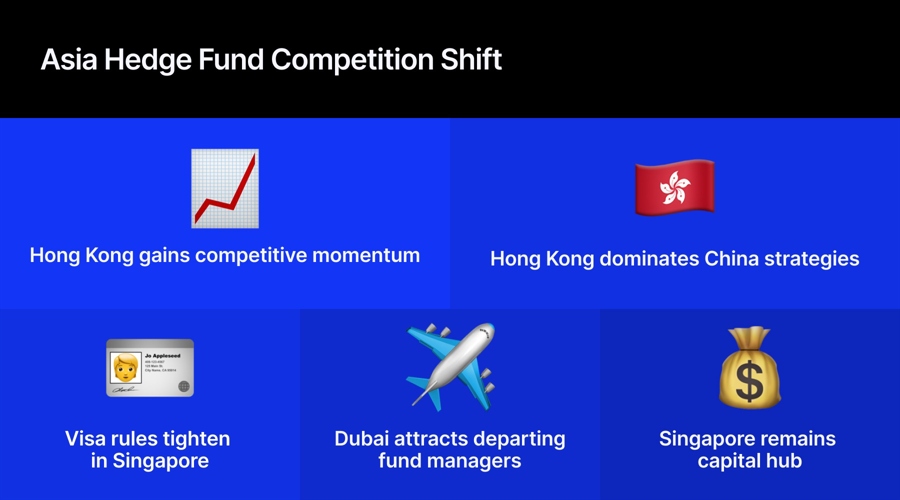
Robust infrastructure and strong regulation have been key tools in Singapore’s offering to hedge funds looking for a presence in Asia, although it continues to face stiff competition from other regional locations.
Singapore Summit: Meet the largest APAC brokers you know (and those you still don't!).
According to IG, Singapore and Hong Kong are battling to become the Asian centre for hedge funds. Both cities are gateways to huge and increasingly wealthy regions (Singapore for ASEAN, Hong Kong for mainland China) and benefit from excellent infrastructure, a strong regulatory background and very low taxes.
Sally Mung, senior product manager, hedge fund services, Asia Pacific, securities services at BNP Paribas, observes that innovation in onshore fund structures has established Singapore as a regional funds hub and made it a strong locus for growth going forward.
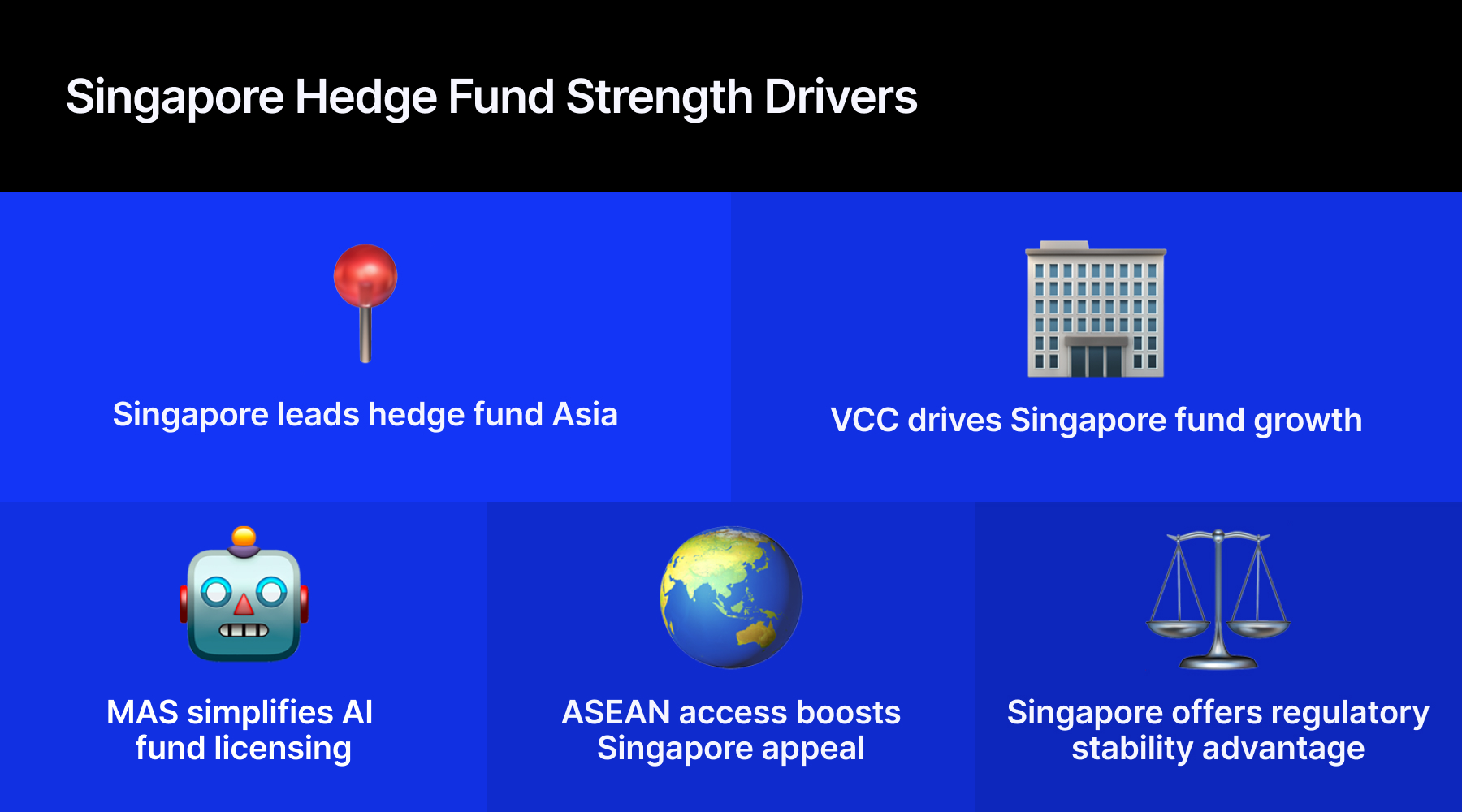
As we have previously discussed, Singapore’s variable capital company or VCC initiative has reduced the barriers to entry, in principle enabling managers to target a wider range of previously excluded individual investors at a lower entry point.
VCC and regulatory innovation
Another key recent development has been the move by the Monetary Authority of Singapore (MAS) to simplify the licensing processes for fund managers utilising artificial intelligence, a decision that has transformed Singapore into a testing ground for the application of regulated machine learning .
- In Singapore, Retail Brokers' Growth Does Not Come from Acquisition
- Singapore Independent Wealth Sector Has Less Than 10% Market Share, but Vast Room for Growth
- “A Modest but Steady Expansion”: Dual-Listing Plans and ETF Inflows Lift Singapore’s Equity Market
The role of Singapore’s hedge funds has also shifted significantly over the course of this decade as they have transitioned from being simply channels for Western capital to creators of innovative quantitative strategies that are on a par with those offered by their peers in the West.
“The VCC has really been impactful since its launch in 2020,” says Patrick Na, head of financial services, South East Asia at TMF Group. “It offers a flexible, corporate-like vehicle with features such as variable capital (easy subscriptions/redemptions), umbrella structures with multiple sub-funds and straightforward re-domiciliation from offshore jurisdictions.
This has lowered costs, sped up setup - which is now measured in weeks rather than months - and provided tax efficiencies.”
Hedge fund strategies account for around 20% of variable capital companies, and discussions are ongoing around enhancements to further expand eligibility and simplify processes. According to Na, the structure has directly contributed to AUM growth, ecosystem development (service providers) and Singapore’s shift toward onshore fund domiciliation.
Singapore is an attractive market for hedge funds because of its predictability; regulations are clear, the legal system is trusted and capital movements are relatively easy. Furthermore, with its tax efficiency, VCC structures and proximity to other Asian markets, Singapore is a practical base for running hedge funds, observes Kelly Chia, head of investment strategy at UOB Private Bank.
Talent and visa constraints
One of the challenges facing the hedge fund sector in Singapore has been the tightening of rules concerning the employment of expats - specifically in the financial sector - with anecdotal reports of companies finding it difficult to get visas for their staff and authorities making it difficult for existing non-Singaporean workers to get visa extensions.
This contrasts with the approach taken by Dubai, for example, which offers many different kinds of work permits and operates a zero bureaucracy programme to make applying easy.
“Singapore is stricter on visas and permanent residencies compared to Hong Kong,” accepts Chia. “However, many fund managers accept this trade-off for Singapore’s stability, policy consistency and lower geopolitical noise, giving Singapore an edge in long term planning and family office-driven capital.”
Competitive positioning and listings
Singapore's appeal rests on several reinforcing pillars including its strategic position as a financial hub in Asia, a strong regulatory framework that provides a stable and transparent environment for investors, political stability, advanced infrastructure, strategic location and a favourable tax regime, says Na.
All these factors attract both domestic and international hedge funds, he adds, noting that while Singapore and Hong Kong are the two dominant Asian centres, they differ in a number of ways in terms of focus and talent attraction.
“Local politics are complicating Singapore's efforts to remain competitive against Hong Kong and Dubai,” says Na. “Many Singaporeans blame an influx of expats - particularly from Hong Kong during the Covid lockdowns - for driving up housing prices and other costs.
Singapore tightened employment pass rules for the financial sector and a lot of senior portfolio managers who have been in Singapore for years struggle to get permanent residence, so after a few tries, they simply move to Dubai.”
On the other hand, Hong Kong has been on the offensive. The territory saw a 24% increase in hedge fund managers, private equity fund managers and family offices over a three-year period to mid-2024.
However, Na suggests that Singapore retains structural advantages in terms of political stability, clean governance and an ASEAN gateway that Hong Kong simply cannot replicate.
“The two cities are increasingly differentiated and no longer seen as substitutable,” he says. “Hong Kong dominates for China-facing strategies and Singapore for Southeast Asia and broader Asia-Pacific mandates.”
On the question of whether Singapore may be losing some competitive edge as more companies choose to list on foreign exchanges, Na acknowledges that there is genuine concern. The Singapore exchange has seen delistings outnumber new listings in recent years, with many firms opting for higher liquidity and valuations on US exchanges, Hong Kong or elsewhere.
Singapore's growth is poised to moderate as its export-driven model is strained by geopolitical tensions and a fragmenting global trading system, though it could draw support from opportunities in the Middle East. https://t.co/o1KccqTNgC
— The Japan Times (@japantimes) April 20, 2026
“However, SGX and MAS have responded, for example with the new SGX-Nasdaq bridge, a dual listing bridge connecting both exchanges providing companies in Asia with a direct and harmonised framework, whose aim is to help revive sentiment and attract more listings,” he says. “Singapore’s strength remains in asset management and private capital rather than public equity listings per se.”
Continued Attractiveness Despite Identified Constraints
Even as more companies explore listing overseas, Singapore continues to remain attractive for hedge funds as most managers there allocate capital globally instead of relying on local IPO pipelines, says Chia.
“Singapore’s value lies in being a capital and decision making hub rather than an exchange destination,” he concludes. “VCC structures have also removed real friction – both operationally and in terms of tax - making it easier to launch funds, add strategies and attract global allocators. For many managers, this can tip the decision in favour of Singapore rather than offshore alternatives.”


