TASE has announced the launch date of its new indices and the proposed cancellation of December 2016 indices update.
Bloomberg
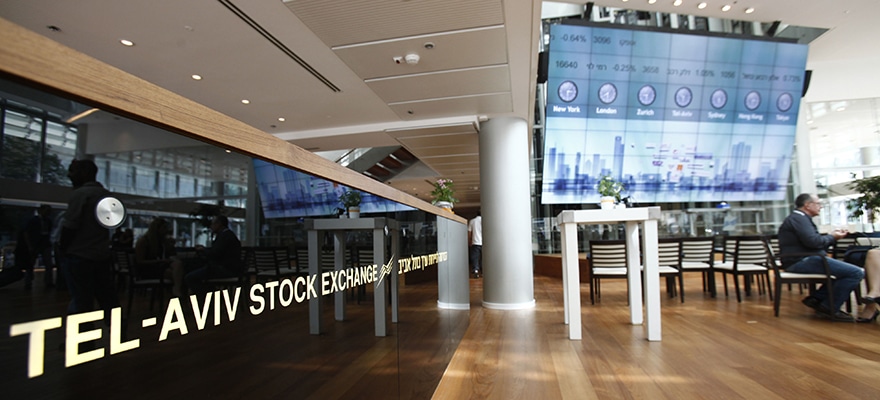
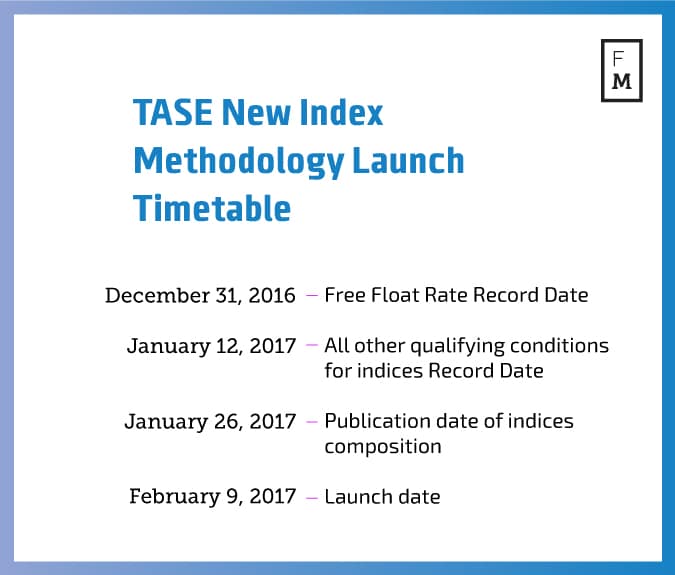
After announcing plans to expand its benchmark indices in January 2016, Tel Aviv Stock Exchange (TASE) announced today that the new indices methodology will be effective from 9th February, 2017.
During the past year, the detailed rules for the new index methodology have been approved and formulated based on extensive discussions with market activists, institutional investors and public companies.
The weight cap on the TA-35, TA-125 and TA Banks-5 indices will be reduced gradually over a course of approximately six months (the "Transition Period").
Prior to the launch, TASE will publish a full "Milestones Timetable", which will be implemented during the Transition Period.
Cancellation of December 16 Indices Update
A proposal to cancel December 2016 indices update will also be discussed by TASE's Board. This December, the indices composition were supposed to be updated according to the current indices rules but due to the closeness to the launch of the new index methodology, cancelling the December 2016 update is considered to be in the best interest of investors, indices trackers and traded companies.
Softening rules for new companies to encourage IPOs
The TASE board will discuss a proposal to reduce the minimum free float rate in the first two years following an IPO to just 20 percent to be included in flagship indices.
Companies which offered shares on TASE starting January 2014 will also benefit from this easing, being within the first two years following the implementation of the new index methodology. After two years, the free float rate will be 30 percent for companies included in the indices and 35 percent for companies not included in the indices, as has been determined for the other companies traded on TASE.
Gradual increase of minimum free float rate for "veteran" shares
The change in the free float rate for "veteran" shares will be implemented gradually over a course of a year:
December 31, 2016 – 25 percent minimum free float rate
June 30, 2017 - 30 percent minimum free float rate
December 31st, 2017 – free float rate in shares included in the flagship indices will be minimum 30 percent and free float rate in shares not included in flagship indices will be minimum 35 percent.
Commenting on today’s announcement, Robby Goldenberg, Senior Vice President, Head of Trading, Derivatives & Indices Department, said: "We consider the new index methodology, which will be implemented in about half a year, a major step, that among other things, will contribute to reducing market concentrations on the indices to the benefit of investors and public companies, and reduce exposure for index trackers, who manage NIS 35 billion in financial instruments based on TASE's equity indices".
After announcing plans to expand its benchmark indices in January 2016, Tel Aviv Stock Exchange (TASE) announced today that the new indices methodology will be effective from 9th February, 2017.
During the past year, the detailed rules for the new index methodology have been approved and formulated based on extensive discussions with market activists, institutional investors and public companies.
The weight cap on the TA-35, TA-125 and TA Banks-5 indices will be reduced gradually over a course of approximately six months (the "Transition Period").
Prior to the launch, TASE will publish a full "Milestones Timetable", which will be implemented during the Transition Period.
Cancellation of December 16 Indices Update
A proposal to cancel December 2016 indices update will also be discussed by TASE's Board. This December, the indices composition were supposed to be updated according to the current indices rules but due to the closeness to the launch of the new index methodology, cancelling the December 2016 update is considered to be in the best interest of investors, indices trackers and traded companies.
Softening rules for new companies to encourage IPOs
The TASE board will discuss a proposal to reduce the minimum free float rate in the first two years following an IPO to just 20 percent to be included in flagship indices.
Companies which offered shares on TASE starting January 2014 will also benefit from this easing, being within the first two years following the implementation of the new index methodology. After two years, the free float rate will be 30 percent for companies included in the indices and 35 percent for companies not included in the indices, as has been determined for the other companies traded on TASE.
Gradual increase of minimum free float rate for "veteran" shares
The change in the free float rate for "veteran" shares will be implemented gradually over a course of a year:
December 31, 2016 – 25 percent minimum free float rate
June 30, 2017 - 30 percent minimum free float rate
December 31st, 2017 – free float rate in shares included in the flagship indices will be minimum 30 percent and free float rate in shares not included in flagship indices will be minimum 35 percent.
Commenting on today’s announcement, Robby Goldenberg, Senior Vice President, Head of Trading, Derivatives & Indices Department, said: "We consider the new index methodology, which will be implemented in about half a year, a major step, that among other things, will contribute to reducing market concentrations on the indices to the benefit of investors and public companies, and reduce exposure for index trackers, who manage NIS 35 billion in financial instruments based on TASE's equity indices".
Singapore Independent Wealth Sector Has Less Than 10% Market Share, but Vast Room for Growth
FP Markets Winner Spotlight 🏆 | Global Broker of the Year 2025 #Trading #Broker #Innovation #Shorts
FP Markets Winner Spotlight 🏆 | Global Broker of the Year 2025 #Trading #Broker #Innovation #Shorts
FP Markets takes the spotlight as Global Broker of the Year 2025 at the Finance Magnates Awards.
Martin Stoilov, Head of Client Experience, shares that trust, innovation, and people played a key role in the company’s success, supported by a strong foundation of integrity and client-centricity.
Following this milestone, FP Markets continues to focus on growth, technology investment, and its core values of transparency and excellence.
👉 Be part of FM Awards 2026: https://awards.financemagnates.com/#nominate
FP Markets takes the spotlight as Global Broker of the Year 2025 at the Finance Magnates Awards.
Martin Stoilov, Head of Client Experience, shares that trust, innovation, and people played a key role in the company’s success, supported by a strong foundation of integrity and client-centricity.
Following this milestone, FP Markets continues to focus on growth, technology investment, and its core values of transparency and excellence.
👉 Be part of FM Awards 2026: https://awards.financemagnates.com/#nominate
In this video, we review @HolaPrimeMarketsOfficial, a multi-asset forex and CFDs broker offering different account types, trading platforms, and flexible trading conditions.
We cover the broker’s overall offering, including account options, trading environment, platforms like MT4 and MT5, and additional services such as managed accounts and fast withdrawals.
Watch the full video to see if Hola Prime Markets fits your trading needs.
📣 Stay up to date with the latest in finance and trading. Follow Finance Magnates for industry news, insights, and global event coverage.
Connect with us:
🔗 LinkedIn: /financemagnates
👍 Facebook: /financemagnates
📸 Instagram: https://www.instagram.com/financemagnates
🐦 X: https://x.com/financemagnates
🎥 TikTok: https://www.tiktok.com/tag/financemagnates
▶️ YouTube: /@financemagnates_official
#HolaPrime #ForexBroker #CFDTrading #FinanceMagnates #Trading #Forex #BrokerReview
In this video, we review @HolaPrimeMarketsOfficial, a multi-asset forex and CFDs broker offering different account types, trading platforms, and flexible trading conditions.
We cover the broker’s overall offering, including account options, trading environment, platforms like MT4 and MT5, and additional services such as managed accounts and fast withdrawals.
Watch the full video to see if Hola Prime Markets fits your trading needs.
📣 Stay up to date with the latest in finance and trading. Follow Finance Magnates for industry news, insights, and global event coverage.
Connect with us:
🔗 LinkedIn: /financemagnates
👍 Facebook: /financemagnates
📸 Instagram: https://www.instagram.com/financemagnates
🐦 X: https://x.com/financemagnates
🎥 TikTok: https://www.tiktok.com/tag/financemagnates
▶️ YouTube: /@financemagnates_official
#HolaPrime #ForexBroker #CFDTrading #FinanceMagnates #Trading #Forex #BrokerReview
Hola Prime Review: What You Need to Know | Full Breakdown by Finance Magnates
Hola Prime Review: What You Need to Know | Full Breakdown by Finance Magnates
In this video, we review @HolaPrime_Global, a proprietary trading firm offering evaluation programs and performance-based payouts in simulated market environments.
We cover how the challenge model works, including account types, profit splits (up to 95%), trading rules, and what it takes to reach a funded account. You’ll also learn about available platforms like MT4, MT5, cTrader, and more, along with insights into payouts, support, and trading conditions.
Watch the full video to see if Hola Prime fits your trading style.
📣 Stay up to date with the latest in finance and trading. Follow Finance Magnates for industry news, insights, and global event coverage.
Connect with us:
🔗 LinkedIn: /financemagnates
👍 Facebook: /financemagnates
📸 Instagram: https://www.instagram.com/financemagnates
🐦 X: https://x.com/financemagnates
🎥 TikTok: https://www.tiktok.com/tag/financemagnates
▶️ YouTube: /@financemagnates_official
#HolaPrime #PropFirm #Trading #FinanceMagnates #Forex #FuturesTrading #TradingReview #PropFirmReview
In this video, we review @HolaPrime_Global, a proprietary trading firm offering evaluation programs and performance-based payouts in simulated market environments.
We cover how the challenge model works, including account types, profit splits (up to 95%), trading rules, and what it takes to reach a funded account. You’ll also learn about available platforms like MT4, MT5, cTrader, and more, along with insights into payouts, support, and trading conditions.
Watch the full video to see if Hola Prime fits your trading style.
📣 Stay up to date with the latest in finance and trading. Follow Finance Magnates for industry news, insights, and global event coverage.
Connect with us:
🔗 LinkedIn: /financemagnates
👍 Facebook: /financemagnates
📸 Instagram: https://www.instagram.com/financemagnates
🐦 X: https://x.com/financemagnates
🎥 TikTok: https://www.tiktok.com/tag/financemagnates
▶️ YouTube: /@financemagnates_official
#HolaPrime #PropFirm #Trading #FinanceMagnates #Forex #FuturesTrading #TradingReview #PropFirmReview
Axi Winner Spotlight 🏆 | Global Most Innovative Broker 2025 #Innovation #Trading #Fintech #Broker
Axi Winner Spotlight 🏆 | Global Most Innovative Broker 2025 #Innovation #Trading #Fintech #Broker
Axi takes the spotlight at the Finance Magnates Awards, winning Global Most Innovative Broker 2025.
Olivia Xenofontos and Ivanna Openko share how the team will feel: proud, motivated, and ready to keep delivering.
They also describe the night as well-organized, focused, and enjoyable for all.
👉 Be part of FM Awards 2026.
Axi takes the spotlight at the Finance Magnates Awards, winning Global Most Innovative Broker 2025.
Olivia Xenofontos and Ivanna Openko share how the team will feel: proud, motivated, and ready to keep delivering.
They also describe the night as well-organized, focused, and enjoyable for all.
👉 Be part of FM Awards 2026.
Recognition that matters.
Built on transparency.
Driven by the industry.
The Finance Magnates Awards 2026.
Nominations are now open.
🔗 https://awards.financemagnates.com/?utm_source=SM&utm_medium=social&utm_campaign=recognition-matters
Recognition that matters.
Built on transparency.
Driven by the industry.
The Finance Magnates Awards 2026.
Nominations are now open.
🔗 https://awards.financemagnates.com/?utm_source=SM&utm_medium=social&utm_campaign=recognition-matters