As groups and individuals diversify across products, regions and time zones, professional trading firms are evolving. Speakers at a recent FOW conference tell us what that looks like in the derivatives marketplace today.
FOW's Conference, The Evolution of Professional Trading II, was held on February 25 in London.
Traders are doing more “extreme things” to make money, as agility trumps the race-to-zero in moving between products and asset classes, said panellists at a recent FOW conference.
“The successful guys seem to be able to jump around to where it’s hot,” said Mark Phelps, Global Head of Sales at GH Financials. The clearing provider connects to some 30 exchanges, representing thousands of products. “If you’ve got the energy to look around, you may find something that is doing 30, 40 thousand (lots) a day.”
...commodities is a random walk.
He pointed to the Euronext Milling Wheat contract as a case in point. “We did 40,000 lots a day over the last three months on average. It’s things like that traders should go out there and try and find because it’s an opportunity that other people aren’t looking at.”
Out of Singapore, Phelps said that at least one firm was making “a disproportionate amount of money” on the out-of-hours session on Eurodollar futures, for example.
This, when traders are moving out because the Fed rate hike failed to meet market expectations of surging volumes, he added. ICE Gilt futures, on the other hand, posted a record month for GHF in January. “Maybe this Brexit talk, there’s going to be more volume there.”
The Euribor-Schatz ‘Ted Spread’ meanwhile is in vogue on the back of negative rates, and Phelps is seeing “a few more people dipping their toes back in that”.
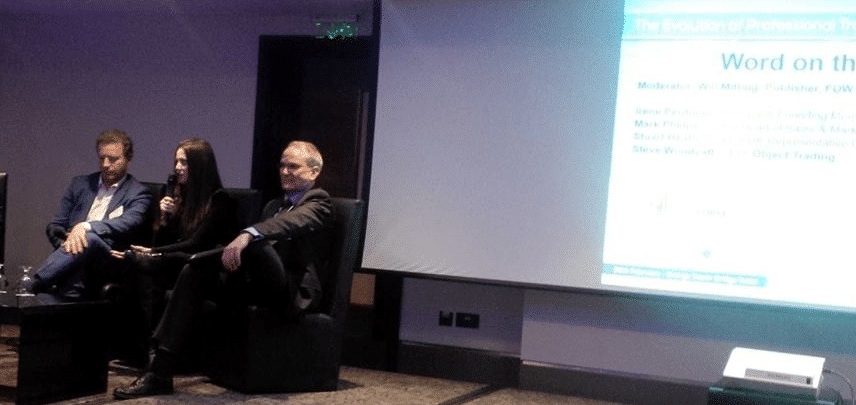
From L-R: Mark Phelps, GHF; Irene Perdomo, Devet Capital; Steve Woodyatt, Object Trading
In terms of new products, Phelps said Eurex’s VSTOXX is getting a lot of interest from VIX traders in the US. “That’s one of the few products that seems to be coming to life, and really catching the market’s attention.”
Steve Woodyatt, CEO of Object Trading, a trading tech firm, said that clients are moving further out regionally.
Some examples are: tin and metals contracts in Hong Kong and Shanghai; Japan Exchange Group bringing its Mothers index futures on-line; and notably, the DGCX for its rupee contract, which recently transacted more than 30% of global rupee.
Compare that to 10% in Singapore and single digit percentages via the CME, Woodyatt added.
Irene Perdomo, Principal and Founding Partner at systematic trading firm Devet Capital, said that commodities are also back in fashion but for the wrong reasons. “Commodities are very low, and people think they are going to go up...but until commodities are not zero, they can go down.”
Even if speculators are right directionally, they have to be right, at the right time - specifically, before the roll of the contract. “The contango of the curve is so high, that you are going to lose about four or five percent if you need to roll the contract,” she said.
...applying the market data program to all of the market segments, is not appropriate.
“I personally don’t believe in taking a directional view in commodities, not in the short term. If you want to take direction or view in three years’ time, and you have big pockets for the margin consumption – perfect. But otherwise commodities is a random walk,” Perdomo added.
In the systematic world more generally, however, she sees a surge in interest in alternative liquid strategies, or trying to find new sources of "whatever Liquidity ", not limited to any particular asset class.
Woodyatt puts it this way: “What used to be perhaps more of a race- to-zero-latency, it’s no longer that. It’s now breadth and depth of access and agility to move around across different platforms, different asset classes, and combine those in a systematic way that makes people profitable.”
Doing that comes with major caveats, in particular the cost of market data, which led to a heated debate as being too costly. It’s not so much that exchanges shouldn’t charge for data, said GHF’s Phelps, but it's “a bit rich” to charge sometimes crippling fees for data that trading firms themselves create.
It’s a very complex business decision...
“I don’t think there’s anyone in the audience that has a problem with the exchanges trying to derive revenues from market data, the point about this is applying the market data program to all of the market segments, is not appropriate. These guys are creating this data and they are the most price sensitive,” said GHF’s Phelps.
Object Trading's Woodyatt said that becoming an agile multi-asset class prop trader is not an overnight decision: “It’s a very complex business decision, and people are fundamentally looking at their business strategy, as well as their systematic and discretionary strategies that they trade to maintain profitability and return on their investment.”
Traders are doing more “extreme things” to make money, as agility trumps the race-to-zero in moving between products and asset classes, said panellists at a recent FOW conference.
“The successful guys seem to be able to jump around to where it’s hot,” said Mark Phelps, Global Head of Sales at GH Financials. The clearing provider connects to some 30 exchanges, representing thousands of products. “If you’ve got the energy to look around, you may find something that is doing 30, 40 thousand (lots) a day.”
...commodities is a random walk.
He pointed to the Euronext Milling Wheat contract as a case in point. “We did 40,000 lots a day over the last three months on average. It’s things like that traders should go out there and try and find because it’s an opportunity that other people aren’t looking at.”
Out of Singapore, Phelps said that at least one firm was making “a disproportionate amount of money” on the out-of-hours session on Eurodollar futures, for example.
This, when traders are moving out because the Fed rate hike failed to meet market expectations of surging volumes, he added. ICE Gilt futures, on the other hand, posted a record month for GHF in January. “Maybe this Brexit talk, there’s going to be more volume there.”
The Euribor-Schatz ‘Ted Spread’ meanwhile is in vogue on the back of negative rates, and Phelps is seeing “a few more people dipping their toes back in that”.
From L-R: Mark Phelps, GHF; Irene Perdomo, Devet Capital; Steve Woodyatt, Object Trading
In terms of new products, Phelps said Eurex’s VSTOXX is getting a lot of interest from VIX traders in the US. “That’s one of the few products that seems to be coming to life, and really catching the market’s attention.”
Steve Woodyatt, CEO of Object Trading, a trading tech firm, said that clients are moving further out regionally.
Some examples are: tin and metals contracts in Hong Kong and Shanghai; Japan Exchange Group bringing its Mothers index futures on-line; and notably, the DGCX for its rupee contract, which recently transacted more than 30% of global rupee.
Compare that to 10% in Singapore and single digit percentages via the CME, Woodyatt added.
Irene Perdomo, Principal and Founding Partner at systematic trading firm Devet Capital, said that commodities are also back in fashion but for the wrong reasons. “Commodities are very low, and people think they are going to go up...but until commodities are not zero, they can go down.”
Even if speculators are right directionally, they have to be right, at the right time - specifically, before the roll of the contract. “The contango of the curve is so high, that you are going to lose about four or five percent if you need to roll the contract,” she said.
...applying the market data program to all of the market segments, is not appropriate.
“I personally don’t believe in taking a directional view in commodities, not in the short term. If you want to take direction or view in three years’ time, and you have big pockets for the margin consumption – perfect. But otherwise commodities is a random walk,” Perdomo added.
In the systematic world more generally, however, she sees a surge in interest in alternative liquid strategies, or trying to find new sources of "whatever Liquidity ", not limited to any particular asset class.
Woodyatt puts it this way: “What used to be perhaps more of a race- to-zero-latency, it’s no longer that. It’s now breadth and depth of access and agility to move around across different platforms, different asset classes, and combine those in a systematic way that makes people profitable.”
Doing that comes with major caveats, in particular the cost of market data, which led to a heated debate as being too costly. It’s not so much that exchanges shouldn’t charge for data, said GHF’s Phelps, but it's “a bit rich” to charge sometimes crippling fees for data that trading firms themselves create.
It’s a very complex business decision...
“I don’t think there’s anyone in the audience that has a problem with the exchanges trying to derive revenues from market data, the point about this is applying the market data program to all of the market segments, is not appropriate. These guys are creating this data and they are the most price sensitive,” said GHF’s Phelps.
Object Trading's Woodyatt said that becoming an agile multi-asset class prop trader is not an overnight decision: “It’s a very complex business decision, and people are fundamentally looking at their business strategy, as well as their systematic and discretionary strategies that they trade to maintain profitability and return on their investment.”
Cyprus Diaspora Forum and REALTYon Launch Strategic Collaboration to Connect Global Investors with Cyprus Real Estate Opportunities
CMC Markets’ Artur Delijergijevs on Metals Demand, Volatility, & Stable Execution
CMC Markets’ Artur Delijergijevs on Metals Demand, Volatility, & Stable Execution
In this exclusive Executive Interview, Finance Magnates speaks with Artur Delijergijevs, Head of Systematic Market Making at CMC Markets, about the current state of metals demand and market volatility.
Delijergijevs offers a desk-level view on:
- Metals Demand: Why metals are seeing the strongest demand from both retail and institutional clients right now.
- The Safe-Haven Debate: Questioning whether gold still fits the classic safe-haven definition given large daily price movements.
- Volatile Market Prep: How a market-making desk prepares its systems and pricing for stressed market conditions and high-impact economic events.
- Hybrid Execution: Why the best execution model combines electronic speed with human relationship support, especially during volatility.
- AI in Workflow: Where CMC Markets is integrating machine learning for risk management and pricing, and the limitations of AI during stressed markets.
- Dubai's Role: The strategic importance of Dubai’s location for covering global trading sessions across Asia, Europe, and the US.
Watch to understand how CMC Markets maintains stable pricing and reliable execution quality in high-volatility environments.
#CMCmarkets #forex #metals #gold #trading #volatility #MarketMaking #iFXDubai #FinanceMagnates #Finance #Fintech #Execution #AlgorithmicTrading #RiskManagement
In this exclusive Executive Interview, Finance Magnates speaks with Artur Delijergijevs, Head of Systematic Market Making at CMC Markets, about the current state of metals demand and market volatility.
Delijergijevs offers a desk-level view on:
- Metals Demand: Why metals are seeing the strongest demand from both retail and institutional clients right now.
- The Safe-Haven Debate: Questioning whether gold still fits the classic safe-haven definition given large daily price movements.
- Volatile Market Prep: How a market-making desk prepares its systems and pricing for stressed market conditions and high-impact economic events.
- Hybrid Execution: Why the best execution model combines electronic speed with human relationship support, especially during volatility.
- AI in Workflow: Where CMC Markets is integrating machine learning for risk management and pricing, and the limitations of AI during stressed markets.
- Dubai's Role: The strategic importance of Dubai’s location for covering global trading sessions across Asia, Europe, and the US.
Watch to understand how CMC Markets maintains stable pricing and reliable execution quality in high-volatility environments.
#CMCmarkets #forex #metals #gold #trading #volatility #MarketMaking #iFXDubai #FinanceMagnates #Finance #Fintech #Execution #AlgorithmicTrading #RiskManagement
Finance Magnates Awards 2026 – Nominations Now Open
Finance Magnates Awards 2026 – Nominations Now Open
The Finance Magnates Awards 2026 nominations are now open. 🏆
From fintech innovators to leading brokers, this is where the finance industry celebrates its biggest achievements.
Winners will be announced at the Cyprus Gala Dinner on November 6, 2026.
Nominate your brand now.
https://awards.financemagnates.com/?utm_source=linkedin&utm_medium=video&utm_campaign=nominations-open
#FMAwards #FinanceMagnates #FintechAwards #Fintech #FinanceIndustry
The Finance Magnates Awards 2026 nominations are now open. 🏆
From fintech innovators to leading brokers, this is where the finance industry celebrates its biggest achievements.
Winners will be announced at the Cyprus Gala Dinner on November 6, 2026.
Nominate your brand now.
https://awards.financemagnates.com/?utm_source=linkedin&utm_medium=video&utm_campaign=nominations-open
#FMAwards #FinanceMagnates #FintechAwards #Fintech #FinanceIndustry
Finance Magnates Awards 2026 | Nominations Now Open 🏆#Fintech #FMAwards #TradingIndustry
Finance Magnates Awards 2026 | Nominations Now Open 🏆#Fintech #FMAwards #TradingIndustry
Lights on. Cameras ready. 🎬
Finance Magnates Awards 2026 nominations are now open. 🏆
#FMAwards #FinanceMagnates #FintechAwards #Fintech
Lights on. Cameras ready. 🎬
Finance Magnates Awards 2026 nominations are now open. 🏆
#FMAwards #FinanceMagnates #FintechAwards #Fintech
Exness sees trust as the key theme for growth in MENA Trading Growth for 2026
Exness sees trust as the key theme for growth in MENA Trading Growth for 2026
Mohammad Amer, Regional Commercial Director at Exness, sits down to discuss the booming MENA financial trading market. Find out why Dubai is key to the company's growth strategy, how a mobile-first generation is changing expectations, and why trust will be the defining theme for traders in 2026.
In this interview, you'll learn:
* Why Dubai and the MENA region are critical growth markets for fintech and online trading.
* How Exness is addressing the demands of mobile-first, younger traders through engineering, platform stability, and transparent conditions.
* The essential role local talent plays in providing a culturally relevant and compliant user experience.
* Mohammad Amer's outlook on the future of the online trading industry and why stronger controls and systems are necessary.
* Why "trust" isn't just a brand value, but has commercial value—and why he predicts 2026 will be the "Year of Trust."
Key Takeaways:
➡️ The MENA region is rapidly shaping global financial markets.
➡️ New traders expect stability, precise execution, and transparency.
➡️ Local expertise is key to regulatory compliance and user experience.
➡️ Future success belongs to firms capable of meeting rising standards across regulation and platform consistency.
Read the full article at: https://www.financemagnates.com/thought-leadership/exness-sees-trust-as-the-key-theme-for-growth-in-mena-trading-growth-for-2026/
#Exness #MENA #Trading #FinTech #Dubai #OnlineTrading #FinanceMagnates #MohammadAmer #Trust #MobileTrading
Mohammad Amer, Regional Commercial Director at Exness, sits down to discuss the booming MENA financial trading market. Find out why Dubai is key to the company's growth strategy, how a mobile-first generation is changing expectations, and why trust will be the defining theme for traders in 2026.
In this interview, you'll learn:
* Why Dubai and the MENA region are critical growth markets for fintech and online trading.
* How Exness is addressing the demands of mobile-first, younger traders through engineering, platform stability, and transparent conditions.
* The essential role local talent plays in providing a culturally relevant and compliant user experience.
* Mohammad Amer's outlook on the future of the online trading industry and why stronger controls and systems are necessary.
* Why "trust" isn't just a brand value, but has commercial value—and why he predicts 2026 will be the "Year of Trust."
Key Takeaways:
➡️ The MENA region is rapidly shaping global financial markets.
➡️ New traders expect stability, precise execution, and transparency.
➡️ Local expertise is key to regulatory compliance and user experience.
➡️ Future success belongs to firms capable of meeting rising standards across regulation and platform consistency.
Read the full article at: https://www.financemagnates.com/thought-leadership/exness-sees-trust-as-the-key-theme-for-growth-in-mena-trading-growth-for-2026/
#Exness #MENA #Trading #FinTech #Dubai #OnlineTrading #FinanceMagnates #MohammadAmer #Trust #MobileTrading
Paytiko CEO Razi Salih on Why Payment Orchestration is a MUST-HAVE for Brokers in 2026
Paytiko CEO Razi Salih on Why Payment Orchestration is a MUST-HAVE for Brokers in 2026
At iFX Expo Dubai, Finance Magnates spoke with Razi Salih, CEO at Paytiko, about the evolution of the payments ecosystem and why payment orchestration has shifted from an option to a necessity for brokers, prop firms, and exchanges.
Mr. Salih explains how global expansion, the need for deep localisation, and the sheer number of new payment methods, from instant banking to stablecoins, are driving this critical infrastructure shift.
#PaymentOrchestration #Fintech #Brokerage #TradingPayments #RaziSalih #Paytiko #iFXExpoDubai #Stablecoins #AIinFintech
At iFX Expo Dubai, Finance Magnates spoke with Razi Salih, CEO at Paytiko, about the evolution of the payments ecosystem and why payment orchestration has shifted from an option to a necessity for brokers, prop firms, and exchanges.
Mr. Salih explains how global expansion, the need for deep localisation, and the sheer number of new payment methods, from instant banking to stablecoins, are driving this critical infrastructure shift.
#PaymentOrchestration #Fintech #Brokerage #TradingPayments #RaziSalih #Paytiko #iFXExpoDubai #Stablecoins #AIinFintech