As the Asian financial center’s exchange SGX is aiming to ramp up its corporate bonds trading unit, the exchange has announced the selection of TradingScreen to deliver a platform solution to the growing segment.
While the bond markets of Hong Kong, Singapore and Korea are comparatively advanced and liquid, markets in China, India, Indonesia and Thailand are still at an early stage of development. The Singapore Exchange is aiming to add a new platform in order to boost its offering.
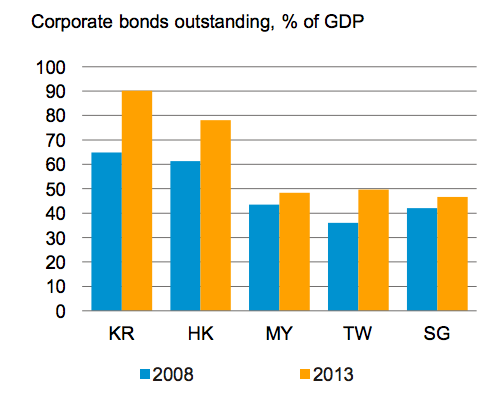
Largest Asian Corporate Bonds Markets, Source: Deutsche Bank Research
According to Deutsche Bank’s Research, “While fast growth in bond markets has provided an effective source of financing for the corporate sector, its development is far from complete. Corporate leverage and indebtedness have risen throughout the region, notably in China.”
“There is a structural imperative underpinning growth in corporate bond markets. Long-term projects increasingly require funding from the non-public sector, given the region’s demographic challenges, emerging middle classes and substantial needs in infrastructure and urban development, which cannot all be met via fiscal spending only,” the report concludes.
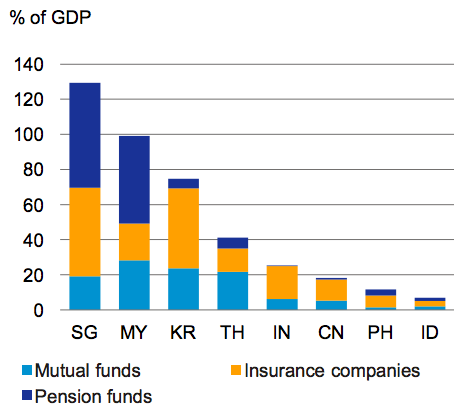
Institutional Investors Assets, % of GDP, Source: Deutsche Bank Research
The amount of assets at institutional investors' disposal in Singapore surpasses 100% of GDP and, in these terms, Singapore is the leader in the Asian market.
The rapid development of the Asian bond market is now prompting an organized and efficient secondary market (OTC). However, meanwhile, increasing regulatory and capital adequacy requirements make it harder for the traditional secondary-market liquidity providers to meet the demand.
As a result, the market is searching for alternatives that could alleviate the liquidity and intermediation needs that have arisen. With the new technology, traders will be able to take advantage of a comprehensive Asian bond trading service.

TradingScreen's CEO, Philippe Buhannic, shared in the company announcement, "We are very pleased to be working with SGX, to launch a bond trading platform that will both respond to the current liquidity challenge and provide customers with additional choices and increased trading efficiency. We are looking forward to the development of the Asian bond market as one of the most important opportunities for the Buy Side community among the new tradable assets."
The President of the SGX added, "We were keen to invest in technology that would equip the region with a versatile platform addressing the peculiarities of bond trading within the Asian markets. TradingScreen as our technology platform provider will help us achieve this and will allow us to adapt to clients' needs in the coming years while providing the best trading service for bonds in Asia.”
The SGX signed a long-term contract with TradingScreen and pledged to continue working with the industry to deliver full end-to-end automation and to optimize the bonds trading experience for its clients.
While the bond markets of Hong Kong, Singapore and Korea are comparatively advanced and liquid, markets in China, India, Indonesia and Thailand are still at an early stage of development. The Singapore Exchange is aiming to add a new platform in order to boost its offering.
Largest Asian Corporate Bonds Markets, Source: Deutsche Bank Research
According to Deutsche Bank’s Research, “While fast growth in bond markets has provided an effective source of financing for the corporate sector, its development is far from complete. Corporate leverage and indebtedness have risen throughout the region, notably in China.”
“There is a structural imperative underpinning growth in corporate bond markets. Long-term projects increasingly require funding from the non-public sector, given the region’s demographic challenges, emerging middle classes and substantial needs in infrastructure and urban development, which cannot all be met via fiscal spending only,” the report concludes.
Institutional Investors Assets, % of GDP, Source: Deutsche Bank Research
The amount of assets at institutional investors' disposal in Singapore surpasses 100% of GDP and, in these terms, Singapore is the leader in the Asian market.
The rapid development of the Asian bond market is now prompting an organized and efficient secondary market (OTC). However, meanwhile, increasing regulatory and capital adequacy requirements make it harder for the traditional secondary-market liquidity providers to meet the demand.
As a result, the market is searching for alternatives that could alleviate the liquidity and intermediation needs that have arisen. With the new technology, traders will be able to take advantage of a comprehensive Asian bond trading service.
TradingScreen's CEO, Philippe Buhannic, shared in the company announcement, "We are very pleased to be working with SGX, to launch a bond trading platform that will both respond to the current liquidity challenge and provide customers with additional choices and increased trading efficiency. We are looking forward to the development of the Asian bond market as one of the most important opportunities for the Buy Side community among the new tradable assets."
The President of the SGX added, "We were keen to invest in technology that would equip the region with a versatile platform addressing the peculiarities of bond trading within the Asian markets. TradingScreen as our technology platform provider will help us achieve this and will allow us to adapt to clients' needs in the coming years while providing the best trading service for bonds in Asia.”
The SGX signed a long-term contract with TradingScreen and pledged to continue working with the industry to deliver full end-to-end automation and to optimize the bonds trading experience for its clients.
GCEX Adds Tokenized Oil as Crude Volatility Pulls Traders Back to Energy
Featured Videos
Buying The Deep: Digital Asset Adoption in APAC and Beyond
The persisting price drops test the industry's commitment to crypto adoption. While on-chain innovation is making headway across market mechanics, from stablecoins to tokenization, investors remains cautious.
This session brings together market structure experts and institutional investors to explore how a prolonged bear market affects their long-term strategy, and where the opportunities lie ahead of the next cycle.
Attendees will walk away with:
First-hand account of the bear market's impact on various industry players
Understanding of what custody, connectivity, and settlement gaps still hamper growth in APAC
Insight into how client mandates and operational readiness are shaping who moves and who waits
Perspective on what institutional investors need to move toward actual digital asset capital deployment
The persisting price drops test the industry's commitment to crypto adoption. While on-chain innovation is making headway across market mechanics, from stablecoins to tokenization, investors remains cautious.
This session brings together market structure experts and institutional investors to explore how a prolonged bear market affects their long-term strategy, and where the opportunities lie ahead of the next cycle.
Attendees will walk away with:
First-hand account of the bear market's impact on various industry players
Understanding of what custody, connectivity, and settlement gaps still hamper growth in APAC
Insight into how client mandates and operational readiness are shaping who moves and who waits
Perspective on what institutional investors need to move toward actual digital asset capital deployment
The persisting price drops test the industry's commitment to crypto adoption. While on-chain innovation is making headway across market mechanics, from stablecoins to tokenization, investors remains cautious.
This session brings together market structure experts and institutional investors to explore how a prolonged bear market affects their long-term strategy, and where the opportunities lie ahead of the next cycle.
Attendees will walk away with:
First-hand account of the bear market's impact on various industry players
Understanding of what custody, connectivity, and settlement gaps still hamper growth in APAC
Insight into how client mandates and operational readiness are shaping who moves and who waits
Perspective on what institutional investors need to move toward actual digital asset capital deployment
The persisting price drops test the industry's commitment to crypto adoption. While on-chain innovation is making headway across market mechanics, from stablecoins to tokenization, investors remains cautious.
This session brings together market structure experts and institutional investors to explore how a prolonged bear market affects their long-term strategy, and where the opportunities lie ahead of the next cycle.
Attendees will walk away with:
First-hand account of the bear market's impact on various industry players
Understanding of what custody, connectivity, and settlement gaps still hamper growth in APAC
Insight into how client mandates and operational readiness are shaping who moves and who waits
Perspective on what institutional investors need to move toward actual digital asset capital deployment
This panel explores the key insights and emerging trends shaping modern trading behavior, examining how user expectations are evolving across global markets and what these shifts mean for industry participants.
Funding & Exit in Singapore from Pre-Seed to Liquidity
Singapore's capital infrastructure is wider than its reputation for stability suggests.
Sovereign backing from Temasek and GIC, a growing family office network, sector-specialized venture funds, and a public market pathway through the Singapore Exchange, the city-state supports capital formation at every stage of the lifecycle.
Held in partnership with 8Circle, this session gathers practitioners across the capital stack to examine how Singapore functions as both an investment and an exit destination.
Attendees will walk away with:
Understanding of what makes SGX a credible listing pathway for high-growth companies in 2026
Insight into alternative exit channels: private secondary markets, digital marketplace exits, and strategic acquisitions
Perspective on what founders and capital allocators should be doing at each stage to preserve exit optionality
Singapore's capital infrastructure is wider than its reputation for stability suggests.
Sovereign backing from Temasek and GIC, a growing family office network, sector-specialized venture funds, and a public market pathway through the Singapore Exchange, the city-state supports capital formation at every stage of the lifecycle.
Held in partnership with 8Circle, this session gathers practitioners across the capital stack to examine how Singapore functions as both an investment and an exit destination.
Attendees will walk away with:
Understanding of what makes SGX a credible listing pathway for high-growth companies in 2026
Insight into alternative exit channels: private secondary markets, digital marketplace exits, and strategic acquisitions
Perspective on what founders and capital allocators should be doing at each stage to preserve exit optionality
Singapore's capital infrastructure is wider than its reputation for stability suggests.
Sovereign backing from Temasek and GIC, a growing family office network, sector-specialized venture funds, and a public market pathway through the Singapore Exchange, the city-state supports capital formation at every stage of the lifecycle.
Held in partnership with 8Circle, this session gathers practitioners across the capital stack to examine how Singapore functions as both an investment and an exit destination.
Attendees will walk away with:
Understanding of what makes SGX a credible listing pathway for high-growth companies in 2026
Insight into alternative exit channels: private secondary markets, digital marketplace exits, and strategic acquisitions
Perspective on what founders and capital allocators should be doing at each stage to preserve exit optionality
Singapore's capital infrastructure is wider than its reputation for stability suggests.
Sovereign backing from Temasek and GIC, a growing family office network, sector-specialized venture funds, and a public market pathway through the Singapore Exchange, the city-state supports capital formation at every stage of the lifecycle.
Held in partnership with 8Circle, this session gathers practitioners across the capital stack to examine how Singapore functions as both an investment and an exit destination.
Attendees will walk away with:
Understanding of what makes SGX a credible listing pathway for high-growth companies in 2026
Insight into alternative exit channels: private secondary markets, digital marketplace exits, and strategic acquisitions
Perspective on what founders and capital allocators should be doing at each stage to preserve exit optionality
Singapore's capital infrastructure is wider than its reputation for stability suggests.
Sovereign backing from Temasek and GIC, a growing family office network, sector-specialized venture funds, and a public market pathway through the Singapore Exchange, the city-state supports capital formation at every stage of the lifecycle.
Held in partnership with 8Circle, this session gathers practitioners across the capital stack to examine how Singapore functions as both an investment and an exit destination.
Attendees will walk away with:
Understanding of what makes SGX a credible listing pathway for high-growth companies in 2026
Insight into alternative exit channels: private secondary markets, digital marketplace exits, and strategic acquisitions
Perspective on what founders and capital allocators should be doing at each stage to preserve exit optionality
Singapore's capital infrastructure is wider than its reputation for stability suggests.
Sovereign backing from Temasek and GIC, a growing family office network, sector-specialized venture funds, and a public market pathway through the Singapore Exchange, the city-state supports capital formation at every stage of the lifecycle.
Held in partnership with 8Circle, this session gathers practitioners across the capital stack to examine how Singapore functions as both an investment and an exit destination.
Attendees will walk away with:
Understanding of what makes SGX a credible listing pathway for high-growth companies in 2026
Insight into alternative exit channels: private secondary markets, digital marketplace exits, and strategic acquisitions
Perspective on what founders and capital allocators should be doing at each stage to preserve exit optionality
FM Daily Brief – 10 June 2026
Today’s Wednesday, the 10th of June 2026, and these are our main stories: Bybit’s zero-fee stock CFD push, prop trading access to SpaceX shares, and TradeStation’s European expansion into US markets.
AI Getting Real for Brokers
Brokers and providers moved from the noise phase to treating AI tools as a core product question, with implications on anything from hiring priorities to acquisition strategy.
This session gathers retail brokers, platform builders, and AI tool providers to examine how LLMs change affect client trust, results, and risk.
Attendees will walk away with:
A first-hand account of where AI-driven trading tools generate real client value
Insight into how institutional adoption is raising client expectations and what brokers need to do to keep pace
Clarity on the liability question: when an AI-driven recommendation leads to a bad trade, where does responsibility
Brokers and providers moved from the noise phase to treating AI tools as a core product question, with implications on anything from hiring priorities to acquisition strategy.
This session gathers retail brokers, platform builders, and AI tool providers to examine how LLMs change affect client trust, results, and risk.
Attendees will walk away with:
A first-hand account of where AI-driven trading tools generate real client value
Insight into how institutional adoption is raising client expectations and what brokers need to do to keep pace
Clarity on the liability question: when an AI-driven recommendation leads to a bad trade, where does responsibility
Brokers and providers moved from the noise phase to treating AI tools as a core product question, with implications on anything from hiring priorities to acquisition strategy.
This session gathers retail brokers, platform builders, and AI tool providers to examine how LLMs change affect client trust, results, and risk.
Attendees will walk away with:
A first-hand account of where AI-driven trading tools generate real client value
Insight into how institutional adoption is raising client expectations and what brokers need to do to keep pace
Clarity on the liability question: when an AI-driven recommendation leads to a bad trade, where does responsibility
Brokers and providers moved from the noise phase to treating AI tools as a core product question, with implications on anything from hiring priorities to acquisition strategy.
This session gathers retail brokers, platform builders, and AI tool providers to examine how LLMs change affect client trust, results, and risk.
Attendees will walk away with:
A first-hand account of where AI-driven trading tools generate real client value
Insight into how institutional adoption is raising client expectations and what brokers need to do to keep pace
Clarity on the liability question: when an AI-driven recommendation leads to a bad trade, where does responsibility
Brokers and providers moved from the noise phase to treating AI tools as a core product question, with implications on anything from hiring priorities to acquisition strategy.
This session gathers retail brokers, platform builders, and AI tool providers to examine how LLMs change affect client trust, results, and risk.
Attendees will walk away with:
A first-hand account of where AI-driven trading tools generate real client value
Insight into how institutional adoption is raising client expectations and what brokers need to do to keep pace
Clarity on the liability question: when an AI-driven recommendation leads to a bad trade, where does responsibility
Brokers and providers moved from the noise phase to treating AI tools as a core product question, with implications on anything from hiring priorities to acquisition strategy.
This session gathers retail brokers, platform builders, and AI tool providers to examine how LLMs change affect client trust, results, and risk.
Attendees will walk away with:
A first-hand account of where AI-driven trading tools generate real client value
Insight into how institutional adoption is raising client expectations and what brokers need to do to keep pace
Clarity on the liability question: when an AI-driven recommendation leads to a bad trade, where does responsibility