Saudi Stock Exchange Opens to International Investors
Wednesday,17/06/2015|15:58GMTby
Andy Traveller
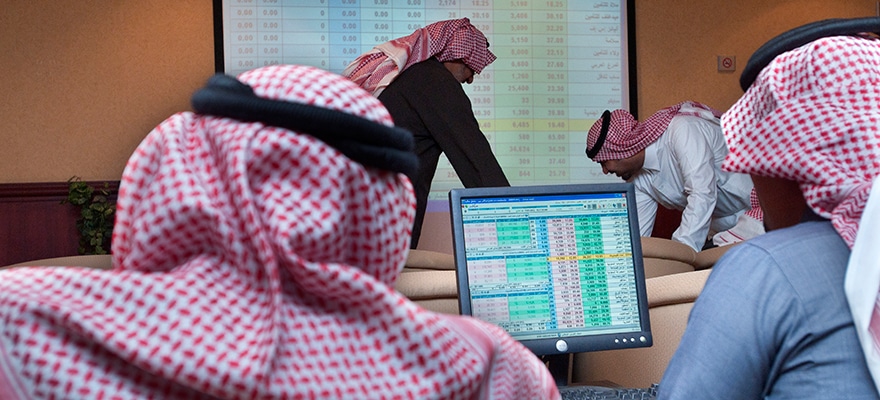
In a bid to diversify its economy, Saudi Arabia has granted limited access to its stock market for qualified foreign investors.
(Photo: Bloomberg)
The Saudi Stock Exchange, Tadawul, yesterday opened its doors to international investors. The decision allows qualified foreign investors (QFIs) – namely, those institutional investors with a minimum of US$5 billion in assets under management and at least a five-year track record– to access the US$580 billion Saudi stock market, by far the biggest in the Gulf.
The decision allows qualified foreign investors to access the US$580 billion Saudi stock market.
Saudi Arabia represents approximately 50 percent of the US$1.6 trillion Gulf economy and is the 19th largest in the world. While GDP growth has recently been downgraded, the projections remain at 2.5 percent for 2015. The stock market itself has seen significant fluctuations in recent months, rebounding by 15% from a 23% drop in late 2014, widely believed to be closely correlated with the struggling price of oil. However, the market valuations remain high.
Access
Foreign investors are now permitted to directly buy Saudi stocks, which could hitherto only be accessed via so-called participatory notes and Exchange -traded funds.
The decision may be seen as the next step in a gradual opening up of the broader Saudi economy to private investment; the motivating driver for which is the desire to reduce reliance on oil income.
But the opening up of the Saudi Stock Exchange is not without restriction. Firstly, there are a number of caps. According to Bloomberg, the new scheme allows foreigners to own as much as 49 percent of a single stock. Any given QFI may hold up to 5 percent of a single equity and a 20 percent ceiling in any one stock applies to all QFIs. In total, QFI holdings will not exceed 10 percent of the market.
Secondly, real estate interests in the holy cities of Medina and Mecca are not permitted for non-Muslim investors. This extends to investment in companies with assets in these locales.
Indeed, six companies are completely off-limits: Makkah Construction & Development Co., Jabal Omar Development Co., Medina-based Taiba Holding Co., Knowledge Economic City Co., Saudi Real Estate Co. and The National Shipping Co. of Saudi Arabia.
However, chief executive officer of the stock exchange, Adel Al-Ghamdi, has indicated that the rules will evolve as time goes by.
The Rationale
The decision may be seen as the next step in a gradual opening up of the broader Saudi economy to private investment; the motivating driver for which is the desire to reduce reliance on oil income. Controlling the world’s second largest hydrocarbon reserves, approximately 75% of budget revenues and 90% of export earnings come from the oil industry. This makes Saudi Arabia the least diversified economy in the Cooperation Council for the Arab States of the Gulf (GCC).
And with the slump in oil prices, the Kingdom’s foreign reserves have been rapidly dwindling, exacerbated by Saudi's involvement in the neighbouring conflict zones of Yemen and Syria.
By allowing internatinal innvestors into the market, the quality of corporate governance at Saudi companies will be lifted.
A point that has been more explicitly emphasised is that by allowing QFIs into the market, the quality of corporate governance at Saudi companies will be lifted. This will be achieved via their participation in general assembly meetings and the ability to nominate representatives to boards.
Chief executive, Adel Al-Ghamdi, commented: “We are excited to welcome foreign investors to our exchange. This is an important and considered next step in a long journey that will continue the development of the exchange, enhance governance among listed businesses and improve research and knowledge in the market.”
The Saudi Stock Exchange, Tadawul, yesterday opened its doors to international investors. The decision allows qualified foreign investors (QFIs) – namely, those institutional investors with a minimum of US$5 billion in assets under management and at least a five-year track record– to access the US$580 billion Saudi stock market, by far the biggest in the Gulf.
The decision allows qualified foreign investors to access the US$580 billion Saudi stock market.
Saudi Arabia represents approximately 50 percent of the US$1.6 trillion Gulf economy and is the 19th largest in the world. While GDP growth has recently been downgraded, the projections remain at 2.5 percent for 2015. The stock market itself has seen significant fluctuations in recent months, rebounding by 15% from a 23% drop in late 2014, widely believed to be closely correlated with the struggling price of oil. However, the market valuations remain high.
Access
Foreign investors are now permitted to directly buy Saudi stocks, which could hitherto only be accessed via so-called participatory notes and Exchange -traded funds.
The decision may be seen as the next step in a gradual opening up of the broader Saudi economy to private investment; the motivating driver for which is the desire to reduce reliance on oil income.
But the opening up of the Saudi Stock Exchange is not without restriction. Firstly, there are a number of caps. According to Bloomberg, the new scheme allows foreigners to own as much as 49 percent of a single stock. Any given QFI may hold up to 5 percent of a single equity and a 20 percent ceiling in any one stock applies to all QFIs. In total, QFI holdings will not exceed 10 percent of the market.
Secondly, real estate interests in the holy cities of Medina and Mecca are not permitted for non-Muslim investors. This extends to investment in companies with assets in these locales.
Indeed, six companies are completely off-limits: Makkah Construction & Development Co., Jabal Omar Development Co., Medina-based Taiba Holding Co., Knowledge Economic City Co., Saudi Real Estate Co. and The National Shipping Co. of Saudi Arabia.
However, chief executive officer of the stock exchange, Adel Al-Ghamdi, has indicated that the rules will evolve as time goes by.
The Rationale
The decision may be seen as the next step in a gradual opening up of the broader Saudi economy to private investment; the motivating driver for which is the desire to reduce reliance on oil income. Controlling the world’s second largest hydrocarbon reserves, approximately 75% of budget revenues and 90% of export earnings come from the oil industry. This makes Saudi Arabia the least diversified economy in the Cooperation Council for the Arab States of the Gulf (GCC).
And with the slump in oil prices, the Kingdom’s foreign reserves have been rapidly dwindling, exacerbated by Saudi's involvement in the neighbouring conflict zones of Yemen and Syria.
By allowing internatinal innvestors into the market, the quality of corporate governance at Saudi companies will be lifted.
A point that has been more explicitly emphasised is that by allowing QFIs into the market, the quality of corporate governance at Saudi companies will be lifted. This will be achieved via their participation in general assembly meetings and the ability to nominate representatives to boards.
Chief executive, Adel Al-Ghamdi, commented: “We are excited to welcome foreign investors to our exchange. This is an important and considered next step in a long journey that will continue the development of the exchange, enhance governance among listed businesses and improve research and knowledge in the market.”
FP Markets Winner Spotlight 🏆 | Global Broker of the Year 2025 #Trading #Broker #Innovation #Shorts
FP Markets Winner Spotlight 🏆 | Global Broker of the Year 2025 #Trading #Broker #Innovation #Shorts
FP Markets takes the spotlight as Global Broker of the Year 2025 at the Finance Magnates Awards.
Martin Stoilov, Head of Client Experience, shares that trust, innovation, and people played a key role in the company’s success, supported by a strong foundation of integrity and client-centricity.
Following this milestone, FP Markets continues to focus on growth, technology investment, and its core values of transparency and excellence.
👉 Be part of FM Awards 2026: https://awards.financemagnates.com/#nominate
FP Markets takes the spotlight as Global Broker of the Year 2025 at the Finance Magnates Awards.
Martin Stoilov, Head of Client Experience, shares that trust, innovation, and people played a key role in the company’s success, supported by a strong foundation of integrity and client-centricity.
Following this milestone, FP Markets continues to focus on growth, technology investment, and its core values of transparency and excellence.
👉 Be part of FM Awards 2026: https://awards.financemagnates.com/#nominate
In this video, we review @HolaPrimeMarketsOfficial, a multi-asset forex and CFDs broker offering different account types, trading platforms, and flexible trading conditions.
We cover the broker’s overall offering, including account options, trading environment, platforms like MT4 and MT5, and additional services such as managed accounts and fast withdrawals.
Watch the full video to see if Hola Prime Markets fits your trading needs.
📣 Stay up to date with the latest in finance and trading. Follow Finance Magnates for industry news, insights, and global event coverage.
Connect with us:
🔗 LinkedIn: /financemagnates
👍 Facebook: /financemagnates
📸 Instagram: https://www.instagram.com/financemagnates
🐦 X: https://x.com/financemagnates
🎥 TikTok: https://www.tiktok.com/tag/financemagnates
▶️ YouTube: /@financemagnates_official
#HolaPrime #ForexBroker #CFDTrading #FinanceMagnates #Trading #Forex #BrokerReview
In this video, we review @HolaPrimeMarketsOfficial, a multi-asset forex and CFDs broker offering different account types, trading platforms, and flexible trading conditions.
We cover the broker’s overall offering, including account options, trading environment, platforms like MT4 and MT5, and additional services such as managed accounts and fast withdrawals.
Watch the full video to see if Hola Prime Markets fits your trading needs.
📣 Stay up to date with the latest in finance and trading. Follow Finance Magnates for industry news, insights, and global event coverage.
Connect with us:
🔗 LinkedIn: /financemagnates
👍 Facebook: /financemagnates
📸 Instagram: https://www.instagram.com/financemagnates
🐦 X: https://x.com/financemagnates
🎥 TikTok: https://www.tiktok.com/tag/financemagnates
▶️ YouTube: /@financemagnates_official
#HolaPrime #ForexBroker #CFDTrading #FinanceMagnates #Trading #Forex #BrokerReview
Hola Prime Review: What You Need to Know | Full Breakdown by Finance Magnates
Hola Prime Review: What You Need to Know | Full Breakdown by Finance Magnates
In this video, we review @HolaPrime_Global, a proprietary trading firm offering evaluation programs and performance-based payouts in simulated market environments.
We cover how the challenge model works, including account types, profit splits (up to 95%), trading rules, and what it takes to reach a funded account. You’ll also learn about available platforms like MT4, MT5, cTrader, and more, along with insights into payouts, support, and trading conditions.
Watch the full video to see if Hola Prime fits your trading style.
📣 Stay up to date with the latest in finance and trading. Follow Finance Magnates for industry news, insights, and global event coverage.
Connect with us:
🔗 LinkedIn: /financemagnates
👍 Facebook: /financemagnates
📸 Instagram: https://www.instagram.com/financemagnates
🐦 X: https://x.com/financemagnates
🎥 TikTok: https://www.tiktok.com/tag/financemagnates
▶️ YouTube: /@financemagnates_official
#HolaPrime #PropFirm #Trading #FinanceMagnates #Forex #FuturesTrading #TradingReview #PropFirmReview
In this video, we review @HolaPrime_Global, a proprietary trading firm offering evaluation programs and performance-based payouts in simulated market environments.
We cover how the challenge model works, including account types, profit splits (up to 95%), trading rules, and what it takes to reach a funded account. You’ll also learn about available platforms like MT4, MT5, cTrader, and more, along with insights into payouts, support, and trading conditions.
Watch the full video to see if Hola Prime fits your trading style.
📣 Stay up to date with the latest in finance and trading. Follow Finance Magnates for industry news, insights, and global event coverage.
Connect with us:
🔗 LinkedIn: /financemagnates
👍 Facebook: /financemagnates
📸 Instagram: https://www.instagram.com/financemagnates
🐦 X: https://x.com/financemagnates
🎥 TikTok: https://www.tiktok.com/tag/financemagnates
▶️ YouTube: /@financemagnates_official
#HolaPrime #PropFirm #Trading #FinanceMagnates #Forex #FuturesTrading #TradingReview #PropFirmReview
Axi Winner Spotlight 🏆 | Global Most Innovative Broker 2025 #Innovation #Trading #Fintech #Broker
Axi Winner Spotlight 🏆 | Global Most Innovative Broker 2025 #Innovation #Trading #Fintech #Broker
Axi takes the spotlight at the Finance Magnates Awards, winning Global Most Innovative Broker 2025.
Olivia Xenofontos and Ivanna Openko share how the team will feel: proud, motivated, and ready to keep delivering.
They also describe the night as well-organized, focused, and enjoyable for all.
👉 Be part of FM Awards 2026.
Axi takes the spotlight at the Finance Magnates Awards, winning Global Most Innovative Broker 2025.
Olivia Xenofontos and Ivanna Openko share how the team will feel: proud, motivated, and ready to keep delivering.
They also describe the night as well-organized, focused, and enjoyable for all.
👉 Be part of FM Awards 2026.
Recognition that matters.
Built on transparency.
Driven by the industry.
The Finance Magnates Awards 2026.
Nominations are now open.
🔗 https://awards.financemagnates.com/?utm_source=SM&utm_medium=social&utm_campaign=recognition-matters
Recognition that matters.
Built on transparency.
Driven by the industry.
The Finance Magnates Awards 2026.
Nominations are now open.
🔗 https://awards.financemagnates.com/?utm_source=SM&utm_medium=social&utm_campaign=recognition-matters