BIS Releases Semi-Annual Report - Charts Volume Decline During 2012
Monday,13/05/2013|10:28GMTby
Andrew Saks McLeod
For those industry participants wishing to gain clarity on 2012's drift in volumes, the BIS has released a set of statistics to set out its findings in its semi-annual report.
Unpredictability is as much of a bugbear as it is an attraction for many participants in FX, and events surrounding the overall direction experienced in volume have been no exception. 2012 was a year of ever decreasing circles, showing a decline in overall volume worldwide. The Bank of International Settlements (BIS) has released a series of detailed data in its semi-annual report, providing an insight into the possible reasons for the drift in volumes.
Various factors contributed to 2012's declines, including Japan’s Leverage restriction limiting all FX companies to offering their clients a maximum of 1:25.
The first quarter of 2013 however, painted a completely different picture, with volumes surging to record levels in the case of many firms across the globe, the most recent of which was DMM Securities posting a five-fold increase in trading volume after its acquisition of Gaitame Japan.
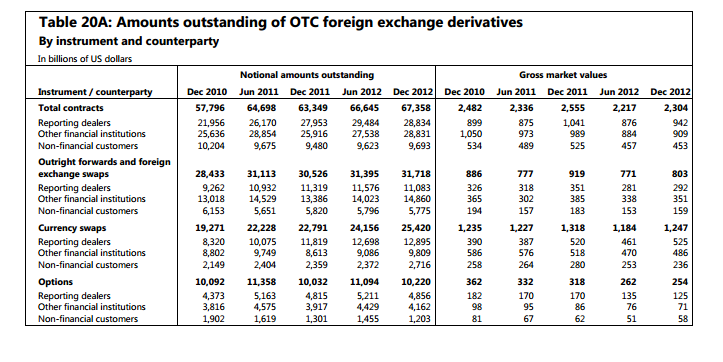
BIS Report - Detailed Volume Statistics
Industry attempts to monitor these global trends are of importance, and new data released late last week cites adjustments made by market participants to adhere to the impending regulation and emergence of swap futures as being a major factor, albeit in North America in this case.
The data was issued by the BIS as part of its semi-annual OTC derivatives report released on May 7, which examined the industry from June to December 2012 and showed an overall drop of $6 trillion in notional outstanding to a final figure of $633 trillion.
According to Zohar Hod of SuperDerivatives, FX derivatives remain in demand as hedging instruments due to the crucial role they play in facilitating cross-border trade and providing stability to businesses.
BIS said the data masked a larger overall decline due to the depreciation of the US dollar against the euro and Swiss franc from June to December last year, which increased the dollar value of contracts denominated in those currencies.
Hod believes the results reflect the participants' concerns about the future of the OTC derivatives market as new regulation begin to come into force, namely Title VII rules within the US Dodd-Frank Act.
"Uncertainty in the regulatory space remains the real bug bear for both the buy- and sell-side, which have yet to get a clear steer on the costs of using these instruments to manage risk going forwards," he said. "OTC derivatives remain an essential and integral part of Risk Management for institutions across the board, but as expected, this uncertainty has had an impact on overall volumes."
Dodd-Frank rules are coming into force on a rolling basis, which began earlier this year with major swaps participants reporting OTC derivatives trades to trade repositories. From 10 June, most US buy-side firms will have to begin centrally clearing OTC derivatives trades.
In anticipation of the new rules, exchanges have offered futures instruments structured to replicate the function of swaps, but which avoid the more costly intensive regulatory requirements for OTC derivatives. Swap futures have seen significant growth since they emerged in the second half of last year, although a growing number of market participants have claimed the disparity between swaps and futures rules forms an uneven competitive environment.
Unpredictability is as much of a bugbear as it is an attraction for many participants in FX, and events surrounding the overall direction experienced in volume have been no exception. 2012 was a year of ever decreasing circles, showing a decline in overall volume worldwide. The Bank of International Settlements (BIS) has released a series of detailed data in its semi-annual report, providing an insight into the possible reasons for the drift in volumes.
Various factors contributed to 2012's declines, including Japan’s Leverage restriction limiting all FX companies to offering their clients a maximum of 1:25.
The first quarter of 2013 however, painted a completely different picture, with volumes surging to record levels in the case of many firms across the globe, the most recent of which was DMM Securities posting a five-fold increase in trading volume after its acquisition of Gaitame Japan.
BIS Report - Detailed Volume Statistics
Industry attempts to monitor these global trends are of importance, and new data released late last week cites adjustments made by market participants to adhere to the impending regulation and emergence of swap futures as being a major factor, albeit in North America in this case.
The data was issued by the BIS as part of its semi-annual OTC derivatives report released on May 7, which examined the industry from June to December 2012 and showed an overall drop of $6 trillion in notional outstanding to a final figure of $633 trillion.
According to Zohar Hod of SuperDerivatives, FX derivatives remain in demand as hedging instruments due to the crucial role they play in facilitating cross-border trade and providing stability to businesses.
BIS said the data masked a larger overall decline due to the depreciation of the US dollar against the euro and Swiss franc from June to December last year, which increased the dollar value of contracts denominated in those currencies.
Hod believes the results reflect the participants' concerns about the future of the OTC derivatives market as new regulation begin to come into force, namely Title VII rules within the US Dodd-Frank Act.
"Uncertainty in the regulatory space remains the real bug bear for both the buy- and sell-side, which have yet to get a clear steer on the costs of using these instruments to manage risk going forwards," he said. "OTC derivatives remain an essential and integral part of Risk Management for institutions across the board, but as expected, this uncertainty has had an impact on overall volumes."
Dodd-Frank rules are coming into force on a rolling basis, which began earlier this year with major swaps participants reporting OTC derivatives trades to trade repositories. From 10 June, most US buy-side firms will have to begin centrally clearing OTC derivatives trades.
In anticipation of the new rules, exchanges have offered futures instruments structured to replicate the function of swaps, but which avoid the more costly intensive regulatory requirements for OTC derivatives. Swap futures have seen significant growth since they emerged in the second half of last year, although a growing number of market participants have claimed the disparity between swaps and futures rules forms an uneven competitive environment.
Singapore Independent Wealth Sector Has Less Than 10% Market Share, but Vast Room for Growth
FP Markets Winner Spotlight 🏆 | Global Broker of the Year 2025 #Trading #Broker #Innovation #Shorts
FP Markets Winner Spotlight 🏆 | Global Broker of the Year 2025 #Trading #Broker #Innovation #Shorts
FP Markets takes the spotlight as Global Broker of the Year 2025 at the Finance Magnates Awards.
Martin Stoilov, Head of Client Experience, shares that trust, innovation, and people played a key role in the company’s success, supported by a strong foundation of integrity and client-centricity.
Following this milestone, FP Markets continues to focus on growth, technology investment, and its core values of transparency and excellence.
👉 Be part of FM Awards 2026: https://awards.financemagnates.com/#nominate
FP Markets takes the spotlight as Global Broker of the Year 2025 at the Finance Magnates Awards.
Martin Stoilov, Head of Client Experience, shares that trust, innovation, and people played a key role in the company’s success, supported by a strong foundation of integrity and client-centricity.
Following this milestone, FP Markets continues to focus on growth, technology investment, and its core values of transparency and excellence.
👉 Be part of FM Awards 2026: https://awards.financemagnates.com/#nominate
In this video, we review @HolaPrimeMarketsOfficial, a multi-asset forex and CFDs broker offering different account types, trading platforms, and flexible trading conditions.
We cover the broker’s overall offering, including account options, trading environment, platforms like MT4 and MT5, and additional services such as managed accounts and fast withdrawals.
Watch the full video to see if Hola Prime Markets fits your trading needs.
📣 Stay up to date with the latest in finance and trading. Follow Finance Magnates for industry news, insights, and global event coverage.
Connect with us:
🔗 LinkedIn: /financemagnates
👍 Facebook: /financemagnates
📸 Instagram: https://www.instagram.com/financemagnates
🐦 X: https://x.com/financemagnates
🎥 TikTok: https://www.tiktok.com/tag/financemagnates
▶️ YouTube: /@financemagnates_official
#HolaPrime #ForexBroker #CFDTrading #FinanceMagnates #Trading #Forex #BrokerReview
In this video, we review @HolaPrimeMarketsOfficial, a multi-asset forex and CFDs broker offering different account types, trading platforms, and flexible trading conditions.
We cover the broker’s overall offering, including account options, trading environment, platforms like MT4 and MT5, and additional services such as managed accounts and fast withdrawals.
Watch the full video to see if Hola Prime Markets fits your trading needs.
📣 Stay up to date with the latest in finance and trading. Follow Finance Magnates for industry news, insights, and global event coverage.
Connect with us:
🔗 LinkedIn: /financemagnates
👍 Facebook: /financemagnates
📸 Instagram: https://www.instagram.com/financemagnates
🐦 X: https://x.com/financemagnates
🎥 TikTok: https://www.tiktok.com/tag/financemagnates
▶️ YouTube: /@financemagnates_official
#HolaPrime #ForexBroker #CFDTrading #FinanceMagnates #Trading #Forex #BrokerReview
Hola Prime Review: What You Need to Know | Full Breakdown by Finance Magnates
Hola Prime Review: What You Need to Know | Full Breakdown by Finance Magnates
In this video, we review @HolaPrime_Global, a proprietary trading firm offering evaluation programs and performance-based payouts in simulated market environments.
We cover how the challenge model works, including account types, profit splits (up to 95%), trading rules, and what it takes to reach a funded account. You’ll also learn about available platforms like MT4, MT5, cTrader, and more, along with insights into payouts, support, and trading conditions.
Watch the full video to see if Hola Prime fits your trading style.
📣 Stay up to date with the latest in finance and trading. Follow Finance Magnates for industry news, insights, and global event coverage.
Connect with us:
🔗 LinkedIn: /financemagnates
👍 Facebook: /financemagnates
📸 Instagram: https://www.instagram.com/financemagnates
🐦 X: https://x.com/financemagnates
🎥 TikTok: https://www.tiktok.com/tag/financemagnates
▶️ YouTube: /@financemagnates_official
#HolaPrime #PropFirm #Trading #FinanceMagnates #Forex #FuturesTrading #TradingReview #PropFirmReview
In this video, we review @HolaPrime_Global, a proprietary trading firm offering evaluation programs and performance-based payouts in simulated market environments.
We cover how the challenge model works, including account types, profit splits (up to 95%), trading rules, and what it takes to reach a funded account. You’ll also learn about available platforms like MT4, MT5, cTrader, and more, along with insights into payouts, support, and trading conditions.
Watch the full video to see if Hola Prime fits your trading style.
📣 Stay up to date with the latest in finance and trading. Follow Finance Magnates for industry news, insights, and global event coverage.
Connect with us:
🔗 LinkedIn: /financemagnates
👍 Facebook: /financemagnates
📸 Instagram: https://www.instagram.com/financemagnates
🐦 X: https://x.com/financemagnates
🎥 TikTok: https://www.tiktok.com/tag/financemagnates
▶️ YouTube: /@financemagnates_official
#HolaPrime #PropFirm #Trading #FinanceMagnates #Forex #FuturesTrading #TradingReview #PropFirmReview
Axi Winner Spotlight 🏆 | Global Most Innovative Broker 2025 #Innovation #Trading #Fintech #Broker
Axi Winner Spotlight 🏆 | Global Most Innovative Broker 2025 #Innovation #Trading #Fintech #Broker
Axi takes the spotlight at the Finance Magnates Awards, winning Global Most Innovative Broker 2025.
Olivia Xenofontos and Ivanna Openko share how the team will feel: proud, motivated, and ready to keep delivering.
They also describe the night as well-organized, focused, and enjoyable for all.
👉 Be part of FM Awards 2026.
Axi takes the spotlight at the Finance Magnates Awards, winning Global Most Innovative Broker 2025.
Olivia Xenofontos and Ivanna Openko share how the team will feel: proud, motivated, and ready to keep delivering.
They also describe the night as well-organized, focused, and enjoyable for all.
👉 Be part of FM Awards 2026.
Recognition that matters.
Built on transparency.
Driven by the industry.
The Finance Magnates Awards 2026.
Nominations are now open.
🔗 https://awards.financemagnates.com/?utm_source=SM&utm_medium=social&utm_campaign=recognition-matters
Recognition that matters.
Built on transparency.
Driven by the industry.
The Finance Magnates Awards 2026.
Nominations are now open.
🔗 https://awards.financemagnates.com/?utm_source=SM&utm_medium=social&utm_campaign=recognition-matters