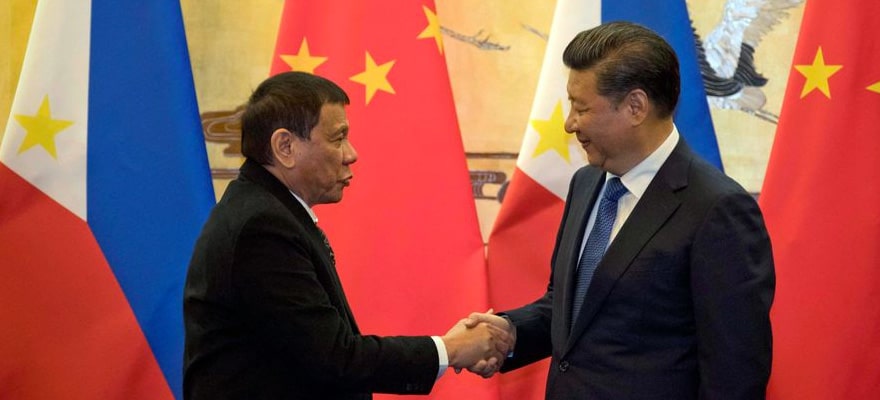
President Duterte of the Philippines makes ridicule and worse of the US. Critics write that this spells doom for the US pivot from the Middle East to the Asia Pacific.
The current validity of the geopolitical projection of force forward which the US has practiced for more than 240 years, since US Marines landed in the Bahamas in 1775, is now called into question. In the Middle East, the US methodology of military shock and awe followed by drive-by nation-building, have proven to be singularly unsustainable.
As Robert Kennedy said in his speech on the Vietnam War in 1967, at Kansas University, we must do better than to destroy cities and countries in order to save them. This model of "destroy in order to save" applies as directly to Mosul and Iraq today as it did to US destruction of a village near Saigon in 1967.
Venezuela's Pres. used the US as scapegoat & China as savior! Oils in xchange of loans & came economic collapse!READ https://t.co/jJYNPo6aOa
We can only wonder whether the US pivot from the Middle East to the Asia-Pacific will be more successful than its predecessors in Latin America, Haiti, Vietnam, the Middle East and Afghanistan.
Shock and Awe and Nation-Building
The US involvement in the Middle East and Afghanistan and the lack of conclusion are provided as examples of failed nation-building. Military campaigns, the "shock and awe" are precursors to the protracted work of nation-building. Nation-building as we saw when the US Marines occupied Haiti from 1915-1934, is often not something the US does very effectively.
The Marshall Plan which provided loans and grants to Europe after its utter destruction after WWII and the administration of Japan by Gen. Douglas McArthur are prominent exceptions from which important lessons can be derived. US loans and grants were successful in post WWII Europe because the Europeans were empowered to achieve their own economic and political success.
Japan's culture was changed by its US occupation when everything from its language to its administration, laws and businesses became more simplified, streamlined and democratic. It is also important to note that Japan could not rearm by law and that as a result its resources were spent on civilian economic pursuits as opposed to military adventures, while the US provided its defense. Importantly, US know-how imbued the Japanese industrial sector when Deming and Juran taught the Japanese statistical quality control.
China's Nation-Building
China's nation-building efforts are evidenced throughout Africa and to a lesser extent, in South America. The Chinese Resources for Infrastructure Investment or R4I program also known as the Angola Model, began in Angola, a country rich in oil resources but defective in governance and in dire need of infrastructure investment. Importantly, Angola could not access global capital markets and sought China's help because it had nowhere else to turn for money.
R4I is a unique form of mercantilism whereby loans and contracts grant the Chinese loan and infrastructure providers the almost exclusive right to contracts for infrastructure projects, markets and mining concessions in the target country. In Venezuela, China provided $65 billion in loans in exchange for thousands of barrels of oil per day. Denouement of R4I
Can Chinese investment which has been so ineffectual in Angola and Venezuela improve the quality of life in the Philippines?
Unlike the US foreign policy of proposing to make the world safe for democracy and the use of military and soft power to promote anti-communist and anti-socialist regimes in the Americas and elsewhere, China has not shown any great concern for the type of governments for which it arranged R4I. The result is deplorable and near disastrous.
Angola has been lavished with loans in exchange for oil. This has not resulted in any significant improvement in the quality of life of anyone there except for that of a small Angolan aristocracy. The infant mortality rate of Angola is one of the highest in the world, for example.
The situation in Venezuela is even more distressing. Recently, a hospital in Venezuela which has too few incubators, had to decide which babies would be incubated and live and which would die. The long lines of women looking to buy food, the high unemployment, high inflation, the lack of diapers, food, toilet paper and the most basic necessities of life result from incompetent economic administration of billions of dollars of resources provided Venezuela by China.
Under Chavez, thousands of Venezuelans were lifted out of poverty as the state subsidized everything from fuel to food. The Venezuelan economy continued however to depend principally on its heavy oil for its principal means of income while economic diversification and entrepreneurship were neglected.

The Venezuelan capital of Caracas was a Latin American financial hub in the 1980s, full of gleaming skyscrapers and energy companies eager to exploit the largest national oil reserve in the world. But oil-boom profits disappeared by the 1990s when crude prices fell, while corruption and cronyism discredited the two entrenched parties. In 1998, Hugo Chávez rode to power on a wave of populism. His socialist overhaul, though, sent the Venezuelan economy into a tailspin that his successor, Mr. Maduro, has made worse.
A Canal Too Far?
China intended to build a sea level canal across Nicaragua until its slowing economy and the growing price tag and native resistance to such a project brought Chinese party leaders to their senses.
What Now?
The US political scenario is imbued with a decidedly anti-globalization and anti-global trade stance. Globalization and global trade in particular are being blamed for the loss of manufacturing jobs in the US.
JUST IN on #Duterte from former Foreign Secretary Albert Del Rosario: "What is unfolding before us must be considered a national tragedy." pic.twitter.com/16pdm5go45
It is argued rather vehemently that poorly negotiated trade treaties are largely responsible for the loss of over 3 million manufacturing jobs from 1990-2010. This anti-trade and anti-trade treaty bias does not bode well for a US Congress ratification of the TPP, the Trans-Pacific Partnership agreement. More on this later.
It has been reported that automation is the culprit for the lion's share of US manufacturing job losses. In the meantime and as I have written in another article, the very nature of enterprise in the US and Europe is changing.
Crowd-based Capitalism, the Sharing Economy, what I call a New Economy is changing the future of work in the US and elsewhere. Its effects are not yet measurable and policy makers will be strongly impacted in the areas of taxation, job and economic growth.
The Pivot
It is implied that the US is failing in the Middle East and in Afghanistan. The Obama administration, it is postulated, implemented a policy of pivoting, of exerting geopolitical hegemony in the direction of Southeast Asia as a direct result.
Enter the Philippines
President Duterte of the Philippines has arranged a rapprochement with China despite the Chinese South China Sea initiatives and despite the international law rulings against China regarding the rocks, islets, reefs and atolls on which it is building air and naval bases, radar installations and other military facilities.
Mr. Obama has been called the "son of a whore" on several occasions by Duterte. Duterte has sought Chinese economic aid and has negotiated contracts worth $13+ billion with China.
It is an important question whether Chinese investment which has been so ineffectual in raising the quality of life in Angola, the rest of Africa and Venezuela, can improve the quality of life in the Philippines or indeed in the rest of Asia. Long-running resentment toward a history of what is perceived as condescension and neglect exacerbate the prospects for a continued close economic, military and cultural relationship among the US and the Philippines.
Since the time when admiral Dewey entered Manila harbor and ordered Gridley, his gunnery officer to open fire on the Spanish fleet docked there, the US has treated the Philippines as a military and geopolitical satellite. US special forces, Marines and naval forces have trained alongside their Philippine counterparts. When the Philippines were devastated by a hurricane, US aid was the first to arrive.
This history, these events led to the assumption that the US and the Philippines would remain close allies indefinitely and that the Philippines were central to the US pivot. The US has naval and air bases in Japan and South Korea. The US Marines are more and more questionably esconsed in Okinawa. Some 2,000 US Marines are to be based in Australia.
One Belt, One Road
China has embarked on a policy of One Belt, One Road. It is unclear the degree to which R4I will play a role in this geopolitical policy. In everything it engages in, from e-commerce on Alibaba and Tencent to R4I, it is clear that Chinese foreign policy and economic policy are one. The purpose of this policy is to provide markets for Chinese goods and contracts for China's enterprises.
Both Fail
Both Chinese and US hegemonic efforts as presently conceived and organized are in my opinion doomed to fail. US economic policy has fostered the success of nationally monopolistic and globally oligopolistic corporations.
These efforts have failed to create and to empower a native entrepreneurial class in the countries the US has helped to rebuild and views as allies, with the exception of Germany and Europe. SMEs create 2/3 of global jobs and make an outsized contribution to economic and job growth. In the New Economy, it will be micro-entrepreneurs who will drive economic and job growth and importantly, contribute to an improved quality of life everywhere.
When Hernando de Soto, the Peruvian economist, explained to Egyptians the causes of the Tunisian beginning of the Arab Spring, he told them that it took too long to record title to land and to take out a mortgage there. A man in the audience came up to de Soto after the speech and said, "your prophet chased the merchants out of the temple, our prophet was a merchant." It was the frustration of Muhamad Bouazzizi's effort to expand his produce business by buying a truck that led to his self-immolation and the protests of the Arab Spring. It is a cause of microentrepreneurship crushed by a culture of bureaucracy.
Everywhere, platforms are being created to empower the individual with opportunity and a better quality of life. The US and Chinese policies do not address or empower this trend.
China fails to sustainably implement an effective improvement in the economic and political life of other countries. Its R4I program is a failure. China's e-commerce platforms serve to promote and sell Chinese-made counterfeits of brand-name goods.
Intellectual property violation and shoddy construction and capital goods are the hallmark of Chinese global expansion. Finally, Chinese e-commerce platforms utilize the most invasive of methods to determine the credit-worthiness of the buyer of goods from China. Privacy and cybersecurity concerns are sure to trump the Chinese execution of One Belt, One Road.
President Duterte of the Philippines makes ridicule and worse of the US. Critics write that this spells doom for the US pivot from the Middle East to the Asia Pacific.
The current validity of the geopolitical projection of force forward which the US has practiced for more than 240 years, since US Marines landed in the Bahamas in 1775, is now called into question. In the Middle East, the US methodology of military shock and awe followed by drive-by nation-building, have proven to be singularly unsustainable.
As Robert Kennedy said in his speech on the Vietnam War in 1967, at Kansas University, we must do better than to destroy cities and countries in order to save them. This model of "destroy in order to save" applies as directly to Mosul and Iraq today as it did to US destruction of a village near Saigon in 1967.
Venezuela's Pres. used the US as scapegoat & China as savior! Oils in xchange of loans & came economic collapse!READ https://t.co/jJYNPo6aOa
We can only wonder whether the US pivot from the Middle East to the Asia-Pacific will be more successful than its predecessors in Latin America, Haiti, Vietnam, the Middle East and Afghanistan.
Shock and Awe and Nation-Building
The US involvement in the Middle East and Afghanistan and the lack of conclusion are provided as examples of failed nation-building. Military campaigns, the "shock and awe" are precursors to the protracted work of nation-building. Nation-building as we saw when the US Marines occupied Haiti from 1915-1934, is often not something the US does very effectively.
The Marshall Plan which provided loans and grants to Europe after its utter destruction after WWII and the administration of Japan by Gen. Douglas McArthur are prominent exceptions from which important lessons can be derived. US loans and grants were successful in post WWII Europe because the Europeans were empowered to achieve their own economic and political success.
Japan's culture was changed by its US occupation when everything from its language to its administration, laws and businesses became more simplified, streamlined and democratic. It is also important to note that Japan could not rearm by law and that as a result its resources were spent on civilian economic pursuits as opposed to military adventures, while the US provided its defense. Importantly, US know-how imbued the Japanese industrial sector when Deming and Juran taught the Japanese statistical quality control.
China's Nation-Building
China's nation-building efforts are evidenced throughout Africa and to a lesser extent, in South America. The Chinese Resources for Infrastructure Investment or R4I program also known as the Angola Model, began in Angola, a country rich in oil resources but defective in governance and in dire need of infrastructure investment. Importantly, Angola could not access global capital markets and sought China's help because it had nowhere else to turn for money.
R4I is a unique form of mercantilism whereby loans and contracts grant the Chinese loan and infrastructure providers the almost exclusive right to contracts for infrastructure projects, markets and mining concessions in the target country. In Venezuela, China provided $65 billion in loans in exchange for thousands of barrels of oil per day. Denouement of R4I
Can Chinese investment which has been so ineffectual in Angola and Venezuela improve the quality of life in the Philippines?
Unlike the US foreign policy of proposing to make the world safe for democracy and the use of military and soft power to promote anti-communist and anti-socialist regimes in the Americas and elsewhere, China has not shown any great concern for the type of governments for which it arranged R4I. The result is deplorable and near disastrous.
Angola has been lavished with loans in exchange for oil. This has not resulted in any significant improvement in the quality of life of anyone there except for that of a small Angolan aristocracy. The infant mortality rate of Angola is one of the highest in the world, for example.
The situation in Venezuela is even more distressing. Recently, a hospital in Venezuela which has too few incubators, had to decide which babies would be incubated and live and which would die. The long lines of women looking to buy food, the high unemployment, high inflation, the lack of diapers, food, toilet paper and the most basic necessities of life result from incompetent economic administration of billions of dollars of resources provided Venezuela by China.
Under Chavez, thousands of Venezuelans were lifted out of poverty as the state subsidized everything from fuel to food. The Venezuelan economy continued however to depend principally on its heavy oil for its principal means of income while economic diversification and entrepreneurship were neglected.
The Venezuelan capital of Caracas was a Latin American financial hub in the 1980s, full of gleaming skyscrapers and energy companies eager to exploit the largest national oil reserve in the world. But oil-boom profits disappeared by the 1990s when crude prices fell, while corruption and cronyism discredited the two entrenched parties. In 1998, Hugo Chávez rode to power on a wave of populism. His socialist overhaul, though, sent the Venezuelan economy into a tailspin that his successor, Mr. Maduro, has made worse.
A Canal Too Far?
China intended to build a sea level canal across Nicaragua until its slowing economy and the growing price tag and native resistance to such a project brought Chinese party leaders to their senses.
What Now?
The US political scenario is imbued with a decidedly anti-globalization and anti-global trade stance. Globalization and global trade in particular are being blamed for the loss of manufacturing jobs in the US.
JUST IN on #Duterte from former Foreign Secretary Albert Del Rosario: "What is unfolding before us must be considered a national tragedy." pic.twitter.com/16pdm5go45
It is argued rather vehemently that poorly negotiated trade treaties are largely responsible for the loss of over 3 million manufacturing jobs from 1990-2010. This anti-trade and anti-trade treaty bias does not bode well for a US Congress ratification of the TPP, the Trans-Pacific Partnership agreement. More on this later.
It has been reported that automation is the culprit for the lion's share of US manufacturing job losses. In the meantime and as I have written in another article, the very nature of enterprise in the US and Europe is changing.
Crowd-based Capitalism, the Sharing Economy, what I call a New Economy is changing the future of work in the US and elsewhere. Its effects are not yet measurable and policy makers will be strongly impacted in the areas of taxation, job and economic growth.
The Pivot
It is implied that the US is failing in the Middle East and in Afghanistan. The Obama administration, it is postulated, implemented a policy of pivoting, of exerting geopolitical hegemony in the direction of Southeast Asia as a direct result.
Enter the Philippines
President Duterte of the Philippines has arranged a rapprochement with China despite the Chinese South China Sea initiatives and despite the international law rulings against China regarding the rocks, islets, reefs and atolls on which it is building air and naval bases, radar installations and other military facilities.
Mr. Obama has been called the "son of a whore" on several occasions by Duterte. Duterte has sought Chinese economic aid and has negotiated contracts worth $13+ billion with China.
It is an important question whether Chinese investment which has been so ineffectual in raising the quality of life in Angola, the rest of Africa and Venezuela, can improve the quality of life in the Philippines or indeed in the rest of Asia. Long-running resentment toward a history of what is perceived as condescension and neglect exacerbate the prospects for a continued close economic, military and cultural relationship among the US and the Philippines.
Since the time when admiral Dewey entered Manila harbor and ordered Gridley, his gunnery officer to open fire on the Spanish fleet docked there, the US has treated the Philippines as a military and geopolitical satellite. US special forces, Marines and naval forces have trained alongside their Philippine counterparts. When the Philippines were devastated by a hurricane, US aid was the first to arrive.
This history, these events led to the assumption that the US and the Philippines would remain close allies indefinitely and that the Philippines were central to the US pivot. The US has naval and air bases in Japan and South Korea. The US Marines are more and more questionably esconsed in Okinawa. Some 2,000 US Marines are to be based in Australia.
One Belt, One Road
China has embarked on a policy of One Belt, One Road. It is unclear the degree to which R4I will play a role in this geopolitical policy. In everything it engages in, from e-commerce on Alibaba and Tencent to R4I, it is clear that Chinese foreign policy and economic policy are one. The purpose of this policy is to provide markets for Chinese goods and contracts for China's enterprises.
Both Fail
Both Chinese and US hegemonic efforts as presently conceived and organized are in my opinion doomed to fail. US economic policy has fostered the success of nationally monopolistic and globally oligopolistic corporations.
These efforts have failed to create and to empower a native entrepreneurial class in the countries the US has helped to rebuild and views as allies, with the exception of Germany and Europe. SMEs create 2/3 of global jobs and make an outsized contribution to economic and job growth. In the New Economy, it will be micro-entrepreneurs who will drive economic and job growth and importantly, contribute to an improved quality of life everywhere.
When Hernando de Soto, the Peruvian economist, explained to Egyptians the causes of the Tunisian beginning of the Arab Spring, he told them that it took too long to record title to land and to take out a mortgage there. A man in the audience came up to de Soto after the speech and said, "your prophet chased the merchants out of the temple, our prophet was a merchant." It was the frustration of Muhamad Bouazzizi's effort to expand his produce business by buying a truck that led to his self-immolation and the protests of the Arab Spring. It is a cause of microentrepreneurship crushed by a culture of bureaucracy.
Everywhere, platforms are being created to empower the individual with opportunity and a better quality of life. The US and Chinese policies do not address or empower this trend.
China fails to sustainably implement an effective improvement in the economic and political life of other countries. Its R4I program is a failure. China's e-commerce platforms serve to promote and sell Chinese-made counterfeits of brand-name goods.
Intellectual property violation and shoddy construction and capital goods are the hallmark of Chinese global expansion. Finally, Chinese e-commerce platforms utilize the most invasive of methods to determine the credit-worthiness of the buyer of goods from China. Privacy and cybersecurity concerns are sure to trump the Chinese execution of One Belt, One Road.
William Laraque is the Managing Director of the US-International Trade Services. William Laraque is the Managing Director of US-International Trade Services.
CIX Enters Canada’s Equity Market with Three Trading Venues
Featured Videos
Inside LCG’s Take Over; CMC Markets Adds ChatGPT
Today’s financial news recap covers Inside LCG’s management takeover, CMC Markets adding ChatGPT, iFOREX’s first-half loss, and new Asic rules for trading algorithms.
Finance Magnates Daily Recap brings you the latest news from forex and CFD brokers, fintech, payments, cryptocurrency, digital assets, trading platforms, financial regulation and global markets.
Get the key company news, executive moves, deals, regulatory updates and market developments of the day, in just a few minutes. New episodes published every weekday.
Read more: https://www.financemagnates.com
#FinanceMagnates #ForexNews #FintechNews
Today’s financial news recap covers Inside LCG’s management takeover, CMC Markets adding ChatGPT, iFOREX’s first-half loss, and new Asic rules for trading algorithms.
Finance Magnates Daily Recap brings you the latest news from forex and CFD brokers, fintech, payments, cryptocurrency, digital assets, trading platforms, financial regulation and global markets.
Get the key company news, executive moves, deals, regulatory updates and market developments of the day, in just a few minutes. New episodes published every weekday.
Read more: https://www.financemagnates.com
#FinanceMagnates #ForexNews #FintechNews
Today’s financial news recap covers Inside LCG’s management takeover, CMC Markets adding ChatGPT, iFOREX’s first-half loss, and new Asic rules for trading algorithms.
Finance Magnates Daily Recap brings you the latest news from forex and CFD brokers, fintech, payments, cryptocurrency, digital assets, trading platforms, financial regulation and global markets.
Get the key company news, executive moves, deals, regulatory updates and market developments of the day, in just a few minutes. New episodes published every weekday.
Read more: https://www.financemagnates.com
#FinanceMagnates #ForexNews #FintechNews
Today’s financial news recap covers Inside LCG’s management takeover, CMC Markets adding ChatGPT, iFOREX’s first-half loss, and new Asic rules for trading algorithms.
Finance Magnates Daily Recap brings you the latest news from forex and CFD brokers, fintech, payments, cryptocurrency, digital assets, trading platforms, financial regulation and global markets.
Get the key company news, executive moves, deals, regulatory updates and market developments of the day, in just a few minutes. New episodes published every weekday.
Read more: https://www.financemagnates.com
#FinanceMagnates #ForexNews #FintechNews
Professional development doesn’t always fit neatly into a two-hour block.
That’s why FM Academy courses are designed to be flexible.
You can spend 15 minutes learning, leave the course and come back the next day exactly where you stopped. Or, if you have more time, you can keep going.
The goal is to make learning work around your schedule, so you have a better chance of actually retaining what you learn.
#FinanceMagnates #FMAcademy #ProfessionalDevelopment #Fintech #FinanceCareers
Professional development doesn’t always fit neatly into a two-hour block.
That’s why FM Academy courses are designed to be flexible.
You can spend 15 minutes learning, leave the course and come back the next day exactly where you stopped. Or, if you have more time, you can keep going.
The goal is to make learning work around your schedule, so you have a better chance of actually retaining what you learn.
#FinanceMagnates #FMAcademy #ProfessionalDevelopment #Fintech #FinanceCareers
Professional development doesn’t always fit neatly into a two-hour block.
That’s why FM Academy courses are designed to be flexible.
You can spend 15 minutes learning, leave the course and come back the next day exactly where you stopped. Or, if you have more time, you can keep going.
The goal is to make learning work around your schedule, so you have a better chance of actually retaining what you learn.
#FinanceMagnates #FMAcademy #ProfessionalDevelopment #Fintech #FinanceCareers
Professional development doesn’t always fit neatly into a two-hour block.
That’s why FM Academy courses are designed to be flexible.
You can spend 15 minutes learning, leave the course and come back the next day exactly where you stopped. Or, if you have more time, you can keep going.
The goal is to make learning work around your schedule, so you have a better chance of actually retaining what you learn.
#FinanceMagnates #FMAcademy #ProfessionalDevelopment #Fintech #FinanceCareers
Professional development doesn’t always fit neatly into a two-hour block.
That’s why FM Academy courses are designed to be flexible.
You can spend 15 minutes learning, leave the course and come back the next day exactly where you stopped. Or, if you have more time, you can keep going.
The goal is to make learning work around your schedule, so you have a better chance of actually retaining what you learn.
#FinanceMagnates #FMAcademy #ProfessionalDevelopment #Fintech #FinanceCareers
Professional development doesn’t always fit neatly into a two-hour block.
That’s why FM Academy courses are designed to be flexible.
You can spend 15 minutes learning, leave the course and come back the next day exactly where you stopped. Or, if you have more time, you can keep going.
The goal is to make learning work around your schedule, so you have a better chance of actually retaining what you learn.
#FinanceMagnates #FMAcademy #ProfessionalDevelopment #Fintech #FinanceCareers
How AI and Technology Are Changing Trading | Amir Amidian | FISG Interstellar Group
How are AI, technology, regulation and execution shaping the future of trading? In this studio interview, Amir Amidian, Global Head of Research at FISG - Interstellar Group, discusses the group's approach to technology, compliance, trader education and global expansion.
Amir also explains how Interstellar uses its proprietary Flux One execution technology and how AI could help traders identify and learn from past mistakes.
In this interview, you'll learn:
How Interstellar approaches regulation across multiple jurisdictions
How Flux One is designed to improve execution speed
Why trader education remains a key focus
How AI is being used to support traders
Why reliability, innovation and trust are central to the group's approach
Interstellar's plans for further international expansion
#Trading #AI #Fintech #Forex #TradingTechnology #FinanceMagnates
How are AI, technology, regulation and execution shaping the future of trading? In this studio interview, Amir Amidian, Global Head of Research at FISG - Interstellar Group, discusses the group's approach to technology, compliance, trader education and global expansion.
Amir also explains how Interstellar uses its proprietary Flux One execution technology and how AI could help traders identify and learn from past mistakes.
In this interview, you'll learn:
How Interstellar approaches regulation across multiple jurisdictions
How Flux One is designed to improve execution speed
Why trader education remains a key focus
How AI is being used to support traders
Why reliability, innovation and trust are central to the group's approach
Interstellar's plans for further international expansion
#Trading #AI #Fintech #Forex #TradingTechnology #FinanceMagnates
How are AI, technology, regulation and execution shaping the future of trading? In this studio interview, Amir Amidian, Global Head of Research at FISG - Interstellar Group, discusses the group's approach to technology, compliance, trader education and global expansion.
Amir also explains how Interstellar uses its proprietary Flux One execution technology and how AI could help traders identify and learn from past mistakes.
In this interview, you'll learn:
How Interstellar approaches regulation across multiple jurisdictions
How Flux One is designed to improve execution speed
Why trader education remains a key focus
How AI is being used to support traders
Why reliability, innovation and trust are central to the group's approach
Interstellar's plans for further international expansion
#Trading #AI #Fintech #Forex #TradingTechnology #FinanceMagnates
How are AI, technology, regulation and execution shaping the future of trading? In this studio interview, Amir Amidian, Global Head of Research at FISG - Interstellar Group, discusses the group's approach to technology, compliance, trader education and global expansion.
Amir also explains how Interstellar uses its proprietary Flux One execution technology and how AI could help traders identify and learn from past mistakes.
In this interview, you'll learn:
How Interstellar approaches regulation across multiple jurisdictions
How Flux One is designed to improve execution speed
Why trader education remains a key focus
How AI is being used to support traders
Why reliability, innovation and trust are central to the group's approach
Interstellar's plans for further international expansion
#Trading #AI #Fintech #Forex #TradingTechnology #FinanceMagnates
How are AI, technology, regulation and execution shaping the future of trading? In this studio interview, Amir Amidian, Global Head of Research at FISG - Interstellar Group, discusses the group's approach to technology, compliance, trader education and global expansion.
Amir also explains how Interstellar uses its proprietary Flux One execution technology and how AI could help traders identify and learn from past mistakes.
In this interview, you'll learn:
How Interstellar approaches regulation across multiple jurisdictions
How Flux One is designed to improve execution speed
Why trader education remains a key focus
How AI is being used to support traders
Why reliability, innovation and trust are central to the group's approach
Interstellar's plans for further international expansion
#Trading #AI #Fintech #Forex #TradingTechnology #FinanceMagnates
How are AI, technology, regulation and execution shaping the future of trading? In this studio interview, Amir Amidian, Global Head of Research at FISG - Interstellar Group, discusses the group's approach to technology, compliance, trader education and global expansion.
Amir also explains how Interstellar uses its proprietary Flux One execution technology and how AI could help traders identify and learn from past mistakes.
In this interview, you'll learn:
How Interstellar approaches regulation across multiple jurisdictions
How Flux One is designed to improve execution speed
Why trader education remains a key focus
How AI is being used to support traders
Why reliability, innovation and trust are central to the group's approach
Interstellar's plans for further international expansion
#Trading #AI #Fintech #Forex #TradingTechnology #FinanceMagnates
BlackBull IPO Delayed; Equiti Opens Second UAE Storefront
Today’s financial news recap covers BlackBull's IPO is delayed, BlackBull's IPO is delayed until 2027, Equiti opens a second UAE physical storefront, eToro prepares to move clients to its new AI-centred app and financial contracts could take almost half of prediction-market volume by 2035.
Finance Magnates Daily Recap brings you the latest news from forex and CFD brokers, fintech, payments, cryptocurrency, digital assets, trading platforms, financial regulation and global markets.
Get the key company news, executive moves, deals, regulatory updates and market developments of the day, in just a few minutes. New episodes published every weekday.
Read more: https://www.financemagnates.com
#FinanceMagnates #ForexNews #FintechNews
Today’s financial news recap covers BlackBull's IPO is delayed, BlackBull's IPO is delayed until 2027, Equiti opens a second UAE physical storefront, eToro prepares to move clients to its new AI-centred app and financial contracts could take almost half of prediction-market volume by 2035.
Finance Magnates Daily Recap brings you the latest news from forex and CFD brokers, fintech, payments, cryptocurrency, digital assets, trading platforms, financial regulation and global markets.
Get the key company news, executive moves, deals, regulatory updates and market developments of the day, in just a few minutes. New episodes published every weekday.
Read more: https://www.financemagnates.com
#FinanceMagnates #ForexNews #FintechNews
Today’s financial news recap covers BlackBull's IPO is delayed, BlackBull's IPO is delayed until 2027, Equiti opens a second UAE physical storefront, eToro prepares to move clients to its new AI-centred app and financial contracts could take almost half of prediction-market volume by 2035.
Finance Magnates Daily Recap brings you the latest news from forex and CFD brokers, fintech, payments, cryptocurrency, digital assets, trading platforms, financial regulation and global markets.
Get the key company news, executive moves, deals, regulatory updates and market developments of the day, in just a few minutes. New episodes published every weekday.
Read more: https://www.financemagnates.com
#FinanceMagnates #ForexNews #FintechNews
Today’s financial news recap covers BlackBull's IPO is delayed, BlackBull's IPO is delayed until 2027, Equiti opens a second UAE physical storefront, eToro prepares to move clients to its new AI-centred app and financial contracts could take almost half of prediction-market volume by 2035.
Finance Magnates Daily Recap brings you the latest news from forex and CFD brokers, fintech, payments, cryptocurrency, digital assets, trading platforms, financial regulation and global markets.
Get the key company news, executive moves, deals, regulatory updates and market developments of the day, in just a few minutes. New episodes published every weekday.
Read more: https://www.financemagnates.com
#FinanceMagnates #ForexNews #FintechNews
Today’s financial news recap covers BlackBull's IPO is delayed, BlackBull's IPO is delayed until 2027, Equiti opens a second UAE physical storefront, eToro prepares to move clients to its new AI-centred app and financial contracts could take almost half of prediction-market volume by 2035.
Finance Magnates Daily Recap brings you the latest news from forex and CFD brokers, fintech, payments, cryptocurrency, digital assets, trading platforms, financial regulation and global markets.
Get the key company news, executive moves, deals, regulatory updates and market developments of the day, in just a few minutes. New episodes published every weekday.
Read more: https://www.financemagnates.com
#FinanceMagnates #ForexNews #FintechNews
Today’s financial news recap covers BlackBull's IPO is delayed, BlackBull's IPO is delayed until 2027, Equiti opens a second UAE physical storefront, eToro prepares to move clients to its new AI-centred app and financial contracts could take almost half of prediction-market volume by 2035.
Finance Magnates Daily Recap brings you the latest news from forex and CFD brokers, fintech, payments, cryptocurrency, digital assets, trading platforms, financial regulation and global markets.
Get the key company news, executive moves, deals, regulatory updates and market developments of the day, in just a few minutes. New episodes published every weekday.
Read more: https://www.financemagnates.com
#FinanceMagnates #ForexNews #FintechNews
Why Multi-PSP Routing Is Becoming Non-Negotiable | Finance Magnates Webinar
As merchants scale, relying on a single payment service provider (PSP) can create operational and payment risks.
In this Finance Magnates webinar, Paytiko explores why online merchants are moving toward multi-PSP setups and payment orchestration, and how smart routing can help businesses manage transactions across different providers, markets and payment methods.
The webinar covers:
• The risks of relying on a single PSP
• How payment orchestration and multi-PSP routing work
• How transactions can be routed based on approval rates, cost and geography
• How cascading and failover can help maintain payment flows
• The role of payment methods such as crypto, stablecoins and open banking
• How merchants can build a more flexible payment strategy as they scale
Watch the full webinar to learn how multi-PSP orchestration can help merchants build a more resilient and optimized payment infrastructure.
#PaymentOrchestration #Payments #Fintech #PSP #Ecommerce #Paytiko #FinanceMagnates #Webinar
As merchants scale, relying on a single payment service provider (PSP) can create operational and payment risks.
In this Finance Magnates webinar, Paytiko explores why online merchants are moving toward multi-PSP setups and payment orchestration, and how smart routing can help businesses manage transactions across different providers, markets and payment methods.
The webinar covers:
• The risks of relying on a single PSP
• How payment orchestration and multi-PSP routing work
• How transactions can be routed based on approval rates, cost and geography
• How cascading and failover can help maintain payment flows
• The role of payment methods such as crypto, stablecoins and open banking
• How merchants can build a more flexible payment strategy as they scale
Watch the full webinar to learn how multi-PSP orchestration can help merchants build a more resilient and optimized payment infrastructure.
#PaymentOrchestration #Payments #Fintech #PSP #Ecommerce #Paytiko #FinanceMagnates #Webinar
As merchants scale, relying on a single payment service provider (PSP) can create operational and payment risks.
In this Finance Magnates webinar, Paytiko explores why online merchants are moving toward multi-PSP setups and payment orchestration, and how smart routing can help businesses manage transactions across different providers, markets and payment methods.
The webinar covers:
• The risks of relying on a single PSP
• How payment orchestration and multi-PSP routing work
• How transactions can be routed based on approval rates, cost and geography
• How cascading and failover can help maintain payment flows
• The role of payment methods such as crypto, stablecoins and open banking
• How merchants can build a more flexible payment strategy as they scale
Watch the full webinar to learn how multi-PSP orchestration can help merchants build a more resilient and optimized payment infrastructure.
#PaymentOrchestration #Payments #Fintech #PSP #Ecommerce #Paytiko #FinanceMagnates #Webinar
As merchants scale, relying on a single payment service provider (PSP) can create operational and payment risks.
In this Finance Magnates webinar, Paytiko explores why online merchants are moving toward multi-PSP setups and payment orchestration, and how smart routing can help businesses manage transactions across different providers, markets and payment methods.
The webinar covers:
• The risks of relying on a single PSP
• How payment orchestration and multi-PSP routing work
• How transactions can be routed based on approval rates, cost and geography
• How cascading and failover can help maintain payment flows
• The role of payment methods such as crypto, stablecoins and open banking
• How merchants can build a more flexible payment strategy as they scale
Watch the full webinar to learn how multi-PSP orchestration can help merchants build a more resilient and optimized payment infrastructure.
#PaymentOrchestration #Payments #Fintech #PSP #Ecommerce #Paytiko #FinanceMagnates #Webinar
As merchants scale, relying on a single payment service provider (PSP) can create operational and payment risks.
In this Finance Magnates webinar, Paytiko explores why online merchants are moving toward multi-PSP setups and payment orchestration, and how smart routing can help businesses manage transactions across different providers, markets and payment methods.
The webinar covers:
• The risks of relying on a single PSP
• How payment orchestration and multi-PSP routing work
• How transactions can be routed based on approval rates, cost and geography
• How cascading and failover can help maintain payment flows
• The role of payment methods such as crypto, stablecoins and open banking
• How merchants can build a more flexible payment strategy as they scale
Watch the full webinar to learn how multi-PSP orchestration can help merchants build a more resilient and optimized payment infrastructure.
#PaymentOrchestration #Payments #Fintech #PSP #Ecommerce #Paytiko #FinanceMagnates #Webinar
As merchants scale, relying on a single payment service provider (PSP) can create operational and payment risks.
In this Finance Magnates webinar, Paytiko explores why online merchants are moving toward multi-PSP setups and payment orchestration, and how smart routing can help businesses manage transactions across different providers, markets and payment methods.
The webinar covers:
• The risks of relying on a single PSP
• How payment orchestration and multi-PSP routing work
• How transactions can be routed based on approval rates, cost and geography
• How cascading and failover can help maintain payment flows
• The role of payment methods such as crypto, stablecoins and open banking
• How merchants can build a more flexible payment strategy as they scale
Watch the full webinar to learn how multi-PSP orchestration can help merchants build a more resilient and optimized payment infrastructure.
#PaymentOrchestration #Payments #Fintech #PSP #Ecommerce #Paytiko #FinanceMagnates #Webinar