
33,675 UK Companies May Be Avoiding New Director ID Checks. Why Banks and Brokers Should Pay Attention

Wednesday, 07/10/2026 | 19:15 GMT by Tanya Chepkova
  • The companies were not similarly late a year earlier but fell behind as existing directors became subject to identity verification requirements.
  • Verification status can reveal changes or inconsistencies in public records, but financial firms must investigate them through their own customer due diligence.
uk scam fraud

New research has identified a filing pattern that raises a question for KYB teams at banks, brokers and payment firms: why did tens of thousands of UK companies fall behind on their filings as director identity checks took effect?

Shareflo found 33,675 active companies that were not similarly late a year earlier but now had overdue confirmation statements and no visible verification record for at least one director.

The pattern does not prove that the companies are avoiding the checks, but it gives compliance teams a new information to consider when assessing corporate customers.

How Shareflo Reached 33,675

Shareflo, a UK cap-table and company compliance platform, analysed more than three million active, non-dormant private companies. It initially found 52,397 businesses that were materially overdue on 1 September, had not been similarly late a year earlier and had at least one individual director.

By 19 September, 13,401 had submitted the missing filing. Another 5,321 had directors whose identities appeared to have been verified through roles at other companies. The remainder formed the group highlighted in the research.

The largest increase occurred among companies between one and 12 months late, where overdue filings rose 138.5% over the year. Short delays increased only modestly, while the number of businesses with longstanding filing problems changed little.
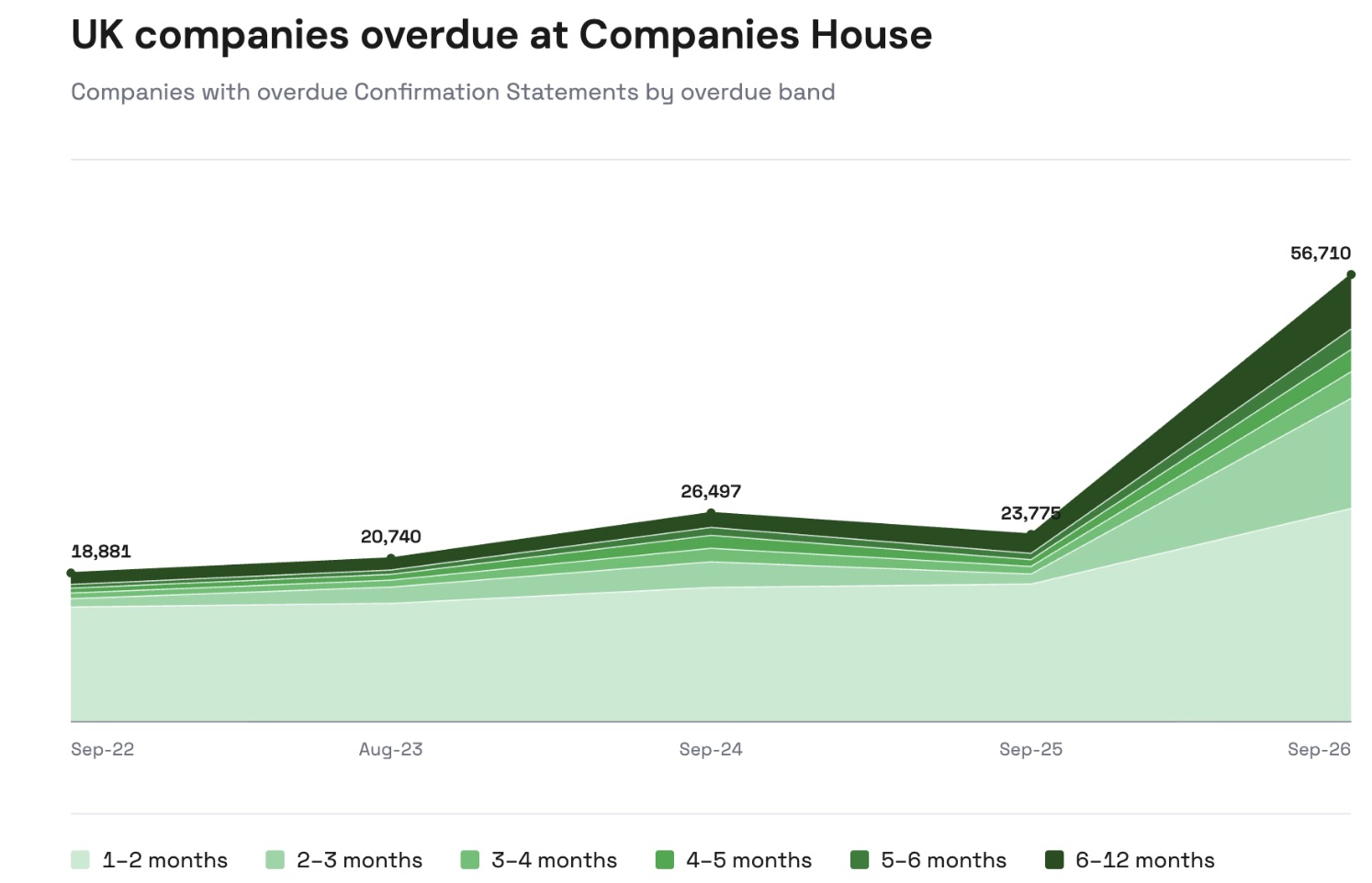
UK companies with overdue Confirmation Statements. Source: Shareflo

Mandatory identity verification began on 18 November 2025. New directors must verify before appointment, while existing directors must provide their personal codes when their companies file their next annual confirmation statements during a 12-month transition.

The timing creates a possible connection with the verification rollout, but the data do not establish that the new requirement caused the filing delays.

What the Pattern Adds to KYB

Banks, brokers and payment firms must identify their corporate customers, understand who owns or controls them and monitor whether the information remains consistent over time.

Companies House verification gives compliance teams another external data point to compare with information supplied during onboarding and subsequent reviews.

Change in filing behaviour might be a useful signal. A company that previously kept its records current but became overdue as identity checks took effect may leave the financial firm with an additional question to resolve.

Companies House warns that its public information is not comprehensive and that every filing cannot be closely examined. Director verification can expose inconsistencies or missing information, but financial firms must still resolve those questions through their own customer due diligence.

New research has identified a filing pattern that raises a question for KYB teams at banks, brokers and payment firms: why did tens of thousands of UK companies fall behind on their filings as director identity checks took effect?

Shareflo found 33,675 active companies that were not similarly late a year earlier but now had overdue confirmation statements and no visible verification record for at least one director.

The pattern does not prove that the companies are avoiding the checks, but it gives compliance teams a new information to consider when assessing corporate customers.

How Shareflo Reached 33,675

Shareflo, a UK cap-table and company compliance platform, analysed more than three million active, non-dormant private companies. It initially found 52,397 businesses that were materially overdue on 1 September, had not been similarly late a year earlier and had at least one individual director.

By 19 September, 13,401 had submitted the missing filing. Another 5,321 had directors whose identities appeared to have been verified through roles at other companies. The remainder formed the group highlighted in the research.

The largest increase occurred among companies between one and 12 months late, where overdue filings rose 138.5% over the year. Short delays increased only modestly, while the number of businesses with longstanding filing problems changed little.

UK companies with overdue Confirmation Statements. Source: Shareflo

Mandatory identity verification began on 18 November 2025. New directors must verify before appointment, while existing directors must provide their personal codes when their companies file their next annual confirmation statements during a 12-month transition.

The timing creates a possible connection with the verification rollout, but the data do not establish that the new requirement caused the filing delays.

What the Pattern Adds to KYB

Banks, brokers and payment firms must identify their corporate customers, understand who owns or controls them and monitor whether the information remains consistent over time.

Companies House verification gives compliance teams another external data point to compare with information supplied during onboarding and subsequent reviews.

Change in filing behaviour might be a useful signal. A company that previously kept its records current but became overdue as identity checks took effect may leave the financial firm with an additional question to resolve.

Companies House warns that its public information is not comprehensive and that every filing cannot be closely examined. Director verification can expose inconsistencies or missing information, but financial firms must still resolve those questions through their own customer due diligence.

About the Author: Tanya Chepkova
Tanya Chepkova
  • 528 Articles
  • 3 Followers
About the Author: Tanya Chepkova
Tanya Chepkova is a News Editor at Finance Magnates with more than 16 years of experience in financial journalism, covering forex, crypto, and digital asset markets. Her work spans daily industry reporting and data-driven, long-form explainers focused on market structure, trading models, and regulatory shifts. Before joining Finance Magnates, she led the editorial team of a cryptocurrency-focused media outlet for six years. Her reporting combines analytical depth with clear storytelling, with particular attention to how structural changes in trading, stablecoin infrastructure, and emerging products such as prediction markets reshape the broader financial ecosystem. She covers global developments and provides additional insight into CIS markets. Areas of Coverage: Crypto and digital asset markets Prediction markets Stablecoins and cross-border payments Industry analysis and long-form explainers
  • 528 Articles
  • 3 Followers

More from the Author

Institutional FX

!"#$%&'()*+,-./0123456789:;<=>?@ABCDEFGHIJKLMNOPQRSTUVWXYZ[\]^_`abcdefghijklmnopqrstuvwxyz{|} !"#$%&'()*+,-./0123456789:;<=>?@ABCDEFGHIJKLMNOPQRSTUVWXYZ[\]^_`abcdefghijklmnopqrstuvwxyz{|}