Financial and Business News

“The Majority of a Broker’s Revenue Comes from Its B-Book Functionality,” Kieran Duff at FMLS:25

Wednesday, 24/12/2025 | 13:00 GMT by Jared Kirui
  • Duff expressed skepticism, saying that while funded accounts can benefit the industry, low entry barriers often encourage reckless trading behavior.
  • Watch the full video interview from Finance Magnates London Summit 2025.

“The majority of revenue for a broker and, you know, correct me if I'm wrong on this, if anybody knows better, but the majority of their revenue comes from their B book functionality,” opined Kieran Duff, the Head of UK Growth and Business Development at Darwinex at FMLS:25.

Duff, Speaking with Jonathan Fine, Content Strategist at Ultimate Group, used his time not to talk about quick wins or marketing tricks, but about the virtue of patience in both trading and business.

Redefining the Broker Model

Darwinex, he explained, walks an unorthodox path. “Think of us as a company that owns a broker, but we’re not a broker in the traditional sense,” he said. The firm forgoes the common B-book approach—where brokers profit from client losses—in favor of pure A-book execution and a model that capitalizes on nurturing profitable traders.

He drew a clear line between Darwinex’s model and the broader industry’s habit of squeezing as much profit as possible from clients in a short time before they disappear.

Darwinex is a London-headquartered multi-asset broker and asset manager, founded in 2012, that provides an platform where traders can trade forex, CFDs, stocks, ETFs and futures while simultaneously building a verified track record that can attract investor capital under its regulatory umbrella, earning performance fees when investors allocate to their strategies.

Instead, he stressed that Darwinex does not take positions against its traders and has deliberately chosen a harder route, prioritizing sustained, long-term trading results over quick commercial gains.
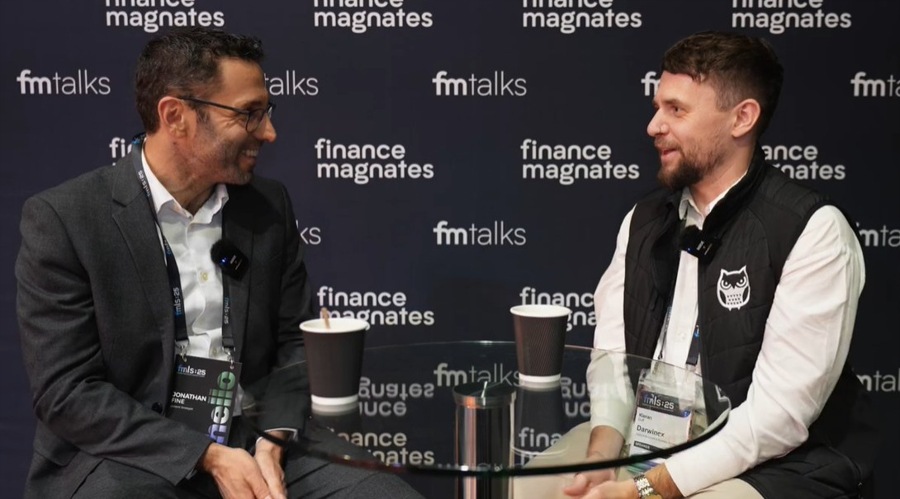
Interview with Kieran Duff (right)

“So instead of capturing lifetime value of your client and how can we, you know, as a business, make the most money out of this person for the longest period of time whilst capturing their best interest. Death time value is how can we take as much money off this person before, you know, they die and then move on.”

You may also like: “MENA’s Digital Banking Challenge Isn’t Demand; It’s the Restrictive Infrastructure,” Jas Shah at FMLS:25

But the humor quickly gave way to Duff’s core message: genuine success in trading, as in brokerage management, rarely rewards short-term thinking. Referencing a quote he half-remembered, he said, “If you focus on the long-term goal and do everything with that in mind, that’s the real shortcut.”

The Prop Trading Paradox

Asked about the booming prop trading sector, Duff admitted his views were “highly opinionated.” While he acknowledged that the rise of funded account models had “potential to benefit the industry,” he warned that their near-zero barriers to entry also foster unhealthy trading behavior.

“So, I could go to the pub. Let's say you'd never heard of trading before. I could say, did you know you can spend 500 pounds, get a hundred thousand dollars in buying power and you can make 10 grand next week. You will tell me where to sign.”

“But the problem with the funding companies and not, I never hear anybody talk about this is they create an artificial environment for you to trade in.”

He recounted a personal experience in which a software error nearly cost him his account—a mistake corrected only after he reached a firm board member through personal connections. “That changed my view completely. I realized how fragile these setups can be.”

Learning, Slowly

While Duff personally profits from prop trading as an experienced trader, he advised newcomers to be cautious. “You trade a prop account completely differently than a personal or investor account,” he said. “If you keep chasing short-term rewards, you’ll stay stuck in that loop. You’re the perfect client—for them.”

In one of the interview’s most candid moments, Duff reflected on humility and growth. Now seven years into trading and three years in the industry, he recently began studying for the Investment Management Certificate—and was struck by how vast the knowledge gap remains.

More from FMLS:25: “Prop Trading Will Transform FX Like Retail Did 25 Years Ago,” ATFX’s Drew Niv at FMLS:25

“And I realised as soon as I opened that book and read the first two sentences, there's a huge gap between my knowledge now being a trader for seven years, working in the industry for three years. You know, there's still a huge gap of what I know and where I need to be.”

AI: Tool, Not Oracle

The conversation closed on artificial intelligence, a recurring theme at this year’s summit. Duff sees AI as a productivity enhancer, not a replacement for judgment or intuition.

“So, I will utilize AI for my productivity so that I can take notes, I can build emails, I can do all of these different things that might take me five minutes to do a task, but I can do it in 30 seconds like that. Okay. Only backend? No writing? No trading analysis? I don't use it for trade.”

He cautioned against overhyping automation . “But even if you give somebody, and I will stand by this, you know, with anybody that I speak to, you could give somebody all the tools, all the capital, the setup, the infrastructure, the environment, everything that they need to succeed.”

As the interview wrapped, Duff’s philosophy seemed to circle back to his recurring idea—that sustainable growth, whether for traders or firms, is never instantaneous. “Take the long haul,” he smiled. “Use AI for efficiency—but not for thinking.”

“The majority of revenue for a broker and, you know, correct me if I'm wrong on this, if anybody knows better, but the majority of their revenue comes from their B book functionality,” opined Kieran Duff, the Head of UK Growth and Business Development at Darwinex at FMLS:25.

Duff, Speaking with Jonathan Fine, Content Strategist at Ultimate Group, used his time not to talk about quick wins or marketing tricks, but about the virtue of patience in both trading and business.

Redefining the Broker Model

Darwinex, he explained, walks an unorthodox path. “Think of us as a company that owns a broker, but we’re not a broker in the traditional sense,” he said. The firm forgoes the common B-book approach—where brokers profit from client losses—in favor of pure A-book execution and a model that capitalizes on nurturing profitable traders.

He drew a clear line between Darwinex’s model and the broader industry’s habit of squeezing as much profit as possible from clients in a short time before they disappear.

Darwinex is a London-headquartered multi-asset broker and asset manager, founded in 2012, that provides an platform where traders can trade forex, CFDs, stocks, ETFs and futures while simultaneously building a verified track record that can attract investor capital under its regulatory umbrella, earning performance fees when investors allocate to their strategies.

Instead, he stressed that Darwinex does not take positions against its traders and has deliberately chosen a harder route, prioritizing sustained, long-term trading results over quick commercial gains.

Interview with Kieran Duff (right)

“So instead of capturing lifetime value of your client and how can we, you know, as a business, make the most money out of this person for the longest period of time whilst capturing their best interest. Death time value is how can we take as much money off this person before, you know, they die and then move on.”

You may also like: “MENA’s Digital Banking Challenge Isn’t Demand; It’s the Restrictive Infrastructure,” Jas Shah at FMLS:25

But the humor quickly gave way to Duff’s core message: genuine success in trading, as in brokerage management, rarely rewards short-term thinking. Referencing a quote he half-remembered, he said, “If you focus on the long-term goal and do everything with that in mind, that’s the real shortcut.”

The Prop Trading Paradox

Asked about the booming prop trading sector, Duff admitted his views were “highly opinionated.” While he acknowledged that the rise of funded account models had “potential to benefit the industry,” he warned that their near-zero barriers to entry also foster unhealthy trading behavior.

“So, I could go to the pub. Let's say you'd never heard of trading before. I could say, did you know you can spend 500 pounds, get a hundred thousand dollars in buying power and you can make 10 grand next week. You will tell me where to sign.”

“But the problem with the funding companies and not, I never hear anybody talk about this is they create an artificial environment for you to trade in.”

He recounted a personal experience in which a software error nearly cost him his account—a mistake corrected only after he reached a firm board member through personal connections. “That changed my view completely. I realized how fragile these setups can be.”

Learning, Slowly

While Duff personally profits from prop trading as an experienced trader, he advised newcomers to be cautious. “You trade a prop account completely differently than a personal or investor account,” he said. “If you keep chasing short-term rewards, you’ll stay stuck in that loop. You’re the perfect client—for them.”

In one of the interview’s most candid moments, Duff reflected on humility and growth. Now seven years into trading and three years in the industry, he recently began studying for the Investment Management Certificate—and was struck by how vast the knowledge gap remains.

More from FMLS:25: “Prop Trading Will Transform FX Like Retail Did 25 Years Ago,” ATFX’s Drew Niv at FMLS:25

“And I realised as soon as I opened that book and read the first two sentences, there's a huge gap between my knowledge now being a trader for seven years, working in the industry for three years. You know, there's still a huge gap of what I know and where I need to be.”

AI: Tool, Not Oracle

The conversation closed on artificial intelligence, a recurring theme at this year’s summit. Duff sees AI as a productivity enhancer, not a replacement for judgment or intuition.

“So, I will utilize AI for my productivity so that I can take notes, I can build emails, I can do all of these different things that might take me five minutes to do a task, but I can do it in 30 seconds like that. Okay. Only backend? No writing? No trading analysis? I don't use it for trade.”

He cautioned against overhyping automation . “But even if you give somebody, and I will stand by this, you know, with anybody that I speak to, you could give somebody all the tools, all the capital, the setup, the infrastructure, the environment, everything that they need to succeed.”

As the interview wrapped, Duff’s philosophy seemed to circle back to his recurring idea—that sustainable growth, whether for traders or firms, is never instantaneous. “Take the long haul,” he smiled. “Use AI for efficiency—but not for thinking.”

About the Author: Jared Kirui
Jared Kirui
  • 2496 Articles
  • 50 Followers
Jared is an experienced financial journalist passionate about all things forex and CFDs.

More from the Author

Retail FX