Investors’ preferences are pushing brokerages such as INFINOX, CedarFX and Exness to prioritize sustainability.
"Companies with strong ESG practices often exhibit resilience and attract investor demand, but the risks include greenwashing, performance volatility, and regulatory uncertainty": EBC's Director of Brand and Sustainability.
In the Forex world, where currencies are bought and sold in
the blink of an eye, a new trend is emerging - achieving sustainability goals. Concerns about the environment
are amplifying as the tangible impacts of climate change intensify. From
scorching heatwaves to devastating wildfires and catastrophic floods, the
urgent call to address climate issues grows louder by the day.
Amid this environmental awakening, Forex brokers are
stepping into the spotlight, not just as financial intermediaries but as agents
of change. Recognizing the profound significance of sustainability, they are
pioneering a shift towards eco-conscious practices and investments aligned with
green initiatives.
Brokerages such as INFINOX, CedarFX, and Exness are being
driven by investors' preferences to prioritize sustainability, highlighting a
pivotal transformation in the industry.
Exploring Eco-Friendly Investment
Operating a green business involves managing finances
innovatively to ensure sustainable growth. Entrepreneurs in eco-friendly
ventures can explore different investment options like penny stocks,
cryptocurrencies, traditional assets, and Forex trading to
boost profits.
Forex trading stands out as environmentally friendly due to
its digital nature, resulting in lower carbon emissions compared to other
trading methods like cryptocurrency.
To trade Forex in an environmentally responsible way, investors should choose
brokers committed to sustainable practices and consider investing in currencies
from environmentally proactive countries. Despite its limitations, making
sustainable investment decisions and selecting responsible brokers can have
positive long-term impacts on the planet.
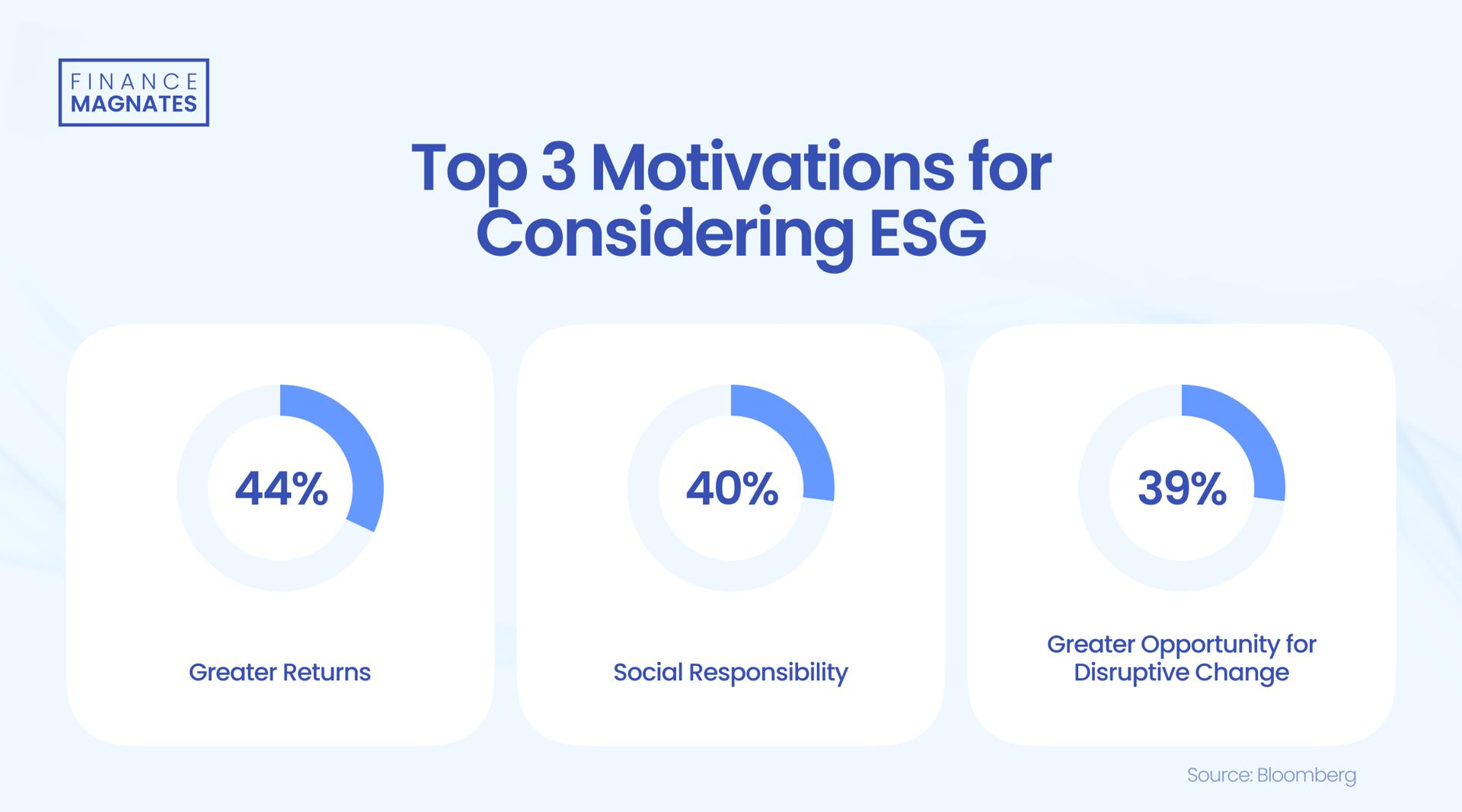
Top 3 Motivations for Considering ESG
In the world of cryptocurrency, mining
serves as the backbone for solving complex puzzles and validating transactions.
However, this process demands substantial processing power, leading to
significant energy consumption. Critics often highlight the environmental toll
of cryptocurrency mining, citing its heavy reliance on energy resources.
As
miners navigate through these challenges in pursuit of solutions, concerns
about the ecological footprint of this industry continue to surface,
emphasizing the need for sustainable approaches in the realm of digital
currencies.
This collaboration has led to the launch of a program
focused on global reforestation, with a tree planted for every business card
issued. These durable cards, designed for lifelong use, symbolize both
companies' focus on sustainability and environmental stewardship.
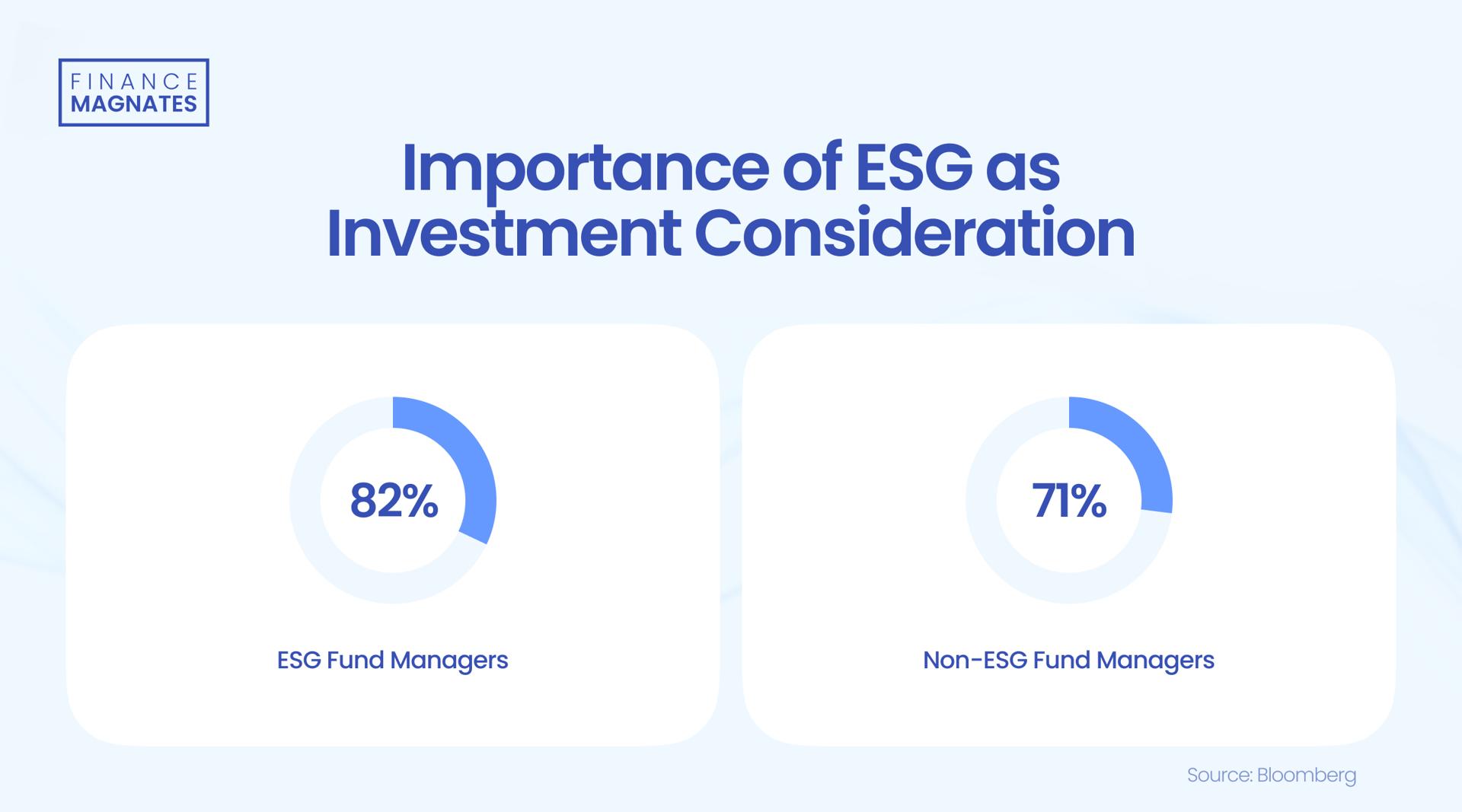
ESG as Investment Consideration
The initiative aims to prioritize reforestation in regions
facing significant environmental challenges, connecting daily business
practices with global conservation endeavours. The initiative's rollout has
commenced in the UK and Lisbon, with plans for expansion to the UAE and other INFINOX regions in the
pipeline.
CedarFX, another retail brokerage firm, matches commissions
paid by Eco Account holders to offset its carbon footprint and support tree
planting via the Eden Reforestation Project in countries like Madagascar,
Mozambique, and Nicaragua.
The drones, tailored for Cyprus' terrain by the Cyprus
Institute's Unmanned Systems Research Laboratory, will aid in preserving the
country's natural environment. Additionally, Exness will sponsor
three pilots to operate the drones for two years. This initiative builds on
previous efforts, including the donation of firetrucks, a water pump truck, and
tree-planting events. The total donation to the Department of Forests exceeds
€600,000.
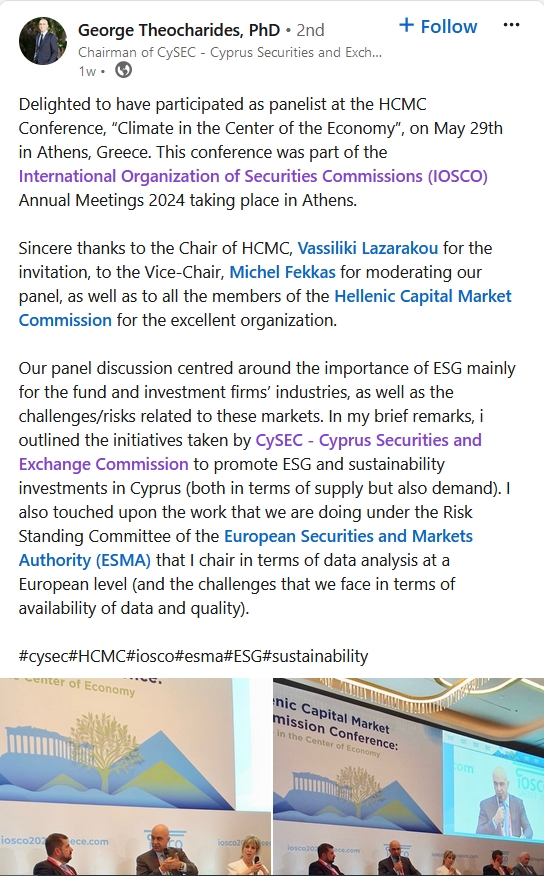
The topic has gained such widespread attention that Dr
George Theocharides, Chairman of CySEC, is emphasizing "the significance
of ESG, particularly for the fund and investment firms’ sectors," while
also underscoring the challenges/risks associated with these markets.
Sustainability has evolved from being a choice to being a
necessity for businesses, driven by consumer and regulatory demands. The
pandemic has accelerated this trend, with consumers increasingly willing to pay
premiums for sustainable brands.
Yen Sim, an expert and advisor of branding and sustainability in the financial services industry, highlights the evolving role of consumers in steering
businesses towards sustainability. According to her: "Consumers have
transformed from passive participants to active drivers of sustainability. They
drive businesses towards sustainability by demanding transparency, ethical
practices, and accountability.”
Yen Sim, an expert and advisor of branding and sustainability in the financial services industry
“This consumer pressure compels companies to prioritize
sustainable practices, innovate, and adapt. Examples from various industries,
such as Patagonia's environmental activism, Apple's carbon-neutral goals, and
Maybank's responsible banking, highlight how consumer expectations shape
corporate strategies and promote a sustainable global economy."
Consequently, companies are integrating sustainability into
their business strategies, viewing it as a means to achieve growth and
operational improvement. According to study by the IBM Institute for Business Value, seven in ten retail and CPG
executives believe that sustainability goals can enhance operational efficiency
and flexibility.
— Manufacturing NI (@ManufacturingNI) May 30, 2024
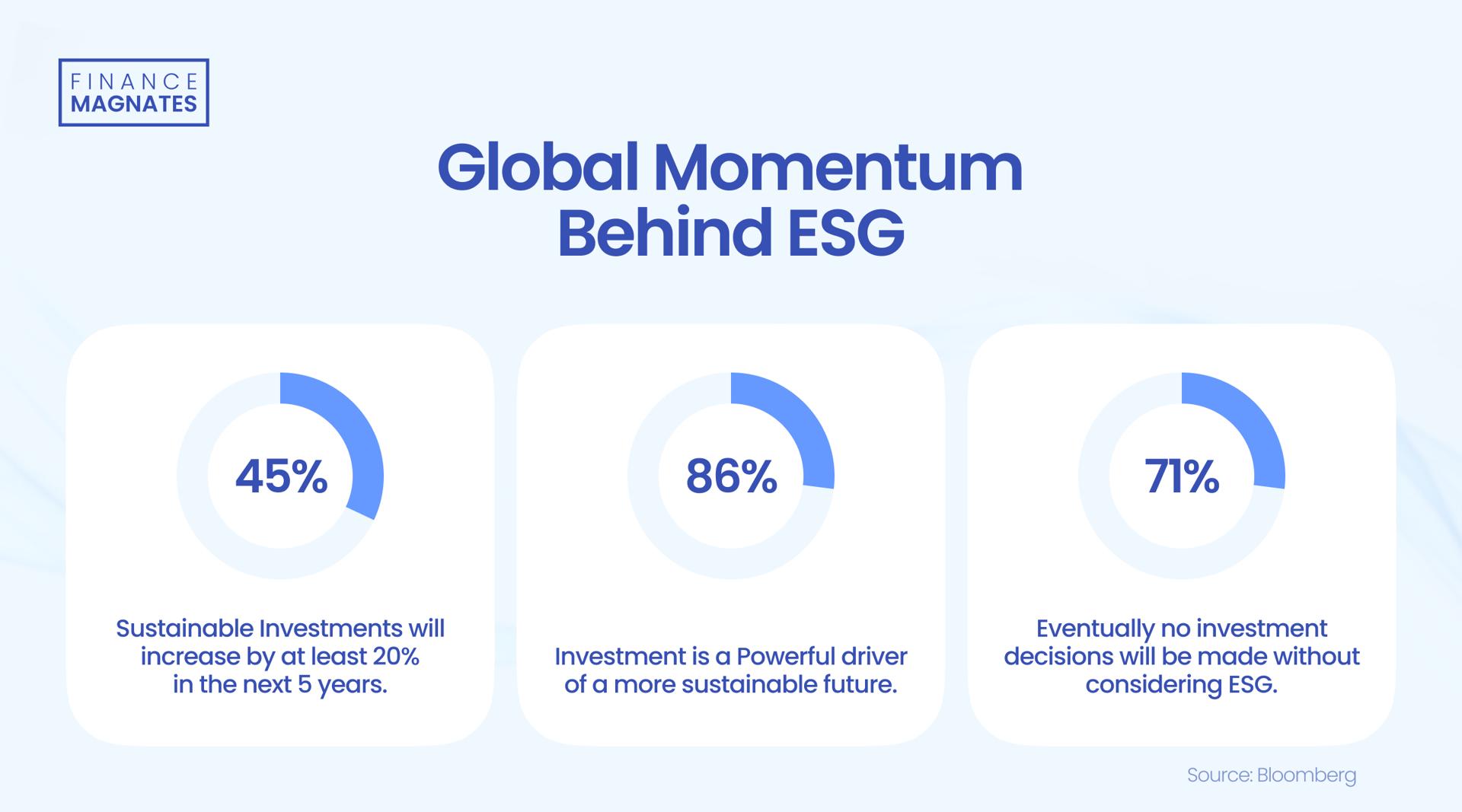
Strong Link between ESG and Shareholder Value
By 2025, ESG assets are projected to reach $50 trillion,
accounting for over a third of the anticipated $140.5 trillion in total global
assets under management, according to Bloomberg.
However, 27% ESG fund managers see financial services as
having the highest ROI potential today. 16% of venture capital leaders prefer Life Sciences Tools
and Services, while 10% favour Mobility. Environmental factors are
the most significant for shareholder value, with renewables and clean energy
receiving the highest portfolio allocations. BloombergNEF estimates $2.1
trillion needed for energy transition investments from 2022-25.
✅Global ESG market to surge by 84% to $33.9 trillion by 2026; $300 million growth in tokenized assets.
ESG investing involves the careful selection of investments
based on environmental impact, social responsibility, and governance practices,
thereby aligning portfolios with responsible companies. By assessing factors
such as climate policies, community engagement, and leadership diversity, ESG
investing strives to foster positive outcomes and contribute to a more
sustainable future.
While ESG investing intersects with sustainable investing
and pursues long-term success by avoiding high-risk or controversial
industries, it's not without its challenges. Despite criticisms, ESG investing
is steadily gaining momentum.
However, the reliance on ESG scores, which may be
based on incomplete data, underscores the need for a nuanced approach.
Selecting ESG investments requires careful consideration of potential
trade-offs and alignment with financial objectives, ensuring a balanced
approach to responsible investing.
In the Forex world, where currencies are bought and sold in
the blink of an eye, a new trend is emerging - achieving sustainability goals. Concerns about the environment
are amplifying as the tangible impacts of climate change intensify. From
scorching heatwaves to devastating wildfires and catastrophic floods, the
urgent call to address climate issues grows louder by the day.
Amid this environmental awakening, Forex brokers are
stepping into the spotlight, not just as financial intermediaries but as agents
of change. Recognizing the profound significance of sustainability, they are
pioneering a shift towards eco-conscious practices and investments aligned with
green initiatives.
Brokerages such as INFINOX, CedarFX, and Exness are being
driven by investors' preferences to prioritize sustainability, highlighting a
pivotal transformation in the industry.
Exploring Eco-Friendly Investment
Operating a green business involves managing finances
innovatively to ensure sustainable growth. Entrepreneurs in eco-friendly
ventures can explore different investment options like penny stocks,
cryptocurrencies, traditional assets, and Forex trading to
boost profits.
Forex trading stands out as environmentally friendly due to
its digital nature, resulting in lower carbon emissions compared to other
trading methods like cryptocurrency.
To trade Forex in an environmentally responsible way, investors should choose
brokers committed to sustainable practices and consider investing in currencies
from environmentally proactive countries. Despite its limitations, making
sustainable investment decisions and selecting responsible brokers can have
positive long-term impacts on the planet.
Top 3 Motivations for Considering ESG
In the world of cryptocurrency, mining
serves as the backbone for solving complex puzzles and validating transactions.
However, this process demands substantial processing power, leading to
significant energy consumption. Critics often highlight the environmental toll
of cryptocurrency mining, citing its heavy reliance on energy resources.
As
miners navigate through these challenges in pursuit of solutions, concerns
about the ecological footprint of this industry continue to surface,
emphasizing the need for sustainable approaches in the realm of digital
currencies.
This collaboration has led to the launch of a program
focused on global reforestation, with a tree planted for every business card
issued. These durable cards, designed for lifelong use, symbolize both
companies' focus on sustainability and environmental stewardship.
ESG as Investment Consideration
The initiative aims to prioritize reforestation in regions
facing significant environmental challenges, connecting daily business
practices with global conservation endeavours. The initiative's rollout has
commenced in the UK and Lisbon, with plans for expansion to the UAE and other INFINOX regions in the
pipeline.
CedarFX, another retail brokerage firm, matches commissions
paid by Eco Account holders to offset its carbon footprint and support tree
planting via the Eden Reforestation Project in countries like Madagascar,
Mozambique, and Nicaragua.
The drones, tailored for Cyprus' terrain by the Cyprus
Institute's Unmanned Systems Research Laboratory, will aid in preserving the
country's natural environment. Additionally, Exness will sponsor
three pilots to operate the drones for two years. This initiative builds on
previous efforts, including the donation of firetrucks, a water pump truck, and
tree-planting events. The total donation to the Department of Forests exceeds
€600,000.
The topic has gained such widespread attention that Dr
George Theocharides, Chairman of CySEC, is emphasizing "the significance
of ESG, particularly for the fund and investment firms’ sectors," while
also underscoring the challenges/risks associated with these markets.
Sustainability has evolved from being a choice to being a
necessity for businesses, driven by consumer and regulatory demands. The
pandemic has accelerated this trend, with consumers increasingly willing to pay
premiums for sustainable brands.
Yen Sim, an expert and advisor of branding and sustainability in the financial services industry, highlights the evolving role of consumers in steering
businesses towards sustainability. According to her: "Consumers have
transformed from passive participants to active drivers of sustainability. They
drive businesses towards sustainability by demanding transparency, ethical
practices, and accountability.”
Yen Sim, an expert and advisor of branding and sustainability in the financial services industry
“This consumer pressure compels companies to prioritize
sustainable practices, innovate, and adapt. Examples from various industries,
such as Patagonia's environmental activism, Apple's carbon-neutral goals, and
Maybank's responsible banking, highlight how consumer expectations shape
corporate strategies and promote a sustainable global economy."
Consequently, companies are integrating sustainability into
their business strategies, viewing it as a means to achieve growth and
operational improvement. According to study by the IBM Institute for Business Value, seven in ten retail and CPG
executives believe that sustainability goals can enhance operational efficiency
and flexibility.
— Manufacturing NI (@ManufacturingNI) May 30, 2024
Strong Link between ESG and Shareholder Value
By 2025, ESG assets are projected to reach $50 trillion,
accounting for over a third of the anticipated $140.5 trillion in total global
assets under management, according to Bloomberg.
However, 27% ESG fund managers see financial services as
having the highest ROI potential today. 16% of venture capital leaders prefer Life Sciences Tools
and Services, while 10% favour Mobility. Environmental factors are
the most significant for shareholder value, with renewables and clean energy
receiving the highest portfolio allocations. BloombergNEF estimates $2.1
trillion needed for energy transition investments from 2022-25.
✅Global ESG market to surge by 84% to $33.9 trillion by 2026; $300 million growth in tokenized assets.
ESG investing involves the careful selection of investments
based on environmental impact, social responsibility, and governance practices,
thereby aligning portfolios with responsible companies. By assessing factors
such as climate policies, community engagement, and leadership diversity, ESG
investing strives to foster positive outcomes and contribute to a more
sustainable future.
While ESG investing intersects with sustainable investing
and pursues long-term success by avoiding high-risk or controversial
industries, it's not without its challenges. Despite criticisms, ESG investing
is steadily gaining momentum.
However, the reliance on ESG scores, which may be
based on incomplete data, underscores the need for a nuanced approach.
Selecting ESG investments requires careful consideration of potential
trade-offs and alignment with financial objectives, ensuring a balanced
approach to responsible investing.
Tareq is a financial writer with 15 years of experience covering global markets. His work spans technical analysis, forex broker reviews, and market sentiment, with a focus on topics relevant to retail traders. He joined Finance Magnates in 2023.
At Finance Magnates, he serves as News Editor, covering retail forex and CFD brokers, cryptocurrency exchanges, fintech firms, and regulatory developments shaping the trading industry. He holds an Honours degree in Information Technology from Anfell College, London.
Education:
Honours degree Information Technology, Anfell College, London
42% of Swiss Financial Firms Have No Digital Fraud Policy, FINMA Finds
Featured Videos
FP Markets Winner Spotlight 🏆 | Global Broker of the Year 2025 #Trading #Broker #Innovation #Shorts
FP Markets Winner Spotlight 🏆 | Global Broker of the Year 2025 #Trading #Broker #Innovation #Shorts
FP Markets Winner Spotlight 🏆 | Global Broker of the Year 2025 #Trading #Broker #Innovation #Shorts
FP Markets Winner Spotlight 🏆 | Global Broker of the Year 2025 #Trading #Broker #Innovation #Shorts
FP Markets takes the spotlight as Global Broker of the Year 2025 at the Finance Magnates Awards.
Martin Stoilov, Head of Client Experience, shares that trust, innovation, and people played a key role in the company’s success, supported by a strong foundation of integrity and client-centricity.
Following this milestone, FP Markets continues to focus on growth, technology investment, and its core values of transparency and excellence.
👉 Be part of FM Awards 2026: https://awards.financemagnates.com/#nominate
FP Markets takes the spotlight as Global Broker of the Year 2025 at the Finance Magnates Awards.
Martin Stoilov, Head of Client Experience, shares that trust, innovation, and people played a key role in the company’s success, supported by a strong foundation of integrity and client-centricity.
Following this milestone, FP Markets continues to focus on growth, technology investment, and its core values of transparency and excellence.
👉 Be part of FM Awards 2026: https://awards.financemagnates.com/#nominate
FP Markets takes the spotlight as Global Broker of the Year 2025 at the Finance Magnates Awards.
Martin Stoilov, Head of Client Experience, shares that trust, innovation, and people played a key role in the company’s success, supported by a strong foundation of integrity and client-centricity.
Following this milestone, FP Markets continues to focus on growth, technology investment, and its core values of transparency and excellence.
👉 Be part of FM Awards 2026: https://awards.financemagnates.com/#nominate
FP Markets takes the spotlight as Global Broker of the Year 2025 at the Finance Magnates Awards.
Martin Stoilov, Head of Client Experience, shares that trust, innovation, and people played a key role in the company’s success, supported by a strong foundation of integrity and client-centricity.
Following this milestone, FP Markets continues to focus on growth, technology investment, and its core values of transparency and excellence.
👉 Be part of FM Awards 2026: https://awards.financemagnates.com/#nominate
In this video, we review @HolaPrimeMarketsOfficial, a multi-asset forex and CFDs broker offering different account types, trading platforms, and flexible trading conditions.
We cover the broker’s overall offering, including account options, trading environment, platforms like MT4 and MT5, and additional services such as managed accounts and fast withdrawals.
Watch the full video to see if Hola Prime Markets fits your trading needs.
📣 Stay up to date with the latest in finance and trading. Follow Finance Magnates for industry news, insights, and global event coverage.
Connect with us:
🔗 LinkedIn: /financemagnates
👍 Facebook: /financemagnates
📸 Instagram: https://www.instagram.com/financemagnates
🐦 X: https://x.com/financemagnates
🎥 TikTok: https://www.tiktok.com/tag/financemagnates
▶️ YouTube: /@financemagnates_official
#HolaPrime #ForexBroker #CFDTrading #FinanceMagnates #Trading #Forex #BrokerReview
In this video, we review @HolaPrimeMarketsOfficial, a multi-asset forex and CFDs broker offering different account types, trading platforms, and flexible trading conditions.
We cover the broker’s overall offering, including account options, trading environment, platforms like MT4 and MT5, and additional services such as managed accounts and fast withdrawals.
Watch the full video to see if Hola Prime Markets fits your trading needs.
📣 Stay up to date with the latest in finance and trading. Follow Finance Magnates for industry news, insights, and global event coverage.
Connect with us:
🔗 LinkedIn: /financemagnates
👍 Facebook: /financemagnates
📸 Instagram: https://www.instagram.com/financemagnates
🐦 X: https://x.com/financemagnates
🎥 TikTok: https://www.tiktok.com/tag/financemagnates
▶️ YouTube: /@financemagnates_official
#HolaPrime #ForexBroker #CFDTrading #FinanceMagnates #Trading #Forex #BrokerReview
In this video, we review @HolaPrimeMarketsOfficial, a multi-asset forex and CFDs broker offering different account types, trading platforms, and flexible trading conditions.
We cover the broker’s overall offering, including account options, trading environment, platforms like MT4 and MT5, and additional services such as managed accounts and fast withdrawals.
Watch the full video to see if Hola Prime Markets fits your trading needs.
📣 Stay up to date with the latest in finance and trading. Follow Finance Magnates for industry news, insights, and global event coverage.
Connect with us:
🔗 LinkedIn: /financemagnates
👍 Facebook: /financemagnates
📸 Instagram: https://www.instagram.com/financemagnates
🐦 X: https://x.com/financemagnates
🎥 TikTok: https://www.tiktok.com/tag/financemagnates
▶️ YouTube: /@financemagnates_official
#HolaPrime #ForexBroker #CFDTrading #FinanceMagnates #Trading #Forex #BrokerReview
In this video, we review @HolaPrimeMarketsOfficial, a multi-asset forex and CFDs broker offering different account types, trading platforms, and flexible trading conditions.
We cover the broker’s overall offering, including account options, trading environment, platforms like MT4 and MT5, and additional services such as managed accounts and fast withdrawals.
Watch the full video to see if Hola Prime Markets fits your trading needs.
📣 Stay up to date with the latest in finance and trading. Follow Finance Magnates for industry news, insights, and global event coverage.
Connect with us:
🔗 LinkedIn: /financemagnates
👍 Facebook: /financemagnates
📸 Instagram: https://www.instagram.com/financemagnates
🐦 X: https://x.com/financemagnates
🎥 TikTok: https://www.tiktok.com/tag/financemagnates
▶️ YouTube: /@financemagnates_official
#HolaPrime #ForexBroker #CFDTrading #FinanceMagnates #Trading #Forex #BrokerReview
In this video, we review @HolaPrimeMarketsOfficial, a multi-asset forex and CFDs broker offering different account types, trading platforms, and flexible trading conditions.
We cover the broker’s overall offering, including account options, trading environment, platforms like MT4 and MT5, and additional services such as managed accounts and fast withdrawals.
Watch the full video to see if Hola Prime Markets fits your trading needs.
📣 Stay up to date with the latest in finance and trading. Follow Finance Magnates for industry news, insights, and global event coverage.
Connect with us:
🔗 LinkedIn: /financemagnates
👍 Facebook: /financemagnates
📸 Instagram: https://www.instagram.com/financemagnates
🐦 X: https://x.com/financemagnates
🎥 TikTok: https://www.tiktok.com/tag/financemagnates
▶️ YouTube: /@financemagnates_official
#HolaPrime #ForexBroker #CFDTrading #FinanceMagnates #Trading #Forex #BrokerReview
In this video, we review @HolaPrimeMarketsOfficial, a multi-asset forex and CFDs broker offering different account types, trading platforms, and flexible trading conditions.
We cover the broker’s overall offering, including account options, trading environment, platforms like MT4 and MT5, and additional services such as managed accounts and fast withdrawals.
Watch the full video to see if Hola Prime Markets fits your trading needs.
📣 Stay up to date with the latest in finance and trading. Follow Finance Magnates for industry news, insights, and global event coverage.
Connect with us:
🔗 LinkedIn: /financemagnates
👍 Facebook: /financemagnates
📸 Instagram: https://www.instagram.com/financemagnates
🐦 X: https://x.com/financemagnates
🎥 TikTok: https://www.tiktok.com/tag/financemagnates
▶️ YouTube: /@financemagnates_official
#HolaPrime #ForexBroker #CFDTrading #FinanceMagnates #Trading #Forex #BrokerReview
Hola Prime Review: What You Need to Know | Full Breakdown by Finance Magnates
Hola Prime Review: What You Need to Know | Full Breakdown by Finance Magnates
Hola Prime Review: What You Need to Know | Full Breakdown by Finance Magnates
Hola Prime Review: What You Need to Know | Full Breakdown by Finance Magnates
Hola Prime Review: What You Need to Know | Full Breakdown by Finance Magnates
Hola Prime Review: What You Need to Know | Full Breakdown by Finance Magnates
In this video, we review @HolaPrime_Global, a proprietary trading firm offering evaluation programs and performance-based payouts in simulated market environments.
We cover how the challenge model works, including account types, profit splits (up to 95%), trading rules, and what it takes to reach a funded account. You’ll also learn about available platforms like MT4, MT5, cTrader, and more, along with insights into payouts, support, and trading conditions.
Watch the full video to see if Hola Prime fits your trading style.
📣 Stay up to date with the latest in finance and trading. Follow Finance Magnates for industry news, insights, and global event coverage.
Connect with us:
🔗 LinkedIn: /financemagnates
👍 Facebook: /financemagnates
📸 Instagram: https://www.instagram.com/financemagnates
🐦 X: https://x.com/financemagnates
🎥 TikTok: https://www.tiktok.com/tag/financemagnates
▶️ YouTube: /@financemagnates_official
#HolaPrime #PropFirm #Trading #FinanceMagnates #Forex #FuturesTrading #TradingReview #PropFirmReview
In this video, we review @HolaPrime_Global, a proprietary trading firm offering evaluation programs and performance-based payouts in simulated market environments.
We cover how the challenge model works, including account types, profit splits (up to 95%), trading rules, and what it takes to reach a funded account. You’ll also learn about available platforms like MT4, MT5, cTrader, and more, along with insights into payouts, support, and trading conditions.
Watch the full video to see if Hola Prime fits your trading style.
📣 Stay up to date with the latest in finance and trading. Follow Finance Magnates for industry news, insights, and global event coverage.
Connect with us:
🔗 LinkedIn: /financemagnates
👍 Facebook: /financemagnates
📸 Instagram: https://www.instagram.com/financemagnates
🐦 X: https://x.com/financemagnates
🎥 TikTok: https://www.tiktok.com/tag/financemagnates
▶️ YouTube: /@financemagnates_official
#HolaPrime #PropFirm #Trading #FinanceMagnates #Forex #FuturesTrading #TradingReview #PropFirmReview
In this video, we review @HolaPrime_Global, a proprietary trading firm offering evaluation programs and performance-based payouts in simulated market environments.
We cover how the challenge model works, including account types, profit splits (up to 95%), trading rules, and what it takes to reach a funded account. You’ll also learn about available platforms like MT4, MT5, cTrader, and more, along with insights into payouts, support, and trading conditions.
Watch the full video to see if Hola Prime fits your trading style.
📣 Stay up to date with the latest in finance and trading. Follow Finance Magnates for industry news, insights, and global event coverage.
Connect with us:
🔗 LinkedIn: /financemagnates
👍 Facebook: /financemagnates
📸 Instagram: https://www.instagram.com/financemagnates
🐦 X: https://x.com/financemagnates
🎥 TikTok: https://www.tiktok.com/tag/financemagnates
▶️ YouTube: /@financemagnates_official
#HolaPrime #PropFirm #Trading #FinanceMagnates #Forex #FuturesTrading #TradingReview #PropFirmReview
In this video, we review @HolaPrime_Global, a proprietary trading firm offering evaluation programs and performance-based payouts in simulated market environments.
We cover how the challenge model works, including account types, profit splits (up to 95%), trading rules, and what it takes to reach a funded account. You’ll also learn about available platforms like MT4, MT5, cTrader, and more, along with insights into payouts, support, and trading conditions.
Watch the full video to see if Hola Prime fits your trading style.
📣 Stay up to date with the latest in finance and trading. Follow Finance Magnates for industry news, insights, and global event coverage.
Connect with us:
🔗 LinkedIn: /financemagnates
👍 Facebook: /financemagnates
📸 Instagram: https://www.instagram.com/financemagnates
🐦 X: https://x.com/financemagnates
🎥 TikTok: https://www.tiktok.com/tag/financemagnates
▶️ YouTube: /@financemagnates_official
#HolaPrime #PropFirm #Trading #FinanceMagnates #Forex #FuturesTrading #TradingReview #PropFirmReview
In this video, we review @HolaPrime_Global, a proprietary trading firm offering evaluation programs and performance-based payouts in simulated market environments.
We cover how the challenge model works, including account types, profit splits (up to 95%), trading rules, and what it takes to reach a funded account. You’ll also learn about available platforms like MT4, MT5, cTrader, and more, along with insights into payouts, support, and trading conditions.
Watch the full video to see if Hola Prime fits your trading style.
📣 Stay up to date with the latest in finance and trading. Follow Finance Magnates for industry news, insights, and global event coverage.
Connect with us:
🔗 LinkedIn: /financemagnates
👍 Facebook: /financemagnates
📸 Instagram: https://www.instagram.com/financemagnates
🐦 X: https://x.com/financemagnates
🎥 TikTok: https://www.tiktok.com/tag/financemagnates
▶️ YouTube: /@financemagnates_official
#HolaPrime #PropFirm #Trading #FinanceMagnates #Forex #FuturesTrading #TradingReview #PropFirmReview
In this video, we review @HolaPrime_Global, a proprietary trading firm offering evaluation programs and performance-based payouts in simulated market environments.
We cover how the challenge model works, including account types, profit splits (up to 95%), trading rules, and what it takes to reach a funded account. You’ll also learn about available platforms like MT4, MT5, cTrader, and more, along with insights into payouts, support, and trading conditions.
Watch the full video to see if Hola Prime fits your trading style.
📣 Stay up to date with the latest in finance and trading. Follow Finance Magnates for industry news, insights, and global event coverage.
Connect with us:
🔗 LinkedIn: /financemagnates
👍 Facebook: /financemagnates
📸 Instagram: https://www.instagram.com/financemagnates
🐦 X: https://x.com/financemagnates
🎥 TikTok: https://www.tiktok.com/tag/financemagnates
▶️ YouTube: /@financemagnates_official
#HolaPrime #PropFirm #Trading #FinanceMagnates #Forex #FuturesTrading #TradingReview #PropFirmReview
Axi Winner Spotlight 🏆 | Global Most Innovative Broker 2025 #Innovation #Trading #Fintech #Broker
Axi Winner Spotlight 🏆 | Global Most Innovative Broker 2025 #Innovation #Trading #Fintech #Broker
Axi Winner Spotlight 🏆 | Global Most Innovative Broker 2025 #Innovation #Trading #Fintech #Broker
Axi Winner Spotlight 🏆 | Global Most Innovative Broker 2025 #Innovation #Trading #Fintech #Broker
Axi Winner Spotlight 🏆 | Global Most Innovative Broker 2025 #Innovation #Trading #Fintech #Broker
Axi Winner Spotlight 🏆 | Global Most Innovative Broker 2025 #Innovation #Trading #Fintech #Broker
Axi takes the spotlight at the Finance Magnates Awards, winning Global Most Innovative Broker 2025.
Olivia Xenofontos and Ivanna Openko share how the team will feel: proud, motivated, and ready to keep delivering.
They also describe the night as well-organized, focused, and enjoyable for all.
👉 Be part of FM Awards 2026.
Axi takes the spotlight at the Finance Magnates Awards, winning Global Most Innovative Broker 2025.
Olivia Xenofontos and Ivanna Openko share how the team will feel: proud, motivated, and ready to keep delivering.
They also describe the night as well-organized, focused, and enjoyable for all.
👉 Be part of FM Awards 2026.
Axi takes the spotlight at the Finance Magnates Awards, winning Global Most Innovative Broker 2025.
Olivia Xenofontos and Ivanna Openko share how the team will feel: proud, motivated, and ready to keep delivering.
They also describe the night as well-organized, focused, and enjoyable for all.
👉 Be part of FM Awards 2026.
Axi takes the spotlight at the Finance Magnates Awards, winning Global Most Innovative Broker 2025.
Olivia Xenofontos and Ivanna Openko share how the team will feel: proud, motivated, and ready to keep delivering.
They also describe the night as well-organized, focused, and enjoyable for all.
👉 Be part of FM Awards 2026.
Axi takes the spotlight at the Finance Magnates Awards, winning Global Most Innovative Broker 2025.
Olivia Xenofontos and Ivanna Openko share how the team will feel: proud, motivated, and ready to keep delivering.
They also describe the night as well-organized, focused, and enjoyable for all.
👉 Be part of FM Awards 2026.
Axi takes the spotlight at the Finance Magnates Awards, winning Global Most Innovative Broker 2025.
Olivia Xenofontos and Ivanna Openko share how the team will feel: proud, motivated, and ready to keep delivering.
They also describe the night as well-organized, focused, and enjoyable for all.
👉 Be part of FM Awards 2026.
Recognition that matters.
Built on transparency.
Driven by the industry.
The Finance Magnates Awards 2026.
Nominations are now open.
🔗 https://awards.financemagnates.com/?utm_source=SM&utm_medium=social&utm_campaign=recognition-matters
Recognition that matters.
Built on transparency.
Driven by the industry.
The Finance Magnates Awards 2026.
Nominations are now open.
🔗 https://awards.financemagnates.com/?utm_source=SM&utm_medium=social&utm_campaign=recognition-matters
Recognition that matters.
Built on transparency.
Driven by the industry.
The Finance Magnates Awards 2026.
Nominations are now open.
🔗 https://awards.financemagnates.com/?utm_source=SM&utm_medium=social&utm_campaign=recognition-matters
Recognition that matters.
Built on transparency.
Driven by the industry.
The Finance Magnates Awards 2026.
Nominations are now open.
🔗 https://awards.financemagnates.com/?utm_source=SM&utm_medium=social&utm_campaign=recognition-matters
Recognition that matters.
Built on transparency.
Driven by the industry.
The Finance Magnates Awards 2026.
Nominations are now open.
🔗 https://awards.financemagnates.com/?utm_source=SM&utm_medium=social&utm_campaign=recognition-matters
Recognition that matters.
Built on transparency.
Driven by the industry.
The Finance Magnates Awards 2026.
Nominations are now open.
🔗 https://awards.financemagnates.com/?utm_source=SM&utm_medium=social&utm_campaign=recognition-matters