

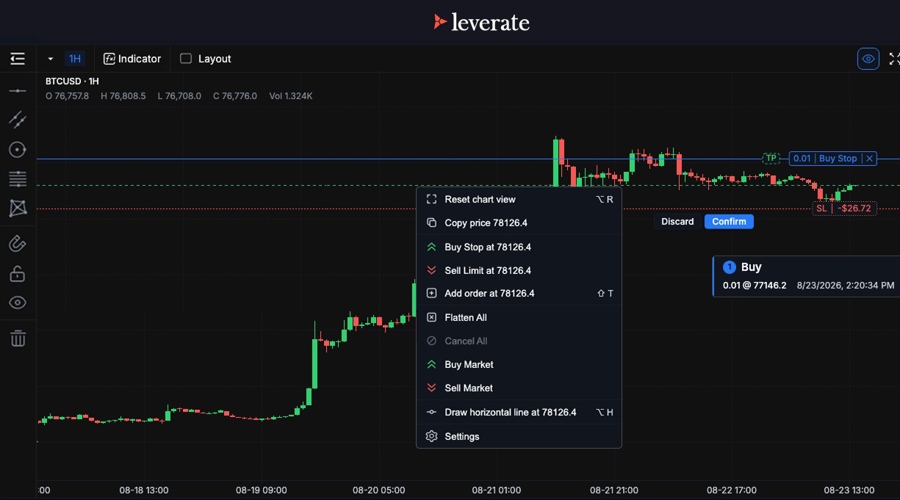
Leverate launched xChart today (Monday), replacing the default chart engine in its trading platform on desktop and mobile. The company said chart orders now use brokers' existing routing and risk checks.
Brokers can set order-confirmation behavior by account group from Leverate's Broker Portal. New accounts begin with confirmation enabled, while prop accounts remain subject to Leverate's risk engine when an order is in flight.
The release extends a trading-technology package that Leverate began offering through account-based pricing in February.
Chart Orders Stay on Existing Broker Routes
xChart combines chart studies, order placement and position management in one workspace. Traders can place pending and market orders from a selected price, then drag Entry, Stop Loss and Take Profit levels on the chart.
Open positions appear on relevant charts with live profit and loss. Traders can close an individual position from its line, while Close All and Cancel All controls handle multiple orders.
For brokers, orders are routed by instrument through existing infrastructure. Leverate said this gives firms one execution path to monitor across different books instead of a separate route for chart-originated trades.
The same route applies when traders use the docked order ticket or place trades from a chart line. Broker branding stays on the interface, and firms can use one chart experience across instruments that may otherwise pass through different execution books.

"The experience feels faster, more natural and easier to work with," said Idan Stambulchik, whom Leverate promoted to Head of Product in May 2025.
- Leverate Moves to Exit Belarus's Forex Market. The Licence Is Still Active
- Leverate Opens a Back-Office MCP Server, Pointing AI at Broker Data Instead of Trades
- Leverate Bundles AI Chat Assistant With a Back-Office View of Client Activity
That assessment comes from Leverate's early feedback, and the company supplied no latency comparison or test results. Execution speed is a broker setting rather than a fixed product claim.
Mobile Gets the Desktop Trading Tools
The mobile version retains the desktop order and position tools, according to Leverate. Charts appear one at a time instead of in a grid, and order lines have larger touch targets to separate dragging a level from scrolling the page.
Bulk actions appear as labeled buttons instead of gestures. Traders swipe between charts, while the larger Entry, Stop Loss and Take Profit controls are intended to reduce accidental page movement during order changes.
On desktop, users can display as many as eight independent charts and choose from more than 10 layouts. The package has six chart types, nine timeframes, 11 drawing tools and four groups of indicators.
Layouts save automatically. Drawings and settings also carry across to mobile. xChart supports localized number and date formats as well as right-to-left languages.
Leverate has offered chart-based trading before. A March 2023 product update added open and closed positions to charts, while SiRiX gained an embedded TradingView option in March 2025.
Platform Vendors Put More Trading on One Screen
Devexperts took a similar single-screen approach on March 18, 2026. Its DXtrade update combined a mobile chart and order-entry panel, with Stop Loss and Take Profit controls kept inside the same view.
Match-Trade presented a rebuilt Match-Trader charting suite on May 7. It added drawing tools, pattern recognition and measurement functions to a platform that already paired built-in charts with a TradingView integration.
Spotware also connects TradingView orders to the cTrader backend through an adapter that uses a broker's established risk controls and connectivity. That integration has been live since 2024, according to the company.
Leverate is keeping both approaches available. Third-party charting remains part of its platform, while xChart gives brokers a native engine carrying their own branding and execution settings. The company said xChart is available now as the default chart engine on desktop and mobile.
The company did not disclose xChart pricing, client adoption or the number of brokers using the new engine.


