BioCatch's research shows that phishing remains Germany's top fraud threat, with cases increasing by 4.8% over the past year.
A large portion (43%) of social media users in Germany invest in digital assets, often relying on influencers.
Germany is grappling with an escalating wave of
digital banking fraud, driven by a surge in phishing attacks, investment scams,
and emerging tactics like QR code phishing.
Unlike other European nations, where fraud trends are
shifting, phishing remains Germany's primary threat, with cases rising 4.8% in
the past year, according to research by BioCatch.
With the EU's Instant Payments Regulation (IPR) now in
effect, fraud risks could intensify as criminals exploit faster transactions to
deceive consumers and financial institutions.
Phishing, Social Engineering, and a Trust Deficit
Phishing scams continue to dominate Germany's fraud
landscape, leading to financial losses and diminishing trust in online banking.
According to the research, Germans have collectively lost €267 billion to
phishing attacks, with 69% of incidents occurring through digital channels.
This has made consumers increasingly wary of online
transactions, with 32% viewing AI as a threat rather than an opportunity. Unlike other European countries where banks often
cover losses, German victims must prove they were not negligent, making it
harder to reclaim stolen funds.
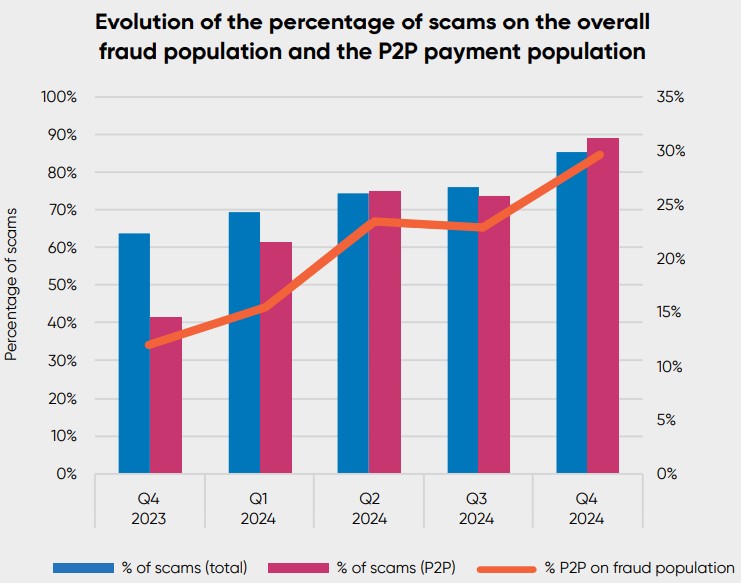
Source: BioCatch
Additionally, the rise of QR code phishing, or
“quishing,” has further complicated the landscape. Fraudsters have
reportedly been placing fake QR codes on parking meters, EV charging stations,
and even bank notifications to steal user credentials and inject malware into
unsuspecting victims' devices.
A staggering 43% of social media users in Germany have
invested in digital assets, often relying on influencers rather than
professional advisors. Despite their confidence, younger investors are highly
vulnerable. While 55% of Gen Z and Millennials believe they won't be scammed,
they now account for 72% of all scam victims.
However, financial losses remain higher among older
generations, with Baby Boomers losing an average of €18,000 per scam compared
to just €400 for Gen Z victims.
Improved Transaction Speeds and Fraud
The EU's Payment Services Directive 3 (PSD3) and the
Instant Payments Regulation (IPR) have introduced significant changes to
banking security. Under IPR, payment service providers must process and confirm
euro-denominated instant payments within 10 seconds.
PSD3 aims to strengthen consumer protections by
enhancing Strong Customer Authentication (SCA) requirements, improving Open
Banking oversight, and enforcing stricter compliance for financial
institutions.
However, lessons from early adopters like the UK
suggest that such measures may be more effective in preventing errors than
stopping fraud. Criminals are already adapting, using social
engineering tactics to manipulate victims into authorizing transactions.
Germany is grappling with an escalating wave of
digital banking fraud, driven by a surge in phishing attacks, investment scams,
and emerging tactics like QR code phishing.
Unlike other European nations, where fraud trends are
shifting, phishing remains Germany's primary threat, with cases rising 4.8% in
the past year, according to research by BioCatch.
With the EU's Instant Payments Regulation (IPR) now in
effect, fraud risks could intensify as criminals exploit faster transactions to
deceive consumers and financial institutions.
Phishing, Social Engineering, and a Trust Deficit
Phishing scams continue to dominate Germany's fraud
landscape, leading to financial losses and diminishing trust in online banking.
According to the research, Germans have collectively lost €267 billion to
phishing attacks, with 69% of incidents occurring through digital channels.
This has made consumers increasingly wary of online
transactions, with 32% viewing AI as a threat rather than an opportunity. Unlike other European countries where banks often
cover losses, German victims must prove they were not negligent, making it
harder to reclaim stolen funds.
Source: BioCatch
Additionally, the rise of QR code phishing, or
“quishing,” has further complicated the landscape. Fraudsters have
reportedly been placing fake QR codes on parking meters, EV charging stations,
and even bank notifications to steal user credentials and inject malware into
unsuspecting victims' devices.
A staggering 43% of social media users in Germany have
invested in digital assets, often relying on influencers rather than
professional advisors. Despite their confidence, younger investors are highly
vulnerable. While 55% of Gen Z and Millennials believe they won't be scammed,
they now account for 72% of all scam victims.
However, financial losses remain higher among older
generations, with Baby Boomers losing an average of €18,000 per scam compared
to just €400 for Gen Z victims.
Improved Transaction Speeds and Fraud
The EU's Payment Services Directive 3 (PSD3) and the
Instant Payments Regulation (IPR) have introduced significant changes to
banking security. Under IPR, payment service providers must process and confirm
euro-denominated instant payments within 10 seconds.
PSD3 aims to strengthen consumer protections by
enhancing Strong Customer Authentication (SCA) requirements, improving Open
Banking oversight, and enforcing stricter compliance for financial
institutions.
However, lessons from early adopters like the UK
suggest that such measures may be more effective in preventing errors than
stopping fraud. Criminals are already adapting, using social
engineering tactics to manipulate victims into authorizing transactions.
Jared Kirui is an Editor at Finance Magnates with more than five years of experience in financial journalism. He covers online trading, fintech, payments, and crypto industries with a focus on companies, regulation and compliance, executive moves, trading technology, and market analysis.
His work has been featured in other media outlets, including Benzinga, ZyCrypto, The Distributed, and The Daily Hodl.
Education:
Bachelor of Commerce degree (Finance option), University of Nairobi
Retail Traders Can Now Access Prediction Markets Through Binance Wallet
FP Markets Winner Spotlight 🏆 | Global Broker of the Year 2025 #Trading #Broker #Innovation #Shorts
FP Markets Winner Spotlight 🏆 | Global Broker of the Year 2025 #Trading #Broker #Innovation #Shorts
FP Markets takes the spotlight as Global Broker of the Year 2025 at the Finance Magnates Awards.
Martin Stoilov, Head of Client Experience, shares that trust, innovation, and people played a key role in the company’s success, supported by a strong foundation of integrity and client-centricity.
Following this milestone, FP Markets continues to focus on growth, technology investment, and its core values of transparency and excellence.
👉 Be part of FM Awards 2026: https://awards.financemagnates.com/#nominate
FP Markets takes the spotlight as Global Broker of the Year 2025 at the Finance Magnates Awards.
Martin Stoilov, Head of Client Experience, shares that trust, innovation, and people played a key role in the company’s success, supported by a strong foundation of integrity and client-centricity.
Following this milestone, FP Markets continues to focus on growth, technology investment, and its core values of transparency and excellence.
👉 Be part of FM Awards 2026: https://awards.financemagnates.com/#nominate
In this video, we review @HolaPrimeMarketsOfficial, a multi-asset forex and CFDs broker offering different account types, trading platforms, and flexible trading conditions.
We cover the broker’s overall offering, including account options, trading environment, platforms like MT4 and MT5, and additional services such as managed accounts and fast withdrawals.
Watch the full video to see if Hola Prime Markets fits your trading needs.
📣 Stay up to date with the latest in finance and trading. Follow Finance Magnates for industry news, insights, and global event coverage.
Connect with us:
🔗 LinkedIn: /financemagnates
👍 Facebook: /financemagnates
📸 Instagram: https://www.instagram.com/financemagnates
🐦 X: https://x.com/financemagnates
🎥 TikTok: https://www.tiktok.com/tag/financemagnates
▶️ YouTube: /@financemagnates_official
#HolaPrime #ForexBroker #CFDTrading #FinanceMagnates #Trading #Forex #BrokerReview
In this video, we review @HolaPrimeMarketsOfficial, a multi-asset forex and CFDs broker offering different account types, trading platforms, and flexible trading conditions.
We cover the broker’s overall offering, including account options, trading environment, platforms like MT4 and MT5, and additional services such as managed accounts and fast withdrawals.
Watch the full video to see if Hola Prime Markets fits your trading needs.
📣 Stay up to date with the latest in finance and trading. Follow Finance Magnates for industry news, insights, and global event coverage.
Connect with us:
🔗 LinkedIn: /financemagnates
👍 Facebook: /financemagnates
📸 Instagram: https://www.instagram.com/financemagnates
🐦 X: https://x.com/financemagnates
🎥 TikTok: https://www.tiktok.com/tag/financemagnates
▶️ YouTube: /@financemagnates_official
#HolaPrime #ForexBroker #CFDTrading #FinanceMagnates #Trading #Forex #BrokerReview
Hola Prime Review: What You Need to Know | Full Breakdown by Finance Magnates
Hola Prime Review: What You Need to Know | Full Breakdown by Finance Magnates
In this video, we review @HolaPrime_Global, a proprietary trading firm offering evaluation programs and performance-based payouts in simulated market environments.
We cover how the challenge model works, including account types, profit splits (up to 95%), trading rules, and what it takes to reach a funded account. You’ll also learn about available platforms like MT4, MT5, cTrader, and more, along with insights into payouts, support, and trading conditions.
Watch the full video to see if Hola Prime fits your trading style.
📣 Stay up to date with the latest in finance and trading. Follow Finance Magnates for industry news, insights, and global event coverage.
Connect with us:
🔗 LinkedIn: /financemagnates
👍 Facebook: /financemagnates
📸 Instagram: https://www.instagram.com/financemagnates
🐦 X: https://x.com/financemagnates
🎥 TikTok: https://www.tiktok.com/tag/financemagnates
▶️ YouTube: /@financemagnates_official
#HolaPrime #PropFirm #Trading #FinanceMagnates #Forex #FuturesTrading #TradingReview #PropFirmReview
In this video, we review @HolaPrime_Global, a proprietary trading firm offering evaluation programs and performance-based payouts in simulated market environments.
We cover how the challenge model works, including account types, profit splits (up to 95%), trading rules, and what it takes to reach a funded account. You’ll also learn about available platforms like MT4, MT5, cTrader, and more, along with insights into payouts, support, and trading conditions.
Watch the full video to see if Hola Prime fits your trading style.
📣 Stay up to date with the latest in finance and trading. Follow Finance Magnates for industry news, insights, and global event coverage.
Connect with us:
🔗 LinkedIn: /financemagnates
👍 Facebook: /financemagnates
📸 Instagram: https://www.instagram.com/financemagnates
🐦 X: https://x.com/financemagnates
🎥 TikTok: https://www.tiktok.com/tag/financemagnates
▶️ YouTube: /@financemagnates_official
#HolaPrime #PropFirm #Trading #FinanceMagnates #Forex #FuturesTrading #TradingReview #PropFirmReview
Axi Winner Spotlight 🏆 | Global Most Innovative Broker 2025 #Innovation #Trading #Fintech #Broker
Axi Winner Spotlight 🏆 | Global Most Innovative Broker 2025 #Innovation #Trading #Fintech #Broker
Axi takes the spotlight at the Finance Magnates Awards, winning Global Most Innovative Broker 2025.
Olivia Xenofontos and Ivanna Openko share how the team will feel: proud, motivated, and ready to keep delivering.
They also describe the night as well-organized, focused, and enjoyable for all.
👉 Be part of FM Awards 2026.
Axi takes the spotlight at the Finance Magnates Awards, winning Global Most Innovative Broker 2025.
Olivia Xenofontos and Ivanna Openko share how the team will feel: proud, motivated, and ready to keep delivering.
They also describe the night as well-organized, focused, and enjoyable for all.
👉 Be part of FM Awards 2026.
Recognition that matters.
Built on transparency.
Driven by the industry.
The Finance Magnates Awards 2026.
Nominations are now open.
🔗 https://awards.financemagnates.com/?utm_source=SM&utm_medium=social&utm_campaign=recognition-matters
Recognition that matters.
Built on transparency.
Driven by the industry.
The Finance Magnates Awards 2026.
Nominations are now open.
🔗 https://awards.financemagnates.com/?utm_source=SM&utm_medium=social&utm_campaign=recognition-matters