Prop firms are flooding India with ads framed as ‘education,’ skirting platform bans.
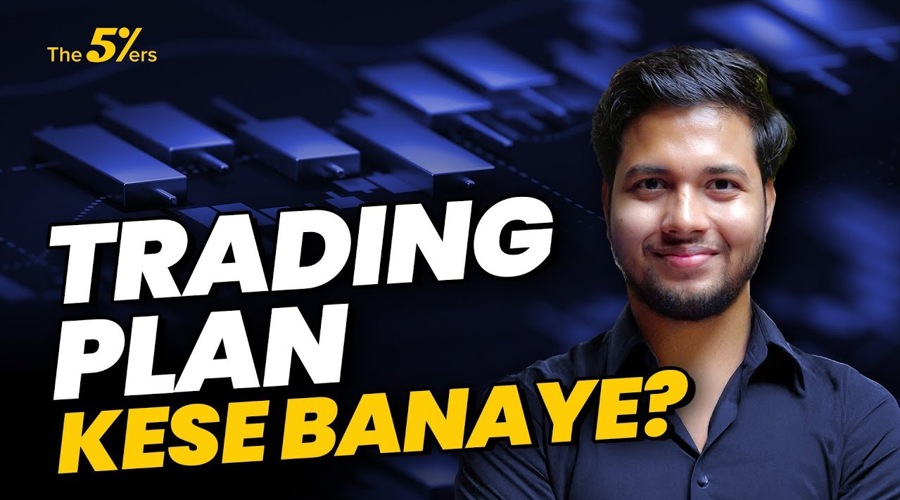
Campaigns with Hinglish (Hindi + English) creatives lift CTR by about 10–12 per cent compared to pure English.
A YouTube video thumbnail in Hinglish on The5ers.com India channel (Source: YT/The5ers India)
FundingPips, The5ers, FundedNext, and Maven are some of the top names in the prop trading industry, and all have one thing in common – India is their top web traffic-generated country, according to Similarweb data. The subcontinent is also a significant market for Alpha Capital, which is more focused on the UK.
Not only these top names, but also an industry-wide search revealed India to be one of the leading markets. A recent prop industry analysis found that roughly 40 per cent of the organic traffic volumes among the prop sector's top 50 companies comes from India.
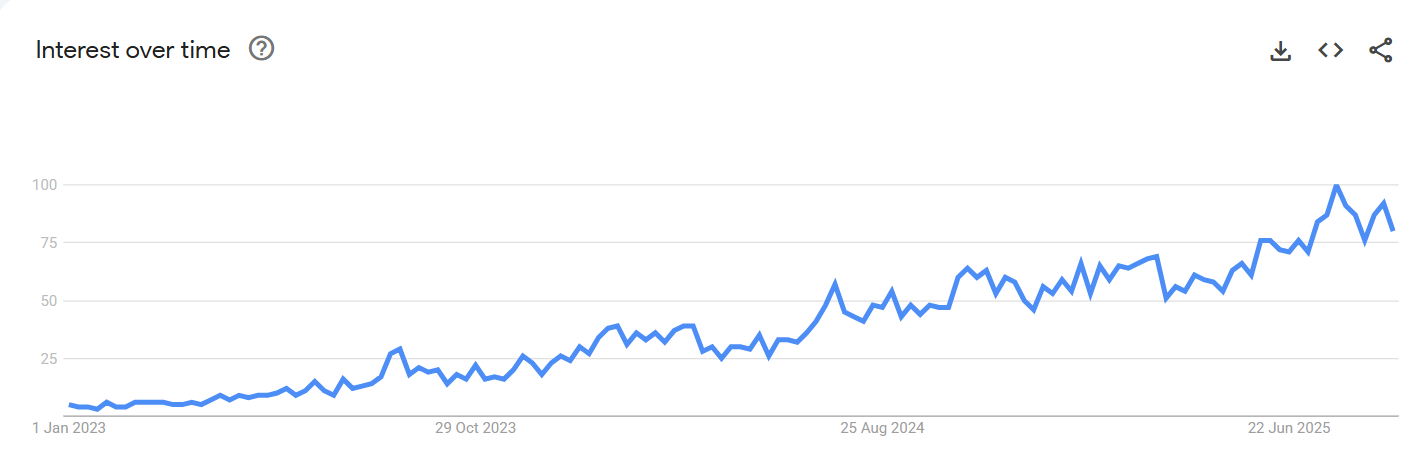
Google Trends also shows Indian interest in prop trading, as popularity for the two related terms – “prop firm” and “prop trading” – has risen sharply since 2023.
Google Trends for the keyword "prop firm" in India
Unlike contracts for difference (CFD) brokers, which benefit when traders trade more, prop firms generate most of their income from challenge fees. If website traffic leads to the purchase of challenges, this can directly correlate with their revenues.
Between 20 per cent and 30 per cent of the prop industry’s overall revenue comes from India, estimates Ruben Abitbol, an independent consultant to prop firms. “While many Indians opted for smaller account sizes due to the low entry barrier, India still ranks among the top in revenue thanks to the sheer trading volumes generated,” he said.
As a result, prop firms are also spending a lot to promote their services to Indians.
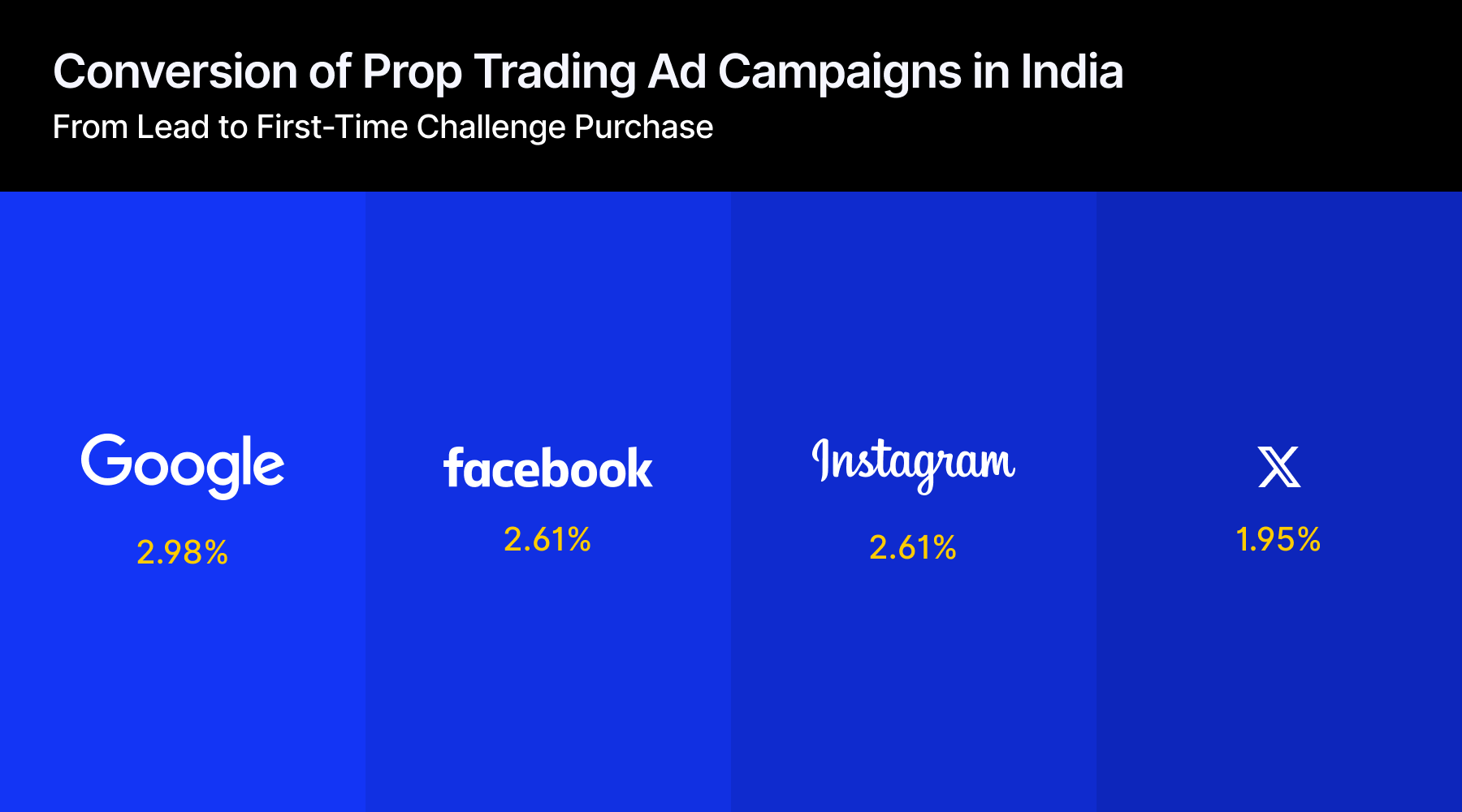
According to Stanislav Galandzovskyi, a user acquisition and growth consultant to prop firms, Google Search is the highest-quality channel for marketing prop firms in India. The conversion from lead to first-time deposit in the country reached 2.98 per cent.
Stanislav Galandzovskyi, a user acquisition and growth consultant to prop firms
While Google ads are strong in quality, Facebook and Instagram promotions are cheaper at about $15 CPL (cost per lead), with 2.61 per cent of those leads converting to deposits.
Although YouTube campaigns have only 0.45 per cent CTR (Click-Through Rate), their view-through rates are solid.
“Animated videos with neutral text like ‘What are global markets?’ worked better than anything mentioning CFD,” Galandzovskyi revealed, specifying on India-centric campaign he ran. “CTAs (call to action) like ‘Free ebook’ or ‘Join webinar’ worked well. Traffic volume was small, but it helped build awareness that later supported conversions through search and remarketing.”
However, The5ers, whose top market by volume – about 12 per cent – comes from India, told FinanceMagnates.com that its primary marketing strategy revolves around content marketing.
Gil Ben Hur, Founder and CEO of The5ers
“We've established a dedicated team that creates culturally relevant content, adapting our proven methods of sharing trading expertise and knowledge to resonate with the Indian trading community,” said Gil Ben Hur, founder and CEO of The5ers.
“This content-driven approach builds genuine trust with our traders because our materials show that we understand their motivations, ambitions, and objectives,” he explained.
The content-driven strategy is clear, as The5ers launched a YouTube channel for India last March, sharing trading videos in Hindi, one of the country’s most spoken languages.
Ben Hur further revealed that The5ers maintains minimal paid advertising efforts in India, focusing more on organic growth.
India has a population of 1.45 billion, as per the World Bank. However, only a fraction of them are potential prop traders, as the country is highly diverse economically, with an extremely low baseline.
The country is still popular among brokers and prop firms as it has a substantial number of developing traders. Abitbol believes that trading is viewed as a privilege in India, shaped by a strong sense of meritocracy. People are conservative with their savings, yet a parallel culture of gambling and speculation runs alongside it.
Galandzovskyi revealed that prop firms’ main target segment in India is young people aged between 18 and 30 years. “Many were students or seeking a secondary source of income,” he said. “They showed strong interest in learning to trade, but average deposits were modest, typically around $20–50 for a first-time deposit.”
Ruben Abitbol, an independent consultant to prop firms
The5ers also revealed that its “3-step low-cost program” is the most sought-after plan among its Indian customers. Its 2-step evaluation plan ranks as the second most popular.
“The popularity of these programs reflects the diverse skill levels within India's trading community, from newcomers seeking affordable entry points to experienced traders looking for more advanced funding opportunities with greater leverage potential,“ said Ben Hur.
Cultural themes work well in advertising in India. According to Galandzovskyi, gold-related creatives and seasonal promos (Diwali, Holi) perform the best.
“A creative featuring gold coins with the tagline ‘Start learning global trading’ outperformed the average click-through rate by 15 per cent,” he said, adding that language is also key in the country, as Hinglish (Hindi + English) creatives lift CTR by about 10–12 per cent compared to pure English.
Multiple prop firms are also running localised ads targeting Indians. “At 21, he went from surviving on ₹50 meals to earning $114k,” an Instagram reel by FundingPips stated, where ₹, the symbol of the Indian currency, was the hook for Indian audiences.
Platforms like FundedNext have also partnered with local social media influencers to produce promotional videos in Indian languages. Several other prop firms have dedicated social media handles and landing pages for Indians.
Although prop trading is not regulated, marketers have to consider the rules of advertising platforms. Meta, the owner of Facebook and Instagram, restricts CFD ads as “misleading financial products,” while Google requires financial services certification.
Marketers are also finding ways around terms like “forex” and “CFD” that might get blocked. They promote “trading education” and “free demo account.” Landing pages are also written as educational articles with registration forms at the bottom, which helps pass moderation.
“We used Lead Ads to generate volume and then followed up with calls. To remain compliant, we avoided terms like ‘forex’ or ‘profit,’ instead using softer angles such as ‘Learn risk management’ or ‘Get a free investing guide.’ Since some accounts were restricted, we kept backup models ready,” Galandzovskyi said.
Interestingly, Google labels campaigns with an educational tone and without a reference to CFDs under “Eligible (limited)” status, which means lower reach but still delivers traffic.
“On Meta, our accounts were disabled several times, which we managed by rotating creatives and keeping backup Business Managers,” Galandzovskyi continued. “New accounts were first warmed up with general finance campaigns before shifting to more trading-focused ads.”
“On the landing pages, we included disclaimers such as: ‘CFDs are not available to Indian residents. Trading involves risk. No guaranteed profits.’ This helped reduce moderation issues and potential complaints while setting clear expectations for users.”
CFDs are not regulated in India. Moreover, the two regulatory heavyweights in the country, the Reserve Bank of India (RBI) and the Securities and Exchange Board of India (SEBI), consider CFDs unlicensed.
This regulatory uncertainty also prompts marketers to keep prop campaigns strictly educational and focus deposit activities on non-resident Indian audiences.
“Our operations globally, including in India, rest on two fundamental principles,” said The5ers’ Ben Hur. “First, proprietary trading firms are not financial service providers – we don't handle clients' money, manage traders' capital, or require traders to invest their own funds through our platform. Second, when a trader qualifies for funding, they are not investing their personal capital. Therefore, Indian traders never directly handle or risk their own money with CFD assets.”
FundingPips, The5ers, FundedNext, and Maven are some of the top names in the prop trading industry, and all have one thing in common – India is their top web traffic-generated country, according to Similarweb data. The subcontinent is also a significant market for Alpha Capital, which is more focused on the UK.
Not only these top names, but also an industry-wide search revealed India to be one of the leading markets. A recent prop industry analysis found that roughly 40 per cent of the organic traffic volumes among the prop sector's top 50 companies comes from India.
Google Trends also shows Indian interest in prop trading, as popularity for the two related terms – “prop firm” and “prop trading” – has risen sharply since 2023.
Google Trends for the keyword "prop firm" in India
Unlike contracts for difference (CFD) brokers, which benefit when traders trade more, prop firms generate most of their income from challenge fees. If website traffic leads to the purchase of challenges, this can directly correlate with their revenues.
Between 20 per cent and 30 per cent of the prop industry’s overall revenue comes from India, estimates Ruben Abitbol, an independent consultant to prop firms. “While many Indians opted for smaller account sizes due to the low entry barrier, India still ranks among the top in revenue thanks to the sheer trading volumes generated,” he said.
As a result, prop firms are also spending a lot to promote their services to Indians.
According to Stanislav Galandzovskyi, a user acquisition and growth consultant to prop firms, Google Search is the highest-quality channel for marketing prop firms in India. The conversion from lead to first-time deposit in the country reached 2.98 per cent.
Stanislav Galandzovskyi, a user acquisition and growth consultant to prop firms
While Google ads are strong in quality, Facebook and Instagram promotions are cheaper at about $15 CPL (cost per lead), with 2.61 per cent of those leads converting to deposits.
Although YouTube campaigns have only 0.45 per cent CTR (Click-Through Rate), their view-through rates are solid.
“Animated videos with neutral text like ‘What are global markets?’ worked better than anything mentioning CFD,” Galandzovskyi revealed, specifying on India-centric campaign he ran. “CTAs (call to action) like ‘Free ebook’ or ‘Join webinar’ worked well. Traffic volume was small, but it helped build awareness that later supported conversions through search and remarketing.”
However, The5ers, whose top market by volume – about 12 per cent – comes from India, told FinanceMagnates.com that its primary marketing strategy revolves around content marketing.
Gil Ben Hur, Founder and CEO of The5ers
“We've established a dedicated team that creates culturally relevant content, adapting our proven methods of sharing trading expertise and knowledge to resonate with the Indian trading community,” said Gil Ben Hur, founder and CEO of The5ers.
“This content-driven approach builds genuine trust with our traders because our materials show that we understand their motivations, ambitions, and objectives,” he explained.
The content-driven strategy is clear, as The5ers launched a YouTube channel for India last March, sharing trading videos in Hindi, one of the country’s most spoken languages.
Ben Hur further revealed that The5ers maintains minimal paid advertising efforts in India, focusing more on organic growth.
India has a population of 1.45 billion, as per the World Bank. However, only a fraction of them are potential prop traders, as the country is highly diverse economically, with an extremely low baseline.
The country is still popular among brokers and prop firms as it has a substantial number of developing traders. Abitbol believes that trading is viewed as a privilege in India, shaped by a strong sense of meritocracy. People are conservative with their savings, yet a parallel culture of gambling and speculation runs alongside it.
Galandzovskyi revealed that prop firms’ main target segment in India is young people aged between 18 and 30 years. “Many were students or seeking a secondary source of income,” he said. “They showed strong interest in learning to trade, but average deposits were modest, typically around $20–50 for a first-time deposit.”
Ruben Abitbol, an independent consultant to prop firms
The5ers also revealed that its “3-step low-cost program” is the most sought-after plan among its Indian customers. Its 2-step evaluation plan ranks as the second most popular.
“The popularity of these programs reflects the diverse skill levels within India's trading community, from newcomers seeking affordable entry points to experienced traders looking for more advanced funding opportunities with greater leverage potential,“ said Ben Hur.
Cultural themes work well in advertising in India. According to Galandzovskyi, gold-related creatives and seasonal promos (Diwali, Holi) perform the best.
“A creative featuring gold coins with the tagline ‘Start learning global trading’ outperformed the average click-through rate by 15 per cent,” he said, adding that language is also key in the country, as Hinglish (Hindi + English) creatives lift CTR by about 10–12 per cent compared to pure English.
Multiple prop firms are also running localised ads targeting Indians. “At 21, he went from surviving on ₹50 meals to earning $114k,” an Instagram reel by FundingPips stated, where ₹, the symbol of the Indian currency, was the hook for Indian audiences.
Platforms like FundedNext have also partnered with local social media influencers to produce promotional videos in Indian languages. Several other prop firms have dedicated social media handles and landing pages for Indians.
Although prop trading is not regulated, marketers have to consider the rules of advertising platforms. Meta, the owner of Facebook and Instagram, restricts CFD ads as “misleading financial products,” while Google requires financial services certification.
Marketers are also finding ways around terms like “forex” and “CFD” that might get blocked. They promote “trading education” and “free demo account.” Landing pages are also written as educational articles with registration forms at the bottom, which helps pass moderation.
“We used Lead Ads to generate volume and then followed up with calls. To remain compliant, we avoided terms like ‘forex’ or ‘profit,’ instead using softer angles such as ‘Learn risk management’ or ‘Get a free investing guide.’ Since some accounts were restricted, we kept backup models ready,” Galandzovskyi said.
Interestingly, Google labels campaigns with an educational tone and without a reference to CFDs under “Eligible (limited)” status, which means lower reach but still delivers traffic.
“On Meta, our accounts were disabled several times, which we managed by rotating creatives and keeping backup Business Managers,” Galandzovskyi continued. “New accounts were first warmed up with general finance campaigns before shifting to more trading-focused ads.”
“On the landing pages, we included disclaimers such as: ‘CFDs are not available to Indian residents. Trading involves risk. No guaranteed profits.’ This helped reduce moderation issues and potential complaints while setting clear expectations for users.”
CFDs are not regulated in India. Moreover, the two regulatory heavyweights in the country, the Reserve Bank of India (RBI) and the Securities and Exchange Board of India (SEBI), consider CFDs unlicensed.
This regulatory uncertainty also prompts marketers to keep prop campaigns strictly educational and focus deposit activities on non-resident Indian audiences.
“Our operations globally, including in India, rest on two fundamental principles,” said The5ers’ Ben Hur. “First, proprietary trading firms are not financial service providers – we don't handle clients' money, manage traders' capital, or require traders to invest their own funds through our platform. Second, when a trader qualifies for funding, they are not investing their personal capital. Therefore, Indian traders never directly handle or risk their own money with CFD assets.”
Arnab Shome is an electronics engineer-turned-financial editor. He holds a Bachelor of Technology from the National Institute of Technology, Agartala. He entered the retail trading industry about a decade ago, covering the cryptocurrency market for Finance Magnates, and later expanded his coverage to include forex and CFDs as well.
His work at Finance Magnates includes C-level interviews, data-driven analysis, opinion pieces, and scoops of industry exclusives. He also contributes to Finance Magnates’ quarterly industry report.
Area of coverage:
1. CFD broker-related news
2. Industry-related Regulatory updates and developments
3. New retail trading trends
4. Prop trading industry updates
5. Executive interviews
Education:
Bachelor of Technology - National Institute of Technology, Agartala (India)
IG Group Weighs Move from London to Wall Street: Report
Featured Videos
Finance Magnates Awards 2026 – Nominations Now Open
Finance Magnates Awards 2026 – Nominations Now Open
Finance Magnates Awards 2026 – Nominations Now Open
Finance Magnates Awards 2026 – Nominations Now Open
The Finance Magnates Awards 2026 nominations are now open. 🏆
From fintech innovators to leading brokers, this is where the finance industry celebrates its biggest achievements.
Winners will be announced at the Cyprus Gala Dinner on November 6, 2026.
Nominate your brand now.
https://awards.financemagnates.com/?utm_source=linkedin&utm_medium=video&utm_campaign=nominations-open
#FMAwards #FinanceMagnates #FintechAwards #Fintech #FinanceIndustry
The Finance Magnates Awards 2026 nominations are now open. 🏆
From fintech innovators to leading brokers, this is where the finance industry celebrates its biggest achievements.
Winners will be announced at the Cyprus Gala Dinner on November 6, 2026.
Nominate your brand now.
https://awards.financemagnates.com/?utm_source=linkedin&utm_medium=video&utm_campaign=nominations-open
#FMAwards #FinanceMagnates #FintechAwards #Fintech #FinanceIndustry
The Finance Magnates Awards 2026 nominations are now open. 🏆
From fintech innovators to leading brokers, this is where the finance industry celebrates its biggest achievements.
Winners will be announced at the Cyprus Gala Dinner on November 6, 2026.
Nominate your brand now.
https://awards.financemagnates.com/?utm_source=linkedin&utm_medium=video&utm_campaign=nominations-open
#FMAwards #FinanceMagnates #FintechAwards #Fintech #FinanceIndustry
The Finance Magnates Awards 2026 nominations are now open. 🏆
From fintech innovators to leading brokers, this is where the finance industry celebrates its biggest achievements.
Winners will be announced at the Cyprus Gala Dinner on November 6, 2026.
Nominate your brand now.
https://awards.financemagnates.com/?utm_source=linkedin&utm_medium=video&utm_campaign=nominations-open
#FMAwards #FinanceMagnates #FintechAwards #Fintech #FinanceIndustry
Finance Magnates Awards 2026 | Nominations Now Open 🏆#Fintech #FMAwards #TradingIndustry
Finance Magnates Awards 2026 | Nominations Now Open 🏆#Fintech #FMAwards #TradingIndustry
Finance Magnates Awards 2026 | Nominations Now Open 🏆#Fintech #FMAwards #TradingIndustry
Finance Magnates Awards 2026 | Nominations Now Open 🏆#Fintech #FMAwards #TradingIndustry
Finance Magnates Awards 2026 | Nominations Now Open 🏆#Fintech #FMAwards #TradingIndustry
Finance Magnates Awards 2026 | Nominations Now Open 🏆#Fintech #FMAwards #TradingIndustry
Lights on. Cameras ready. 🎬
Finance Magnates Awards 2026 nominations are now open. 🏆
#FMAwards #FinanceMagnates #FintechAwards #Fintech
Lights on. Cameras ready. 🎬
Finance Magnates Awards 2026 nominations are now open. 🏆
#FMAwards #FinanceMagnates #FintechAwards #Fintech
Lights on. Cameras ready. 🎬
Finance Magnates Awards 2026 nominations are now open. 🏆
#FMAwards #FinanceMagnates #FintechAwards #Fintech
Lights on. Cameras ready. 🎬
Finance Magnates Awards 2026 nominations are now open. 🏆
#FMAwards #FinanceMagnates #FintechAwards #Fintech
Lights on. Cameras ready. 🎬
Finance Magnates Awards 2026 nominations are now open. 🏆
#FMAwards #FinanceMagnates #FintechAwards #Fintech
Lights on. Cameras ready. 🎬
Finance Magnates Awards 2026 nominations are now open. 🏆
#FMAwards #FinanceMagnates #FintechAwards #Fintech
Exness sees trust as the key theme for growth in MENA Trading Growth for 2026
Exness sees trust as the key theme for growth in MENA Trading Growth for 2026
Exness sees trust as the key theme for growth in MENA Trading Growth for 2026
Exness sees trust as the key theme for growth in MENA Trading Growth for 2026
Exness sees trust as the key theme for growth in MENA Trading Growth for 2026
Exness sees trust as the key theme for growth in MENA Trading Growth for 2026
Mohammad Amer, Regional Commercial Director at Exness, sits down to discuss the booming MENA financial trading market. Find out why Dubai is key to the company's growth strategy, how a mobile-first generation is changing expectations, and why trust will be the defining theme for traders in 2026.
In this interview, you'll learn:
* Why Dubai and the MENA region are critical growth markets for fintech and online trading.
* How Exness is addressing the demands of mobile-first, younger traders through engineering, platform stability, and transparent conditions.
* The essential role local talent plays in providing a culturally relevant and compliant user experience.
* Mohammad Amer's outlook on the future of the online trading industry and why stronger controls and systems are necessary.
* Why "trust" isn't just a brand value, but has commercial value—and why he predicts 2026 will be the "Year of Trust."
Key Takeaways:
➡️ The MENA region is rapidly shaping global financial markets.
➡️ New traders expect stability, precise execution, and transparency.
➡️ Local expertise is key to regulatory compliance and user experience.
➡️ Future success belongs to firms capable of meeting rising standards across regulation and platform consistency.
Read the full article at: https://www.financemagnates.com/thought-leadership/exness-sees-trust-as-the-key-theme-for-growth-in-mena-trading-growth-for-2026/
#Exness #MENA #Trading #FinTech #Dubai #OnlineTrading #FinanceMagnates #MohammadAmer #Trust #MobileTrading
Mohammad Amer, Regional Commercial Director at Exness, sits down to discuss the booming MENA financial trading market. Find out why Dubai is key to the company's growth strategy, how a mobile-first generation is changing expectations, and why trust will be the defining theme for traders in 2026.
In this interview, you'll learn:
* Why Dubai and the MENA region are critical growth markets for fintech and online trading.
* How Exness is addressing the demands of mobile-first, younger traders through engineering, platform stability, and transparent conditions.
* The essential role local talent plays in providing a culturally relevant and compliant user experience.
* Mohammad Amer's outlook on the future of the online trading industry and why stronger controls and systems are necessary.
* Why "trust" isn't just a brand value, but has commercial value—and why he predicts 2026 will be the "Year of Trust."
Key Takeaways:
➡️ The MENA region is rapidly shaping global financial markets.
➡️ New traders expect stability, precise execution, and transparency.
➡️ Local expertise is key to regulatory compliance and user experience.
➡️ Future success belongs to firms capable of meeting rising standards across regulation and platform consistency.
Read the full article at: https://www.financemagnates.com/thought-leadership/exness-sees-trust-as-the-key-theme-for-growth-in-mena-trading-growth-for-2026/
#Exness #MENA #Trading #FinTech #Dubai #OnlineTrading #FinanceMagnates #MohammadAmer #Trust #MobileTrading
Mohammad Amer, Regional Commercial Director at Exness, sits down to discuss the booming MENA financial trading market. Find out why Dubai is key to the company's growth strategy, how a mobile-first generation is changing expectations, and why trust will be the defining theme for traders in 2026.
In this interview, you'll learn:
* Why Dubai and the MENA region are critical growth markets for fintech and online trading.
* How Exness is addressing the demands of mobile-first, younger traders through engineering, platform stability, and transparent conditions.
* The essential role local talent plays in providing a culturally relevant and compliant user experience.
* Mohammad Amer's outlook on the future of the online trading industry and why stronger controls and systems are necessary.
* Why "trust" isn't just a brand value, but has commercial value—and why he predicts 2026 will be the "Year of Trust."
Key Takeaways:
➡️ The MENA region is rapidly shaping global financial markets.
➡️ New traders expect stability, precise execution, and transparency.
➡️ Local expertise is key to regulatory compliance and user experience.
➡️ Future success belongs to firms capable of meeting rising standards across regulation and platform consistency.
Read the full article at: https://www.financemagnates.com/thought-leadership/exness-sees-trust-as-the-key-theme-for-growth-in-mena-trading-growth-for-2026/
#Exness #MENA #Trading #FinTech #Dubai #OnlineTrading #FinanceMagnates #MohammadAmer #Trust #MobileTrading
Mohammad Amer, Regional Commercial Director at Exness, sits down to discuss the booming MENA financial trading market. Find out why Dubai is key to the company's growth strategy, how a mobile-first generation is changing expectations, and why trust will be the defining theme for traders in 2026.
In this interview, you'll learn:
* Why Dubai and the MENA region are critical growth markets for fintech and online trading.
* How Exness is addressing the demands of mobile-first, younger traders through engineering, platform stability, and transparent conditions.
* The essential role local talent plays in providing a culturally relevant and compliant user experience.
* Mohammad Amer's outlook on the future of the online trading industry and why stronger controls and systems are necessary.
* Why "trust" isn't just a brand value, but has commercial value—and why he predicts 2026 will be the "Year of Trust."
Key Takeaways:
➡️ The MENA region is rapidly shaping global financial markets.
➡️ New traders expect stability, precise execution, and transparency.
➡️ Local expertise is key to regulatory compliance and user experience.
➡️ Future success belongs to firms capable of meeting rising standards across regulation and platform consistency.
Read the full article at: https://www.financemagnates.com/thought-leadership/exness-sees-trust-as-the-key-theme-for-growth-in-mena-trading-growth-for-2026/
#Exness #MENA #Trading #FinTech #Dubai #OnlineTrading #FinanceMagnates #MohammadAmer #Trust #MobileTrading
Mohammad Amer, Regional Commercial Director at Exness, sits down to discuss the booming MENA financial trading market. Find out why Dubai is key to the company's growth strategy, how a mobile-first generation is changing expectations, and why trust will be the defining theme for traders in 2026.
In this interview, you'll learn:
* Why Dubai and the MENA region are critical growth markets for fintech and online trading.
* How Exness is addressing the demands of mobile-first, younger traders through engineering, platform stability, and transparent conditions.
* The essential role local talent plays in providing a culturally relevant and compliant user experience.
* Mohammad Amer's outlook on the future of the online trading industry and why stronger controls and systems are necessary.
* Why "trust" isn't just a brand value, but has commercial value—and why he predicts 2026 will be the "Year of Trust."
Key Takeaways:
➡️ The MENA region is rapidly shaping global financial markets.
➡️ New traders expect stability, precise execution, and transparency.
➡️ Local expertise is key to regulatory compliance and user experience.
➡️ Future success belongs to firms capable of meeting rising standards across regulation and platform consistency.
Read the full article at: https://www.financemagnates.com/thought-leadership/exness-sees-trust-as-the-key-theme-for-growth-in-mena-trading-growth-for-2026/
#Exness #MENA #Trading #FinTech #Dubai #OnlineTrading #FinanceMagnates #MohammadAmer #Trust #MobileTrading
Mohammad Amer, Regional Commercial Director at Exness, sits down to discuss the booming MENA financial trading market. Find out why Dubai is key to the company's growth strategy, how a mobile-first generation is changing expectations, and why trust will be the defining theme for traders in 2026.
In this interview, you'll learn:
* Why Dubai and the MENA region are critical growth markets for fintech and online trading.
* How Exness is addressing the demands of mobile-first, younger traders through engineering, platform stability, and transparent conditions.
* The essential role local talent plays in providing a culturally relevant and compliant user experience.
* Mohammad Amer's outlook on the future of the online trading industry and why stronger controls and systems are necessary.
* Why "trust" isn't just a brand value, but has commercial value—and why he predicts 2026 will be the "Year of Trust."
Key Takeaways:
➡️ The MENA region is rapidly shaping global financial markets.
➡️ New traders expect stability, precise execution, and transparency.
➡️ Local expertise is key to regulatory compliance and user experience.
➡️ Future success belongs to firms capable of meeting rising standards across regulation and platform consistency.
Read the full article at: https://www.financemagnates.com/thought-leadership/exness-sees-trust-as-the-key-theme-for-growth-in-mena-trading-growth-for-2026/
#Exness #MENA #Trading #FinTech #Dubai #OnlineTrading #FinanceMagnates #MohammadAmer #Trust #MobileTrading
Paytiko CEO Razi Salih on Why Payment Orchestration is a MUST-HAVE for Brokers in 2026
Paytiko CEO Razi Salih on Why Payment Orchestration is a MUST-HAVE for Brokers in 2026
Paytiko CEO Razi Salih on Why Payment Orchestration is a MUST-HAVE for Brokers in 2026
Paytiko CEO Razi Salih on Why Payment Orchestration is a MUST-HAVE for Brokers in 2026
Paytiko CEO Razi Salih on Why Payment Orchestration is a MUST-HAVE for Brokers in 2026
Paytiko CEO Razi Salih on Why Payment Orchestration is a MUST-HAVE for Brokers in 2026
At iFX Expo Dubai, Finance Magnates spoke with Razi Salih, CEO at Paytiko, about the evolution of the payments ecosystem and why payment orchestration has shifted from an option to a necessity for brokers, prop firms, and exchanges.
Mr. Salih explains how global expansion, the need for deep localisation, and the sheer number of new payment methods, from instant banking to stablecoins, are driving this critical infrastructure shift.
#PaymentOrchestration #Fintech #Brokerage #TradingPayments #RaziSalih #Paytiko #iFXExpoDubai #Stablecoins #AIinFintech
At iFX Expo Dubai, Finance Magnates spoke with Razi Salih, CEO at Paytiko, about the evolution of the payments ecosystem and why payment orchestration has shifted from an option to a necessity for brokers, prop firms, and exchanges.
Mr. Salih explains how global expansion, the need for deep localisation, and the sheer number of new payment methods, from instant banking to stablecoins, are driving this critical infrastructure shift.
#PaymentOrchestration #Fintech #Brokerage #TradingPayments #RaziSalih #Paytiko #iFXExpoDubai #Stablecoins #AIinFintech
At iFX Expo Dubai, Finance Magnates spoke with Razi Salih, CEO at Paytiko, about the evolution of the payments ecosystem and why payment orchestration has shifted from an option to a necessity for brokers, prop firms, and exchanges.
Mr. Salih explains how global expansion, the need for deep localisation, and the sheer number of new payment methods, from instant banking to stablecoins, are driving this critical infrastructure shift.
#PaymentOrchestration #Fintech #Brokerage #TradingPayments #RaziSalih #Paytiko #iFXExpoDubai #Stablecoins #AIinFintech
At iFX Expo Dubai, Finance Magnates spoke with Razi Salih, CEO at Paytiko, about the evolution of the payments ecosystem and why payment orchestration has shifted from an option to a necessity for brokers, prop firms, and exchanges.
Mr. Salih explains how global expansion, the need for deep localisation, and the sheer number of new payment methods, from instant banking to stablecoins, are driving this critical infrastructure shift.
#PaymentOrchestration #Fintech #Brokerage #TradingPayments #RaziSalih #Paytiko #iFXExpoDubai #Stablecoins #AIinFintech
At iFX Expo Dubai, Finance Magnates spoke with Razi Salih, CEO at Paytiko, about the evolution of the payments ecosystem and why payment orchestration has shifted from an option to a necessity for brokers, prop firms, and exchanges.
Mr. Salih explains how global expansion, the need for deep localisation, and the sheer number of new payment methods, from instant banking to stablecoins, are driving this critical infrastructure shift.
#PaymentOrchestration #Fintech #Brokerage #TradingPayments #RaziSalih #Paytiko #iFXExpoDubai #Stablecoins #AIinFintech
At iFX Expo Dubai, Finance Magnates spoke with Razi Salih, CEO at Paytiko, about the evolution of the payments ecosystem and why payment orchestration has shifted from an option to a necessity for brokers, prop firms, and exchanges.
Mr. Salih explains how global expansion, the need for deep localisation, and the sheer number of new payment methods, from instant banking to stablecoins, are driving this critical infrastructure shift.
#PaymentOrchestration #Fintech #Brokerage #TradingPayments #RaziSalih #Paytiko #iFXExpoDubai #Stablecoins #AIinFintech
Altima CTO Sunil Jadhav: Solving Data Fragmentation & Lag for Brokers & Prop Firms
Altima CTO Sunil Jadhav: Solving Data Fragmentation & Lag for Brokers & Prop Firms
Altima CTO Sunil Jadhav: Solving Data Fragmentation & Lag for Brokers & Prop Firms
Altima CTO Sunil Jadhav: Solving Data Fragmentation & Lag for Brokers & Prop Firms
Altima CTO Sunil Jadhav: Solving Data Fragmentation & Lag for Brokers & Prop Firms
Altima CTO Sunil Jadhav: Solving Data Fragmentation & Lag for Brokers & Prop Firms
Altima CTO Sunil Jadhav sits down with Finance Magnates to discuss the core technology challenges facing CFD brokers and proprietary trading firms today.
Jadhav explains how the industry's reliance on batch processing and fragmented systems (where CRMs, risk tools, and trading platforms operate with separate 'sources of truth') leads to delayed data and inconsistent operational decisions. He argues that real-time event processing is essential for managing fast-moving trading activity and risk.
Learn how Altima's unified, event-driven architecture, connecting Altima CRM, Altima Prop, IB systems, and risk management through a single backbone, is designed to provide synchronous data and better operational coordination for modern brokerage and prop firm stacks.
Key Topics:
- Broker and Prop Firm Data Challenges
- The problem of delayed data processing (batch processing vs. real-time events)
- Fragmented systems and conflicting data sources
- Altima's unified, event-driven solution architecture
- The concept of a "risk-aware CRM"
- Built-in risk management in Altima Prop
#Altima #financemagnates #iFXDubai #FinTech #BrokerTech #PropFirm #CFDBroker #TradingTechnology #RealTimeData #RiskManagement #CRM #FinancialMarkets #EventDrivenArchitecture
Altima CTO Sunil Jadhav sits down with Finance Magnates to discuss the core technology challenges facing CFD brokers and proprietary trading firms today.
Jadhav explains how the industry's reliance on batch processing and fragmented systems (where CRMs, risk tools, and trading platforms operate with separate 'sources of truth') leads to delayed data and inconsistent operational decisions. He argues that real-time event processing is essential for managing fast-moving trading activity and risk.
Learn how Altima's unified, event-driven architecture, connecting Altima CRM, Altima Prop, IB systems, and risk management through a single backbone, is designed to provide synchronous data and better operational coordination for modern brokerage and prop firm stacks.
Key Topics:
- Broker and Prop Firm Data Challenges
- The problem of delayed data processing (batch processing vs. real-time events)
- Fragmented systems and conflicting data sources
- Altima's unified, event-driven solution architecture
- The concept of a "risk-aware CRM"
- Built-in risk management in Altima Prop
#Altima #financemagnates #iFXDubai #FinTech #BrokerTech #PropFirm #CFDBroker #TradingTechnology #RealTimeData #RiskManagement #CRM #FinancialMarkets #EventDrivenArchitecture
Altima CTO Sunil Jadhav sits down with Finance Magnates to discuss the core technology challenges facing CFD brokers and proprietary trading firms today.
Jadhav explains how the industry's reliance on batch processing and fragmented systems (where CRMs, risk tools, and trading platforms operate with separate 'sources of truth') leads to delayed data and inconsistent operational decisions. He argues that real-time event processing is essential for managing fast-moving trading activity and risk.
Learn how Altima's unified, event-driven architecture, connecting Altima CRM, Altima Prop, IB systems, and risk management through a single backbone, is designed to provide synchronous data and better operational coordination for modern brokerage and prop firm stacks.
Key Topics:
- Broker and Prop Firm Data Challenges
- The problem of delayed data processing (batch processing vs. real-time events)
- Fragmented systems and conflicting data sources
- Altima's unified, event-driven solution architecture
- The concept of a "risk-aware CRM"
- Built-in risk management in Altima Prop
#Altima #financemagnates #iFXDubai #FinTech #BrokerTech #PropFirm #CFDBroker #TradingTechnology #RealTimeData #RiskManagement #CRM #FinancialMarkets #EventDrivenArchitecture
Altima CTO Sunil Jadhav sits down with Finance Magnates to discuss the core technology challenges facing CFD brokers and proprietary trading firms today.
Jadhav explains how the industry's reliance on batch processing and fragmented systems (where CRMs, risk tools, and trading platforms operate with separate 'sources of truth') leads to delayed data and inconsistent operational decisions. He argues that real-time event processing is essential for managing fast-moving trading activity and risk.
Learn how Altima's unified, event-driven architecture, connecting Altima CRM, Altima Prop, IB systems, and risk management through a single backbone, is designed to provide synchronous data and better operational coordination for modern brokerage and prop firm stacks.
Key Topics:
- Broker and Prop Firm Data Challenges
- The problem of delayed data processing (batch processing vs. real-time events)
- Fragmented systems and conflicting data sources
- Altima's unified, event-driven solution architecture
- The concept of a "risk-aware CRM"
- Built-in risk management in Altima Prop
#Altima #financemagnates #iFXDubai #FinTech #BrokerTech #PropFirm #CFDBroker #TradingTechnology #RealTimeData #RiskManagement #CRM #FinancialMarkets #EventDrivenArchitecture
Altima CTO Sunil Jadhav sits down with Finance Magnates to discuss the core technology challenges facing CFD brokers and proprietary trading firms today.
Jadhav explains how the industry's reliance on batch processing and fragmented systems (where CRMs, risk tools, and trading platforms operate with separate 'sources of truth') leads to delayed data and inconsistent operational decisions. He argues that real-time event processing is essential for managing fast-moving trading activity and risk.
Learn how Altima's unified, event-driven architecture, connecting Altima CRM, Altima Prop, IB systems, and risk management through a single backbone, is designed to provide synchronous data and better operational coordination for modern brokerage and prop firm stacks.
Key Topics:
- Broker and Prop Firm Data Challenges
- The problem of delayed data processing (batch processing vs. real-time events)
- Fragmented systems and conflicting data sources
- Altima's unified, event-driven solution architecture
- The concept of a "risk-aware CRM"
- Built-in risk management in Altima Prop
#Altima #financemagnates #iFXDubai #FinTech #BrokerTech #PropFirm #CFDBroker #TradingTechnology #RealTimeData #RiskManagement #CRM #FinancialMarkets #EventDrivenArchitecture
Altima CTO Sunil Jadhav sits down with Finance Magnates to discuss the core technology challenges facing CFD brokers and proprietary trading firms today.
Jadhav explains how the industry's reliance on batch processing and fragmented systems (where CRMs, risk tools, and trading platforms operate with separate 'sources of truth') leads to delayed data and inconsistent operational decisions. He argues that real-time event processing is essential for managing fast-moving trading activity and risk.
Learn how Altima's unified, event-driven architecture, connecting Altima CRM, Altima Prop, IB systems, and risk management through a single backbone, is designed to provide synchronous data and better operational coordination for modern brokerage and prop firm stacks.
Key Topics:
- Broker and Prop Firm Data Challenges
- The problem of delayed data processing (batch processing vs. real-time events)
- Fragmented systems and conflicting data sources
- Altima's unified, event-driven solution architecture
- The concept of a "risk-aware CRM"
- Built-in risk management in Altima Prop
#Altima #financemagnates #iFXDubai #FinTech #BrokerTech #PropFirm #CFDBroker #TradingTechnology #RealTimeData #RiskManagement #CRM #FinancialMarkets #EventDrivenArchitecture