

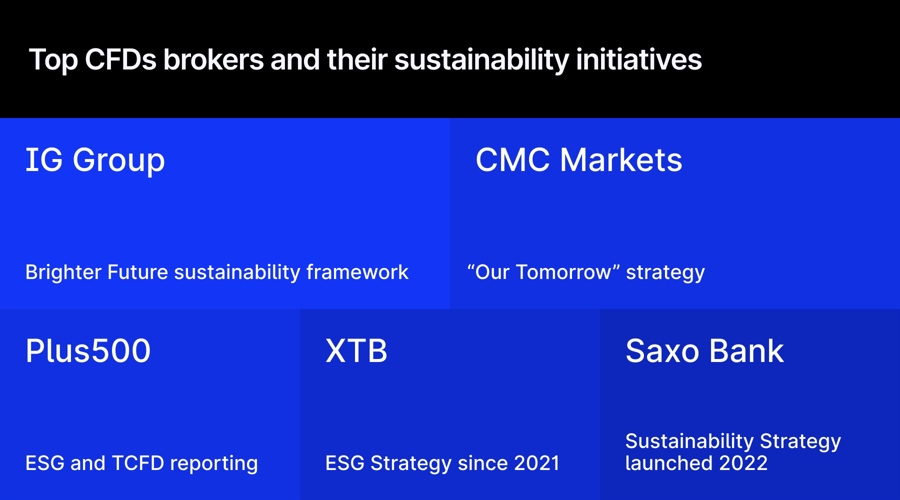
IG Group, CMC Markets, Plus500, XTB, and Saxo Bank are five major contracts for differences (CFD) brokers now publishing formal sustainability or Environmental, Social, and Governance (ESG) frameworks with recurring disclosures. But they are not alone in this track. Others engage mainly through client-facing sustainable investing content rather than firm-level ESG reporting.
Join IG, CMC, and Robinhood in London’s leading trading industry event!
Together, these disclosures emphasise governance oversight, climate impact management, responsible products and client education, community investment, and transparent alignment with frameworks such as TCFD, GRI, and SASB, where stated.
But do such disclosures truly mean these brokers are becoming sustainable? Or what does sustainability actually mean for brokers?
Public Brokers Are Leading the Pack
“Focusing on sustainability” means the broker maintains a named sustainability/ESG strategy or section on its corporate site or annual reporting, with clear pillars, governance, targets, or recognised frameworks.
London-listed IG Group, reportedly the largest CFDs-focused brand, formalises sustainability under its Brighter Future framework, which covers ethics, environmental impact reduction, social mobility and inclusion, and community investment.
The broker is channelling 1 per cent of profit after tax to community initiatives and recognition, such as FTSE4Good inclusion. It made a net profit of £380.4 million in the fiscal year 2025, meaning over £3.8 million went to those initiatives.
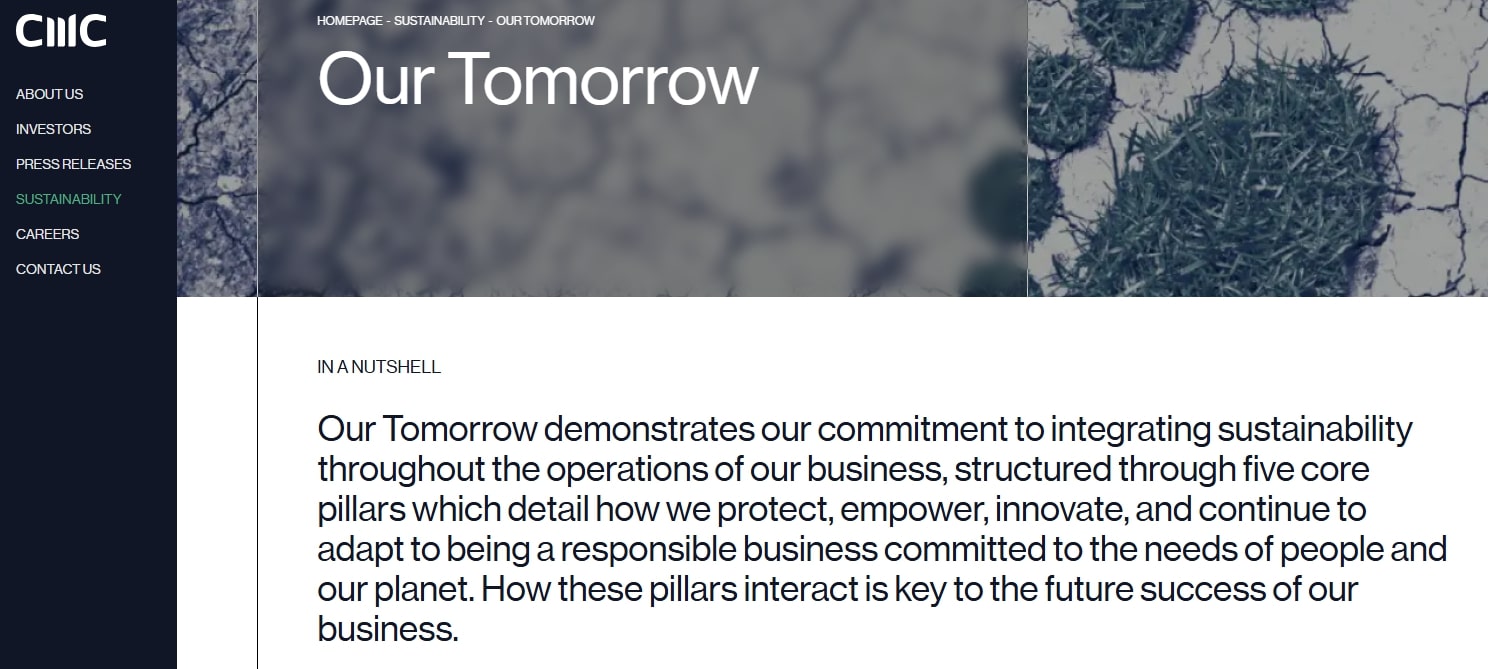
CMC Markets, another local rival of IG, runs an “Our Tomorrow” sustainability strategy governed by a cross-functional Sustainability Committee, informed by frameworks including SASB, GRI, and TCFD, and structured into core pillars such as People Positive and Planet Positive.
Plus500 discloses an ESG governance structure (including Board-level oversight and an ESG Committee), references TCFD reporting, and outlines environmental impact expectations and a path towards net zero in investor ESG materials and annual reporting.
Poland’s XTB also competes with its London-listed rivals and operates a published ESG strategy (since 2021) with three pillars (Environment, Social, Governance), references UN SDGs, and provides non-financial disclosures and a CSRD 2024 sustainability statement on its ESG and investor sites.
- Profit and Planet: Forex Brokers Embrace Sustainability amid $50 Trillion ESG Surge
- IG, CMC, Plus500, and XTB: Client Numbers Surge, but ARPU Reveals the Differences
- “Carbon Credits Are a Quick Fix—Education Is the Long Game” to Make a Broker Sustainable
Private Brokers Can’t Ignore Sustainability
Although those are among the few public CFDs brokers who also have some mandate to adopt sustainability, the privately held ones are also not far behind.
Saxo Bank launched a firmwide Sustainability Strategy in 2022 with strategic drivers such as “Enable Responsible Investing,” “Environmental Consciousness,” and “Future-Focused Business,” and has integrated ESG risk ratings and themes into its client platform and content.
Many brands adopt ESG risk ratings for individual stocks or indices, mainly due to the growing demand for sustainable investments among investors. This is also a widely accepted sustainability measure by most CFD brokers.
For instance, Pepperstone highlights sustainable investing topics through trading guides and thematic content for clients, indicating engagement with ESG themes without a dedicated firm-level sustainability report.
Meanwhile, other big brands are also taking smaller and local measures towards sustainability. Exness, in partnership with the Department of Forests, has initiated a plan to fight Cyprus’s wildfire problem, which involves donating three specialised fire-detecting drones, while Infinox has transitioned to a paperless operation.
But are those initiatives enough for brokers who are often regarded as deep-pocketed firms spending millions of dollars on marketing?
Sustainability is still in the adoption phase, and any step towards it, no matter how big or small, is significant.
Some emerging brokers, however, have taken a different approach to sustainability—they are building a brand around it. Ultima Markets is a broker that has joined the United Nations Global Compact (UNGC) and established a non-profit foundation for its long-term sustainability and social impact efforts. Will other private brokers follow this path? Only time will tell.
Global sustainable-investing assets are about $30.3 trillion on a broad AUM basis, while ESG-labelled fund assets total roughly $3.5 trillion as of June 2025. Broad sustainable assets are projected to surpass $40 trillion by 2030, indicating continued growth, though at a slower pace compared to early 2020s projections.
These numbers clearly show the growing demand for sustainability among investors globally. It also means that demand from customers will push brokers to focus their strategy on sustainability, even if they are not driven by corporate vision.


